TL;DR:
- Early introduction of AAC supports communication development for children as young as 12 months. Consistent modeling and core vocabulary use enhance progress, while AAC does not hinder speech.
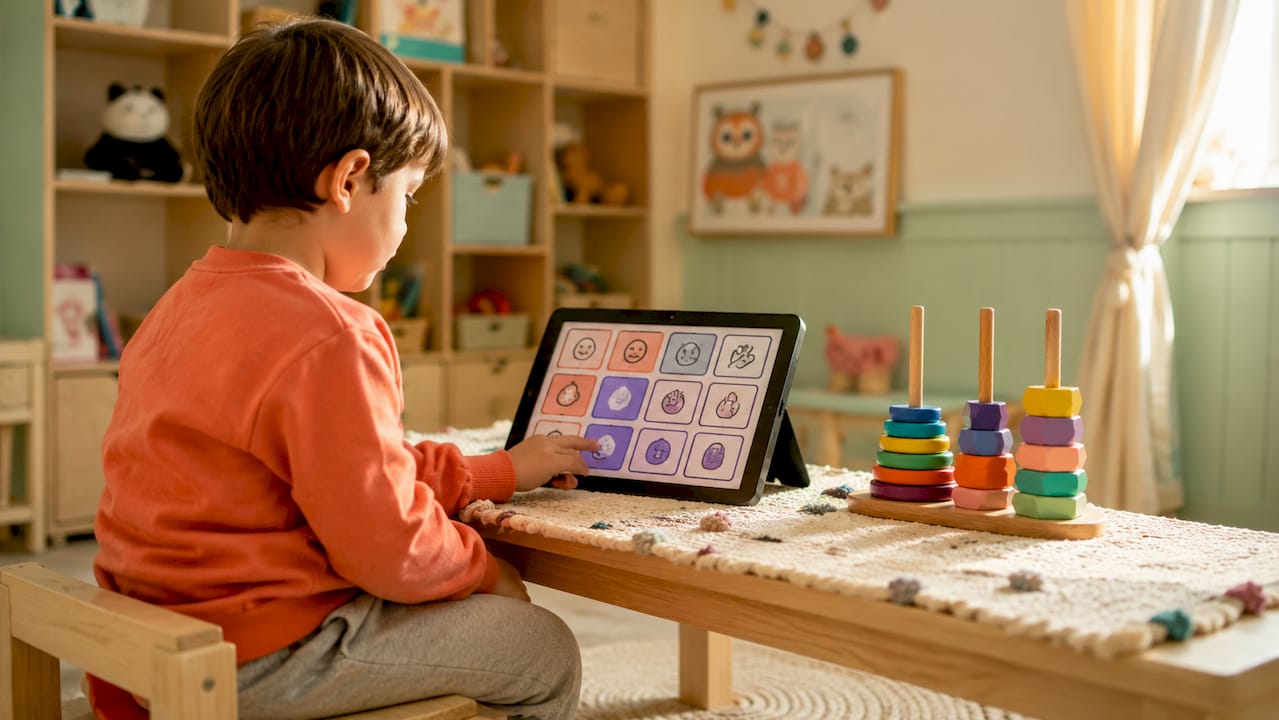
AAC (Augmentative and Alternative Communication) is defined as any method that supports or replaces spoken language for children who struggle to communicate verbally. For young neurodiverse children, AAC for young children is not a last resort. It is a communication right. It covers everything from low-tech picture cards and PECS (Picture Exchange Communication System) boards to high-tech speech-generating apps on a tablet. The core idea is simple: every child deserves a way to say what they need, feel, and think, regardless of whether speech comes easily or not.
What is AAC for young children and when should you start?
The most common question I hear from parents is: “Is my child too young for AAC?” The answer, backed by speech and language therapy consensus, is no. No minimum age exists for introducing AAC. Starting as early as 12 months, when speech delays become apparent, leads to better language outcomes. That is not a small claim. It means waiting until your child is “ready” actively delays their communication development.
There are also zero prerequisite skills needed before starting AAC. A child does not need to make eye contact, sit still, or demonstrate any particular cognitive ability first. Those gatekeeping myths persist, and they cost children months or years of communication access. If your toddler is not yet using words to meet their needs, AAC is worth exploring now, not later.
Signs that AAC might benefit your child include:
- Fewer than ten words by 18 months
- Significant frustration when trying to communicate needs
- Reliance on pulling, pointing, or physical guidance to express wants
- Regression in speech or limited babbling by 12 months
- A diagnosis of autism, ADHD, cerebral palsy, or another condition affecting speech development
Pro Tip: You do not need a formal diagnosis to request an AAC assessment. Ask your health visitor or GP for a referral to a speech and language therapist (SLT) who specialises in AAC. Early referral is always better than waiting.
How do you choose the right AAC tools and vocabulary?
Choosing an AAC system feels overwhelming at first. There are picture boards, PECS, low-tech communication books, and a growing range of apps. The right choice depends on your child’s motor skills, sensory needs, and regulation profile, not on what looks most impressive or what another parent recommends.

Starting with core vocabulary
Core vocabulary of 3–8 functional words is the recommended starting point for toddlers. Core words are the small, high-frequency words that appear across all contexts: “more,” “stop,” “go,” “help,” “want,” “no,” and “yes.” These words do more communicative work than any amount of nouns. A child who can say “more” and “stop” has genuine power in an interaction.
Grid size matters too. A 2x2 grid suits children under two, giving four clear symbols without visual overload. A 3x3 grid works well for ages 2–3. Scaling up too fast creates confusion. Scaling up too slowly limits expression. Your SLT will help you find the right pace.
Low-tech versus high-tech options
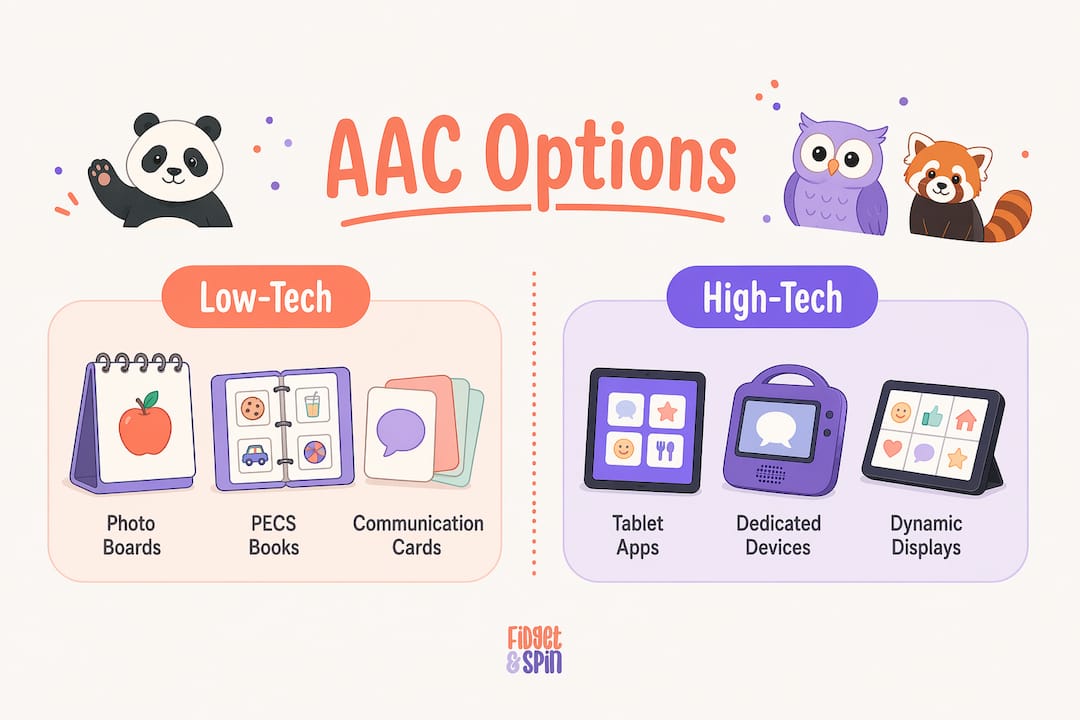
Low-tech options include printed symbol boards, PECS books, and communication cards. They are durable, cheap, and do not need charging. High-tech options are tablet-based apps or dedicated speech-generating devices. Tablets offer flexible, affordable access, with apps ranging from free to around £250 for premium software. Dedicated hardware costs significantly more but offers durability and specialist features.
AAC selection works best when it is diagnosis-agnostic, meaning the choice is driven by the child’s sensory, motor, and regulation needs rather than their label. A child with significant fine motor differences may struggle with a small touchscreen. A child with sensory sensitivities may find a laminated card board easier to handle than a device. These details matter enormously.
| Feature | Low-tech (picture boards, PECS) | High-tech (tablet apps, devices) |
|---|---|---|
| Cost | Low to free | Free apps to £250+ |
| Durability | High | Moderate (needs case) |
| Portability | Very portable | Portable with planning |
| Vocabulary capacity | Limited | Expandable |
| Learning curve | Gentle | Steeper initially |
Pro Tip: Start with a low-tech system alongside any high-tech option. If the tablet dies or gets left at nursery, your child still has a way to communicate. Two systems working together is not confusing. It is practical.
How do you use AAC effectively day to day?
The single most effective strategy for AAC use is also the simplest: model it yourself. This approach is called aided language stimulation, and it is the gold standard for effective AAC use. You use the AAC device or board yourself, in real conversation, to show your child how it works. You are not drilling them. You are demonstrating.
Here is how to build that into ordinary days:
- At mealtimes: Point to “more” on the board when you offer another spoonful. Say the word as you point. Do not wait for your child to do it first.
- During play: Use the device to say “go” when you push a car, or “stop” when the game pauses. Keep it light and fun.
- At bath time: Model “help” when you open the shampoo, or “all done” when you lift them out. Routine moments are the best teaching moments.
- During transitions: Use “go” and “stop” to narrate what is happening. Predictability reduces anxiety and creates space for communication.
- At bedtime: Model “more” for another story, or “no” if they push a book away. Even refusal is communication.
Consistent AAC modelling in daily routines leads to language absorption even when a child does not immediately use the device themselves. After 2–3 months of modelling without independent use, that is entirely normal. Continued exposure is what matters. Think of it like reading to a child before they can read. The input comes long before the output.
Avoid quizzing your child on AAC use. Asking “what do you want?” while pointing at the device and waiting expectantly creates pressure. Natural exposure and modelling without pressure yields far better results. The goal is a child who reaches for their board because it works, not because they have been drilled to perform.
Consistency across settings matters too. Nursery staff, grandparents, and childminders all need to know how the system works. A quick five-minute handover and a laminated reference card goes a long way. Caregiver modelling integrated into everyday life, rather than reserved for therapy sessions, is what drives progress.
What are the biggest AAC misconceptions to avoid?
The fear that AAC will stop a child from developing speech is the most persistent and most damaging myth in this space. AAC does not hinder speech development. Research consensus among speech and language therapists is clear on this. AAC supports verbal communication. It gives children a way to practise the act of communicating while their speech catches up, or alongside it.
Other common pitfalls include:
- Hand-over-hand prompting. This can create aversion to AAC devices. Physically guiding a child’s hand to press a symbol feels controlling, not supportive. Model the action yourself instead.
- Removing AAC when speech starts to emerge. Many children use AAC and speech simultaneously for extended periods. Taking away the device too soon removes a communication tool the child still relies on.
- Treating AAC as a therapy activity. If the board only comes out during SLT sessions, it will not generalise. AAC needs to be available all day, in every setting.
- Waiting for the “perfect” system. A good-enough system used consistently beats a perfect system that never gets started.
- Limiting vocabulary to nouns. “Ball,” “cup,” and “dog” are useful, but core words like “more,” “help,” and “stop” do far more communicative work across the day.
AAC is not a sign of failure. It is a sign that you are taking your child’s communication seriously and giving them every possible tool to participate in the world around them.
Key takeaways
Early AAC introduction, combined with consistent caregiver modelling and core vocabulary, gives young neurodiverse children the strongest foundation for communication and social participation.
| Point | Details |
|---|---|
| Start early, no prerequisites | AAC can begin at 12 months; no skills or diagnosis are required before starting. |
| Core vocabulary first | Begin with 3–8 functional words on a 2x2 or 3x3 grid matched to your child’s age. |
| Model, don’t quiz | Use the AAC device yourself in daily routines; avoid pressure or hand-over-hand prompting. |
| AAC supports speech | Research confirms AAC promotes, not hinders, verbal communication development. |
| Keep it available always | AAC must be accessible all day, in every setting, for it to become a real communication tool. |
What I actually found hard about starting AAC
I will be honest. The first time I sat at the kitchen table with a laminated symbol board and tried to use it myself, I felt ridiculous. Remy was two and a half. He was not looking at me. He was spinning a wheel on an upturned toy car. I pointed to “more” and said “more” and felt like I was performing to an empty room.
That feeling lasted weeks. Nobody tells you that the early stages of AAC modelling feel thankless. You are doing it into a void and trusting that something is landing. What shifted for me was stopping thinking of it as a therapy task and starting thinking of it as just… talking. I talk to Remy constantly. I narrate, I comment, I describe. Adding the board to that was not so different once I stopped making it precious.
The moment he reached for the board himself, unprompted, to press “stop” when I tried to leave his room at bedtime, I cried. Not because it was a miracle. Because it worked. He had something to say and a way to say it. That is what communication through play and daily life actually looks like. Messy, slow, and then suddenly, quietly, real.
Trust the process. The void is not empty.
— Caitlin
Sensory play and AAC: how Fidget and Spin can help
At Fidget and Spin, our weekly sensory play sessions in Brighton and Hove are designed for neurodiverse children aged 1–6, and they are genuinely AAC-friendly spaces. We welcome boards, devices, and any communication system your child uses. Our three sensory zones (Wiggle & Bounce, Snuggle & Chill, and Squish & Squeeze) give children regulated, low-pressure environments where communication can happen naturally, not on demand.
Play is one of the most powerful contexts for embedding AAC in everyday life, and our sessions are built around exactly that. If you want a space where your child’s communication tools are welcomed and understood, come and see how our sessions work. We also offer SEN-friendly birthday parties across Brighton, Hove, and wider Sussex for children aged 1–7, where every child belongs.
FAQ
Does AAC stop children from learning to speak?
AAC does not stop speech development. Research confirms it promotes verbal communication by giving children a way to practise communicating while their speech develops.
What age can a child start using AAC?
There is no minimum age. AAC can be introduced from 12 months, and no prerequisite skills are required before starting.
What is the best AAC system for a toddler?
The best system depends on your child’s motor skills, sensory needs, and regulation profile. A speech and language therapist specialising in AAC is the right person to guide that choice.
How long before my child uses AAC independently?
Two to three months of modelling without independent use is entirely normal. Consistent daily exposure is what builds towards independent use over time.
Can my child use AAC and speech at the same time?
Yes. Many children use AAC and spoken words simultaneously for extended periods. Removing AAC when speech begins to emerge takes away a tool the child still needs.
Recommended
- Supporting an autistic toddler: a practical parent’s guide | Fidget and Spin Brighton
- Step by step early years inclusion: a parent’s guide | Fidget and Spin Brighton
- A practical guide to emotional regulation for SEN children | Fidget and Spin Brighton
- Parent support tips for raising neurodiverse children | Fidget and Spin Brighton