Keep it short, keep it small, keep it predictable. Sixty to ninety minutes, four to eight guests (or fewer), a visual schedule, a quiet corner your child can retreat to and an exit plan everyone agrees on before the first balloon goes up. Everything else in party planning is decoration on top of that.
TL;DR:
- Smaller guest lists of four to eight children and shorter parties of 60 to 90 minutes help prevent overstimulation and meltdowns.
- Choosing familiar venues with natural light, quiet spaces, and non-echoing surfaces significantly reduces sensory overload for children with sensory sensitivities.
- Incorporating visual schedules, quiet corners, and predictable activities ensures children feel secure and manage transitions more easily.
- Clear communication about party expectations, such as a relaxed pace and sensory accommodations, helps set realistic guest expectations and reduces anxiety.
- SEN-friendly party packages from Fidget & Spin include sensory zones, flexible pacing, and support aimed at creating a safe, enjoyable environment for neurodivergent children.
Table of Contents
- ADHD birthday party ideas: the checklist to screenshot now
- Choosing a venue that doesn’t fight your child’s senses
- Getting guest numbers, timing and duration right
- Setting up a sensory-safe space: light, sound and quiet corners
- Activities that calm instead of compete
- Handling food, cake and the birthday song without drama
- Preparing your child with a visual schedule and a short rehearsal
- Exit plans and trusted adults: the safety net behind the fun
- How I design a sensory-friendly party at Fidget & Spin
- Managing the moment a child’s behaviour tips over
- Invitation wording that sets expectations without over-explaining
- Talking to guests who don’t know much about ADHD or sensory needs
- Choosing party favours that don’t add to the sensory load
- Letting your child help plan their own party
- A personal note from Caitlin: permission to make the party yours
- How Fidget & Spin can help with your next party
- Sources
- FAQ
ADHD birthday party ideas: the checklist to screenshot now
I’ve thrown enough parties for my son Remy to know the panic that sets in three days before, when you’re googling at midnight wondering if a bouncy castle is a good idea or a disaster waiting to happen. It can be either. It depends entirely on the structure around it.
Here’s the checklist I actually use:
- Cap the time at an hour to an hour and a half, with two hours as the absolute outer limit before overstimulation tips into meltdown territory, according to ADDERS guidance on children with ADHD.
- Keep the guest list to a few children, around four to eight, or sometimes just one or two close friends if your child does better with fewer people to track, per the same ADDERS guidance.
- Build a visual schedule or social story showing what happens and in what order. The TAND Toolkit notes this is one of the most reliable ways to cut transition anxiety before it starts.
- Set up a chill-out zone with ear defenders, a soft blanket, and whatever fidget toy your child reaches for on a hard day.
- Make singing optional and games non-competitive. Nobody needs musical chairs turning into a meltdown over a missing seat.
Screenshot that list. Print it. Stick it to the fridge. You don’t need to remember it, you just need to follow it.
Choosing a venue that doesn’t fight your child’s senses
Soft play centres are a gamble. I’ve walked into ones that felt like a fire alarm going off in a shoebox, and others that were, frankly, fine. The difference is usually acoustics and crowd size, not the venue’s reputation.
Home, or a familiar outdoor spot like a garden or a quiet corner of a local park, tends to win because your child already knows the sounds, the smells, and the exits. If you do book somewhere, ask direct questions before you pay a deposit:
- Can we get a quieter room, away from the main hall?
- Will you turn music off or down during our slot?
- Is natural light available, or is it all strip lighting?
- Can we have a private hire slot rather than sharing with other families?
Non-echoing surfaces and natural light genuinely change how a space feels for a sensory-sensitive child, something venue selection guidance from Kind Hours backs up. A private, sensory-focused session or SEN party package costs more than the local leisure centre slot, but if it means your child actually enjoys their own party rather than enduring it, that’s not a luxury. That’s the point.
Getting guest numbers, timing and duration right
Smaller guest lists paired with structured activities are consistently the combination that keeps kids regulated through a party, according to research on parties for neurodivergent children. Start with 4 to 8 children, and don’t be afraid to cut that to two or three if your child regulates better in tight, familiar company.
- Pick your child’s strongest time of day. Mid-morning works for a lot of children before the afternoon energy dip; check what’s true for yours.
- Slot food and cake into the visual schedule rather than springing them as a surprise.
- Stop at 90 minutes where you can. Two hours is the ceiling, not a target.
Shorter parties aren’t a compromise. They’re often the reason the whole thing works.
Setting up a sensory-safe space: light, sound and quiet corners
Every party I run has one non-negotiable: a spot where a child can go and not be found by well-meaning adults asking if they’re “having fun yet.”
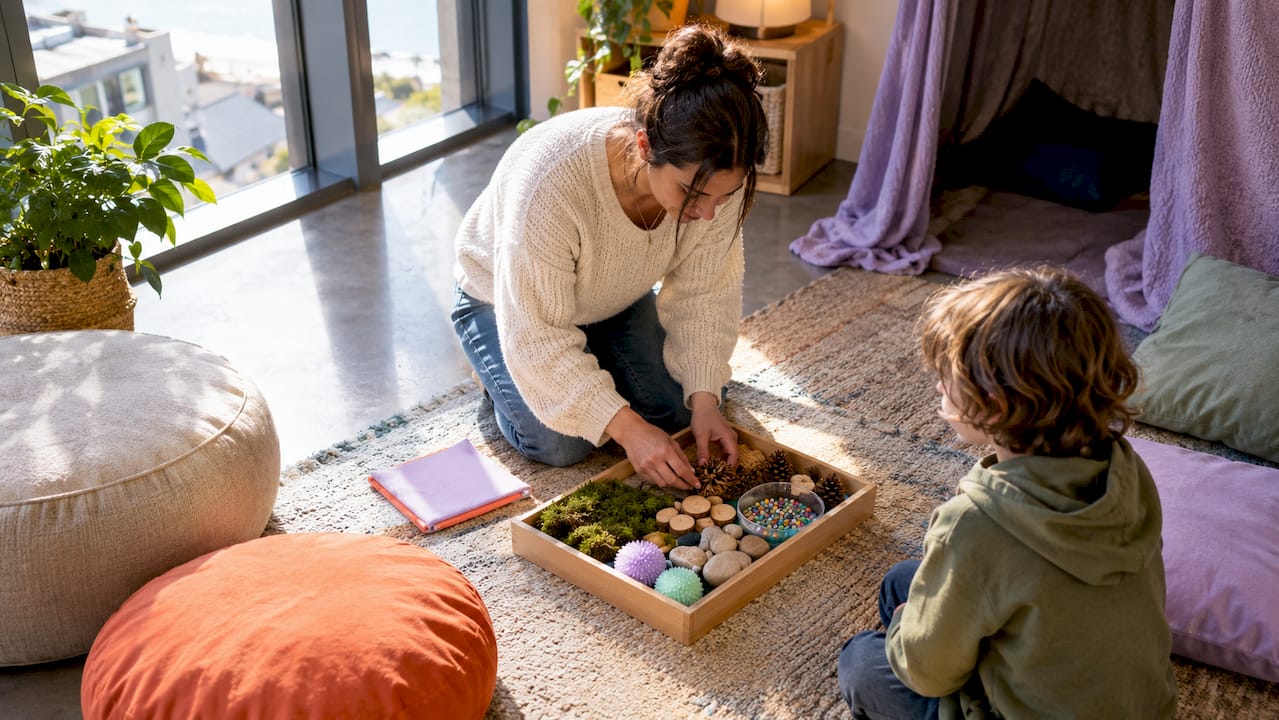
Fill that corner with soft seating, a low lamp rather than a ceiling light, ear defenders, and two or three fidgets your child already trusts. Keep music low, or off entirely for stretches of the party. Sensory-friendly setups work best when they add options rather than strip everything back, per guidance from Autism Unlocked, so the quiet corner sits alongside the main activity, not instead of it.
- Swap strip lighting for lamps or fairy lights.
- Offer headphones openly to every child, not quietly to one.
- Tell guests why the corner exists, in plain terms, so no one treats it as odd.
Pro Tip: Say the quiet corner’s purpose out loud at the start, in front of everyone. “This is where anyone can go if it gets loud.” One sentence removes all the stigma.
Activities that calm instead of compete
Elimination games are my least favourite invention in the history of children’s parties. Someone’s always out first, someone’s always crying by round two, and the noise spikes exactly when you don’t want it to.
Go for activities kids can drift in and out of: a craft table, a sensory bin with rice or pasta, a bubble station, or simple cupcake decorating. A low-key treasure hunt with visual clues works well because it’s collaborative, not competitive. Present each activity with a clear time limit and make joining in optional, never expected, echoing the approach WonderBaby recommends for sensory-friendly parties. For more structured game ideas that adapt well, our guide to autism-friendly party games has options that don’t rely on speed or sudden noise.
- Skip musical chairs, pass-the-parcel eliminations, and pin-the-tail style guessing games.
- Avoid party poppers, sudden music stops, or surprise noises.
- Let children move between activities freely instead of rotating on a timer.
Handling food, cake and the birthday song without drama
Cake time is where a lot of parties go sideways, usually because everyone’s staring at one child while singing loudly and lighting fire near their face. Understandably, some children hate every second of that.
Serve familiar, clearly labelled food, and keep a backup snack your child actually eats in case the party spread doesn’t appeal. Make the song optional: a quiet countdown, a family-only candle moment later, or LED candles instead of real flames all work.
- Ask about allergies directly in the invitation, not on the day.
- Offer at least one plain, familiar option alongside anything themed.
- Skip the singing entirely if your child finds it stressful. Nobody will remember it didn’t happen.
Preparing your child with a visual schedule and a short rehearsal
A social story or visual schedule works because it turns an unknown event into a known sequence: arrival, games, food, cake, home. Include photos where you can, and put the exit plan in it too, so leaving isn’t a mystery.
- Build a simple sequence card or story showing each stage of the party in order.
- Share a photo or short video of the venue in advance. A 40-second walk-through can cut pre-event anxiety more than a long verbal explanation ever does.
- Do a two-minute rehearsal at home: “First we’ll say hello, then there’s cake, then home.”
- Send a short note to other parents: “Ours gets loud fast for [child’s name], so we’ve got a quiet corner and we’ll finish by [time]. Thanks for understanding.”
Our guide to using a visual schedule before a party has templates if you want a starting point rather than a blank page.
Exit plans and trusted adults: the safety net behind the fun
Every party needs an exit plan agreed before it starts, not improvised when your child is already overwhelmed. A three-piece plan works: a code word, a named quiet spot, and an agreed time to leave if needed.
Brief one trusted adult, whether that’s you, your partner, or a relative who knows your child’s cues, to watch for signs of overload rather than waiting for a collapse. A pre-agreed exit plan with a code word, honoured the moment it’s used, builds enough trust that children often stay longer and enjoy more of the party, not less.
- Agree the code word with your child beforehand, somewhere quiet, not at the party.
- Pick a quiet spot in advance, whether that’s a car, a bedroom, or a garden bench.
- Honour the first use without negotiation. That’s what makes it work next time.
Remember the golden rule from ADDERS: 60 to 90 minutes, two hours maximum. An exit plan matters less when the party was never designed to run past the point your child can cope with.
How I design a sensory-friendly party at Fidget & Spin
At our sessions, we split the room into three zones: Wiggle & Bounce for big movement, Squish & Squeeze for tactile play and fidgets, Snuggle & Chill for low-stim retreat. Children move between them as their regulation shifts, no permission needed. Our shorter party slots build in extra adult support and a dedicated quiet area rather than cramming three hours of stimulation into one room. If you’d rather hand the planning over than build it yourself, our parties page shows how the packages work.
Managing the moment a child’s behaviour tips over
It will happen. A child will melt down, bolt, or shut down completely, and the room will go quiet and everyone will look at you. Plan for it before it happens, not during.
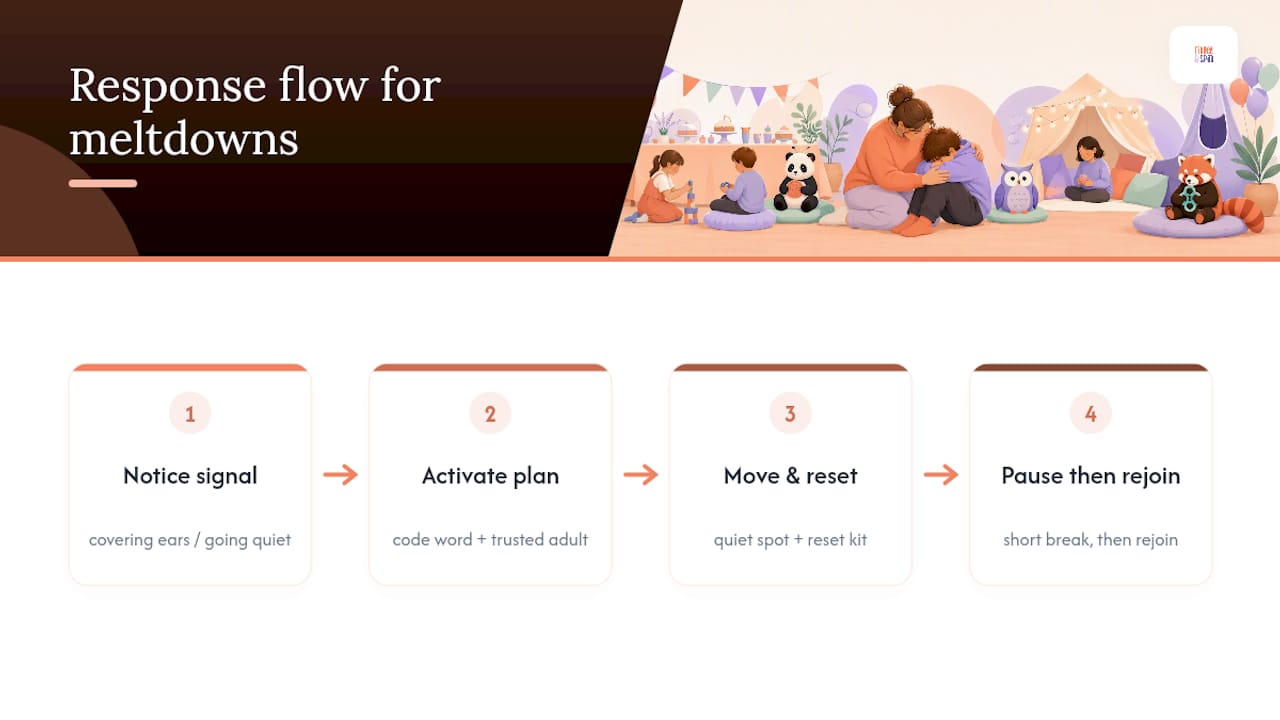
Have your exit plan already agreed (code word, quiet spot, trusted adult) so you’re executing a plan rather than inventing one under pressure. Keep a small “reset kit” nearby: a favourite fidget, ear defenders, a snack you know they’ll eat. Don’t try to talk your child out of a meltdown mid-event; get them somewhere quieter first, then talk.
Brief your trusted adult in one sentence beforehand: “If you see him covering his ears or going quiet, that’s the signal, take him to the quiet room.” One-sentence briefings work because people remember them.
If another child’s behaviour is the trigger, whether that’s a grab, a loud noise, or an unexpected touch, step in early rather than waiting to see if it resolves. Redirecting attention to a new activity often works better than asking a group of six-year-olds to “calm down,” a phrase that has never once worked in the history of birthday parties.
Afterwards, don’t treat it as a failure. A ten-minute break in a quiet spot, followed by rejoining the party, is a full participation story, not a partial one. I’ve watched Remy leave a party three times and come back three times, and by the end he was the one asking if we could stay a bit longer. That’s a good party.
Invitation wording that sets expectations without over-explaining
The invite is your first chance to manage expectations, and a plain sentence does more work than a paragraph of apology. You don’t owe anyone a diagnosis explanation, but a short heads-up saves everyone confusion on the day.
Try something like: “It’s a small, relaxed party, 90 minutes, with a quiet space available if anyone needs a break. Feel free to ask if you’ve got questions.” That’s it. No jargon, no over-justifying, no clinical language about anyone’s brain.
If you want to flag specific things, keep it concrete: “There won’t be a bouncy castle” or “music will be kept low” tells parents exactly what to expect, which matters more than any label. Concrete detail beats vague reassurance every time, because parents can actually picture what they’re walking into.
Include the practical basics clearly: start and end time, address, RSVP method, allergy question, and whether siblings are welcome. Vague invitations create more anxiety than direct ones, for you and for the guests.
Talking to guests who don’t know much about ADHD or sensory needs
Some of the parents at your child’s party will have never heard the word “regulation” used outside a washing machine manual. That’s fine. You’re not running a training session, you’re throwing a party.
Keep it short and practical rather than educational. A message like: “Ours finds loud, busy things tricky sometimes, so we’ve kept the party small and there’s a quiet corner if any child needs a break, not just ours” works because it normalises the accommodation for everyone, not just your child.
Avoid over-explaining diagnoses or processing differences unless you want to. You’re allowed to just say “this is how we do parties” without a lecture attached. Most parents will follow your lead without needing the full picture, and the ones who ask thoughtful questions are usually the ones worth having at the next one too.
If a guest’s child struggles with the pace, resist the urge to apologise for your own child’s needs shaping the day. It’s your child’s birthday. The party is allowed to be built around what actually works for them.
Choosing party favours that don’t add to the sensory load
Party bags stuffed with plastic whistles, sticky sweets, and tiny loose pieces are basically a hazard disguised as a treat. I stopped doing them years ago and nobody’s ever complained.
Favours that work well tend to be quiet, tactile, and useful rather than novelty. Think a small fidget toy, a scented (or unscented, check allergies) putty, a simple sensory-friendly toy, or a book. Skip anything with a loud noise function, party horns are the enemy of every quiet corner you just built.

Labelled, allergy-friendly treats matter here too, particularly if you’ve got mixed dietary needs among guests. Allergy-friendly favour options exist precisely because “everyone gets identical sweets” stopped being a workable default years ago.
Keep favours meaningful over abundant. One good item beats five cheap ones rattling around a bag, and it means less plastic clutter heading home in car seats afterwards. If your child has strong opinions on textures or colours, let that guide the choice. A favour your own child would actually want to keep is usually the right one for everyone else too.
Letting your child help plan their own party
Remy picked the theme for his last party (dinosaurs, again) and insisted on choosing which songs played, which sounds like a small thing until you realise how much comfort it gave him walking in. He knew what to expect because he’d chosen it.
Involving your child in planning doesn’t mean handing over every decision. It means offering real choices within a structure you’ve already built: which two activities from a shortlist, which cake flavour, whether the quiet corner has cushions or a tent. Choice within limits reduces anxiety far more than either total control or none at all.
Show them the visual schedule as you build it, not just on the day. Let them see the plan taking shape, ask questions about it, and change their mind about small things. That ownership tends to carry through the actual event, because it stops feeling like something happening to them and starts feeling like something they made.
If your child wants no party at all some years, that’s a legitimate answer too. A quiet family celebration is still a celebration, and it might be the version that actually lets everyone, including you, enjoy the day rather than survive it.
A personal note from Caitlin: permission to make the party yours
I’ve left more than one party early, Remy in one arm, a half-eaten party bag in the other, feeling like I’d failed at something everyone else finds easy. I hadn’t. The party had been built for a different kind of child.
Pick one thing from this list. A quiet corner. A shorter time slot. One tweak, done well, is a win. Tell me yours over on our socials, I’d genuinely like to know what worked for your child.
— Caitlin
How Fidget & Spin can help with your next party
There are other routes to a good party: DIY at home, a soft play booking, a private hall hire. Fidget and Spin exists because Anthony and I couldn’t find any of them built around Remy’s needs, so we built our own.
Our SEN-friendly party packages are designed by SEN parents, not retrofitted from a standard kids’ party template. Every booking gets sensory zoning across Wiggle & Bounce, Squish & Squeeze and Snuggle & Chill, flexible pacing, and a genuinely low-judgement room. The Wee One starts from £220, The Big One from £320, and The Whole Shebang from £530, with add-ons like a sensory play station or extra time if your child needs a longer runway.
If you’d rather test the waters first, our weekly SEN Stay and Play sessions cost £7.50 and give your child a feel for our zones before committing to a party. When you’re ready, check dates and packages on our parties page and book the slot that fits your child, not the other way round.
Sources
- Throwing a birthday party for children with ADHD
- Visual supports and social stories (TAND Toolkit)
- Sensory-friendly birthday party tips (WonderBaby)
FAQ
What are some fun activities for a child with ADHD at a party?
Craft stations, sensory bins, bubble stations, and simple treasure hunts work well because children can join and leave without pressure. Avoid elimination games like musical chairs, which tend to spike anxiety and noise right when you want calm.
What makes a birthday party sensory-friendly?
A sensory-friendly party controls light and sound, offers a quiet retreat with ear defenders and fidgets, and avoids sudden noises or surprises. Structured, predictable activities paired with a smaller guest list are consistently reported as the most effective combination for keeping children regulated, according to research on neurodivergent children’s parties.
How can I help a 9 year old with ADHD enjoy a party more?
Involve them in choosing activities and the schedule, keep the guest list small, and agree an exit plan with a code word before the party starts. A visual schedule showing the sequence of events reduces the anxiety that often builds before transitions, per the TAND Toolkit.
How do I throw a birthday party for a 5 year old with sensory needs?
Keep it to 60 to 90 minutes, invite 4 to 8 children (or fewer for a sensitive child), and set up a quiet corner from the start. Build a visual schedule together beforehand so your child knows exactly what happens and when it ends.
Does Fidget and Spin run SEN-friendly birthday parties?
Yes, Fidget and Spin offers three SEN-friendly party packages across Brighton, Hove and Sussex: The Wee One from £220, The Big One from £320, and The Whole Shebang from £530. Full details and add-ons are listed on the parties page.