
TL;DR:
- Parenting children with early signs of ADHD can be challenging, especially since traits often overlap with typical behavior before age six. Early support using responsive parenting and accessible community groups can improve outcomes even before a formal diagnosis is made. Diagnosis involves a structured NHS process that requires professional referral and assessment across multiple settings, with support options available regardless of diagnosis status.
Attention deficit hyperactivity disorder (ADHD) in young children is defined by persistent patterns of inattention, impulsivity, and hyperactivity that go well beyond what you’d expect for a child’s age and stage. If you’re parenting a toddler or preschooler in the UK and something feels different, you’re probably right to pay attention. The tricky part is that ADHD traits often overlap with typical behaviour in children aged 2–5, which is exactly why formal diagnosis is usually deferred until age six. That doesn’t mean you’re left waiting with nothing. Understanding what you’re seeing is the first step. Doing something about it comes next.
What are the early signs of ADHD in young children UK?
Spotting ADHD traits in a child under six is genuinely hard. A three-year-old who can’t sit still at the dinner table is not automatically showing signs of ADHD. The difference lies in degree, persistence, and context.
ADHD presents in three broad patterns: predominantly inattentive, predominantly hyperactive-impulsive, and combined. In young children, the hyperactive-impulsive type tends to be most visible. You might notice:
- Running or climbing constantly, even in situations where it’s clearly not appropriate
- Difficulty waiting for a turn, grabbing toys from other children without apparent awareness
- Talking non-stop, interrupting, or blurting out answers before a question is finished
- Moving from one activity to the next within seconds, rarely completing anything
- Emotional reactions that feel disproportionate and take a long time to settle
- Difficulty following multi-step instructions, even simple ones
The inattentive type is quieter and often missed in young children. A child who drifts off during stories, loses things constantly, or seems to be in their own world may be showing inattentive traits. These children don’t tend to cause disruption, so they get overlooked.
Diagnostic criteria require symptoms to be present for six months or more and to show up in at least two different settings, such as at home and at nursery. A child who is only bouncy at home but calm everywhere else is less likely to meet the threshold. That context matters.
Sensory processing differences often sit alongside ADHD traits. A child who is overwhelmed by noise, textures, or crowds may be dysregulated rather than defiant. Understanding the difference changes how you respond, and that shift in response changes everything.

Pro Tip: Keep a simple written log of specific behaviours, how long they last, and where they happen. When you eventually speak to a GP or health visitor, that record is far more useful than trying to recall examples on the spot.
How does the ADHD diagnosis process work for young children in the UK?
The NHS pathway for diagnosing ADHD in children is structured, and it takes time. Knowing what to expect reduces the shock of it.
The process generally works like this:
- Speak to your GP or health visitor. Describe what you’re observing, when it happens, and how long it’s been going on. Bring your behaviour log if you have one.
- A professional initiates the referral. Self-referrals are not accepted on NHS pathways. The referral must come from a GP, school teacher, or SENCO (Special Educational Needs Coordinator).
- Questionnaires go to parents and teachers. Both settings provide information independently, which is how clinicians assess whether traits appear across multiple environments.
- Clinical assessment takes place. This can include structured observations, developmental history, and in some cases a computer-based Qb Test. Appointments can run up to 90 minutes.
- A diagnosis is considered. For children under six, formal diagnosis is typically deferred because impulsivity and difficulty sitting still are part of typical development at that age.
| Stage | What happens | Who is involved |
|---|---|---|
| Referral | GP or professional submits referral | GP, SENCO, health visitor |
| Questionnaires | Behaviour rating scales completed | Parents, nursery or school staff |
| Assessment | Clinical interview and possible Qb Test | Paediatrician or psychiatrist |
| Diagnosis | Formal diagnosis if criteria are met | Specialist clinician |
| Support plan | Graduated, tailored plan agreed | Family, school, clinical team |
Waiting lists for NHS assessments are long in most areas of the UK. Some families consider private assessment, but private diagnoses must be ratified by local NHS trusts before medication can be managed within NHS pathways. Check your local trust’s policy before spending money on a private route.
Pro Tip: Ask your GP to note the referral date in writing. Waiting list disputes are easier to resolve when you have a paper trail.
What early support can parents use before and after diagnosis?
Support does not have to wait for a diagnosis. This is the part most parents don’t realise, and it matters enormously.
Responsive and low-demand parenting approaches are consistently recommended for families supporting neurodivergent children. These are not about lowering expectations. They are about reducing unnecessary friction so a child can actually engage. Practically, that looks like:
- Giving one instruction at a time rather than a sequence
- Using visual cues alongside verbal instructions (pictures, objects, gestures)
- Building transition warnings into the day (“five more minutes, then we’re leaving”)
- Reducing background noise and sensory clutter where possible
- Naming emotions out loud to help a child build their own emotional vocabulary
- Choosing connection over correction when a child is already dysregulated
ADHD management works best as a graduated, tailored approach that combines psychoeducation, behavioural strategies, and, where appropriate, medication. Medication is not a cure. It is one tool, and it is not suitable for every child or every family.
Psychoeducation simply means learning about ADHD. Reading about it, attending a workshop, or doing an online course helps you understand why your child does what they do. That understanding shifts your responses from reactive to considered. It also reduces the guilt that so many parents carry quietly.
Sensory play strategies are particularly useful for young children with ADHD traits. Activities that involve heavy work (pushing, pulling, carrying), tactile exploration (sand, water, dough), or rhythmic movement (swinging, rocking) support regulation. A regulated child is a more available child.

Your own wellbeing is not a luxury. Small, consistent changes work better than trying to overhaul everything at once. Acknowledge the emotional weight of caregiving. Find one person who gets it, whether that’s a partner, a friend, or another parent in a support group.
Pro Tip: The Coram Family Lives free online course on parenting neurodivergent children is genuinely useful and you can do it in the evenings at your own pace. No referral needed.
How can UK parents access support services for children with ADHD?
Knowing where to look saves weeks of searching. Here are the most useful starting points for families in the UK:
- ADHD UK offers peer support groups, webinars, and guidance written by people with lived experience. Groups typically meet online in the evenings, which works for parents who can’t get out.
- ADHD Aware provides information and community support regardless of diagnostic status.
- Coram Family Lives runs free online parenting courses specifically for families of neurodivergent children.
- Your school’s SENCO is one of the most underused resources available. Early conversations with a SENCO can unlock practical support before any diagnosis exists. Schools have tiered mechanisms to help based on identified need, not waiting for a label.
- Your Local Offer is a statutory resource every local authority in England must publish. It lists education, health, and social care services available to children with SEND in your area. Search “[your council name] Local Offer” to find it.
| Resource | What it offers | Diagnosis needed? |
|---|---|---|
| ADHD UK | Peer groups, webinars, expert advice | No |
| ADHD Aware | Community support, information | No |
| Coram Family Lives | Free online parenting courses | No |
| School SENCO | In-school support and adjustments | No |
| Local Offer | Directory of local SEND services | No |
Waiting lists are long, but many neurodivergent-friendly groups and early years services offer targeted support while families wait. Don’t put everything on hold until a letter arrives. The support available now is real and it helps.
If your child attends nursery or a childcare setting, speak to the key person or room leader. Early years providers can make reasonable adjustments without a formal diagnosis. They can also contribute observations that strengthen a future referral.
For families in Sussex, neurodiverse play groups offer a way to connect with other parents and find sensory-friendly spaces where children can just be themselves.
Key takeaways
Early understanding of ADHD traits in young children, combined with responsive parenting and proactive use of available support, produces better outcomes than waiting for a formal diagnosis to act.
| Point | Details |
|---|---|
| Diagnosis is usually from age six | UK clinical guidelines defer formal ADHD diagnosis until six due to typical toddler behaviour overlap. |
| Symptoms must appear in two settings | Traits need to persist for six months or more and show up at home and in nursery or school. |
| Referrals require a professional | GPs, SENCOs, and teachers can refer; self-referrals are not accepted on NHS pathways. |
| Support is available without a diagnosis | ADHD UK, ADHD Aware, Coram Family Lives, and school SENCOs all help before any label exists. |
| Responsive parenting reduces friction | Low-demand, sensory-aware approaches support regulation and make daily life more manageable. |
What I’ve learned from parenting Remy before the diagnosis came
I spent a long time convinced I was doing something wrong. Remy would bolt across car parks, melt down at transitions, and leave every toddler group in chaos. I’d watch other children sit for a story and feel a specific kind of loneliness that’s hard to describe. Not jealousy exactly. More like grief for the version of parenting I’d imagined.
What helped most wasn’t a diagnosis. It was understanding. Reading about ADHD and sensory processing differences gave me a framework for what I was seeing. Remy wasn’t being difficult. He was dysregulated. That shift changed how I responded, and how I responded changed how he coped.
The peer support side surprised me. I expected it to be a bit grim, a circle of exhausted parents comparing horror stories. It wasn’t. It was funny, honest, and practical. People shared what actually worked, not what the leaflets said. That’s where I learned about visual schedules, about heavy work, about picking battles with intention rather than desperation.
Anthony and I built Fidget and Spin because we needed somewhere that understood. Somewhere Remy could move, explore, and regulate without anyone sighing. If you’re in that waiting period before diagnosis, or just trying to make sense of what you’re seeing, you’re not alone. The hard stuff is real. So is the support.
— Caitlin
Sensory play sessions built for children like yours
Fidget and Spin runs weekly sensory stay-and-play sessions in Brighton and Hove, designed specifically for neurodiverse children aged 1–6. Every session is structured around three zones: Wiggle & Bounce for big movement, Snuggle & Chill for low-stimulation rest, and Squish & Squeeze for tactile play and fidgets.
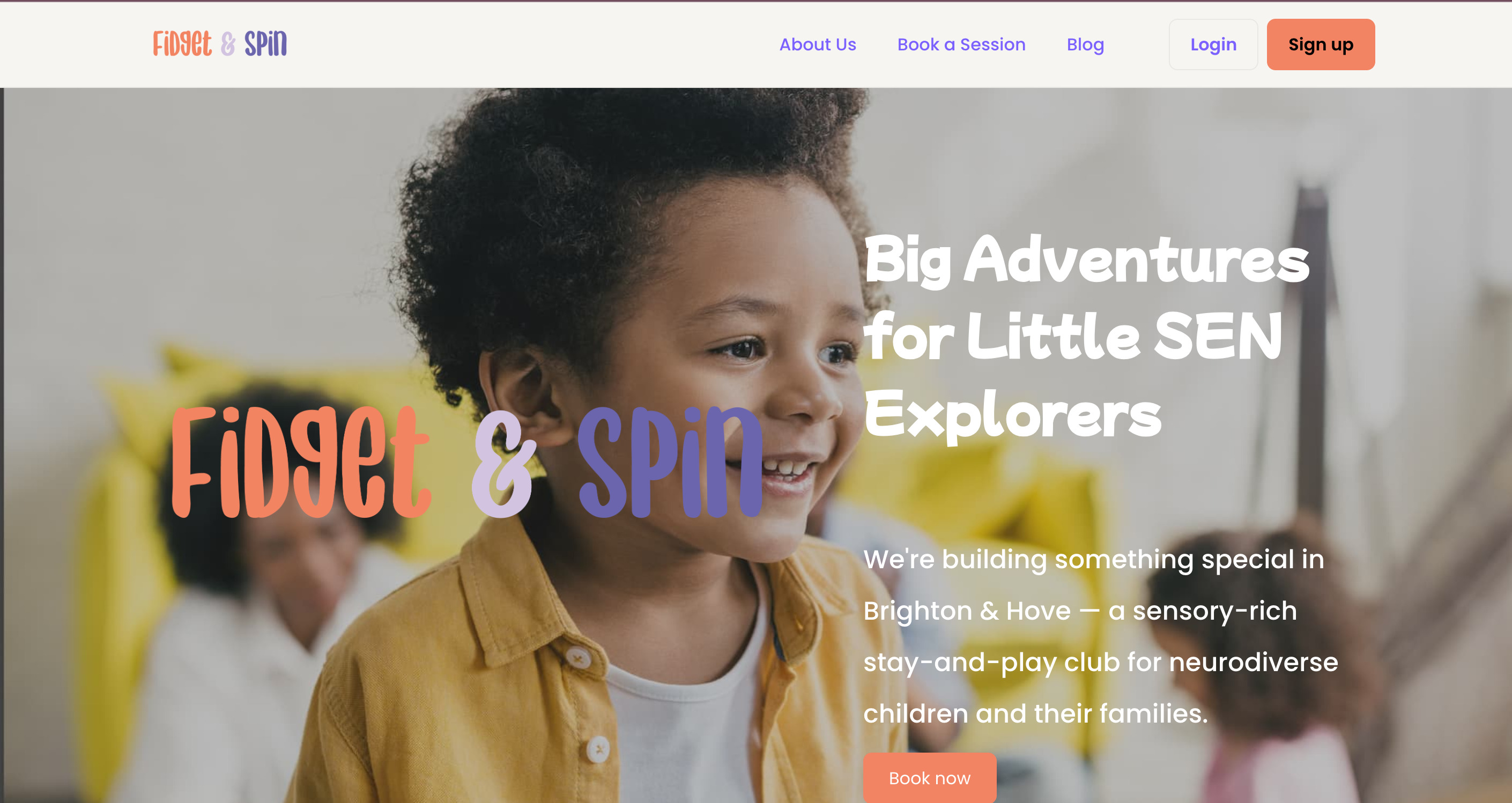
There are no expectations about how your child should play or how long they should stay in one place. Sessions are kept small, the environment is predictable, and the other parents in the room get it. Book a sensory play session and see what it feels like to be somewhere built for your child. Fidget and Spin also offers SEN-friendly birthday parties across Brighton, Hove, and wider Sussex for families who want a celebration without the sensory chaos.
FAQ
What age can a child be diagnosed with ADHD in the UK?
Formal ADHD diagnosis in the UK is generally reserved for children aged six and older, because impulsivity and hyperactivity are part of typical development in younger children.
Can I self-refer my child for an ADHD assessment?
No. NHS pathways require a referral from a professional such as a GP, school teacher, or SENCO. Self-referrals are not accepted.
What support is available before my child gets a diagnosis?
Support is available immediately through organisations like ADHD UK, ADHD Aware, and Coram Family Lives, as well as through your child’s school SENCO, all without a formal diagnosis.
Does ADHD medication cure the condition?
Medication is not a cure for ADHD. It is one part of a graduated, tailored approach that also includes behavioural strategies and psychoeducation, and it is not suitable for every child.
What should I do while waiting for an NHS assessment?
Contact your school’s SENCO, access free online courses through Coram Family Lives, and connect with peer support groups like ADHD UK. Waiting lists are long, but practical support is available right now.
Recommended
- Parent support tips for raising neurodiverse children | Fidget and Spin Brighton
- What is neurodiversity? A guide for parents and carers | Fidget and Spin Brighton
- SEN parenting UK: what support is actually out there | Fidget and Spin Brighton
- Do fidget toys improve attention in young children? | Fidget and Spin Brighton