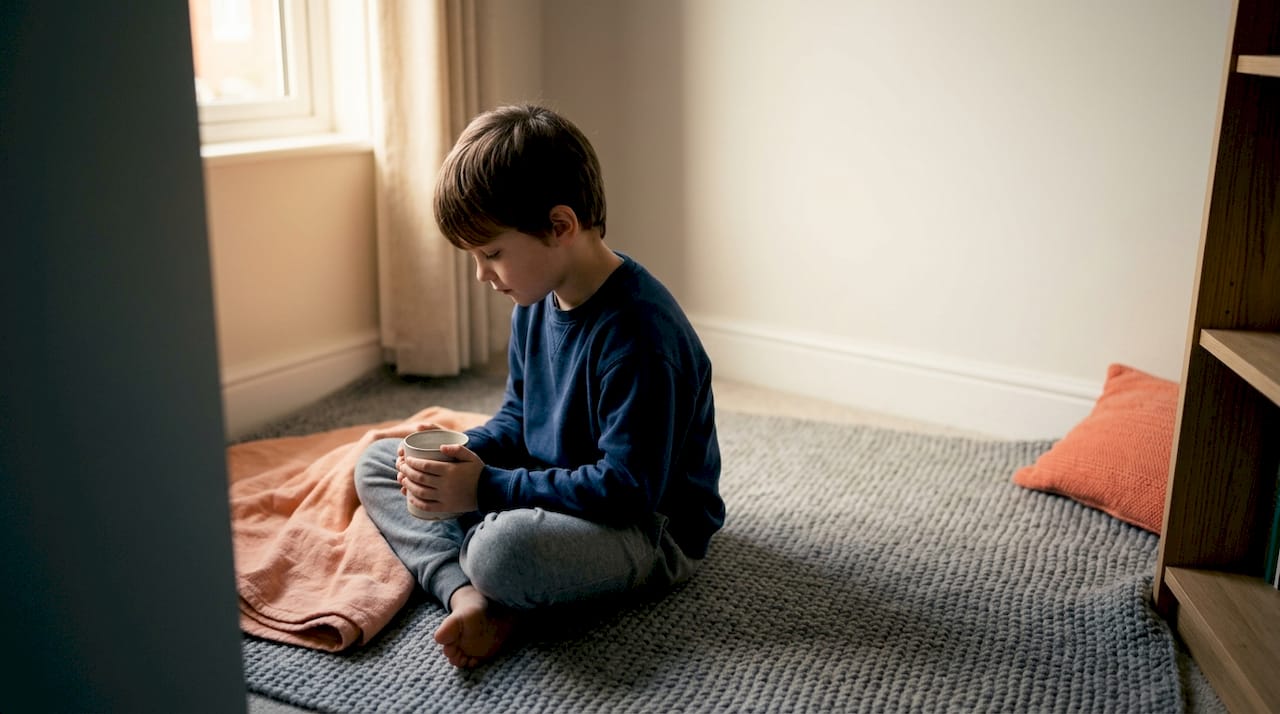
The after party comedown is your child’s nervous system settling the bill for a day of noise, lights, crowds and forced small talk. The single most useful thing you can do the moment you’re through your own front door is cut the sensory input and meet basic needs, water, food, quiet, before anything else. That’s it. That’s the whole first move. Ambitious about Autism and years of running sensory sessions at Fidget & Spin both point the same way: don’t debrief, don’t ask questions, just lower the noise and let the body catch up.
TL;DR:
- Lower sensory input immediately upon arriving home by dimming lights, turning off devices, and avoiding conversations to help your child recover faster.
- Meet basic needs like water and protein before attempting to engage or ask questions, as physical discomfort is often a hidden cause of distress.
- Prepare for parties by creating visual schedules, packing sensory kits, and communicating openly with hosts to reduce unexpected stimuli and promote smoother recovery.
- Use scheduled quiet breaks, proper seating choices, and minimal language during events to prevent overload and help your child regulate during the party.
- Monitor recovery into the following day, and seek professional support if symptoms like extended shutdowns, skill loss, or self-harm occur.
Table of Contents
- What is an after party comedown for an autistic child?
- Quick recovery checklist for the first hour home
- Practical preparation before the party to reduce the risk
- In-event tactics that reduce later dysregulation
- Structured aftercare: the first three hours and bedtime
- The day after: pacing recovery and spotting patterns
- When to seek extra support
- Meltdown or shutdown: spotting the early signs
- Talking to your child about the party in advance
- Spotting and managing the specific sensory triggers at parties
- Getting other adults on board
- Reintroducing social stimuli after the crash
- Common mistakes that make the comedown worse
- What actually worked for us: a note from our kitchen
- How Fidget and Spin helps you rehearse the recovery, not just the party
- Sources
- FAQ
What is an after party comedown for an autistic child?
It’s the crash that comes after the party’s over. Not during it, that’s often when the masking is holding strong, but an hour or three later, or sometimes the next morning. The body’s been running on adrenaline through a birthday party, a wedding, a school disco, and once the demand stops, the fuel that was propping everything up stops as well.
I’ve watched my son Remy hold it together beautifully at a cousin’s birthday, all smiles, all “yes please” to cake, and then meltdown spectacularly over the wrong colour cup twenty minutes after we got home. It wasn’t about the cup.
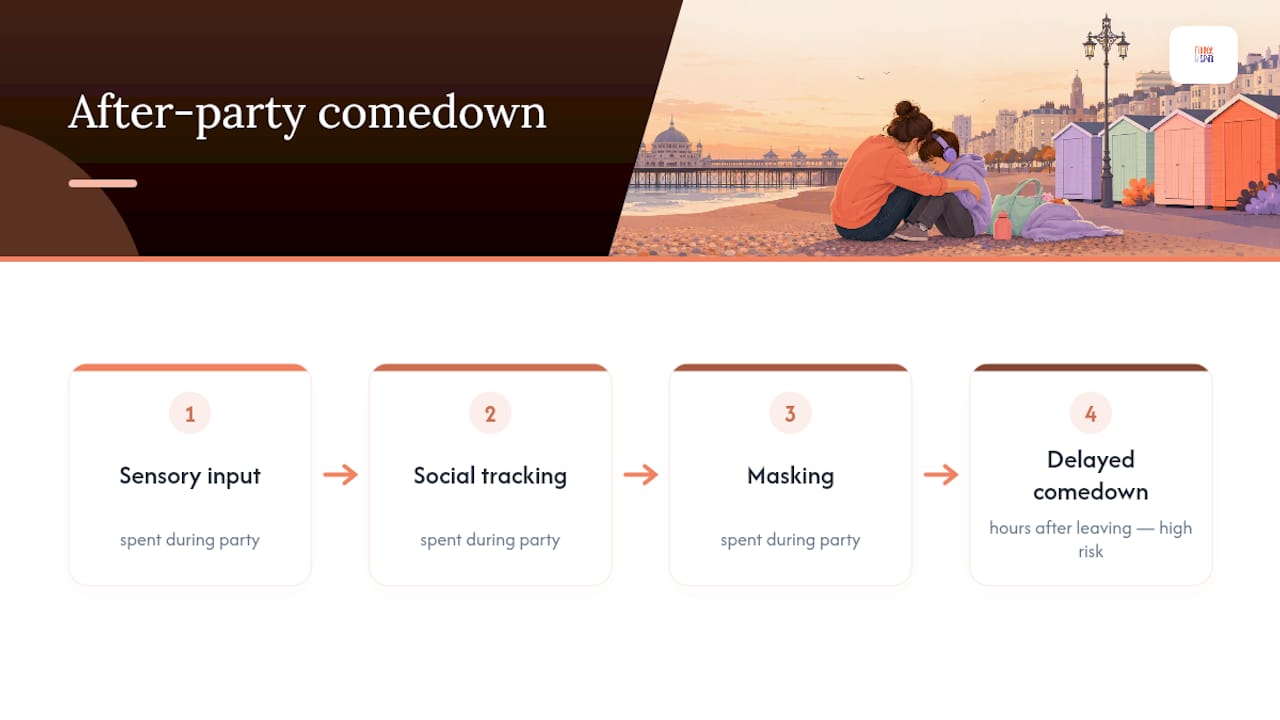
NeuroDiversion calls this a social hangover, and the framing helps: three things get spent at a party, sensory input, social tracking (working out who’s talking to whom, what’s expected next) and masking (holding the “acceptable” face in place). Spend all three and the bill lands later, often the next day. The hours right after leaving are the highest-risk window for tipping into meltdown or shutdown, because the adrenaline that got your child through the front door is still running and there’s nothing left to spend it on except a wrong-coloured cup.
Worth knowing early: a meltdown and a shutdown aren’t the same thing, and they don’t need the same response. More on that below. For now, the target is simple, get the sensory dial down before anything else happens.
Quick recovery checklist for the first hour home
This is the bit I wish someone had handed me on a laminated card five years ago. Here’s the order that actually works, tested on our own kitchen floor more times than I’d like to admit.
- Cut inputs immediately. Lights down, TV off, your phone out of sight. Don’t chat. Silence is doing the work here.
- Meet basic needs before words. Water first, then something with protein, not sugar. Check quickly for pain, a wet sock, an itchy label. Comedowns get blamed on “behaviour” when the real culprit is a full bladder or a scratchy tag.
- Offer one low-demand calming option. Headphones, a weighted lap pad, the fidget that’s been in the party bag the whole time. Don’t offer five options. Offer one, maybe two.
- Say less, not more. Two-option prompts only, “blanket or bean bag?”, not “how was the party, what did you think of the cake, did you like Freya’s present?” Child Mind Institute research backs this: minimal language and limited choices reduce the cognitive load your child is trying to survive.
- Read the room before deciding on company. Some children need you sat quietly nearby. Others need you gone. Respect a request for space as information, not rejection.
Pro Tip: Keep a “landing kit” by the front door, headphones, a snack, a fidget, so step three doesn’t depend on anyone having the energy to go and find things.
Supervise closely if there’s any sign of self-harm or a shutdown that isn’t lifting. Otherwise, alone time in a safe, low-stim room is often the fastest route back.
Practical preparation before the party to reduce the risk
Sarah, one of the parents I chat to at our Tuesday sessions, told me she used to treat parties as something to survive. Now she treats them as something to budget for, and the difference in her daughter’s recovery time has been enormous.
The idea, borrowed loosely from the concept of budgeting a sensory battery, is that every event has a cost, and you can plan around it rather than being ambushed by it.
- Protect the period before the event. Use predictable meals, proper rest, and avoid stacking big outings.
- Build a one-page visual timetable or a short social story so the shape of the day is known in advance, not sprung on them.
- Pack a compact sensory kit: noise-reducing headphones, a familiar small toy, a snack that won’t melt in a bag, and a spare top in case the party one feels wrong by hour two.
- Have one honest, practical conversation with the host. Ask where the quiet corner is, whether the big light switch can go off for ten minutes if needed. Most hosts say yes when you just ask plainly.
- If you can, do a short pre-visit or send photos of the venue beforehand. Even a five-minute look at the actual room removes a chunk of the unknown.
None of this guarantees a smooth day. It just means the sensory battery starts fuller, so the crash lands softer.
In-event tactics that reduce later dysregulation
You can’t stop a party being loud. You can stop your child absorbing all of it at once.
- Plan quiet breaks on a timer, not “when things go wrong”. Ten minutes outside every forty-five minutes, agreed in advance, works better than waiting for a crisis.
- Choose seating near an exit, away from speakers, away from the doorway where every new arrival triggers a fresh wave of noise and greeting.
- Use the kit you packed. Headphones on before the room gets loud, not after. Sunglasses if the lighting’s harsh. Fidget in hand from the start, not produced as a last resort.
- Keep your own language minimal too. Offer tiny choices, “stay five more minutes or go now?”, and mean it either way.
- Have an exit script ready that needs no explanation: “Right, we’re off, thanks so much.” No apology, no lecture to your child about what a shame it is. Ambitious about Autism is clear that shutdowns are a protective reset, not a choice, and leaving early isn’t giving in, it’s good management.
Pro Tip: Tell the host in advance you might leave without a long goodbye. It saves an awkward scene and stops you feeling you owe anyone an explanation mid-exit.
Somewhere at our own autism-friendly party sessions, we build these breaks into the structure of the event itself, so no one has to fight for them on the day.
Structured aftercare: the first three hours and bedtime
Think of this in phases rather than one long evening.
- 0 to 15 minutes. Cut everything you can. Lights, sound, questions. This is triage, not conversation.
- 15 to 60 minutes. Move to a properly low-stim zone. Deep pressure often helps here, a firm hug if welcomed, a weighted blanket, sitting under a duvet.
- 1 to 3 hours. Keep demands to almost nothing. A familiar quiet game, predictable screen time if that’s genuinely calming for your child rather than overstimulating.
- Bedtime. Stick to the usual routine even if it’s earlier than normal. Skip the debrief entirely, “so what was your favourite bit?” can wait for another day, or never happen at all.
What to avoid: long conversations about the party, new instructions, anything that asks your child to process more information while they’re already flooded.
Signs of genuine recovery: speech coming back to its normal pace, appetite returning, a bit of humour creeping in. Signs they’re still overwhelmed: monosyllables, flat affect, or a meltdown that seems to come from nowhere. Our get-home-calm evening plan walks through this exact sequence if you want it written out somewhere you can actually find it at 6pm on party day.
The day after: pacing recovery and spotting patterns
The next morning is where a lot of families come unstuck, because they assume the hard part’s over. NeuroDiversion’s research on social hangovers suggests the opposite, the crash often peaks the day after, not the night of.
- Lower your expectations for the day. Cancel non-essential activities and minimize demands to support recovery.
- Protein and water matter more than they sound like they should. A short walk outside can genuinely help reset things, even ten minutes round the block.
- Keep social contact light, familiar people, familiar activities, nothing new introduced on a recovery day. Screens are fine if they’re calming rather than another source of noise and demand.
- Watch the pattern over months, not just this one event. If recovery is taking longer after every outing, or your child seems to be losing skills they had before, that’s worth flagging rather than absorbing as normal. That trajectory can be an early sign of burnout, and it’s worth reading up on general mental health strategies for parents navigating that kind of sustained pressure too.
When to seek extra support
Most comedowns settle within a day or two with rest and low demands. Some don’t, and that’s worth acting on rather than quietly managing alone.
- Watch for shutdowns lasting well beyond a day, loss of previously held skills, or recovery times that keep stretching with each event.
- Any sign of self-harm needs prompt attention, not a wait-and-see approach.
- Keep a simple log: date, what the event involved, what triggered the dip, how long recovery took. Ambitious about Autism notes this kind of record is genuinely useful to clinicians and schools deciding on adjustments.
- Start with your GP or paediatrician, and loop in the SENCO or an occupational therapist for school-based support.
- While you wait for appointments, local SEN charities and school adjustments can bridge the gap.
Meltdown or shutdown: spotting the early signs
Ten minutes before Remy’s last real meltdown, he went quiet. Properly quiet, not calm quiet. That’s usually the tell.
A meltdown tends to look loud, crying, shouting, sometimes physical, an overflow that’s visible from across the room. A shutdown looks like the opposite, withdrawal, going still, stopping speech altogether, sometimes appearing “fine” to anyone who doesn’t know the signs. Medical News Today describes both as involuntary responses to overwhelm, not choices, and not things a child can simply be told to stop.
Early signs worth learning for your own child specifically: a change in voice pitch, sudden clumsiness, covering ears that weren’t covered five minutes ago, repeating one phrase, or going unusually still and monosyllabic. These often show up before the obvious crisis point, and catching them early is the whole game.
Child Mind Institute research is blunt about this: intervening in the earliest stage, removing whatever’s triggering it and offering a practised coping skill, is far more effective than trying to manage a full meltdown once it’s underway. Once shutdown sets in, the right response isn’t to coax someone out of it. It’s to build the low-demand, low-sensory space and wait.
Talking to your child about the party in advance
You don’t need a script from a workbook. You need honesty, pitched at your child’s level.
Tell them plainly what’s coming, who’ll be there, roughly how long, whether there’s food they’ll recognise. If your child uses AAC or PECS, build the timetable into that system rather than relying on speech alone under pressure. A visual schedule, even a scrappy one drawn on the back of an envelope, does more work than a perfectly worded conversation.
Give them agency over the exit before you arrive. “If you want to go, tell me and we’ll go, no questions.” That single sentence, said and meant, takes an enormous amount of anxiety off the table for a PDA child especially, because the demand of “you must stay” has been removed before it was ever placed.
Avoid over-promising. Don’t say “you’ll have a brilliant time,” because if they don’t, that’s now another thing to process. Say what’s actually true: “It might be loud. We’ve got your headphones. We can leave whenever you want.”
Rehearse if it helps. Some children do better with a walk-through the day before, even just talking through the running order of games, cake, presents, home. Others find rehearsal itself stressful and would rather have the bare facts once. You know which one your child is.
Spotting and managing the specific sensory triggers at parties
Parties are a trigger buffet, and the same three usually top the list, lighting, noise, and crowd density.
Fluorescent strip lighting and flashing party lights are common flashpoints, harsh and flickering in a way that’s genuinely uncomfortable rather than just “a bit bright.” Ask hosts to dim what they can, or bring sunglasses as a low-key fix that doesn’t require anyone’s permission.
Noise stacks in layers most people don’t notice, music, chatter, a bouncy castle motor, someone’s balloon popping. It’s the layering that overwhelms, not any single sound. Headphones with noise reduction cut the stack down to something manageable.
Crowd density matters more than crowd size. Ten people in a small hallway can be worse than fifty spread across a garden. Positioning near a door or in a room with more space genuinely changes the experience, and it costs nothing to ask for it. Low-stimulation party ideas built around smaller footprints and better-spaced rooms make a measurable difference here, and it’s why we design our own sessions around exactly that principle.
Getting other adults on board
The comedown isn’t just your job. Grandparents, partners, older siblings, they all need the same three sentences you’d give a host.
Tell them plainly what recovery looks like for your child and what it doesn’t need, questions, jokes about the meltdown, a running commentary on how tired they seem. Sensory overload research points to something simple that works well here, a clear permission script everyone in the house agrees to in advance. Something like “I need twenty quiet minutes” that any family member can say, and everyone else honours without question, protects the recovery window from well-meaning interference.
Give other adults a job that isn’t “cheer them up.” Dim the lights, fetch water, keep younger siblings occupied elsewhere. Practical tasks beat hovering every time. And if a grandparent doesn’t get it yet, that’s not a battle to fight in the moment, it’s a conversation for another day, calmly, away from your child.
Reintroducing social stimuli after the crash
There’s no fixed timetable for this, but there is a wrong way to do it, and it’s rushing back to “normal” because the calendar says so.
Start small. A short call with one familiar friend, not a group chat. A ten-minute visit to a quiet relative, not a return to nursery the next morning at full pace. Watch how your child responds to each small reintroduction before adding the next one.
Some children want company again within a day. Others need a full week of low-key nothing before another social event feels survivable. Let your child’s own recovery signs, appetite back, speech back to normal pace, some spark of humour, set the pace rather than the school run or the next invitation on the fridge.
Common mistakes that make the comedown worse
The biggest one I see, and the one I’ve made myself, is the post-party debrief. “So what was your favourite bit?” feels harmless. To a flooded nervous system, it’s another demand to process language and produce an answer.
A few others worth naming plainly:
- Assuming the meltdown at 6pm is “about” whatever set it off at 6pm. It’s almost never about the cup, the toy, the socks. It’s about everything that came before.
- Piling on new instructions during recovery, “right, let’s get your pyjamas on, brush your teeth, and tell me about the party.” One demand at a time, if any.
- Treating a shutdown as sulking or manipulation and trying to talk your child out of it. It’s a protective response, not a strategy.
- Cancelling the next day’s routine entirely out of guilt, then overcompensating with a big treat that adds fresh stimulation right when rest is needed.
- Waiting until things are already at crisis point to offer the sensory kit, headphones on after the meltdown starts help far less than headphones on before.
What actually worked for us: a note from our kitchen
For years, I dreaded parties before they’d even started. That dread was its own exhausting thing, on top of everything else.
What changed things wasn’t a big system. It was one small experiment, a “landing kit” by the door and a house rule that nobody, including me, asks questions for the first thirty minutes home. It failed the first two times because I couldn’t help myself. Third time, I kept quiet, and Remy came back to himself in under an hour instead of the usual three.

Copyable checklist: kit by the door, silence for thirty minutes, one low-demand offer, water and protein before words, no debrief. That’s the whole thing.
If you want more of what we’ve tried and ditched, our sessions are full of parents swapping exactly this kind of scruffy, real-world detail.
— Caitlin
How Fidget and Spin helps you rehearse the recovery, not just the party
Fidget and Spin is the practice run most families never get, a chance to test what actually calms your child before the real party, not during it. Our weekly sensory sessions include zones for movement, low-stimulation recovery, and tactile play, helping you see in real time what settles your child fastest.
If a party’s coming up, SEN-friendly birthday packages are built around exactly the tactics in this article: timed quiet breaks, a low-stim zone on site, and a running order that doesn’t ambush anyone. Every package can be adapted, tell us what your child needs and we’ll build around it rather than the other way round. You can book a party package directly, or see how a weekly session runs first if you’d rather test the waters before committing to a whole event. Either way, get in touch about adaptations, we’re used to the ask.
Sources
- Meltdowns and shutdowns | Ambitious about Autism
- How to de-escalate an autistic meltdown | Child Mind Institute
- Social hangover: Why events wreck you | NeuroDiversion
- Autistic meltdown | Medical News Today
FAQ
What is an after party comedown in autism?
It’s the sensory and emotional crash that follows a busy social event, driven by the combined cost of sensory input, social tracking and masking, and it can appear immediately or peak the next day, according to NeuroDiversion.
What’s the very first thing to do when you get home?
Cut sensory input straight away, lights down, noise off, and offer water and food before conversation. Communication and demands can wait until basic needs are met.
How do I tell a meltdown apart from a shutdown?
A meltdown is usually loud and outward, crying, shouting, physical overflow, while a shutdown is quiet withdrawal, stillness, and loss of speech, both are involuntary responses to overwhelm rather than choices, per Medical News Today.
How long does a typical comedown last?
It varies hugely, some children recover within an hour with a low-stim space, others need a full quiet day, and recovery that keeps stretching over repeated events is worth flagging to a GP or paediatrician.
Can a managed party actually reduce the comedown?
Yes, structuring timed breaks, quiet zones and lower crowd density into the event itself, the approach we build into every Fidget and Spin party package, tends to leave less to recover from afterwards.
When should I worry enough to get professional help?
Seek support if shutdowns last well beyond a day, your child loses previously held skills, recovery times keep increasing, or there’s any sign of self-harm, starting with your GP, SENCO or an occupational therapist.