
TL;DR:
- An autism friendly birthday party in Sussex focuses on sensory regulation rather than social expectations, creating a calm, child-led environment. Noise control, predictable transitions, and flexible activities help neurodiverse children enjoy celebrations without overwhelming them. Costs vary based on venue choice and setup, but planning around individual sensory needs ensures meaningful and enjoyable experiences.
An autism friendly birthday party in Sussex is a calm, child-led celebration designed around sensory needs rather than social expectations. For parents of autistic, ADHD, or PDA children, the standard party format — loud music, crowds, rigid games, and a room full of well-meaning but unprepared adults — can turn a birthday into a survival exercise. We know this because we’ve lived it. Anthony and I built Fidget and Spin precisely because the venues and formats that exist for most children simply don’t work for kids like our son Remy. This guide covers the best local options, practical planning tips, and honest advice for making a sensory-friendly celebration actually enjoyable.
1. What makes an autism friendly birthday party in Sussex work?
A genuinely inclusive birthday party is built around sensory regulation, not a schedule. That means controllable noise levels, predictable transitions, and the freedom for children to engage at their own pace. Child-led, flexible parties reduce stress and improve enjoyment far more reliably than structured itineraries. The difference between a party your child remembers fondly and one they spend under a table is usually in the details: lighting, guest numbers, and whether there is somewhere quiet to go when it all gets a bit much.
Sensory-friendly celebrations in Sussex are increasingly recognised as a distinct category, separate from generic “inclusive” events. The term you will see used by SEN professionals is sensory-adapted provision, which covers adjustments to the physical environment, social demands, and communication expectations. Both terms are useful. The key is that the party is shaped around the child, not the other way around.
2. Top autism friendly venues in Sussex
Finding the right venue takes more than a Google search. Here are the local options worth knowing about, with honest notes on what each offers.
Daisy Chain, Sussex Daisy Chain runs inclusive birthday packages for neurodivergent children, with sessions starting around £200 for two hours and a typical £50 non-refundable deposit. Their approach is child-led rather than structured, which matters enormously. Animal interactions are a central feature, and for many sensory-seeking children, that is genuinely regulating rather than just cute.
The Little Play Village, Worthing This venue reduces attendee capacity to around 9–10 children for SEND events, roughly 50% of their usual limit. Smaller groups mean less noise, less crowding, and far fewer unexpected sensory inputs. They run dedicated SEND sessions rather than just labelling standard sessions as inclusive, which is a meaningful distinction.
MissionFiit Activity Hub, Hailsham Soft play hire at MissionFiit starts from £70 for a two-hour session. This is the budget end of the market, and it comes with a trade-off: you manage the sensory adaptations yourself. That is not necessarily a problem if you know your child well and can arrive early to set the space up, but it requires more planning from you.
The Third Space, Brighton Run by Achieve Together, The Third Space combines hydrotherapy with sensory-friendly community activities. Hydrotherapy supports emotional regulation and physical wellbeing in neurodiverse children, making it a genuinely different option for a birthday celebration or post-party treat.
Fidget and Spin, Brighton and Hove Fidget and Spin offers private sensory birthday parties for children aged 1–7 across Brighton, Hove, and wider Sussex. Three zones (Wiggle & Bounce, Snuggle & Chill, and Squish & Squeeze) cover the full range of sensory needs, from big movement to low-stimulation rest. Packages run from The Wee One at £220 to The Whole Shebang at £530.
Pro Tip: When contacting any venue, ask specifically about music volume controls, lighting adjustments, and whether they can cap guest numbers. Generic “inclusive” labels can be misleading. Vetting venues on controllable stimuli is the single most useful thing you can do before booking.
3. Sensory-friendly activities that actually work at parties
The activities that work best for neurodiverse children share one quality: they do not demand performance. No pass-the-parcel where everyone watches you. No musical chairs where losing feels catastrophic. The best autism-friendly party games are low-pressure, repeatable, and sensory-rich.
Activities worth including:
- Sensory trays and tactile play. Kinetic sand, water beads, slime, and foam all offer regulating input without requiring social interaction.
- Soft play and movement zones. Big body movement helps children regulate before and after more demanding social moments.
- Quiet craft stations. Sticker art, threading beads, or simple colouring give children something to focus on that is not other people.
- Animal interaction. Where available, this is often the highlight for sensory-seeking children.
- Sensory tents or dens. A low-stimulation retreat space is not optional. It is the thing that keeps the party going.
Visual schedules help children know what is coming next, which reduces the anxiety of transitions. Keep the schedule loose and picture-based rather than time-stamped. Freedom to move between activities, rather than a rigid rotation, is what sensory zones with varied inputs are designed to support.
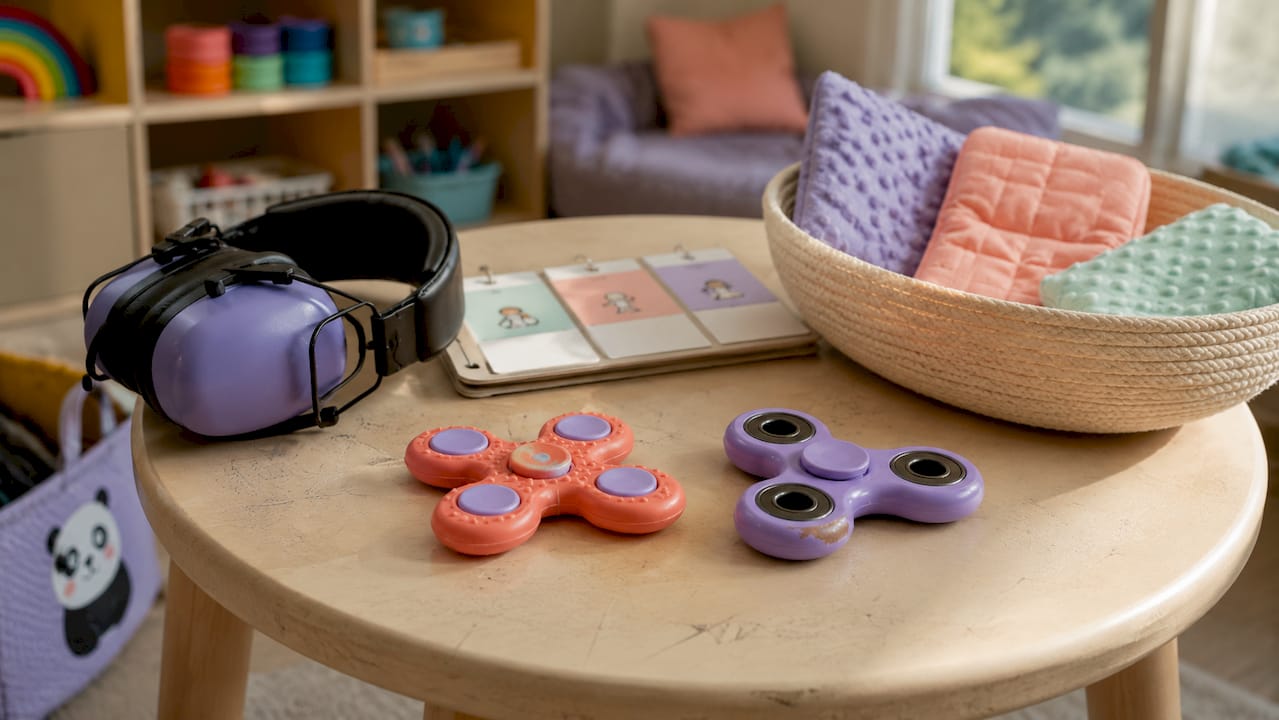
Pro Tip: Set up a “regulation station” before guests arrive. A basket with fidget toys, a weighted lap pad, noise-reducing ear defenders, and a few familiar comfort items gives children a self-directed way to manage their own needs without adult intervention.
4. How to plan a sensory-friendly party at home or in a community space
Planning a party at home gives you the most control, and control is exactly what makes these celebrations work. Here is a practical sequence.
- Limit guest numbers. Six to eight children is a manageable group for most neurodiverse children. More than that, and the noise and unpredictability escalate quickly.
- Prepare the environment in advance. Remove harsh lighting where you can. Lay out sensory materials before guests arrive so children can settle in gradually.
- Plan food carefully. Sensory food preferences are real and valid. Offer familiar textures alongside anything new, and always check for allergies. A separate quiet eating space helps children who find communal mealtimes overwhelming.
- Use AAC or PECS if your child uses them. Have communication tools visible and accessible throughout. Brief other parents in advance so they are not caught off guard.
- Build in a flexible schedule. A visual timetable with pictures (not words) gives structure without rigidity. Include a “free play” block that can expand or contract as needed.
- Educate your guests. A short, friendly note to parents before the party explaining the setup prevents well-meaning adults from accidentally undoing your preparation. Something like: “We keep noise low and let children lead. Please follow their cues.”
- Have an exit plan. Know in advance what you will do if your child needs to leave their own party. It happens. Having a quiet room ready, or a familiar activity to retreat to, means it does not have to mean the party is over.
Pro Tip: Run a shorter trial play session with one or two close friends a week before the party. It helps your child know what to expect and gives you useful information about what adjustments to make.
For children with communication differences, the guide on planning a party for a non-verbal child covers this in much more detail and is worth reading before you finalise your plans.
5. Sensory-friendly parties versus standard birthday parties
The gap between a standard children’s party and a sensory-adapted one is larger than most people realise. Standard parties are built around neurotypical assumptions: children can tolerate loud music, enjoy group games, manage transitions without warning, and regulate their emotions in a crowd. For many autistic children, those assumptions are wrong on every count.
| Criteria | Standard party | Sensory-friendly party |
|---|---|---|
| Noise level | High, often uncontrolled | Managed, with quiet zones available |
| Guest numbers | 15–30 children typical | 6–10 children, often capped |
| Activity structure | Rigid schedule, group games | Child-led, flexible, self-directed |
| Staff or host training | General childcare | SEN-aware, sensory-informed |
| Communication support | Verbal instructions | Visual schedules, AAC-friendly |
| Cost | £100–£250 typical | £200–£530 depending on provision |
Smaller guest groups with reduced noise significantly lower sensory overload risks. The trade-off is cost and planning complexity. Sensory-adapted parties require more preparation and often more investment. But the alternative, a child who spends their birthday in distress, is not really a party at all.
6. Who benefits most from a sensory-friendly celebration?
Sensory-adapted parties are most valuable for children who experience sensory processing differences, communication challenges, or anxiety in unpredictable social situations. That includes autistic children, children with ADHD, PDA profiles, and sensory processing disorder, as well as children who have not yet received a diagnosis but clearly struggle in standard party environments.
Children who benefit most tend to share some of these experiences:
- Becoming overwhelmed by noise, crowds, or unexpected touch
- Struggling with transitions between activities without warning
- Using AAC, PECS, or other communication supports
- Finding unstructured social time with unfamiliar children difficult
- Needing movement or sensory input to regulate their emotions
Siblings and neurotypical friends also benefit from sensory-friendly setups. Smaller groups, calmer environments, and child-led activities are genuinely better for most children, not just those with identified needs. First birthdays and transition events (starting school, moving house) are particularly good moments to choose a lower-pressure format, because the child is already managing a lot of change.
Key takeaways
An autism friendly birthday party in Sussex works best when it is child-led, sensory-adapted, and planned with honest attention to your child’s specific needs rather than what a party “should” look like.
| Point | Details |
|---|---|
| Child-led structure reduces stress | Flexible, self-directed parties improve enjoyment more than rigid schedules. |
| Guest numbers matter | Limiting to 6–10 children significantly reduces sensory overload risks. |
| Vet venues on specifics | Ask about lighting, music controls, and capacity caps before booking. |
| Communication tools belong at parties | AAC and PECS should be visible and accessible throughout the celebration. |
| Quiet zones are non-negotiable | A regulation station or sensory retreat keeps the party going for longer. |
What I’ve actually learned from Remy’s birthdays
I will be honest with you. Remy’s third birthday was a disaster by conventional standards. We booked a soft play venue, invited too many people, and watched him spend forty minutes in a corner with his hands over his ears while the other children ran riot. I cried in the car on the way home. Not because he had a meltdown, but because I had set him up for one.
What I have learned since is that the party is for the child, not for the parents’ idea of what a birthday should look like. The year we did a small gathering at home with three friends, a sensory tray full of kinetic sand, and a cake he could eat without gagging, he was genuinely happy. He sang to himself. He made eye contact. He asked to do it again.
I am deeply sceptical of venues that slap “inclusive” on their website without changing anything meaningful. Ask them what they actually do differently. If they cannot tell you specifically how they manage noise, lighting, and guest numbers, that is your answer. The sensory party options in Hove and wider Sussex have improved considerably in recent years, but the gap between marketing and reality is still wide in places.
The other thing nobody tells you: you are allowed to grieve the party you imagined and still build something better. Those two things can coexist.
— Caitlin
Fidget and Spin’s sensory birthday parties in Sussex
Fidget and Spin runs sensory birthday parties for children aged 1–7 across Brighton, Hove, and wider Sussex. Every party is private hire, which means the space belongs entirely to your child and your guests for the duration. No strangers. No unexpected noise from another group. No one giving you the look.
Three packages cover different budgets and group sizes, from The Wee One at £220 through to The Whole Shebang at £530. Anthony and I designed every element of the space and the session structure around what Remy needed and couldn’t find anywhere else. If you want to know how the sessions are set up before you book, the how our sessions work page walks you through it honestly. No jargon, no corporate inclusion-speak.
FAQ
What makes a birthday party autism friendly?
An autism friendly birthday party limits sensory inputs, reduces guest numbers, and allows children to lead their own engagement. Quiet zones, visual schedules, and flexible timing are the core features that make the biggest difference.
How many children should I invite to a sensory-friendly party?
Most sensory-adapted venues in Sussex cap parties at 9–10 children to reduce noise and crowding. At home, six to eight guests is a manageable and comfortable number for most neurodiverse children.
How much does an autism friendly birthday party in Sussex cost?
Costs range from around £70 for basic soft play hire to £200 or more for specialist inclusive packages. Fidget and Spin’s sensory birthday parties start at £220 for private hire with full sensory provision.
Can I plan a sensory-friendly party at home?
Yes. Limiting guests, preparing sensory materials in advance, using visual schedules, and setting up a quiet retreat space are the most effective steps. A trial play session with one or two friends beforehand helps your child know what to expect.
Do autism friendly parties work for children with ADHD or PDA too?
Sensory-adapted, child-led celebrations benefit children across a wide range of neurodivergencies, including ADHD and PDA profiles. The key features (low sensory demand, flexible structure, and freedom to self-regulate) support most children who find standard party environments difficult.
Recommended
- Autism friendly party games: your 2026 guide | Fidget and Spin Brighton
- Autism-friendly play groups in Brighton: 2026 guide | Fidget and Spin Brighton
- Neurodiverse play groups in Sussex: a parent’s guide | Fidget and Spin Brighton
- Sensory party Hove: top inclusive options for neurodiverse kids | Fidget and Spin Brighton