TL;DR:
- Fidget tools serve as sensory regulation aids that help neurodiverse children manage attention, emotions, and sensory processing. They work best when carefully matched to the child’s sensory needs, supporting focus and emotional stability through consistent use. Proper introduction and contextual use within a wider regulation toolkit enhance their effectiveness and acceptance.
Fidget tools are sensory regulation aids that help neurodiverse children manage attention, emotional regulation, and sensory processing by providing controlled, repetitive physical input. In occupational therapy, they are more formally called sensory fidgets or sensory regulation tools, but most parents and teachers just call them fidgets. The benefits of fidget tools are real and research-supported, though they work best when matched carefully to a child’s individual sensory profile. Tools like Chewigem chewable jewellery, textured stress balls, and weighted lap pads each target different sensory systems. Used thoughtfully, they can reduce anxiety, support focus, and help a child stay regulated enough to actually participate in the world around them.
What are the benefits of fidget tools for focus and attention?
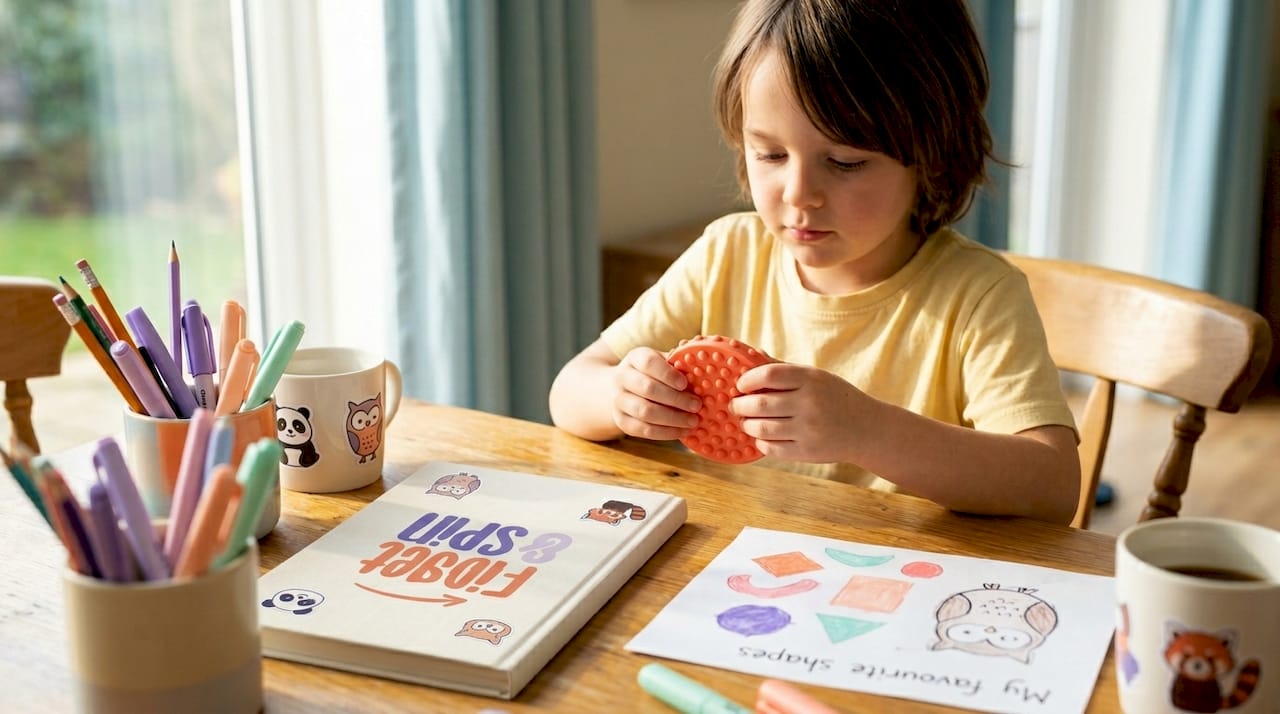
Remy, my six-year-old, can sit through a story if he has something in his hands. Without it, he’s on the floor within two minutes. That’s not naughtiness. That’s his nervous system asking for input.

The science backs this up. Fidgeting increases pupil diameter during auditory processing tasks, which is a physiological marker of heightened arousal and engagement. Crucially, the same 2026 MDPI study found that auditory task performance remained stable, meaning the fidgeting did not impair what the child was doing. It supported it. That distinction matters enormously when you’re trying to convince a teacher that the stress ball in your child’s hand is not a distraction.
For children with ADHD and sensory processing differences, sustaining attention is not a willpower problem. It is a regulation problem. The nervous system needs a certain level of arousal to focus, and for many neurodivergent children, that level is only reached through movement or sensory input. Fidgets provide that input quietly and without disrupting others. You can read more about the evidence on fidget toys and how they support regulated focus in neurodiverse children.
“Fidget tools are not toys. They are sensory regulation strategies. The difference matters for how we introduce them, where we allow them, and how we measure whether they are working.” — Life Skills Advocate
Pro Tip: If a teacher questions why your child needs a fidget during lessons, share the 2026 MDPI pupil dilation study. Physiological data is harder to dismiss than a parent’s observation, however valid that observation is.
There are limits, of course. Not every child benefits equally, and the type of fidget matters. A spinner that catches the light will pull visual attention away from the teacher. A smooth, silent tangle toy in a pocket will not. Individual variability is real, and what works brilliantly for one child may actively worsen distraction for another.

How do different fidget tools match different sensory needs?
The single biggest mistake I see parents make, including past me, is buying a fidget because it looked good on Amazon and hoping for the best. Therapists categorise fidget tools by sensory system, and proprioceptive needs won’t be met by a light tactile toy and vice versa. Matching the tool to the need is everything.
Sensory over-responsivity affects approximately 69 to 93% of autistic children, which means the majority of autistic kids are not just “a bit sensitive.” Their nervous systems are genuinely processing sensory input differently, and the wrong fidget can tip them into overwhelm rather than regulation.
Here is a practical breakdown of the main sensory systems and the fidget types that correspond to each:
| Sensory system | What it needs | Example fidget tools |
|---|---|---|
| Tactile (touch) | Varied textures, light pressure | Textured stress balls, bumpy fidget rings, Tangle Therapy toys |
| Proprioceptive (body awareness) | Deep pressure, resistance | Weighted lap pads, resistance putty, squeeze tubes |
| Oral-motor (mouth) | Chewing, sucking, blowing | Chewigem pendants, chewable pencil toppers, chewy tubes |
| Visual | Controlled, predictable movement | Liquid motion bubblers, slow-moving sand timers |
| Auditory | Rhythmic, repetitive sound | Clicking fidgets, soft percussion instruments |
| Vestibular (movement and balance) | Rocking, swinging, spinning | Wobble cushions, balance boards |
Pro Tip: Ask your child’s occupational therapist to identify their primary sensory system before buying anything. One targeted tool used consistently beats a drawer full of random fidgets every time.
A mismatched tool does not just fail to help. It can actively make things worse. A child who is already visually overstimulated does not need a glittery spinner. A child seeking oral-motor input will chew their jumper sleeve if you do not give them something appropriate to chew instead. The sensory integration strategies that work in clinical settings are built on exactly this kind of careful matching.
What are the emotional and behavioural benefits beyond focus?
Focus gets all the attention (no pun intended), but the emotional and behavioural benefits of sensory aids are just as significant for daily life. When Remy is regulated, he is kind, funny, and curious. When he is dysregulated, everything is a crisis. Fidget tools do not fix dysregulation, but they can prevent it from escalating in the first place.
Occupational therapy using Ayres Sensory Integration® showed significant improvements in emotional regulation, executive functions, and participation in a randomised controlled study of 94 children aged 6 to 8 with ADHD. That is not a small sample or a weak study design. It is solid evidence that sensory-based interventions change outcomes. Fidget tools are one accessible, low-cost component of that kind of sensory support.
The emotional benefits parents and carers most commonly report include:
- Reduced frequency and intensity of meltdowns, particularly in transition-heavy environments like school pick-up or supermarkets
- Lower baseline anxiety, especially in children who use oral-motor tools like Chewigem throughout the day
- Improved impulse control, because the hands have something to do that is not hitting, grabbing, or throwing
- Greater ability to tolerate waiting, which is genuinely hard for children with ADHD or PDA profiles
- More successful participation in group activities, because the child can regulate enough to stay present
The caveat here is real and worth naming. Sensory toys can help some feel calmer or more focused, but fit varies widely. Some toys worsen distraction or meltdowns. Trial and monitoring are not optional extras. They are the whole point. A fidget tool that a child treats as a toy, throwing it, flicking it at siblings, or obsessing over it to the exclusion of everything else, is not functioning as a regulation tool. That is a signal to reassess, not to abandon the idea entirely.
How to introduce fidget tools at home and school
The practical bit. Because buying the right tool is only half the job.
-
Start with one tool, not five. Introduce a single fidget that matches your child’s primary sensory need. Give it two weeks before evaluating. Multiple new tools at once makes it impossible to know what is working.
-
Teach the purpose explicitly. Tell your child what the tool is for and when to use it. “This is your squeeze ball. You use it when you need to calm your hands or help your brain focus.” Children, especially autistic children, benefit from clear, direct explanations rather than hoping they will intuit the purpose.
-
Set environmental expectations. A fidget that works at the kitchen table may not work in a noisy classroom. Consider noise sensitivity when choosing tools. A clicking fidget is fine at home and a disaster in a quiet exam room. Matching tools to the environment is as important as matching them to the child.
-
Observe before deciding it has failed. Watch for tool drift, the moment when your child’s attention shifts entirely to the fidget and away from the task. That is the signal to intervene with a gentle redirect, not to confiscate the tool permanently.
-
Talk to the school. A brief letter from an occupational therapist or a note in the EHCP (Education, Health and Care Plan) carries weight. Teachers are more likely to allow a fidget tool when it is framed as a regulation strategy rather than a personal preference.
-
Build a wider toolkit. Fidget tools do best as part of a broader self-regulation toolkit. Pair them with movement breaks, a visual schedule, and, where appropriate, mindfulness or breathing exercises. The goal is for your child to develop transferable regulation skills, not to become dependent on one object.
The OT and play-based support available for neurodiverse children can help you build exactly this kind of layered approach, with professional guidance on which tools and strategies suit your child’s specific profile.
Key takeaways
Fidget tools work best when matched to a child’s specific sensory system, used consistently, and embedded within a wider regulation toolkit rather than treated as a standalone fix.
| Point | Details |
|---|---|
| Sensory matching is non-negotiable | Proprioceptive, tactile, oral-motor, and visual needs each require different tool types. |
| Focus benefits are physiologically supported | 2026 research shows fidgeting increases arousal without impairing task performance. |
| Emotional regulation gains are significant | OT using sensory integration showed measurable improvements in emotional regulation in children with ADHD. |
| Tool drift is a real risk | Watch for attention shifting to the fidget itself and redirect early rather than removing the tool. |
| Wider toolkit matters | Pair fidgets with movement breaks, visual schedules, and coping strategies for lasting regulation skills. |
What I have actually learned from three years of fidget trial and error
I have bought a lot of fidgets. Some were revelations. Some ended up under the sofa within forty-eight hours. The glittery spinner that looked brilliant on Instagram? Remy stared at it for twenty minutes and forgot I existed. The plain, slightly boring resistance putty from his OT? He uses it every single morning before school and the difference in his ability to get dressed without a meltdown is genuinely noticeable.
What I wish someone had told me earlier is that the best fidget tool is almost always the least exciting one. The ones that work are the ones that provide the right sensory input without becoming the main event. They fade into the background of a child’s regulation, which is exactly what they are supposed to do.
I also want to be honest about the social side of this. Remy has had the “why does he have that thing?” conversation more times than I can count. At Fidget and Spin, we built the Squish and Squeeze zone partly because we wanted a space where nobody raises an eyebrow at a child with a chew necklace or a wobble cushion. That normalisation matters. Children who feel embarrassed about their regulation tools stop using them, and then everyone loses.
The research is genuinely encouraging, and the how fidget toys help focus evidence has strengthened considerably in 2026. But the lived experience is what I trust most. Find the right tool, give it time, and watch your child. They will tell you, one way or another, whether it is working.
— Caitlin
Try fidget tools in a space built for your child
At Fidget and Spin, our weekly sensory play sessions in Brighton and Hove give neurodiverse children aged 1 to 6 the chance to explore different fidgets, textures, and sensory experiences in a genuinely low-pressure environment. The Squish and Squeeze zone is full of tactile tools, resistance putty, and sensory materials that let children discover what works for their body, without the side-eye and without the overwhelm. It is also a brilliant way for parents and carers to observe their child’s sensory preferences before investing in a toolkit at home. Book a sensory play session and see what your child gravitates towards. You might be surprised.
FAQ
What are the main benefits of fidget tools for children?
Fidget tools support sensory regulation, improve sustained attention, reduce anxiety, and help with emotional self-regulation. They work by providing controlled sensory input that helps the nervous system reach the arousal level needed for focus and calm.
Are fidget tools suitable for all neurodiverse children?
Not every child responds the same way. Effectiveness varies widely, and a mismatched tool can worsen distraction or overwhelm. An occupational therapist can help identify which sensory systems need support and recommend appropriate tools.
How do fidget tools help with anxiety relief?
Fidget tools provide repetitive, predictable sensory input that can calm an activated nervous system. Oral-motor tools like Chewigem are particularly effective for anxiety, as chewing activates the parasympathetic nervous system and reduces physiological stress responses.
Can fidget tools be used in school?
Yes, with the right preparation. A note from an OT or inclusion in an EHCP strengthens the case for classroom use. Choose tools that are silent and non-visually distracting, and teach your child when and how to use them before introducing them in a school setting.
How do I know if a fidget tool is actually working?
Watch for sustained attention, reduced physical agitation, and fewer emotional outbursts during or after use. If your child is focusing entirely on the fidget rather than the task, that is tool drift and a sign the tool may need to change or the child needs more guidance on its purpose.
Recommended
- The real impact of fidget toys on neurodiverse children | Fidget and Spin Brighton
- How fidget toys help focus in neurodiverse children | Fidget and Spin Brighton
- What is neurodiversity? A guide for parents and carers | Fidget and Spin Brighton
- What is neurodiversity? A guide for parents and carers | Fidget and Spin Brighton