TL;DR:
- Fidget toys support focus and self-regulation in neurodiverse children when carefully chosen and used within structured strategies. Evidence indicates they help maintain arousal and engagement but are not universally effective and require safety considerations. Successful use depends on individual sensory profiles, context, and consistent, thoughtful implementation.
Fidget toys are handheld objects designed to provide controlled sensory input and movement, supporting focus, self-regulation, and sensory processing in neurodiverse children. The benefits of fidget toys are real and well-observed by parents, teachers, and occupational therapists, but they are not universal, and they are not magic. For children with autism, ADHD, PDA, or sensory processing differences, the right fidget tool at the right moment can genuinely shift a child from overwhelmed to engaged. This guide covers what the research actually says, how these tools support regulation in practice, how to choose well, and what to watch out for.
What does the research say about the benefits of fidget toys?
A 2026 MDPI study confirmed that both hand and leg fidgeting increase physiological arousal, measured through pupil dilation, during auditory tasks without any measurable decline in performance. That matters because it challenges the assumption that fidgeting is distraction. The body is doing something useful: maintaining engagement when the brain needs a little more input to stay present.
That said, the picture is not entirely straightforward. A 2018 study found that fidget spinners reduced attention levels in children with ADHD, particularly once the novelty wore off. The toy itself became the focus, rather than the task at hand. This is the tension at the heart of the research: fidgeting as a body-based regulation strategy is supported by evidence, but not every fidget toy delivers that benefit.
The STARFISH perioperative clinical trial lists sensory toys as distraction tools for reducing anxiety in children, while acknowledging that current evidence remains inconclusive. Researchers are cautious. Parents, understandably, cannot always wait for a definitive randomised controlled trial before deciding whether to put a stress ball in their child’s school bag.
A 2026 Springer Nature review of 332 studies found that self-regulation measurement in neurodevelopmental conditions relies heavily on parent reports, which makes it genuinely difficult to assess how much any single tool contributes. This does not mean fidget toys do not help. It means the evidence is still catching up with lived experience.
There is also a safety dimension worth naming clearly. The U.S. Consumer Product Safety Commission issued a 2026 recall of luminous fidget spinner balls sold on Amazon due to accessible button cell batteries posing an ingestion risk. Battery ingestion in young children is a medical emergency. Any fidget toy with a battery compartment needs checking before it goes anywhere near a child.
How do fidget toys support focus and self-regulation?
Think about what happens when Remy, my son, is sitting at the table trying to listen to something. His leg bounces. His fingers tap. His body is doing what it needs to do to keep his brain in the room. Fidget tools give that movement somewhere to go, something to do, without pulling his attention away from what matters.
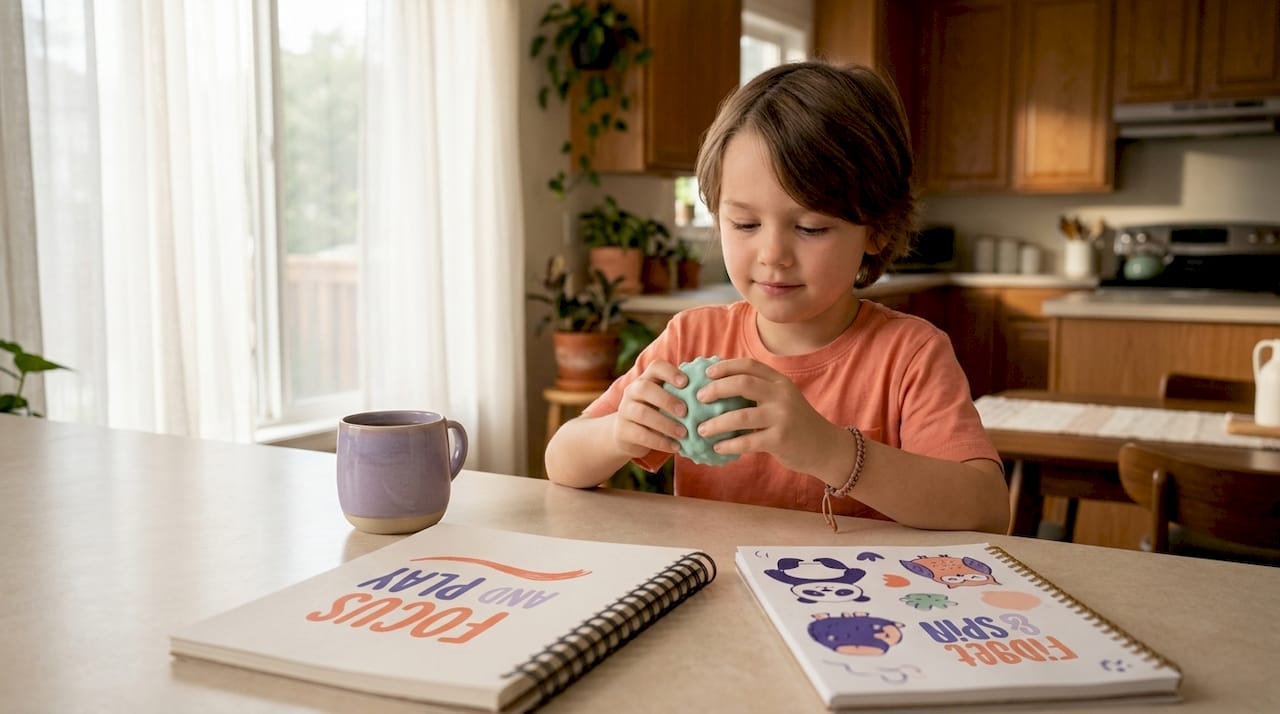
The mechanism is physiological. Controlled sensory input, whether that is squeezing, spinning, stretching, or pressing, activates the nervous system in a way that supports arousal regulation. For children who are under-stimulated, it provides the extra input needed to stay engaged. For children who are heading towards overload, it can offer a controlled outlet that prevents the escalation from building.
The benefits of sensory toys for neurodiverse children extend beyond focus. They can support:
- Anxiety reduction during transitions, waiting, or unfamiliar environments
- Sensory regulation by meeting a child’s need for tactile, proprioceptive, or oral input
- Emotional regulation by giving the body something to do when feelings are building
- Attention during tasks when the sensory input is subtle and does not compete with the activity
The key word in all of that is controlled. A fidget tool works when it meets a sensory need without adding competing input. A quiet, simple squeeze ball during a school assembly is very different from a light-up spinning toy that three other children immediately want to touch.
Sensory profiles vary enormously. A child who seeks proprioceptive input might respond brilliantly to a firm resistance band around a chair leg. A child with oral sensory needs might do better with a chewable pendant from brands like Chewigem or ARK Therapeutic. Observing your child, rather than assuming, is the only reliable starting point.
Pro Tip: If your child’s school uses a visual timetable or PECS system, try pairing a specific fidget tool with a particular activity card. The association can help the toy signal “focus time” rather than just becoming another object to play with.
What types of fidget toys are there, and how do you choose?
The category is broader than most people realise. Fidget spinners are the ones everyone knows, but they are arguably among the least useful for sustained focus. Here is a practical overview of the main types and where they tend to work best.

| Type | Best for | Watch out for |
|---|---|---|
| Stress balls and squeeze toys | Proprioceptive input, anxiety, transitions | Wear and tear; latex allergies |
| Chewable jewellery (e.g., Chewigem) | Oral sensory needs, focus during seated tasks | Sizing for age; supervision for strong chewers |
| Tactile fidget rings and cubes | Discreet classroom use, fine motor engagement | Small parts; novelty fading quickly |
| Resistance bands on chair legs | Whole-body proprioceptive input without distraction | Snapping; noise in quiet settings |
| Putty and theraputty | Tactile and proprioceptive input, calming | Mess; getting stuck in hair or carpet |
| Fidget spinners | Short bursts of vestibular input | Reduced attention over time; distraction risk |
Expert clinicians consistently recommend choosing controllable, covert fidget tools over flashy or loud options, particularly for use during tasks that require attention. A toy that lights up or makes noise is competing with the task, not supporting it.
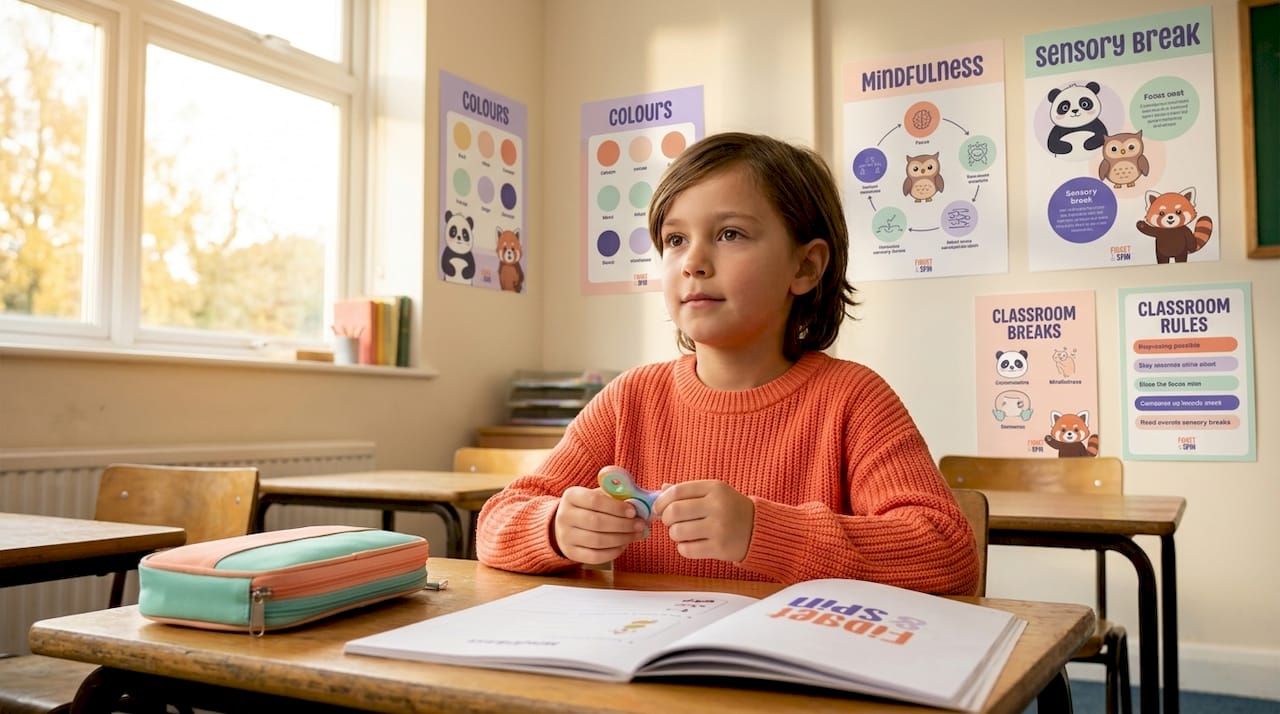
Context matters too. What works at home on the sofa is not necessarily what works in a Year 1 classroom. For school use, quiet and discreet is almost always better. For home or sensory sessions, you have more flexibility to experiment with different textures, resistances, and movements.
Before buying anything, run a quick safety check. Look for choking hazards and battery compartments that are not properly secured. Avoid toys with flashing lights or loud sounds for task-based use. Check age guidance, particularly for children who mouth objects.
Pro Tip: Buy two or three different types before committing to a bulk purchase. Watch how your child uses each one over a week. Are they using it during tasks, or only playing with it? Is it calming them or winding them up? The answer tells you more than any product description.
What are the common challenges, and how do you get the most out of fidget tools?
Remy went through a phase of collecting fidget toys the way other kids collect Pokémon cards. He had twelve. He used none of them for regulation. That is a very common pattern, and it is worth naming honestly.
The main challenges parents run into are:
- The novelty effect. A new toy is exciting. Excitement is not the same as regulation. Most fidget toys lose their appeal within a few weeks if they are used freely and without structure.
- Overstimulation. Some toys add sensory input rather than managing it. A child who is already dysregulated does not need a spinning, clicking, light-up cube.
- Distraction rather than focus. If the toy is more interesting than the task, it is not helping. This is particularly true of visually engaging toys used during activities that require visual attention.
- Inconsistency between home and school. A tool that works brilliantly at home may be confiscated at school, or used differently there, which undermines its effectiveness.
The classroom ‘fidget box’ approach, where children have brief, timed access to fidget tools during transitions rather than all-day access, addresses several of these problems at once. Short, structured access preserves the regulatory benefit without the toy becoming background noise.
Involve your child’s school and, where relevant, their occupational therapist. A coordinated approach, where everyone uses the same tool in the same way, is far more effective than a parent sending in a toy and hoping for the best. If your child has an EHCP or SEN support plan, fidget tools can be written in as a reasonable adjustment.
Pro Tip: Rotate toys every few weeks to manage the novelty effect. Keep two or three in circulation and swap them out before they lose their usefulness. Treat it like a sensory wardrobe, not a permanent collection.
Key takeaways
Fidget toys support focus and regulation in neurodiverse children when chosen carefully, used in context, and treated as one part of a broader sensory and regulation strategy rather than a standalone fix.
| Point | Details |
|---|---|
| Evidence is promising but mixed | Fidgeting supports arousal and engagement, but some toys reduce attention over time. |
| Toy type and design matter | Quiet, controllable, covert tools outperform flashy or loud options in task settings. |
| Safety checks are non-negotiable | Check for battery compartments, choking hazards, and small parts before purchase. |
| Structured access works better | Timed, purposeful use during transitions outperforms unrestricted all-day access. |
| Sensory profiles are individual | Observe your child’s response rather than assuming one type of toy will work for all. |
What I’ve actually learned from years of fidget toy trial and error
I have bought a lot of fidget toys. Some of them were brilliant. Some of them ended up in the bin after Remy used them to flick at the cat. The honest truth is that no toy works in isolation, and the ones that have genuinely helped him are the ones we introduced with intention, not desperation.
The hardest part, early on, was the social side. Remy using a chewable pendant at a birthday party got looks. A fidget cube at a family dinner got comments. There is still a version of the world that reads sensory tools as bad parenting or indulgence, and that is exhausting to push back against when you are already managing a dysregulated child in a loud room.
What shifted things for us was understanding his specific sensory profile well enough to choose tools that actually matched his needs. Proprioceptive input works for him. Visual fidgets do not. That knowledge came from sensory integration strategies we learned over time, from his occupational therapist, and from a lot of observation.
My advice: trust what you see in your own child over what any article, including this one, tells you should work. Stay flexible. Swap things out when they stop working. And do not let anyone make you feel that a small rubber ring on your child’s finger is something to be embarrassed about.
— Caitlin
Try sensory play with Fidget and Spin
At Fidget and Spin, we built our weekly sessions in Brighton and Hove specifically for neurodiverse children aged 1 to 6, because mainstream groups were not working for our family and we knew we were not alone. Our Squish and Squeeze zone is full of tactile tools, fidgets, and sensory materials that children can explore at their own pace, with no pressure and no side-eye. It is a brilliant way to see which types of sensory input your child gravitates towards before you spend money on toys that might not suit them. Book a sensory play session and come and find out what your child actually loves. We also run SEN-friendly birthday parties across Brighton, Hove, and wider Sussex, if you are looking for a celebration that actually works for your child.
FAQ
Are fidget toys effective for children with ADHD?
Fidget toys can support arousal and regulation in children with ADHD, but results vary by toy type and individual. Fidget spinners in particular have been associated with reduced attention over time, so quieter, more controllable tools tend to work better.
How do fidget toys help with anxiety?
Fidget tools are used as distraction and regulation aids for children experiencing anxiety, particularly during transitions, waiting, or unfamiliar situations. They give the body something to do, which can interrupt the escalation cycle before it builds.
What is the safest type of fidget toy for young children?
Avoid toys with battery compartments, small detachable parts, or flashing lights. The CPSC recalled luminous fidget spinner balls in 2026 due to battery ingestion risk, which is a useful reminder to check any battery-powered toy before purchase.
Should fidget toys be allowed in the classroom?
Yes, with structure. Brief, timed access during transitions works better than unrestricted use throughout the day. Quiet, discreet tools are far less likely to distract other children or be confiscated.
Can fidget toys replace other SEN support strategies?
No. Fidget tools are auxiliary regulation supports, not standalone treatments for autism, ADHD, or sensory processing differences. They work best as part of a broader approach that may include occupational therapy, emotional regulation strategies, and coordinated school support.
Recommended
- The real impact of fidget toys on neurodiverse children | Fidget and Spin Brighton
- How fidget toys help focus in neurodiverse children | Fidget and Spin Brighton
- What is neurodiversity? A guide for parents and carers | Fidget and Spin Brighton
- What is neurodiversity? A guide for parents and carers | Fidget and Spin Brighton