
TL;DR:
- Resilience is a learnable process of adapting well to adversity, not a fixed trait.
- Building resilience involves routines, emotional naming, modeling coping, and secure attachments.
- Progress is non-linear; self-compassion for parents and consistent emotional validation support resilience.
Many parents believe that emotional resilience is something a child either has or doesn’t have, a sort of invisible armour some kids are simply born with. It’s a reassuring idea, until your child is lying on the floor of the supermarket because the lights felt too loud and the queue was too long, and you’re wondering why resilience seems so far out of reach. Here’s the truth: resilience is learnable, not fixed, and that changes everything. For parents and carers of neurodiverse children, understanding that resilience is a skill you can actively nurture is one of the most hopeful things you can hold onto.
Table of Contents
- What is emotional resilience?
- What makes up emotional resilience?
- How emotional resilience looks in real life
- Helping your child build emotional resilience
- A fresh perspective: The messy reality of building resilience
- How we can help you support emotional resilience
- Frequently asked questions
Key Takeaways
| Point | Details |
|---|---|
| Resilience is learnable | Emotional resilience can be taught and improved at any age with practical support and skills. |
| Distress is normal | Resilience does not mean children never feel upset, but that they learn to recover and cope. |
| Multiple factors matter | Biological, social, psychological, and environmental factors all play roles in a child’s resilience. |
| Practical steps help | Routine, validation, and supportive environments make building resilience easier for young children. |
What is emotional resilience?
Let’s start by getting clear on what emotional resilience actually is, because it’s often misunderstood. It isn’t about always being cheerful. It’s not about never melting down in the cereal aisle or sailing through transitions without a wobble. According to a widely used APA teaching resource, resilience is best understood as “the process of adapting well in the face of adversity” rather than the absence of distress. That distinction matters enormously.
Think of it this way. Resilience isn’t a wall that keeps difficult feelings out. It’s more like a set of muscles that help your child move through hard feelings and come back to steadiness. Distress is normal. Feeling overwhelmed is normal. Recovery is what resilience looks like.
For neurodiverse children, this framing is especially important. Many of our children feel things more intensely, process the world differently, and face situations every single day that neurotypical children may not even register as stressful. A surprise change to the school routine, a different texture in their dinner, the hum of a fluorescent light. These aren’t dramatic events. But they can create genuine, significant distress.
Here’s a quick list of what emotional resilience is and what it isn’t:
- ✅ It is: the ability to recover from upset and adapt to stress over time
- ✅ It is: a process that can be practised and strengthened
- ✅ It is: something that looks different in every child
- ❌ It isn’t: never getting upset or distressed
- ❌ It isn’t: putting on a brave face and pushing through alone
- ❌ It isn’t: a fixed personality trait your child either has or hasn’t
“Resilience is not a trait that people either have or do not have. It involves behaviours, thoughts, and actions that can be learned and developed in anyone.” — American Psychological Association
That last point is worth sitting with for a moment. Because if resilience can be learned and developed, that means the work you’re doing every day, naming feelings, offering comfort, holding space through meltdowns, it’s all building something real.
What makes up emotional resilience?
So resilience is learnable. Great. But what actually goes into it? What shapes how resilient your child can become?
Research published in the Indian Journal of Psychiatry confirms that resilience is shaped by a combination of biological, psychological, social, and environmental factors. It’s not one thing. It’s a whole constellation of influences, and that’s actually good news, because it means there are multiple points where you can make a difference.

Here’s how those factors tend to play out:
| Factor | What it includes | How you can influence it |
|---|---|---|
| Biological | Nervous system sensitivity, sensory thresholds, genetics | Understanding your child’s profile through assessment |
| Psychological | Self-perception, emotional vocabulary, coping style | Building emotional literacy through naming and validating |
| Social | Friendships, family relationships, trust with adults | Fostering secure, consistent connections |
| Environmental | Home routines, school support, sensory-friendly spaces | Creating predictable, calm environments |
For neurodiverse children specifically, the biological and environmental factors often carry extra weight. A child with a highly sensitive nervous system will need more careful attention to their sensory environment than a child who is less affected by sensory input. This isn’t a weakness. It’s simply their profile, and once you understand it, you can work with it rather than against it.
Pro Tip: If you’re not sure about your child’s sensory profile, an occupational therapist who specialises in sensory processing can be a brilliant starting point. They can help you understand which environments and activities help your child regulate, and which ones tip the balance the other way.
One thing worth emphasising: every child is unique. Two autistic children, or two children with ADHD, can have wildly different resilience profiles. One may find movement deeply regulating, while another needs quiet and stillness. One may thrive with visual schedules, while another finds comfort in repetitive play. Exploring sensory play support can be a meaningful way to discover what works for your particular child.
How emotional resilience looks in real life
Knowing the theory is useful. But what does resilience actually look like on a Monday morning when everything has gone sideways?
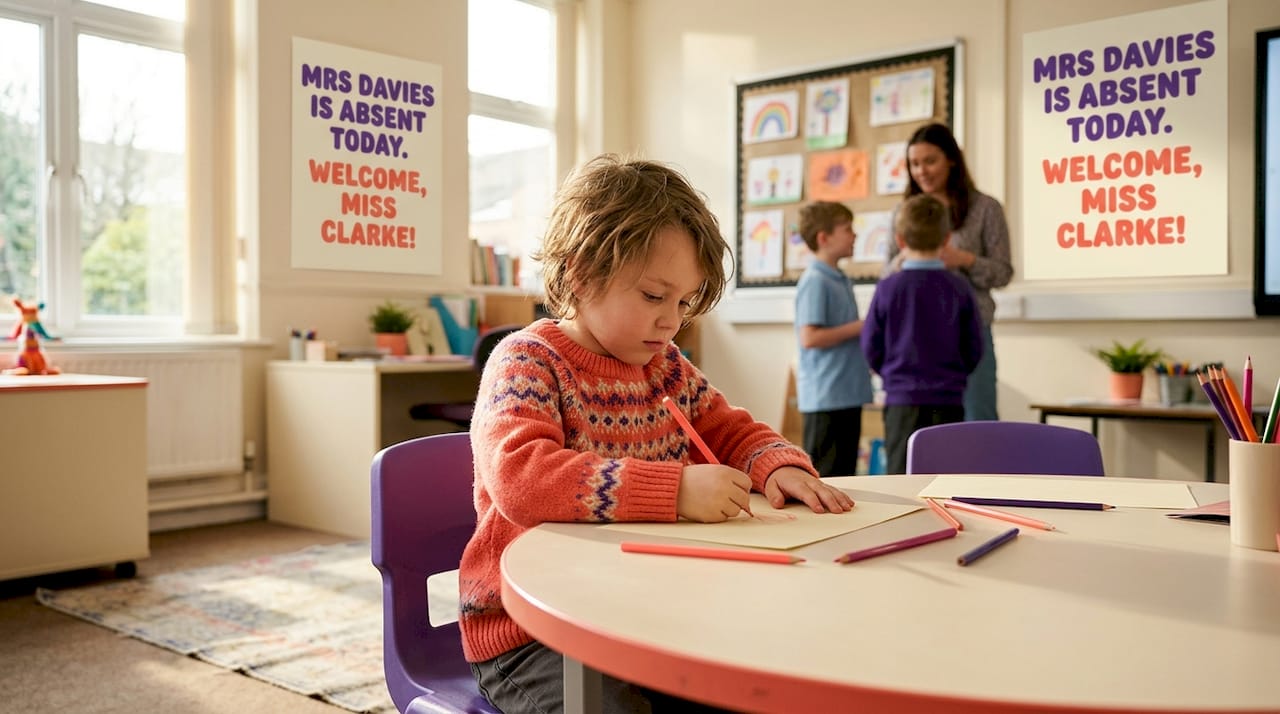
Let’s take a common scenario. Your child’s usual nursery teacher is absent. There’s a supply teacher they’ve never met. The morning routine that usually feels settled has been thrown into uncertainty. Your child becomes distressed.
The APA describes resilience as noticing stress, processing emotions, and gradually regaining balance. Here’s what that looks like in practice, and how a supportive response differs from one that, with the very best intentions, might make things harder:
| Approach | What happens | Impact on resilience |
|---|---|---|
| Dismissive | “It’s fine, stop crying, the new teacher is lovely” | Child learns feelings aren’t valid; distress builds |
| Over-rescuing | Removing child immediately from every difficult situation | Child doesn’t get to practise recovery |
| Supportive | Acknowledging, validating, then gently supporting through | Child builds capacity to cope over time |
A supportive response might look something like this:
- Acknowledge the feeling. “I can see you’re really worried. This feels scary and that makes sense.”
- Stay calm yourself. Your nervous system is contagious. If you’re bracing, your child will feel it.
- Give processing time. Don’t rush to fix or distract. Let the feeling move through.
- Offer a small, familiar anchor. A comfort object, a favourite phrase, a predictable sensory input.
- Praise the effort, not the outcome. “You did something really hard today. I’m so proud of you for trying.”
The key insight here is that you’re not trying to eliminate distress. You’re creating the conditions in which your child can move through it and come back to themselves. That space, held with warmth and patience, is where resilience is actually built. Meltdowns aren’t failures. They’re learning moments, for your child and for you.
Helping your child build emotional resilience
Now we get to the part you can actually do. Right now, today, in your home, with your child. Research confirms that resilience can be practised and improved at any age, which means there’s no such thing as “too late to start.”
Here are the strategies that make the biggest difference for neurodiverse children:
-
🗓️ Build predictable routines. Neurodiverse children often rely heavily on routine to feel safe. Knowing what comes next reduces the cognitive load of navigating a world that can feel unpredictable and overwhelming. Visual schedules, consistent meal and bedtimes, and advance warnings about changes all help.
-
💬 Name emotions out loud. Emotion coaching starts early. When you say “It looks like you’re feeling frustrated because the block fell down,” you’re giving your child language for their inner experience. Over time, this helps them identify and communicate their feelings rather than being swept away by them.
-
🪞 Model your own coping. Children are extraordinarily good at picking up on how the adults around them handle stress. When you say out loud, “I’m feeling a bit overwhelmed right now, I’m going to take three deep breaths,” you’re teaching coping in real time. You don’t need to be perfect at it. You just need to try it visibly.
-
🤝 Build secure attachments. The relationship between a child and their trusted adult is the single most powerful protective factor for resilience. This doesn’t mean always getting it right. It means being consistently present, repairing ruptures with warmth, and showing up again and again.
-
🌱 Celebrate small steps. Progress in emotional regulation rarely looks dramatic. A meltdown that lasted ten minutes instead of thirty is progress. A child who asked for a break instead of bolting is progress. Name and celebrate these moments, because they matter.
Pro Tip: Try keeping a simple “wins journal” where you jot down moments of emotional progress for your child. On the hard days, it’s a reminder of how far they’ve already come. It also helps you notice patterns in what supports them best.
Building wider support matters too. School, playgroups, and extended family all form part of the scaffolding around your child’s resilience. The more people who understand your child’s needs and respond with consistency and warmth, the more resilient they become. You don’t have to build this alone, and you really shouldn’t have to.

A fresh perspective: The messy reality of building resilience
Here’s something that rarely gets said in guides like this one: building resilience is not a tidy, linear process. It is not a checklist you complete and then file away. It is, honestly, two steps forward and one step back on the good weeks, and sometimes the reverse.
There will be days when everything you’ve carefully put in place seems to evaporate. The visual schedule does nothing. The familiar anchor gets thrown across the room. Your child is in full meltdown and you’re doing the emotional gymnastics of staying calm while internally feeling anything but. Those days are not evidence that the strategies aren’t working. They are evidence that this is genuinely hard work.
What I’ve seen, both in families we work with and in honest conversations with parents, is that the most effective thing you can model alongside all the strategies above is self-compassion. For yourself. Children with neurodiverse profiles need carers who can regulate their own emotions well enough to stay present. That is a significant ask. You cannot pour from an empty cup, as worn-out as that phrase has become, it remains true.
No family gets this right every day. The goal isn’t perfection. The goal is direction. Are you, over time, moving towards a home where feelings are named and validated? Where distress is met with presence rather than panic or dismissal? Where your child is learning, slowly, that hard feelings pass? Then you are doing the work. Even on the days it doesn’t feel like it.
Open communication matters here too. Talking honestly with your partner, a trusted friend, or a professional about how you’re coping is not weakness. It is modelling exactly the kind of emotional honesty you want your child to develop.
How we can help you support emotional resilience
At Fidget and Spin, we believe that every child deserves a space where they can explore, wobble, recover, and try again, without pressure and without judgement.

Our sensory stay-and-play sessions in Brighton & Hove are designed specifically for neurodiverse children aged 1 to 7. Each session creates gentle, structured opportunities for emotional regulation through play, sensory exploration, and social interaction at your child’s own pace. Being in a calm, inclusive environment alongside other families who truly understand can make an enormous difference, for your child and for you. Come and see how our sessions work and discover the kind of support that fits your family. When you’re ready, we’d love for you to book a sensory play session and take that next step together.
Frequently asked questions
Is emotional resilience different for neurodiverse children?
Neurodiverse children may need more tailored approaches that account for sensory sensitivities and individual profiles, but resilience is learnable for everyone and can be adapted to suit any child’s unique needs.
Can you teach emotional resilience to a 2-year-old?
Yes, absolutely. You can start by creating consistent routines, naming emotions, and modelling calm responses, because resilience skills can be learned from a very young age and built on over time.
Does being resilient mean a child won’t get upset?
Not at all. Resilient children still feel distress, but they gradually learn to recover after upset rather than staying stuck in it, which is a very different thing from never feeling hard emotions.
What is one simple thing I can do today to help my child’s resilience?
Validate your child’s feelings in the moment and let them see you calmly handle your own frustrations out loud. That combination teaches emotional literacy and coping at the same time, without any special equipment required.