
Book a reduced-capacity, zoned sensory stay-and-play session, or a small private hire with a dedicated quiet corner and staff who won’t blink when your child needs to leave the room. That’s the safe default. Before you hand over a deposit, check three things: a genuine low-stim space away from the main play area, staff who can tell you what “trained” actually means, and booking terms that don’t punish you for a hard day. Everything else in this guide is about how to check those three things properly.
TL;DR:
- A sensory play venue should have clearly accessible quiet spaces near the main areas, with dimmable lighting and effective sound control, not just equipment.
- Confirm that staff can explain their training and procedures explicitly, especially regarding how they handle overwhelmed children, rather than relying on vague promises.
- Always ask specific questions about session capacity, re-entry policies, and the existence of a quiet space during a pre-booking phone call to prevent misunderstandings.
- Opt for shorter, smaller birthday parties with a designated quiet corner and plan exit strategies, such as a code word and packed sensory tools, to reduce overload risks.
- Seek detailed, experience-based reviews from local SEN communities to gauge a venue’s true suitability, rather than relying solely on star ratings or generic marketing claims.
Table of Contents
- What makes a sensory play venue actually usable?
- What should you ask before you book?
- How do you plan a visit or a sensory-friendly birthday party?
- A parent’s view: what helped Remy, and why we built this
- Where should you look for honest reviews?
- Why the standard advice on this gets it backwards
- If you want a direct option: how Fidget and Spin can help
- Sources
- FAQ
What makes a sensory play venue actually usable?
Most soft play centres get one thing right and three things wrong. They’ll have a ball pit and a slide, sure. What they usually don’t have is anywhere to go when the noise gets too much, or staff who notice before the meltdown rather than after it.
Zoning matters more than equipment. A venue that separates big movement (running, climbing, bouncing) from tactile play (sand, water, fidgets) and from low-stim retreat space isn’t being fussy. It’s applying the same logic that inclusive playground designers use outdoors: clear routes, obvious sightlines, and somewhere to pause without leaving the building entirely. Kompan’s Play Institute research backs this up. Zoning and wayfinding help children choose activities and take breaks without a full exit, which is exactly what stops a session ending twenty minutes early in the car park.
A few features separate a venue that’s actually built for this from one that’s just called it that in the marketing copy:
- Sightlines to the quiet space — it needs to be near the action, not down a corridor and round two corners.
- Lighting that can be dimmed — no venue needs strobing party lights running during a stay-and-play slot.
- Sound control — no tannoy announcements every ten minutes, no background music fighting with a dozen shrieking toddlers.
- Reduced capacity — a session capped at a sensible number, not “as many as fit through the door.”
- Step-free access, accessible toilets and changing space — non-negotiable, not a nice extra.
- Buggy and equipment parking — because you’re not travelling light.
There’s no single agreed definition of “SEN-friendly.” Soft Play Scout’s guide is blunt about this: the label might mean quieter sessions, or it might mean nothing more than a laminated poster by the door. That’s why photos, a short video walkthrough, and a booking page that actually states capacity and session length are trust signals, not marketing fluff. If a venue doesn’t show you the room, ask yourself why.
Pro Tip: Ask for a session length, not just a start time. A venue that runs a full two hours, rather than a rushed 60 minutes, gives your child time to actually settle before it’s over.
What should you ask before you book?
Anthony rings venues now. I used to just book and hope, and hope is not a strategy when you’ve got a six-year-old who needs to know exactly what’s coming. A five-minute call tells you more than any website ever will.
- “Can the lighting be dimmed, and is it dimmed as standard or only on request?” Vague answers (“we can look into it”) usually mean it’s never actually been done.
- “Do you run quiet or reduced-capacity sessions, and how many children are booked into them?” A real number beats “it’s usually pretty calm.”
- “Where’s the quiet space, and can I see it before we book?” If they can’t describe it in one sentence, it probably doesn’t exist.
- “What training have staff had, specifically?” Not “we’re inclusive” — ask what happens, step by step, if a child is overwhelmed. WriteUpCafe’s advice on questioning autism-friendly venues is right that scenario questions separate genuine practice from token gestures.
- “What’s your re-entry policy if we need to leave and come back?” Some venues charge again. Some don’t. Ask before, not after.
- “Are carers free, and what are your food and allergy rules?”
Read the answers, not just the words. “Yes, of course” with no detail is a red flag. “Yes, we run a Tuesday session capped at 15 children with the sensory room open throughout” is someone who’s actually thought about it. Soft Play Scout makes the same point: the detail parents need almost never sits on the website, so calling or messaging directly is worth the ten minutes it takes.
How do you plan a visit or a sensory-friendly birthday party?
Nobody tells you how much of SEN parenting is logistics. Before any new venue, I send Remy photos, sometimes a short video if the venue has one, and we talk through it like a mission briefing. A simple visual schedule, even just four boxes drawn on paper (arrive, play, snack, leave), removes a huge amount of the “what happens next” anxiety that ruins a visit before it’s even started.
For parties, smaller is nearly always better. A guest list of six beats a guest list of twenty. A 60 to 90 minute party beats a three-hour marathon that nobody, adult or child, has the stamina for. Remarkable Minds’ guide to SEND birthday parties sets out exactly this: shorter, smaller, with a quiet corner built in from the start, not bolted on when someone’s already struggling.
Have an exit plan before you arrive, not halfway through:
- Agree a code word with your child in advance, one that means “I need to leave now.”
- Identify the quiet spot the second you walk in, even if you never use it.
- Decide who leaves with your child if it comes to that, and say so out loud to the other adult.
- Pack noise-reducing headphones, a couple of fidgets, a spare set of clothes, a trusted snack, and any AAC or PECS supports your child uses day to day.
Pro Tip: If you can choose the slot, book a term-time weekday morning. Weekend afternoons are when every venue in the county is at its loudest and most crowded.
A parent’s view: what helped Remy, and why we built this
I remember one soft play birthday where Remy bolted for the door within four minutes, and I chased him across a car park in my socks. Nobody there was unkind. Nobody was equipped, either. There was no quiet room, no staff member who recognised what was happening, and I left feeling like the problem was us.
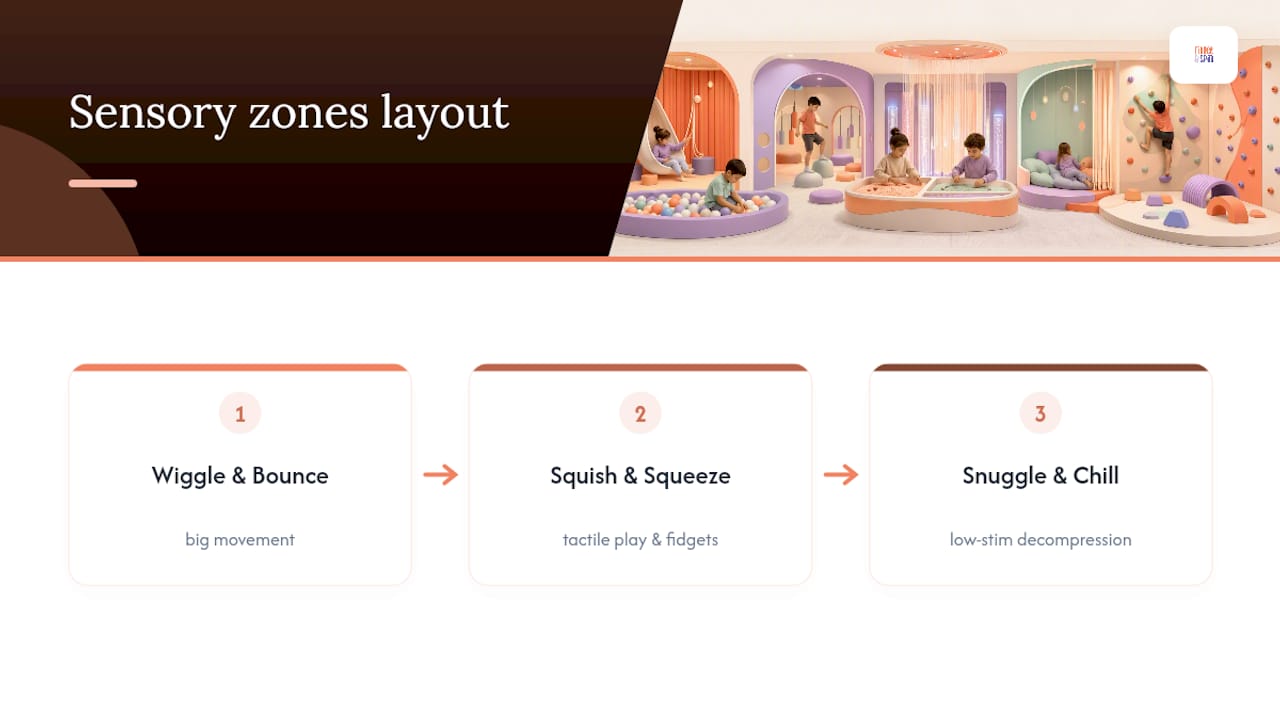
That’s the gap Fidget and Spin exists to close. Our weekly stay-and-play sessions run across three sensory zones: Wiggle & Bounce for big movement, Snuggle & Chill for low-stim, cosy decompression, and Squish & Squeeze for tactile play and fidgets. They’re built for children aged one to six, and the zoning isn’t decoration. It’s the entire point. A child can move from bouncing to fidgets to a beanbag in a low-lit corner without anyone making it a big deal.
Our birthday party packages grew out of the same frustration. You can read more about how the sessions run day to day on our session structure page, and about the thinking behind the zoning on our guide to making play inclusive for neurodiverse kids. Staff training and session capacity details sit on the booking pages themselves, because we’d rather you saw them before you paid than found out after.
Where should you look for honest reviews?
Google reviews tell you almost nothing useful on their own. A five-star soft play centre might be brilliant for a neurotypical six-year-old’s party and hopeless for yours. Star ratings flatten everything.
Look instead for the reviews that mention specifics: a parent describing the quiet room by name, someone noting that staff didn’t fuss when their child needed headphones, a comment about a re-entry policy that actually worked as promised. Facebook groups for local SEN and SEND families are usually more honest than any review platform, because parents in those groups have no reason to be diplomatic. Ask directly: “has anyone taken an autistic or PDA child here, and how did it go?” You’ll get more useful information from three replies in a local group than from fifty generic star ratings.
Treat the absence of detailed reviews as information too. A venue with plenty of star ratings but nobody ever mentioning sensory provisions, quiet spaces or staff awareness probably hasn’t had many SEN families through the door, or those families didn’t feel it was worth mentioning. Either way, that’s worth knowing before you book.
Why the standard advice on this gets it backwards
Most guidance on this topic treats “sensory-friendly” as a badge a venue either has or doesn’t, like a food hygiene rating. It isn’t. It’s a set of specific, checkable decisions: is the quiet room actually near the play area, does the lighting dim, will a member of staff tell you honestly what happens when a child melts down. The badge tells you nothing. The answers to direct questions tell you everything.
The advice I’d cut from most checklists is the emphasis on ratios and equipment lists. Nobody’s session was ruined by a shortage of ball pits. Sessions get ruined by noise nobody controlled, staff who froze, or capacity that was never actually enforced. If you prioritise one thing first, prioritise staff who can describe, in plain terms, what they do when a child is overwhelmed. Everything else, the zoning, the lighting, the quiet corner, only works if the people running the room know how to use it.
Booking hope instead of specifics is how most of us ended up chasing a child across a car park in our socks. Ask the boring, specific questions. They’re the ones that actually protect the day.
— Caitlin
If you want a direct option: how Fidget and Spin can help
Fidget and Spin exists because Anthony and I couldn’t find any of this ourselves, so we built it. It’s the direct alternative to gambling on a mainstream soft play slot and hoping for the best: no guesswork about zoning, no vague answers about staff training, because it’s all decided before you book.
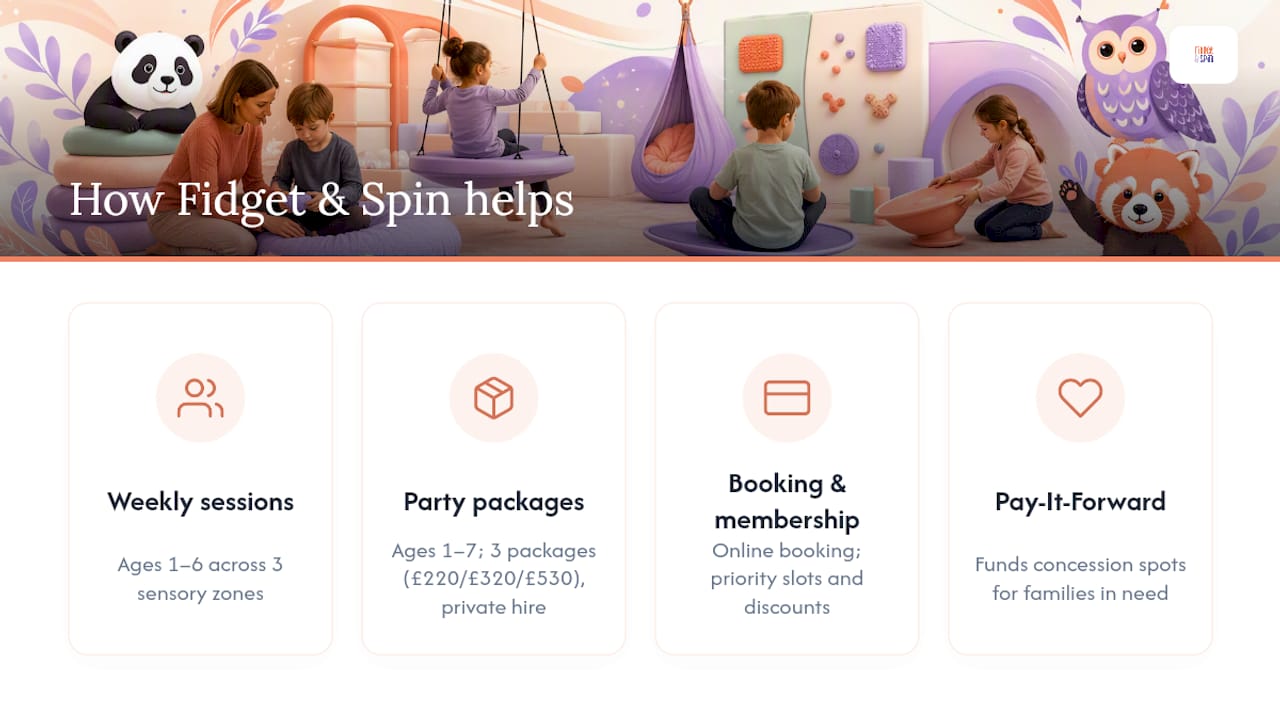
Weekly sessions run for children aged one to six across our three sensory zones, Wiggle & Bounce, Snuggle & Chill and Squish & Squeeze, with reduced numbers so no room ever feels like a crowd. For parties, ages one to seven, we offer three packages: The Wee One (£220), The Big One (£320), and The Whole Shebang (£530), all with private venue hire so you’re never sharing a space with a party that isn’t yours. Booking runs online with straightforward payment, membership gets you priority slots and a discount on sessions, and our Pay-It-Forward scheme funds concession spots for families who need them.
If you’re weighing this up against a party you’ve been dreading, our sensory birthday party page for Brighton and Hove has current dates and package details. Check availability there and get in touch if you want to talk through what would suit your child before you commit.
Sources
For more on the design principles behind inclusive play spaces, Kompan’s Play Institute research is a solid starting point on zoning and wayfinding. For practical party planning, Remarkable Minds’ guide covers guest lists, timing and exit plans in more depth than most party blogs bother with. If mealtime routines and snack planning around outings are a pressure point in your house too, Dinner Roulette Pro’s piece on neurodivergent meal planning is worth a read.
- Kompan Play Institute — inclusive play research
- Soft Play Scout — SEN-friendly soft play guide
- WriteUpCafe — questions to ask when researching autism-friendly places
FAQ
What is the safest first choice for a neurodiverse child’s play session?
A reduced-capacity, zoned stay-and-play session with a clearly signposted quiet space is the safest default, because it lets a child move between activity and rest without leaving the venue.
How long should a sensory-friendly birthday party last?
Most parents and SEND party guides recommend a sensory-friendly birthday party last long enough to enjoy but remain short enough to avoid the overload that comes with an all-afternoon event.
What questions should I ask a venue before booking?
Ask whether lighting can be dimmed, where the quiet space is, what specific training staff have had, and what their re-entry policy is if you need to step out and come back.
Does Fidget and Spin offer both stay-and-play sessions and parties?
Yes. Fidget and Spin runs weekly sensory stay-and-play sessions for ages one to six across three zones, and SEN-friendly birthday party packages for ages one to seven across Brighton, Hove and Sussex.
Where can I find honest reviews from other SEN families?
Local SEN and SEND Facebook groups tend to give more specific, useful feedback than star ratings alone, particularly on quiet spaces, staff awareness and re-entry policies.