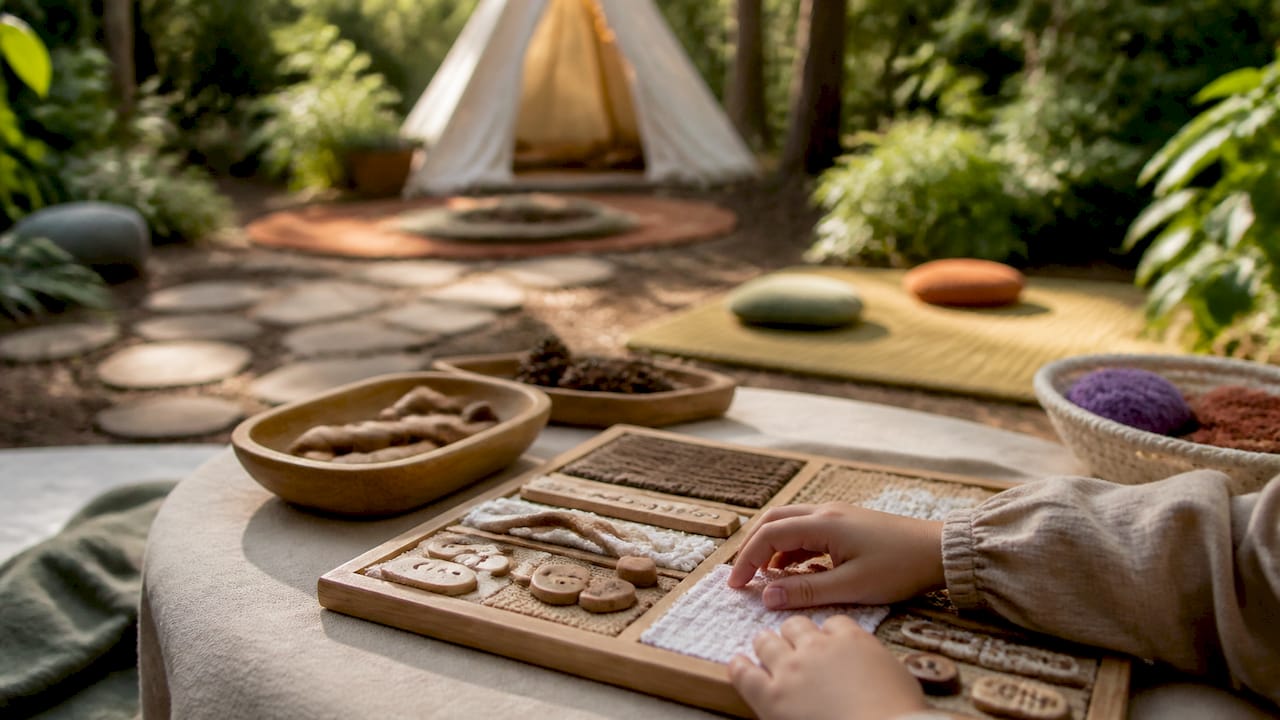
Creative fidget devices, in the context of stay-and-play sessions and SEN-friendly birthday parties, are sensory play stations and activity zones that give children controllable, predictable input. Not the spinner you buy at a petrol station. Not a cube from Amazon. These are set-up stations where a child can choose their input, manage the intensity, and leave when they’re done. Here’s a shortlist of the six you’ll most often see (or want to build):
- Sensory board — fixed textures, zips, and latches on a mounted board
- Tactile tray or bin — kinetic sand, rice, or water beads in a contained tray
- Busy board — fine motor elements: buckles, toggles, velcro, and buttons
- Chewable zone — food-grade chewable tools on a tray with hygiene covers
- Auditory station — small bells, clickers, rain sticks, and textured shakers
- Visual or low-stim cosy zone — lava lamp, fibre-optic strands, soft lighting
If you’re in Brighton, Hove or wider Sussex and want these set up professionally for a session or party, Fidget and Spin’s sensory sessions run weekly for children aged 1–6. They’re useful, safe, and adaptable to your child’s processing differences.
Key takeaways
Creative fidget devices used in group sensory sessions are station-based, child-led, and most effective when paired with movement and oral tools as part of a sensory diet.
| Point | Details |
|---|---|
| Stations, not gadgets | Creative fidget devices in sessions are set-up zones (boards, bins, cosy corners), not retail handheld toys. |
| Child choice reduces overload | Letting children pick their station (tactile, auditory, or visual) lowers dysregulation at the door. |
| Safety is non-negotiable | Remove small parts for under-threes, clean between children, and obtain consent for chewable tools. |
| UK party costs start around £200 | Private SEN party packages commonly start at approximately £200 for a two-hour session, rising with staffing and add-ons. |
| Fidget and Spin | Weekly sessions (ages 1–6) and three party packages (£220–£530, ages 1–7) across Brighton, Hove and Sussex. |
Table of Contents
- What are creative fidget devices and why do they help with regulation?
- Practical station ideas: what to set up and for whom
- How to build a sensory board and a portable tactile tray
- Safety and hygiene checklist for group sessions and parties
- How to fit sensory stations into a party or stay-and-play session
- What does a SEN-friendly party cost in the UK?
- What I’ve learnt from getting it wrong first
- Fidget and Spin: sensory sessions and SEN-friendly parties in Brighton and Sussex
- Sources
- FAQ
What are creative fidget devices and why do they help with regulation?
Remy, my six-year-old, used to walk into a room, scan every corner, and then bolt for the door. Not because he was being difficult. Because nothing in that room told him what to do with his body. The moment we put out a sensory board with a zip and a bit of velcro, he stopped. Chose it. Stayed.
That’s the core of what these stations do. Sensory boards give children consistent, self-directed tactile and auditory input that they can manage at their own pace, which lowers arousal and reduces the chance of a meltdown. The child controls the intensity. That matters enormously for autistic and PDA children who need to feel agency, not compliance.
Adapting the Curiosity Approach into sensory stations — letting children lead their own discovery rather than directing them — reduces sensory overload and supports autonomy. Inclusive Teach’s guidance on this is worth reading if you’re setting up a session at home or in a group.
As part of a broader sensory diet for regulation, these stations work best when paired with movement and oral tools, not used in isolation.
Pro Tip: Before a session or party, ask the child whether they want to start with something to touch, something to listen to, or somewhere quiet to sit. That one question can prevent twenty minutes of dysregulation at the door.
Practical station ideas: what to set up and for whom
Boards and bins are not the same thing, and choosing between them matters. Sensory boards suit fine motor exploration and bounded, predictable input; sensory bins offer immersive, whole-hand proprioceptive feedback but need more containment and cleanup. For group settings, boards are easier to manage between children.
Station types, elements, and age guidance
Tactile tray or bin (ages 1–7) Kinetic sand, coloured rice, water beads, or dried pasta. Kinetic sand holds attention well and is easy to portion into individual trays. Keep beads away from children under three (choking risk). Wipe trays between children.

Sensory board or busy board (ages 2–7) Zips, velcro strips, toggles, latches, and fabric swatches mounted on a board. Better for one-to-one or small-group use. Check fixings monthly — loose screws are a hazard.
Proprioceptive corner (ages 1–6) Wobble boards, balance cushions, and crash mats. Works well in group settings as a movement break between quieter stations. Supervise under-threes closely.
Chewable and oral tools zone (all ages) Food-grade silicone chewables on individual labelled hooks. Never share between children. Require signed consent from parents before use.
Auditory station (ages 2–7) Small handbells, rain sticks, clickers, and textured shakers. Keep volume manageable — one or two items at a time. Works well as a transition tool between activities.
Visual or low-stim cosy zone (all ages) Lava lamp, fibre-optic strands, a pop-up tent with fairy lights. This is your calm corner. Every party and session needs one. Local hire packages often include glow tables and sensory tunnels as part of this zone.
For group settings, boards and cosy zones are the most manageable. Bins and proprioceptive equipment need more supervision and more cleanup time.
How to build a sensory board and a portable tactile tray
I built our first sensory board at the kitchen table on a Tuesday evening with a piece of MDF, a bag of haberdashery bits, and a hot glue gun. It took about 45 minutes and Remy still uses it.
Sensory board (approx. 45 minutes)
Materials: 40cm x 60cm MDF board, sandpaper, non-toxic paint, zip, velcro strip, two cabinet latches, a door hinge, fabric swatches in varied textures, screws, wall fixings.
- Sand and paint the board. Let it dry fully.
- Lay out your elements before fixing anything — let your child handle each one first.
- Screw the hinge and latches directly into the board.
- Glue or staple fabric swatches in a row across the middle.
- Sew or staple the zip onto a fabric patch and fix it to the board.
- Mount at child height. Check all fixings are flush before use.
Swap one element every few weeks to keep it engaging. Document which textures your child seeks and which they avoid.
Portable tactile tray (approx. 20 minutes)
Materials: A shallow lidded storage box (approx. 40cm x 30cm), kinetic sand or coloured rice, small scoops or spoons, a tray liner, a zip-lock bag for storage.
- Line the box with the tray liner.
- Fill to roughly 5cm depth — enough to bury hands, not so much it spills.
- Add one or two small tools (a spoon, a small cup).
- Introduce it to your child with no instruction. Just watch.
- After use, seal the lid and store flat.
- Replace the filler every two to three weeks or when it smells or clumps.
Pro Tip: ABA shaping techniques suggest starting with one-minute engagement goals and building slowly. If your child walks away after 30 seconds, that’s fine — note it, and try a different texture next time.
Safety and hygiene checklist for group sessions and parties
I once spotted glitter in a toddler’s mouth at a craft session. The host hadn’t thought about it. I have thought about nothing else since. Here’s what to check before any group use.
Before the session:
- Inspect every item for loose parts, sharp edges, or broken fixings
- Label each station with the minimum age and any allergy notes
- Remove any item smaller than a 50p coin from under-three areas
- Confirm no latex, wheat, or nut-based materials are present if allergies are flagged
During the session:
- Maintain a minimum of one adult per four children under three, one per six for older children
- Keep a handwashing station or wipes at each tactile station
- Obtain signed consent before any child uses chewable tools
- Have a Now/Next board visible at all times to signal transitions
Cleaning schedule:
- Between children: wipe hard surfaces with a food-safe antibacterial spray; replace tray liners
- After each session: wash fabric elements at 60°C; inspect fixings on boards
- Weekly deep clean: soak silicone chewables in Milton solution; replace any worn or cracked items
Inform your venue insurer that sensory equipment is in use. Offer AAC or PECS support at transitions for non-speaking children. Your calm corner is not optional.
How to fit sensory stations into a party or stay-and-play session
The best party I’ve seen started with a child choosing a station before anyone even said hello. No fanfare. No “right, everyone gather round.” Just: here are the things, pick one.
Now/Next boards significantly reduce anxiety at parties by making transitions predictable. Put one up at the entrance and update it throughout.
Sample 90-minute party timeline
| Time | Activity | Staffing note |
|---|---|---|
| Up to 15 min | Arrival and free-choice stations open | 1 staff member greeting, 1 floating |
| 15–45 min | Guided station rotation (optional) | 1 staff per 4 children |
| 45–60 min | Quiet activity or cosy zone | 1 staff monitoring calm corner |
| 60–65 min | Cake, quietly, at tables | All staff present |
| 75–90 min | Goodbye with Now/Next board visible | 1 staff at door |
Trained staff should observe rather than direct, scaffold choice without pressure, and use a quiet signal (a raised hand or a visual card) rather than a loud verbal cue. For children using AAC or PECS, have symbol cards for each station ready at arrival.
Sensory-friendly invite wording to include:
- Quiet space available throughout
- Bring any comfort items or chewables from home
- Dietary and allergy notes welcome — please tell us in advance
- Flexible arrival window (a 15-minute window reduces door-crowd anxiety)
Pro Tip: Relief Creche Care’s SEN party guidance recommends having a fully separate calm corner with its own visual schedule, not just a corner of the main room. The physical separation matters.
What does a SEN-friendly party cost in the UK?
I remember bracing myself the first time I looked at party quotes. The range was wild.

Private SEN party packages in the UK generally start at a reasonable price for a two-hour session, though single-module hires can come in lower. Local sensory hire listings show party pod and sensory soft play packages starting below that benchmark, while fully staffed packages with multiple zones run considerably higher depending on what’s included.
Main price drivers:
- Staffing levels and training (the biggest variable)
- Venue hire or travel costs
- Equipment quality and variety (glow tables, sensory tunnels, tactile mats)
- Add-ons such as bubble houses or themed lighting
- Supervision ratio required for the age group
Before you book, confirm:
- Is a calm corner included or an add-on?
- Do staff have SEN-specific training?
- Is a Now/Next board provided?
- How is equipment cleaned between parties?
- Are concession or Pay-It-Forward spots available?
Fidget and Spin’s three party packages (The Wee One at £220, The Big One at £320, and The Whole Shebang at £530) are designed for children aged 1–7 across Brighton, Hove and Sussex, with all of the above built in.
What I’ve learnt from getting it wrong first
We left a soft-play party early when Remy was three. He was overwhelmed before the cake came out. I spent the drive home telling myself it was fine. It wasn’t fine. It was a room designed for a child who wasn’t him.
That’s why Anthony and I built Fidget and Spin. Not from a business plan. From that car journey. The real impact of sensory play stations on regulation isn’t theoretical for us. We’ve watched it happen in our own kitchen and in every session we run.
I want to be honest: no single station fixes everything. A sensory board works best as part of a broader sensory diet, ideally shaped with an OT. Inclusive Teach’s OT-informed resources are worth bookmarking alongside your own observations. What we offer is a consistent, trained, lived-experience environment where the setup is already done and the staff already understand.
If you’re not sure where to start, just get in touch. We get it. Not in a corporate-inclusion-policy way. In a “we’ve been that family in the car park” way.
Fidget and Spin: sensory sessions and SEN-friendly parties in Brighton and Sussex
There’s a particular relief in finding a place that doesn’t need explaining. You don’t have to justify why your child needs a quiet corner, or why cake at a table of twelve is too much.
Fidget and Spin runs weekly sensory stay-and-play sessions for children aged 1–6 in Brighton and Hove, across three zones: Wiggle & Bounce (big movement), Snuggle & Chill (low-stim cosy), and Squish & Squeeze (tactile play and fidgets). For birthdays, three SEN-friendly party packages cover ages 1–7 across Brighton, Hove and wider Sussex:
- The Wee One (£220): staffed, calm, sensory stations included
- The Big One (£320): extended session, more zones, Now/Next board
- The Whole Shebang (£530): full setup, all zones, maximum flexibility
Concession spots are available, supported by Pay-It-Forward donations at checkout. To book or ask a question, visit the sessions or parties pages. We’ll talk through accessibility, timing, and what your child needs before you commit to anything.
Sources
- Inclusive birthday parties — Daisy Chain Project
- DIY sensory board for autism — Neurolaunch
- 5 sensory-friendly Curiosity Approach ideas — Inclusive Teach
- DIY sensory stations for ABA independent play — Kids Club ABA
FAQ
What are creative fidget devices in a party or session context?
They are sensory play stations — tactile trays, sensory boards, chewable zones, auditory stations, and low-stim cosy corners — set up so children can choose and control their own sensory input, not retail handheld gadgets.
How do sensory stations help reduce meltdowns at parties?
Predictable, self-directed input lowers arousal; pairing stations with a Now/Next board makes transitions legible, which reduces the anxiety that often precedes a meltdown.
What does a SEN-friendly birthday party cost in the UK?
Private SEN party packages commonly start around £200 for a two-hour session. Fidget and Spin’s packages run from £220 (The Wee One) to £530 (The Whole Shebang) depending on zones, staffing, and duration.
Are sensory stations safe for toddlers in group settings?
Yes, with the right precautions: remove any item smaller than a 50p coin from under-three areas, obtain consent for chewable tools, clean between children, and maintain a minimum ratio of one adult per four children under three.
Can I build sensory stations at home before booking a session?
A portable tactile tray takes roughly 20 minutes to assemble using a lidded storage box and kinetic sand or coloured rice. A basic sensory board takes around 45 minutes with MDF and haberdashery fixings. Both are good starting points before a first session.
Recommended
- Benefits of fidgeting for neurodiverse children: a parent’s guide | Fidget and Spin Brighton
- SEN private party hire in Brighton: what actually works | Fidget and Spin Brighton
- Effects of fidgeting: what every SEN parent should know | Fidget and Spin Brighton
- Benefits of fidget tools for neurodiverse children | Fidget and Spin Brighton