TL;DR:
- Fidget toys can support attention in neurodiverse children when they are quiet and tactile, but effectiveness varies individually. Movement and sensory input help regulate alertness, although visual and distracting fidgets often hinder focus, especially in young children. Proper use involves matching toy types to sensory needs, timing their introduction, and rotating options to maintain benefits.
Fidget toys are sensory regulation tools designed to keep hands occupied with low-effort, repetitive movement, and for some children, particularly those with ADHD or sensory processing differences, they genuinely can improve attention. The key word is some. Whether fidget toys improve attention depends entirely on the child, the type of fidget, and how it is used. Stress balls, silicone sliders, therapy putty, and quiet tactile toys are the most commonly recommended options for young children aged 1–7. The science is mixed but increasingly specific about who benefits and why. This guide cuts through the noise and gives you something practical to work with.
Do fidget toys improve attention? what the research actually says
The honest answer is: it depends, and the research reflects that messiness.
A 2024 meta-analysis of ten studies found that fidget toys have a negligible effect on attention and academic performance overall. That sounds discouraging. But “overall” is doing a lot of heavy lifting in that sentence. When you average across all children, including those with no sensory or attentional differences, the effect shrinks. The children for whom fidgets are most likely to help are not the average.
Stanford-led research offers a more encouraging angle. About 80–82% of students generated more creative ideas when allowed to move freely in their seats, without any measurable drop in focus or memory. That is a significant finding. It tells us that movement and attention are not opposites, even if a fidget spinner twirling on a desk might suggest otherwise.
“The traditional idea that stillness equals attention is outdated, especially for neurodivergent children. Allowing movement helps children with ADHD focus better than requiring stillness.” — Springer Learning & Development
A 2026 neurological study adds another layer. Fidgeting increases physiological arousal, measured through pupil diameter, during auditory processing tasks. Arousal went up. Task performance, however, did not measurably improve. This tells us that the body is responding to the fidget, but the cognitive benefit is not automatic. The fidget creates the conditions for focus. It does not guarantee it.
Visual fidget toys complicate things further. Practitioners consistently find that visually stimulating fidgets, like spinners with flashing lights or moving parts that demand eye contact, often distract rather than help, especially in young children. The visual attention required to watch the toy competes directly with the task at hand.

| Fidget Type | Effect on Attention | Best For |
|---|---|---|
| Quiet tactile (putty, textured stones) | Positive for many neurodiverse children | ADHD, sensory processing differences |
| Silicone sliders, pop toys | Neutral to positive if used without visual focus | Anxiety, mild sensory needs |
| Spinners, light-up fidgets | Often distracting, especially for under-7s | Not recommended for focus support |
| Weighted lap pads | Calming, supports sustained attention | Sensory-seeking and sensory-avoiding children |
Pro Tip: If your child keeps looking at the fidget rather than the activity, swap it for something they can use without looking. Therapy putty or a smooth textured stone works well because the hands can explore without the eyes following.
Why do fidget toys help some children’s brains focus?
Movement is not the enemy of concentration. For many children with ADHD, it is the pathway to it.
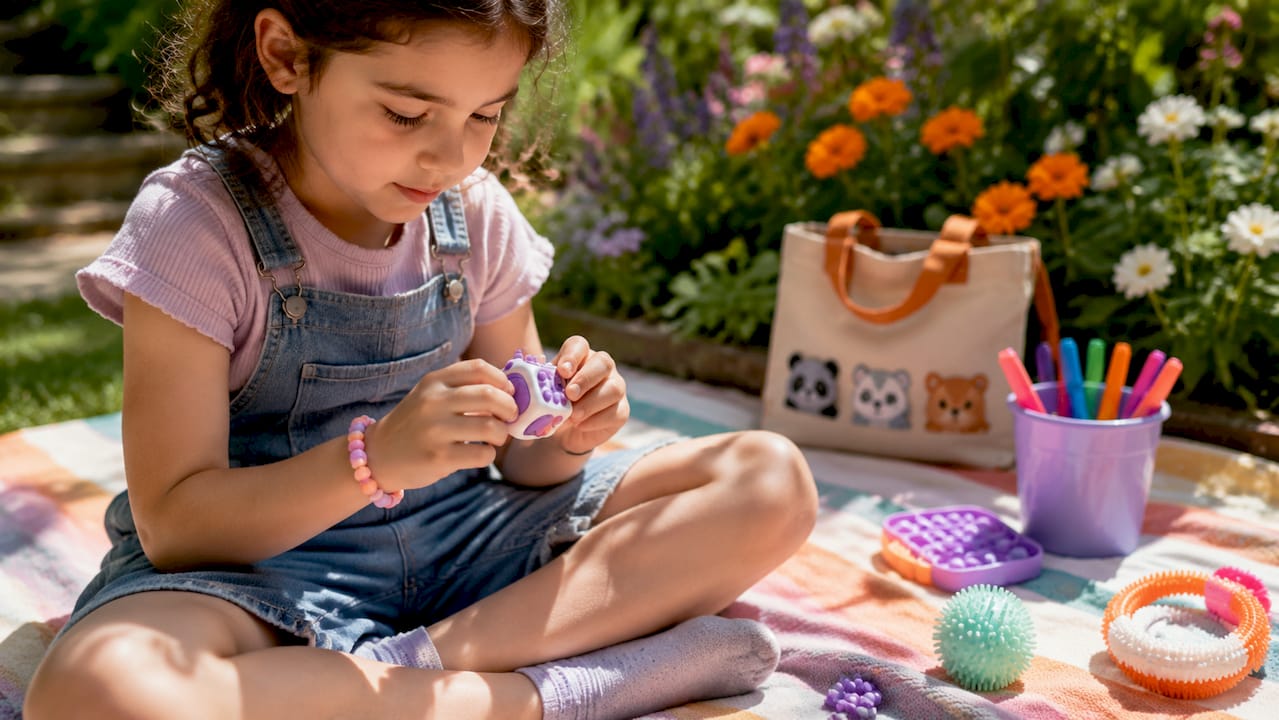
Movement activates neural pathways linked with attention and working memory. When a child’s hands are doing something repetitive and automatic, the brain receives a steady stream of sensory input that helps regulate alertness. Think of it like background noise for the nervous system. The right amount keeps the brain at the level of arousal needed to engage with a task.
For children with sensory processing differences, the world can feel either overwhelming or under-stimulating, sometimes both within the same hour. A fidget toy offers a controlled, predictable source of sensory input. It can reduce anxiety, support self-soothing, and free up cognitive capacity that would otherwise go towards managing discomfort.
The real impact on neurodiverse children is not always dramatic or immediate. Sometimes it is just that a child sits for three more minutes. Sometimes it is that they stop chewing their sleeve. Both count.
Here is what helps when you are trying to work out whether a fidget is genuinely supporting your child:
- Watch what the hands are doing. Is the movement automatic and repetitive, or is your child actively playing with the toy? Automatic fiddling supports regulation. Active play does not.
- Watch the eyes. Are they on the activity or on the fidget? Eyes on the fidget means the toy has become the task.
- Notice the body. Is your child calmer, more settled, less likely to bolt? Regulation shows up in the whole body, not just the hands.
- Check in after five minutes. A fidget that is working will fade into the background. One that is not working will escalate into full play mode.
- Trust your gut. You know your child. If something feels off, it probably is.
Pro Tip: Match the fidget to the sensory need, not the trend. A child who seeks deep pressure will get more from squeezing therapy putty than from a pop toy. A child who is sensory-avoiding might prefer a smooth, cool stone over anything textured.
Efficacy depends entirely on meeting the individual child’s nervous system needs in real time. There is no universal solution, and anyone who tells you otherwise is selling something.
Which fidget toys actually work for young children?
Choosing the right fidget is where most parents get stuck. The market is full of brightly coloured, visually exciting options that are genuinely brilliant as toys and genuinely unhelpful as regulation tools.
The visual distraction trap is real. Fidgets that require visual attention split focus and reduce attention, particularly in children under seven. The rule of thumb is simple: if the toy needs eyes to be interesting, it is a toy, not a tool.
Fidgets that tend to support attention in young children:
- Therapy putty (different resistances for different sensory needs)
- Textured silicone rings or bracelets worn on the wrist
- Smooth worry stones or textured pebbles
- Silicone sliders or pop toys used without looking
- Stretchy resistance bands looped around chair legs for foot fidgeting
- Small fabric squares with varied textures sewn together
Fidgets to use with caution or avoid for focus support:
- Spinners with moving parts that catch the eye
- Light-up or sound-making fidgets
- Fidgets with multiple components that invite construction or sorting
- Anything so novel that the child cannot stop examining it
When a fidget becomes a toy for active play, it stops supporting focus and starts competing with it. This is not a failure. It just means the fidget has done its job as a toy and needs to be retired from regulation duty.
Rotating fidgets helps enormously. Novelty wears off quickly, and a fidget that once helped your child settle may lose its effect after a few weeks. Keeping a small rotation of three or four options and swapping them out regularly maintains the regulatory benefit without requiring constant novelty.
For children aged 1–3, keep fidgets large enough to be safe and simple enough to use without instruction. For children aged 4–7, you can introduce slightly more complex tactile options, but the principle stays the same: hands busy, eyes free.
How to build fidget toys into your child’s daily routine
Getting the most from fidget tools is less about the toy and more about the context. A fidget handed to a child mid-meltdown is unlikely to help. A fidget offered before a tricky transition, or during a quiet activity that requires sustained attention, is far more likely to land well.
Here is a practical framework for building fidget use into daily life:
- Identify the moments that are hardest. For many children, this is transitions, waiting, quiet seated activities, or anything with unpredictable sensory input. These are your prime fidget moments.
- Offer the fidget before the difficulty, not during it. Regulation is proactive. Handing over a stress ball when your child is already dysregulated is like offering a life jacket after someone has gone under.
- Keep it consistent. The same fidget in the same context helps the brain associate the tool with regulation. Remy has a specific silicone ring that lives in his bag for waiting rooms. He knows what it is for.
- Pair fidget time with physical activity breaks. Fidgets support regulation, but they do not replace the need for movement. Short bursts of big movement, jumping, spinning, running, before a seated activity make fidgets more effective, not less.
- Teach self-monitoring gradually. Teaching children to recognise when a fidget is helping versus when it has become a distraction is a skill that builds over time. For younger children, you do the noticing. For children aged five and up, you can start asking: “Is your fidget helping you or distracting you right now?”
- Use sensory play sessions to explore what works. Structured sensory environments, like the Squish and Squeeze zone at Fidget and Spin, let children try different tactile inputs in a low-pressure setting. What a child gravitates towards in play often tells you a lot about what will work as a regulation tool.
The benefits of fidget tools for neurodiverse children are most consistent when the tool is used with intention and matched to the child’s actual sensory profile, not just handed over and hoped for.
Key takeaways
Fidget toys support attention most reliably when they are quiet, tactile, and matched to the individual child’s sensory needs, rather than chosen for novelty or visual appeal.
| Point | Details |
|---|---|
| Research is mixed but specific | Evidence supports fidget use for neurodiverse children, not all children equally. |
| Tactile over visual | Quiet, hands-only fidgets outperform visually stimulating ones for focus support. |
| Rotation prevents fade | Swap fidgets regularly to maintain their regulatory effect as novelty wears off. |
| Timing matters | Offer fidgets before difficult moments, not during dysregulation. |
| Self-monitoring is a skill | Gradually teach children to notice whether their fidget is helping or distracting. |
What i have learnt from remy and a lot of trial and error
I will be honest: when fidget spinners had their moment, I bought three. Remy was fascinated by them for about four days, then used one to whack his water bottle off the table, and that was that.
What actually helped him was a small silicone ring he wears on his wrist during story time at nursery. He does not look at it. He just rolls it back and forth with his thumb. His key worker told me he sits for twice as long now. I nearly cried in the car park.
The thing nobody tells you is that finding the right fidget takes time and feels a bit like guesswork. You try something, it works for a bit, then it stops working, and you feel like you have failed. You have not. You have just learned something about your child’s nervous system, which is genuinely useful information.
We have also learnt that fidgets are one part of a bigger picture. They work best alongside movement breaks, predictable routines, and environments that are not asking too much of Remy’s sensory system in the first place. A fidget in a chaotic, overstimulating room is not going to do much. A fidget in a calm, low-demand setting can make a real difference.
If you are at the stage of wondering whether any of this will work for your child, I want to say: keep going. Experiment without pressure. And trust what you see, because you are watching your child more carefully than anyone.
— Caitlin
Try it in a space built for this
If you want to see what fidget tools look like in practice, and watch your child explore different textures and tactile inputs without any pressure, our sensory play sessions in Brighton and Hove are designed exactly for that.
Fidget and Spin runs weekly SEN stay-and-play sessions for children aged 1–6, with a dedicated Squish and Squeeze zone full of tactile play and fidget tools. It is a space where your child can try things out, and where you can watch what they reach for. That observation is gold when you are trying to work out what supports their regulation at home. Come and see how our sessions work, and bring your questions. We have almost certainly been there too.
FAQ
Do fidget toys improve attention in children with ADHD?
For many children with ADHD, fidget toys can support attention by providing sensory input that stabilises alertness and activates neural pathways linked to working memory. The effect is most consistent with quiet, tactile fidgets used in low-distraction settings.
Do fidget spinners help concentration?
Fidget spinners tend to distract rather than help concentration, particularly in young children, because they require visual attention. Practitioners recommend quiet tactile fidgets over visually stimulating ones for focus support.
At what age can children start using fidget toys?
Children aged 1 and above can use age-appropriate fidget tools, provided they are large enough to be safe and simple enough to use without instruction. Textured fabrics, soft silicone rings, and smooth stones are suitable for toddlers.
How do i know if a fidget toy is helping my child focus?
Watch whether your child’s eyes stay on the activity rather than the fidget, and whether their body appears calmer and more settled. If the fidget becomes active play, it has stopped functioning as a regulation tool.
Why do some children not benefit from fidget toys?
Fidget toys work by meeting specific nervous system needs, and those needs vary by child. A child who is sensory-avoiding may find a textured fidget overwhelming, while a child without significant sensory or attentional differences may simply find it a distraction.
Recommended
- How fidget toys help focus in neurodiverse children | Fidget and Spin Brighton
- Benefits of fidget tools for neurodiverse children | Fidget and Spin Brighton
- Benefits of fidget toys for neurodiverse children | Fidget and Spin Brighton
- The real impact of fidget toys on neurodiverse children | Fidget and Spin Brighton