TL;DR:
- Choosing suitable games for neurodiverse children requires matching sensory profiles, social needs, and communication styles.
- Empirical evidence favors physical and multi-sensory activities, which support social, emotional, and motor development effectively.
Standing in a toy shop aisle, picking up one brightly coloured box after another, and still having absolutely no idea what to choose — honestly, that feeling is exhausting. When your child is neurodiverse, “suitable for ages 3 and up” just doesn’t cut it. You need to know whether the noise level will send them spiralling, whether the rules are too abstract, and whether it will actually mean something to them beyond five minutes of mild interest before it ends up under the sofa. This guide is here to help you cut through the noise and find games that genuinely support your child’s growth in social skills, communication, and sensory exploration.
Table of Contents
- How to choose educational games for neurodiverse kids
- Top physical and sensory games for ages 1-7
- Best games to develop social and communication skills
- Game comparison: pros, cons, and best fit
- What most articles miss about games for neurodiverse children
- Try sensory play in your community
- Frequently asked questions
Key Takeaways
| Point | Details |
|---|---|
| Match games to needs | Choose games based on your child’s sensory profile and developmental goals. |
| Physical play works best | Research favours physical and multi-sensory games for social and emotional gains in young neurodiverse children. |
| Personalisation is key | No single game suits every child—adapt activities and seek feedback from your child and their support team. |
| Group play boosts skills | Games involving peers or family members further enhance communication and social learning. |
How to choose educational games for neurodiverse kids
Let’s start with something reassuring: you don’t need a degree in child development to make brilliant game choices for your little one. What you do need is a basic framework to guide your thinking.
The evidence base for game-based learning in neurodiverse children is growing steadily. Meta-analyses confirm that gamified interventions improve social skills, emotional skills, and executive and motor functions in autistic children, with sensor-based and physical games showing the strongest results. That’s genuinely exciting news, because it validates what many of us have observed at home and in playgroups for years.
So what should you actually be looking for? Here are the core criteria:
- Sensory match: Does the game suit your child’s sensory profile? A child who is hypersensitive to sound will struggle with a game involving loud music or buzzers, no matter how “educational” the box claims it is. Look at the benefits of sensory play and consider which textures, sounds, and movements your child gravitates toward naturally.
- Social interaction at the right level: Some children are ready for group turn-taking; others need to start with parallel play, simply being in the same room as another child without direct interaction. Choose games that meet your child where they are, not where you wish they were.
- Communication support: The best games for neurodiverse children don’t demand verbal responses. They allow for pointing, gesturing, eye contact, or even just physical participation. AAC (augmentative and alternative communication) users need games that welcome alternative responses.
- Avoiding overstimulation: Flashing lights, multiple simultaneous sounds, and cluttered visual designs are common culprits. Simpler, calmer aesthetics tend to work better, especially for children with sensory processing differences.
- Age-appropriate challenge: For the 1 to 7 age range, the game should offer a sense of achievement without requiring skills the child hasn’t yet developed. Frustration is the enemy of play.
For very young children aged one to three, the best games are tactile and open-ended. Think stacking, pouring, squishing, and sorting. For children aged four to seven, structured games with clear, consistent rules work well, particularly when paired with visual supports or simple symbols to explain what’s happening.
“The most powerful thing you can do is match a game to the child in front of you, not the child described on the box. Every neurodiverse child has a unique sensory threshold, and the game that works brilliantly for one child may be genuinely overwhelming for another.” That’s something we see every week through how our sessions work at Fidget and Spin.
Pro Tip: Before purchasing a new game, chat with your child’s speech and language therapist, occupational therapist, or class teacher. They often have specific recommendations tailored to your child’s sensory and developmental profile, and they may even lend you resources to try before you commit. Our sensory playgroup guidance can also help you understand what kinds of activities tend to resonate with different neurodiverse profiles.
With a framework in place, we can now look at specific game options that excel in different areas.
Top physical and sensory games for ages 1-7
Physical and multi-sensory games have stronger empirical support for this age group than digital or screen-based alternatives. In plain terms, getting the body moving and the senses engaged produces the most consistent results for neurodiverse children aged one to seven. Here are some of our favourites:
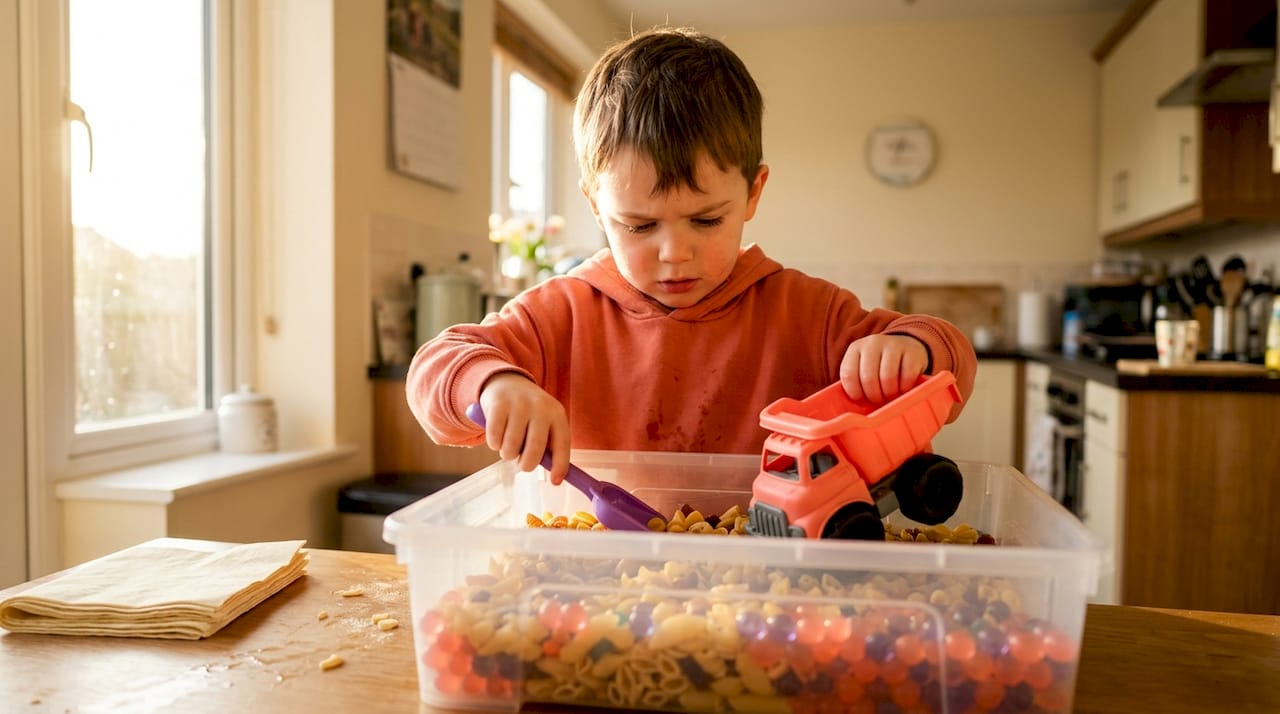
🌊 Tactile sensory bins Fill a container with dried pasta, kinetic sand, water beads, or shredded paper. Hide small objects for your child to discover. This is wonderful for children who are sensory-seeking, and it also works beautifully as a calming activity for children who are anxious. You can adapt the contents based on what your child tolerates.
🎵 Musical movement mats Mats that respond to footsteps with sounds or lights encourage movement and provide immediate sensory feedback. They’re brilliant for cause-and-effect learning and can gently introduce turn-taking when used in a group.
🎪 Simple obstacle courses A row of cushions, a low tunnel, a balance beam made from a plank of wood — obstacle courses support proprioceptive and vestibular processing, which are two sensory systems that many neurodiverse children need extra input through. These courses can be made harder or easier in seconds, making them incredibly flexible.
🪂 Parachute play A lightweight play parachute used in a small group is genuinely magical. It builds shared attention, encourages cooperation, and is almost universally motivating. The visual spectacle of the fabric rippling is calming and engaging at the same time.
Here’s why these games work so well:
- They provide predictable sensory input, which helps children feel safe
- They can be done solo or in a group, depending on the child’s readiness
- They require no verbal communication to participate
- They support the body’s regulatory systems, which can settle a dysregulated child far more effectively than asking them to “calm down”
For inspiration on creating a playful home environment with games like these, it’s worth exploring some of the practical ideas available online, but don’t overlook local resources either.
Pro Tip: You don’t need to spend a lot to create excellent sensory play. A washing-up bowl filled with cornflour and water (oobleck) costs almost nothing and provides extraordinary tactile input. Many children who resist touching certain textures will happily explore oobleck because it behaves so unexpectedly. Our sensory play sessions use activities just like this, and watching a child’s face light up with wonder never gets old. You’ll also find a wealth of practical ideas on the sensory play tips section of our site.
While sensory and physical play forms the foundation, communication and social skills are equally vital.
Best games to develop social and communication skills
Building social and communication skills through play doesn’t mean sitting a child down with flashcards. The most effective approaches are gamified interventions that feel genuinely fun while gently practising the skills that matter. Here are four that work particularly well:
Simon Says This classic game is a brilliant vehicle for attention, listening, and imitation. For neurodiverse children, it builds the capacity to focus on one person, follow verbal or gestural instructions, and experience the joy of getting it right. You can adapt it by using visual cards instead of spoken instructions, which makes it accessible for non-speaking children or those who process language more slowly.
Cooperative movement games Activities where everyone wins together, like working as a group to keep a balloon in the air or passing a beanbag around a circle, remove the anxiety of competition and make the social interaction itself the reward. These are particularly valuable for children who find losing deeply distressing or who struggle with the unpredictability of competitive play.
Simple role-play scenarios Setting up a pretend café, a doctor’s surgery, or a shop gives children a structured social script to follow. Role-play supports theory of mind development (understanding that other people have different thoughts and feelings), verbal and nonverbal communication, and flexibility in social expectations.
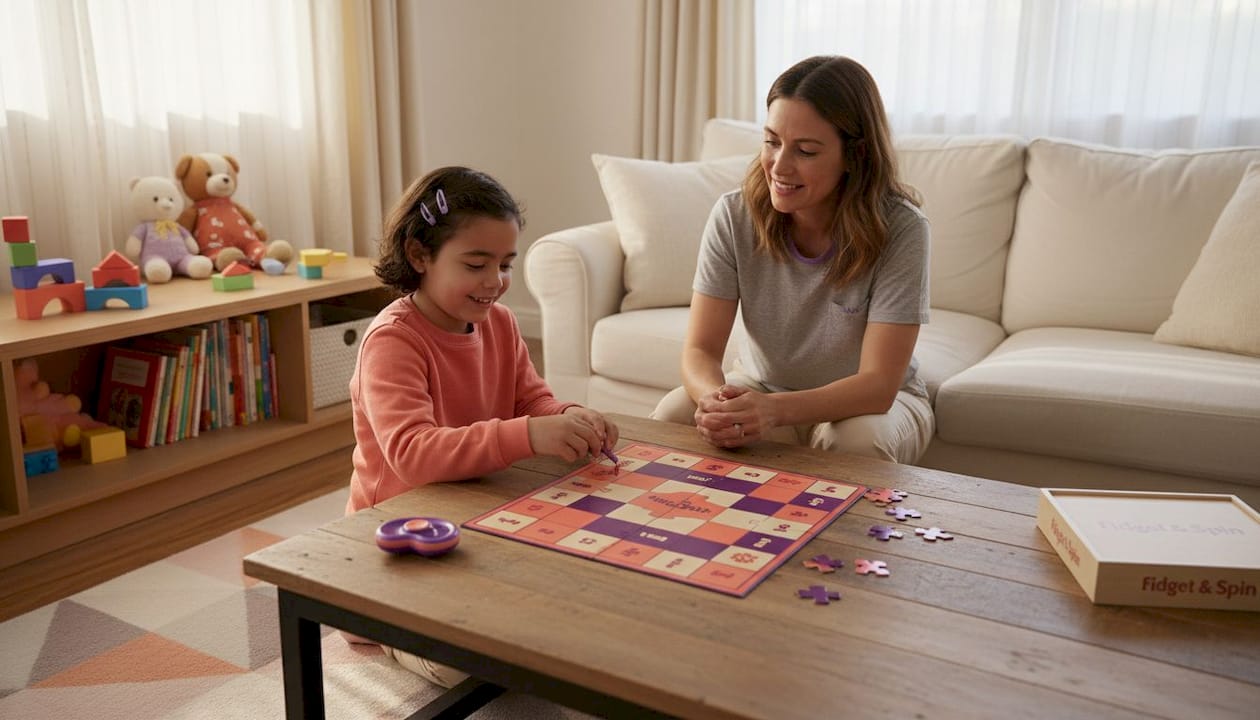
Turn-taking board games Simple games with clear rules and very few pieces, such as basic matching or colour-sorting games, introduce the concept of waiting and taking turns in a concrete, predictable format. Visual timers can help enormously here, giving children a tangible sense of how long they need to wait.
Adaptation strategies are essential. If your child struggles with the noise of a game, reduce the group size or play in a quieter space. If waiting for a turn is genuinely overwhelming, start with two-person games before scaling up. Research-backed support for social skills consistently emphasises that small modifications make a significant difference to engagement and outcomes.
You’ll find practical suggestions for specific adaptations on our game-based social tips blog posts, written with real families in mind.
Having covered sensory and social-communication game choices, it helps to compare these options head-to-head.
Game comparison: pros, cons, and best fit
Use this table as a quick reference to narrow down what might work for your child right now.
| Game | Primary skills | Age range | Sensory intensity | Adaptability | Group or solo |
|---|---|---|---|---|---|
| Tactile sensory bin | Fine motor, sensory regulation | 1 to 4 | Low to medium | Very high | Solo or small group |
| Musical movement mat | Cause-and-effect, movement | 1 to 5 | Medium | Medium | Solo or pair |
| Obstacle course | Proprioception, body awareness | 2 to 7 | Medium to high | Very high | Solo or group |
| Parachute play | Shared attention, cooperation | 2 to 7 | Medium | High | Group |
| Simon Says | Attention, imitation | 3 to 7 | Low | High | Group |
| Cooperative movement | Turn-taking, communication | 3 to 7 | Low to medium | High | Group |
| Role-play scenarios | Language, social scripts | 3 to 7 | Low | Very high | Pair or small group |
| Simple board games | Turn-taking, patience | 4 to 7 | Low | Medium | Pair or small group |
Choosing from this list doesn’t have to be stressful. A few practical pointers:
- Start with games your child already shows interest in, even loosely. A child who loves water will likely engage with a water-based sensory bin more readily than a tactile sand activity.
- Prioritise games that allow flexible participation. A child doesn’t have to follow all the rules to benefit from the activity.
- Sensor-based and structured interventions show the greatest empirical effect for young autistic children, so weight your choices toward physical and sensory options first, especially for children under five.
- Consult your child’s support team before investing in specialist equipment. They may have resources you can borrow.
- Trial and error is not failure. It’s the actual process. Expect some games to land brilliantly and others to be completely ignored. Both outcomes tell you something valuable about your child.
Find our game matching guidance on the Fidget and Spin website for more personalised advice.
Beyond comparisons, what do experienced providers really see work best in real life?
What most articles miss about games for neurodiverse children
Here’s my honest take, built from watching lots of children and talking to even more parents: most “top games” lists are well-intentioned but slightly missing the point.
The implicit message in many of these roundups is that there’s a correct answer. Find the right game, buy it, problem solved. But real progress with neurodiverse children doesn’t work like that. It looks more like: try the game, observe closely, notice what they do with it, adjust, try again, adjust again. It’s iterative, messy, and deeply personal. And that’s actually good news, because it means you don’t need the perfect game. You need the right-enough game and the willingness to adapt.
What we’ve seen consistently at Fidget and Spin is that children don’t thrive because of the game itself. They thrive because of the environment around the game: familiar adults, low sensory pressure, peers who are similarly paced, and the freedom to engage on their own terms. A child who refuses to touch playdough at home may enthusiastically dive into a sensory bin at a group session simply because the social energy is different.
This is why small group activities in sensory-rich, low-pressure spaces tend to outperform anything a digital screen can offer for this age group. It’s not that technology is bad. It’s that the embodied, relational experience of play alongside another person, guided gently by a skilled adult, is simply irreplaceable. Real-world sensory play insight gathered from families across Brighton and Hove bears this out time and again.
Children also change. The game that captivated your four-year-old for three months may feel completely wrong by the time they’re five and a half. Their sensory thresholds shift, their social readiness grows, their interests evolve. So please: don’t frame it as the game “not working anymore.” Frame it as your child outgrowing it. That’s progress, and it deserves to be celebrated.
If you’re ready to put ideas into practice, here’s how to take the next step.
Try sensory play in your community
Sometimes reading about games is helpful, but nothing quite replaces the experience of watching your child light up in a real sensory play environment, surrounded by other children who get it and adults who genuinely understand neurodiverse needs.
At Fidget and Spin, our sessions are designed around exactly the kinds of activities we’ve discussed here, with themed sensory zones, guided group play, and the flexibility to follow your child’s lead. Every session is crafted to support communication, emotional regulation, and social confidence, without pressure and without judgement. You can book a sensory play session to come and see what it’s all about, or learn about our approach before you visit. If sessions are currently full, you’re welcome to join the waitlist and we’ll be in touch as soon as a space opens up.
Frequently asked questions
What are the best types of games for neurodiverse children aged 1-7?
Physical and multi-sensory games are generally best, as research supports their positive impact on social, emotional, and motor skills for this age group. Tactile bins, obstacle courses, and parachute play are strong starting points.
How do I know if a game is suited to my child’s needs?
Observe your child’s sensory preferences, consult their health or education team, and introduce new games gradually to see how they respond. A child’s reaction during play tells you far more than any product description.
Do digital games help neurodiverse children learn social skills?
Sensor-based and structured interventions show more consistent results than digital-only games when it comes to building social and emotional skills in young neurodiverse children. Physical play remains the stronger option for this age group.
Are there budget-friendly ways to create sensory games at home?
Absolutely. DIY sensory bins using dried pasta, rice, or cornflour, plus simple obstacle courses from cushions and tunnels, are excellent low-cost options that rival any expensive toy.
Where can I find local sensory play sessions in the UK?
Specialist sensory playgroups operate in many areas across the UK and offer expert guidance alongside peer connection for both children and their families. Fidget and Spin runs regular sessions in Brighton and Hove specifically for neurodiverse children aged one to seven.