
Fidgeting is not a bad habit. For many neurodiverse children, it is a deliberate regulation tool that improves attention, eases anxiety, and keeps the nervous system balanced. Research confirms that the effects of fidgeting on children with ADHD and autism are largely positive when the fidgeting is supported rather than suppressed. The key word is supported. What helps one child focus can genuinely distract another, so context and individual sensory profile matter enormously.
For neurodiverse children specifically, fidgeting tends to:
- Improve sustained attention during cognitively demanding tasks
- Reduce anxiety by providing predictable rhythmic sensory input
- Support emotional regulation and reduce the likelihood of meltdowns
- Help the nervous system find its “window of tolerance” when sensory input feels chaotic
- Replace more disruptive movements with something quieter and less socially costly
None of this is a universal fix. But the evidence is clear enough that dismissing fidgeting as restlessness or poor behaviour does real harm.
Table of Contents
- Why do children fidget, and what is their body actually doing?
- What are the real benefits and limits of fidgeting?
- How can you support sensory regulation through fidgeting at home?
- How do you integrate fidgeting into inclusive early years settings?
- Key takeaways
- Fidgeting is not the problem. The room is.
- Come and play with us
- FAQ
Why do children fidget, and what is their body actually doing?
Remy, my six-year-old, rocks. He rocks when he is happy, when he is anxious, when he is bored, and sometimes apparently just because Tuesday exists. For years I tried to work out what it meant. The answer, it turns out, is that it means his nervous system is doing its job.
Fidgeting and stimming are purposeful self-regulatory behaviours, not signs of inattention or defiance. For autistic and ADHD children, the nervous system has a narrower window of tolerance, the zone of arousal where a child can function effectively. Fidgeting nudges that system back into range, up when under-stimulated, down when overwhelmed.
The neurological mechanism is specific. Rhythmic movement entrains brain rhythms in sensory areas, providing a predictable stream of sensory input with low prediction error. That regularity gives the brain a stable baseline onto which external signals can be layered, which is why a child who is rocking during a noisy assembly may actually be following it better than the child sitting perfectly still.
Prof. Julie Schweitzer, who has studied the link between ADHD and fidgeting for many years, describes fidgeting as an arousal tool that prevents lethargy and keeps the brain engaged during long, repetitive tasks. Her research found that the longer a task went on, the greater the positive effect of fidgeting on focus.
Pro Tip: Watch your child’s fidgeting for a week without intervening. Note when it increases, what form it takes, and what happens afterwards. Patterns emerge quickly, and they tell you far more than any checklist.
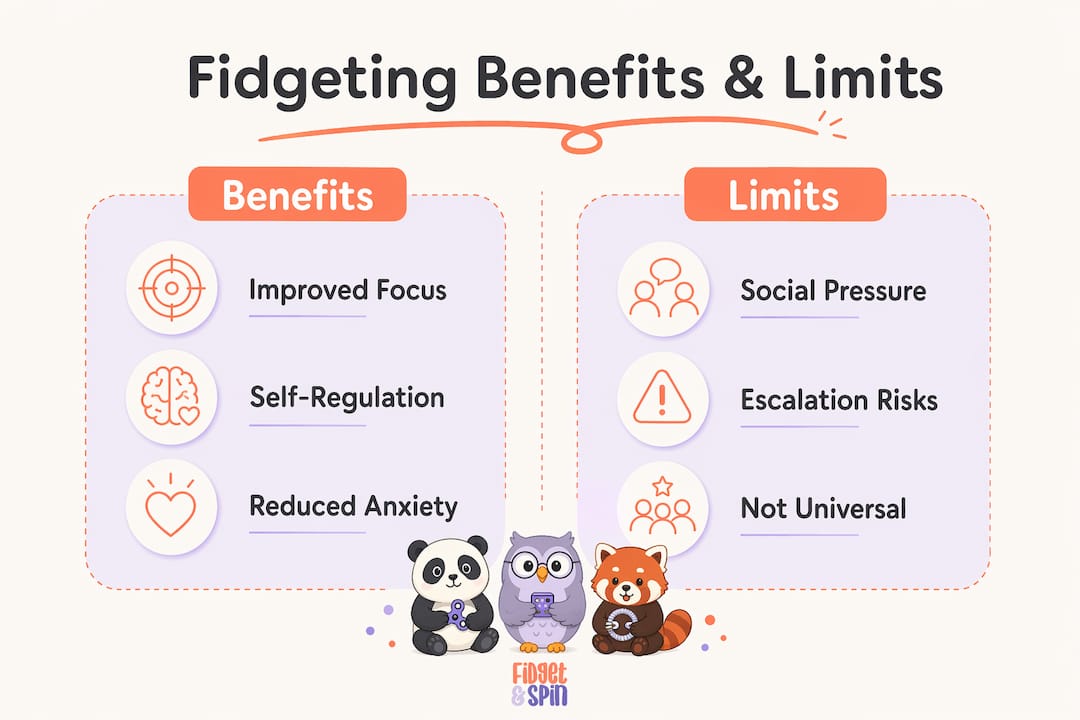
What are the real benefits and limits of fidgeting?
The benefits of fidgeting are well documented for neurodiverse children. A 2024 study published in Frontiers in Psychiatry found significantly more fidgeting during correct trials compared to incorrect ones on cognitive tasks in adults with ADHD, supporting the theory that fidgeting acts as a compensatory mechanism for sustained attention. Parents of autistic children also perceive fidget tools as more beneficial than parents of neurotypical children, particularly for reducing anxiety and improving concentration.
The limits are equally real. Fidget tools introduced universally across a whole classroom show mixed results. Some children find them distracting rather than regulating. A fidget spinner given as a reward for good behaviour becomes a toy, not a regulation tool. Novelty wears off, and for some autistic children, a new object in their visual field reduces attention to instruction before it eventually settles.
The dos and don’ts for managing fidget tools:
- Do introduce a fidget tool during the demanding task itself, not as a reward afterwards
- Do match the tool to the child’s sensory profile (proprioceptive seekers often prefer squeeze tools; vestibular seekers may do better with a wobble cushion)
- Do allow intrinsic fidgeting like rocking, leg bouncing, or hair twirling where it is not harming anyone
- Don’t deploy the same tool for every child and expect the same result
- Don’t suppress fidgeting to manage how the child appears to others
- Don’t remove a tool the moment it looks like the child is “playing” with it rather than focusing
The social pressure to suppress is real and it is damaging. Many neurodiverse children hold it together at school by suppressing regulation all day, then come home and fall apart. Parents often read that as defiance. It is relief. The nervous system has been white-knuckling it since 9am.
How can you support sensory regulation through fidgeting at home?
I spent a long time trying to redirect Remy’s rocking rather than understanding it. The shift that changed things was learning to read what kind of fidgeting I was seeing, not just whether it was happening.

Fidgeting that is calming looks rhythmic, repetitive, and self-contained. The child’s body settles. Fidgeting that signals escalation looks faster, more intense, less patterned. That distinction matters because the response is different. One needs space and quiet. The other might need a change of environment or a co-regulation moment.
Practical ways to support sensory regulation through fidgeting at home and out in the world:
- Offer a small selection of fidget tools and let your child choose, not you
- Build movement into the day before demanding tasks, not just after meltdowns
- Create a low-stim space your child can access independently when they need to regulate
- Normalise your own fidgeting out loud (“I’m going to shake my hands a bit, I’m feeling a bit overwhelmed”)
- Avoid public correction of fidgeting. The side-eye from strangers is their problem, not your child’s
- If a stim is unsafe, redirect to something that meets the same sensory need rather than removing the behaviour entirely
- Work with school to ensure sensory regulation strategies are part of any support plan, not an afterthought
Pro Tip: Ask yourself: “Is this fidget calming or escalating?” If it is calming, leave it alone. If it is escalating, offer a different sensory input rather than asking the child to stop.
How do you integrate fidgeting into inclusive early years settings?
Early years settings carry a particular responsibility here. Children aged one to six are still building their regulatory toolkit. A setting that demands stillness from a body that needs motion is not a neutral environment. It is an actively difficult one.
For SENCOs and early years practitioners, the evidence points clearly towards accommodation rather than suppression. Allowing movement during instruction, whether that is a wobble cushion, a squeeze toy available at the table, or permission to stand, supports learning rather than undermining it. Studies on sensory processing in autistic children show that children who can access regulation strategies during instruction perform better, not worse.
Practical guidelines for inclusive early years settings:
- Offer movement breaks as a built-in part of the session structure, not a consequence of behaviour
- Keep a small selection of quiet fidget tools available at activity stations
- Train all staff to distinguish between fidgeting that is regulating and fidgeting that is escalating
- Avoid whole-group rules that prohibit movement (bouncing, rocking, hand-flapping) unless there is a genuine safety concern
- Communicate with parents about which tools and strategies work at home, then mirror them in the setting
- Use visual supports (PECS, AAC devices, visual timetables) alongside sensory tools so children can signal their needs
- Review sensory accommodations regularly. What works at three may not work at five
The goal is not a perfectly still, perfectly quiet room. The goal is a room where every child can actually learn.
Key takeaways
Fidgeting is a functional regulation strategy for neurodiverse children, and suppressing it consistently makes focus and emotional regulation harder, not easier.
| Point | Details |
|---|---|
| Fidgeting aids attention | Research shows significantly more fidgeting during correct task trials in adults with ADHD, supporting its role in sustained focus. |
| Suppression causes harm | Forcing children to stop fidgeting increases anxiety and consumes the cognitive resources fidgeting was freeing up. |
| Tools need matching | Fidget tools work best when matched to the child’s sensory profile; universal classroom deployment shows mixed results. |
| After-school meltdowns have a cause | Many neurodiverse children suppress regulation all day at school, leading to meltdowns at home that are relief, not defiance. |
| Settings can accommodate | Inclusive early years settings that allow movement and provide sensory tools support better learning outcomes. |
Fidgeting is not the problem. The room is.
I remember sitting in a toddler group when Remy was two, watching him rock back and forth on a wooden chair while the other children sat in a neat circle. The group leader kept gently placing her hand on his knee. He would stop, last about four seconds, and start again. She smiled at me with that particular smile. I smiled back. We both pretended that was fine.
It was not fine. Not because Remy was doing anything wrong, but because that room was not built for him. The expectation of stillness, the circle, the performance of calm. None of it matched how his nervous system works. And I was so busy managing his appearance that I missed what he was actually telling me: I am trying to stay here with you. This is how I do it.
That is what fidgeting is. It is a child’s nervous system doing its best in an environment that was not designed for it. When Anthony and I built Fidget and Spin, we built it around that truth. Three sensory zones because different children need different input. No expectation of stillness. No side-eye. Just space to regulate in whatever way works.
The research backs all of it up. But honestly, Remy taught me first.
Come and play with us
Fidget and Spin runs weekly sensory play sessions in Brighton and Hove for neurodiverse children aged 1–6, with three zones designed around different sensory needs. No pressure to sit still. No pressure to perform. Just play that actually works for your child.
Book a sensory session and see what it feels like when the room is built for your child.
FAQ
Is fidgeting good for children with ADHD?
Yes. Research shows fidgeting acts as a compensatory mechanism that aids sustained attention during cognitively demanding tasks, with more fidgeting observed during correct task performance than incorrect. The longer the task, the greater the benefit tends to be.
Does suppressing fidgeting make things worse?
Suppressing fidgeting increases anxiety and consumes the cognitive resources it was helping to free up. Many neurodiverse children who suppress regulation at school experience meltdowns at home as a result of accumulated nervous system tension.
Do fidget toys work for all children?
No. Fidget tools show mixed results when used universally. They tend to be most effective for children with ADHD or sensory-seeking profiles when introduced during the demanding task itself, rather than as a reward, and when matched to the child’s specific sensory needs.
What is the difference between fidgeting and stimming?
Fidgeting is the term typically used for neurotypical repetitive movement. Stimming (self-stimulatory behaviour) describes the same movements in autistic people. Both serve regulatory functions, but for autistic children stimming is often more frequent, more deliberate, and more essential to nervous system regulation.
How can I tell if my child’s fidgeting is helping or escalating?
Calming fidgeting tends to look rhythmic and self-contained, with the child settling over time. Escalating fidgeting looks faster, more intense, and less patterned. If it is calming, support it. If it is escalating, offer a different sensory input rather than asking the child to stop.
Recommended
- Benefits of fidget tools for neurodiverse children | Fidget and Spin Brighton
- The real impact of fidget toys on neurodiverse children | Fidget and Spin Brighton
- Benefits of fidget toys for neurodiverse children | Fidget and Spin Brighton
- Why kids need fidget toys: a parent’s honest guide | Fidget and Spin Brighton