TL;DR:
- Sensory play stimulates a child’s senses to support brain development, emotional regulation, and attention. It is especially vital for neurodiverse children, offering effective tools through open-ended, tactile, predictable, and scalable materials like water, sand, and clay. Incorporating simple, routine sensory activities into daily life helps regulate emotions, improve focus, and build neural connections essential for lifelong development.
Sensory play is defined as any activity that deliberately stimulates one or more of a child’s senses to support brain development, emotional regulation, and sustained attention. For neurodiverse children, including those with autism, ADHD, PDA, and sensory processing differences, engaging kids in sensory play is not a nice-to-have. It is one of the most effective tools we have. A 2024 Frontiers in Education study found that multi-sensory materials produce superior engagement and learning outcomes compared to traditional toys in children aged 3–6. That finding matters enormously when you are a parent who has watched your child walk away from every toy in the room and spend twenty minutes squeezing a sponge into a bowl of water instead.
What sensory materials and activities best engage neurodiverse children?
The short answer is: materials that invite the body to do something, not just the eyes. Multi-sensory, open-ended materials consistently outperform structured toys for engagement. Water, sand, clay, kinetic sand, and textured fabrics all give a child something to act upon. They can squeeze, pour, press, stretch, and bury. There is no right answer and no wrong move, which removes a huge source of anxiety for many neurodiverse children.
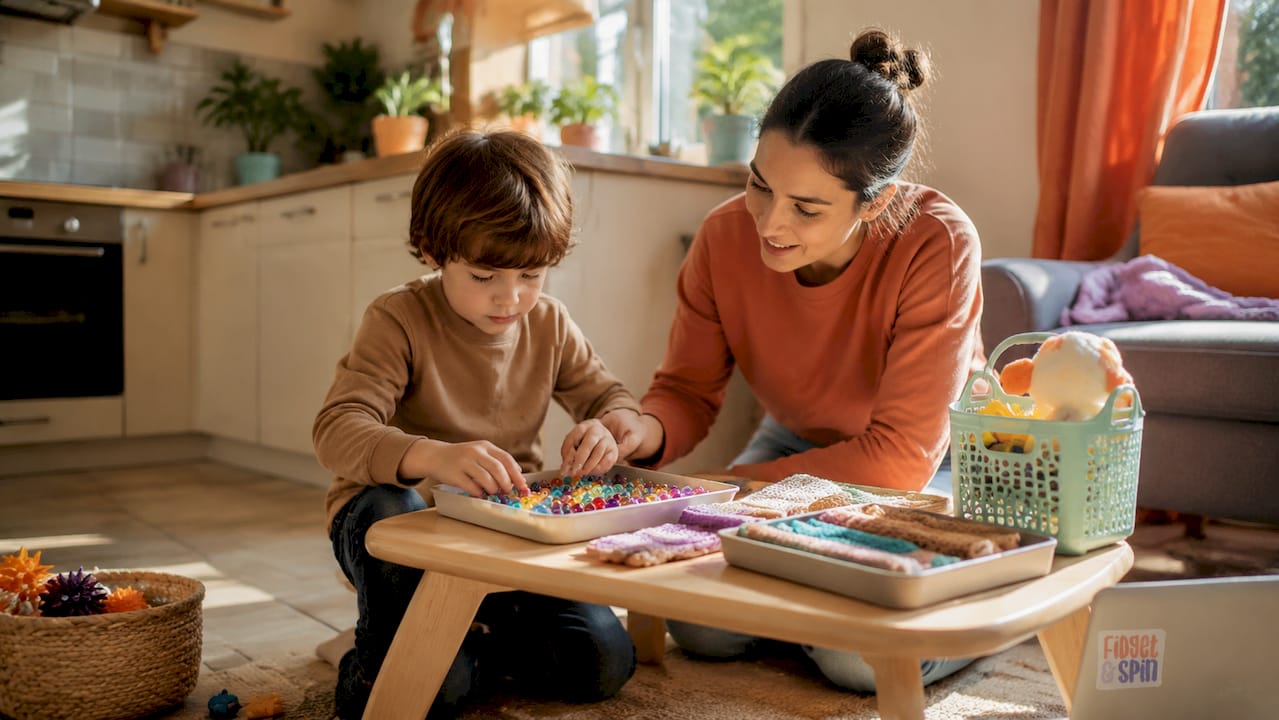
Water play is the entry point most families find easiest. A washing-up bowl, a few sponges, and some small cups is genuinely all you need. Sponge squeeze activities hold toddlers’ attention for 10–30 minutes of continuous engagement. For a child who struggles to stay with any activity for more than two minutes, that is significant. The repetitive action of squeezing and releasing is doing real work on the nervous system, not just keeping them busy.
The best sensory play materials for neurodiverse children tend to share a few qualities:
- Open-ended: No fixed outcome, no pressure to perform
- Tactile: Something to touch, press, or manipulate with the hands
- Predictable: The material behaves consistently, which builds trust and confidence
- Scalable: Can be used simply at first, then made more complex as the child settles
Icy orbs, pom-pom sorting trays, sensory bottles filled with water and glitter, and textured fabric squares all fit this description. Clay and playdough are particularly good because they offer resistance, which many children with proprioceptive needs find regulating.
Pro Tip: Start with one material in a contained space, like a shallow tray or a small box. Resist the urge to add more. A sensory bin overloaded with too many materials overwhelms neurodiverse children far more often than it excites them.
How does sensory play support emotional regulation and focus?
Remy, my son, used to arrive home from nursery absolutely wired. Not naughty, not difficult. Just full. Full of noise and demand and other people’s energy. The thing that reliably helped was not screen time, not a snack, not a quiet word. It was ten minutes with a bowl of dried rice and a few spoons.
That is not a coincidence. Sensory tools like yoga balls and stress balls lower cortisol levels and improve focus by regulating the nervous system. The physical act of engaging with a sensory material shifts the body out of a stress response. It is not magic. It is biology.
The repetitive actions involved in sensory play, squeezing, pouring, pressing, and stirring, are particularly effective for calming and grounding. They also build fine motor skills that support writing and self-care. So the child who spends twenty minutes pouring water from one cup to another is not wasting time. They are doing two things at once.
Sensory play also supports neural connectivity and cognitive flexibility, which are areas where many neurodiverse children need additional support. The brain builds infrastructure through sensory experience. That infrastructure does not stop being useful after early childhood.
Here are four ways sensory play directly supports regulation in daily routines:
- As a transition tool. Offer a brief sensory activity between demanding tasks, like a squeeze ball before homework, to help the nervous system shift gears.
- As a decompression activity. Use it after school, after a busy social situation, or after any experience that has been overstimulating.
- As a morning regulator. Some children need sensory input before they can engage with the day. A short tactile activity at breakfast can set the tone.
- As a communication bridge. Shared sensory play, sitting alongside your child without directing, creates low-pressure space for connection and sometimes language.
“Identifying which sensory inputs soothe your child is the foundation of effective regulation. Once you know what calms them, you can build it into every part of the day.” BBC Tiny Happy People
Our practical guide to emotional regulation goes deeper on this if you want evidence-based strategies alongside the sensory tools.
How to set up sensory play at home without losing your mind
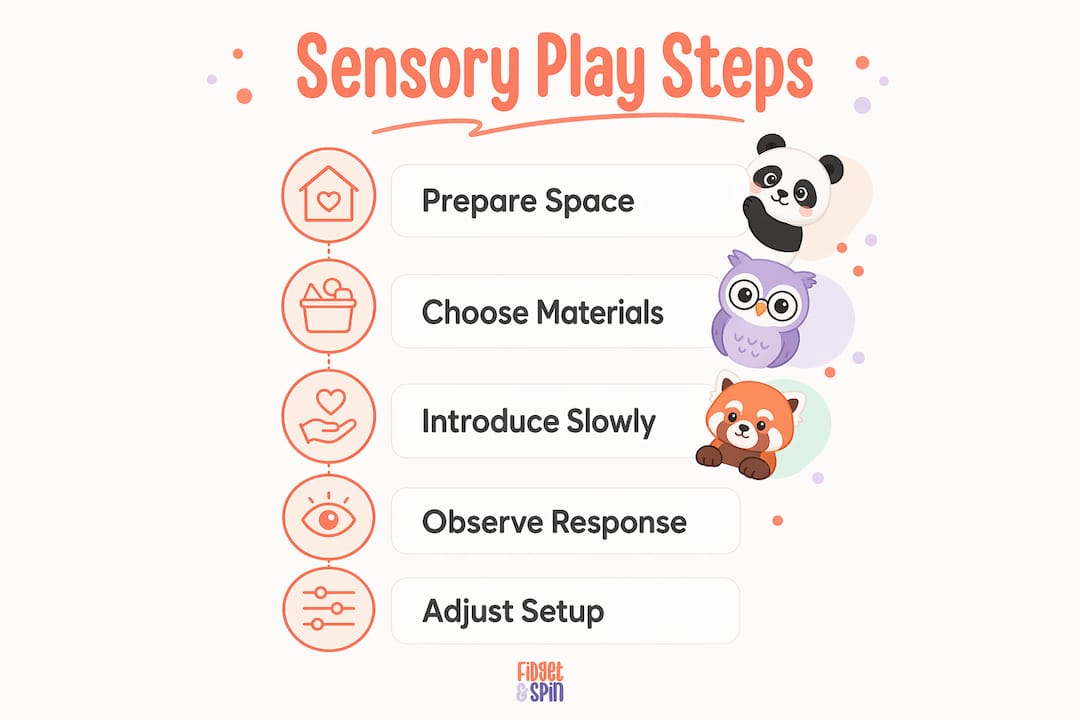
The Reggio Emilia approach describes the environment as the “third teacher.” The space itself shapes what a child does and how long they stay. That principle applies directly to sensory play at home. An intentional setup, even a very simple one, produces better engagement than a pile of toys tipped onto the floor.
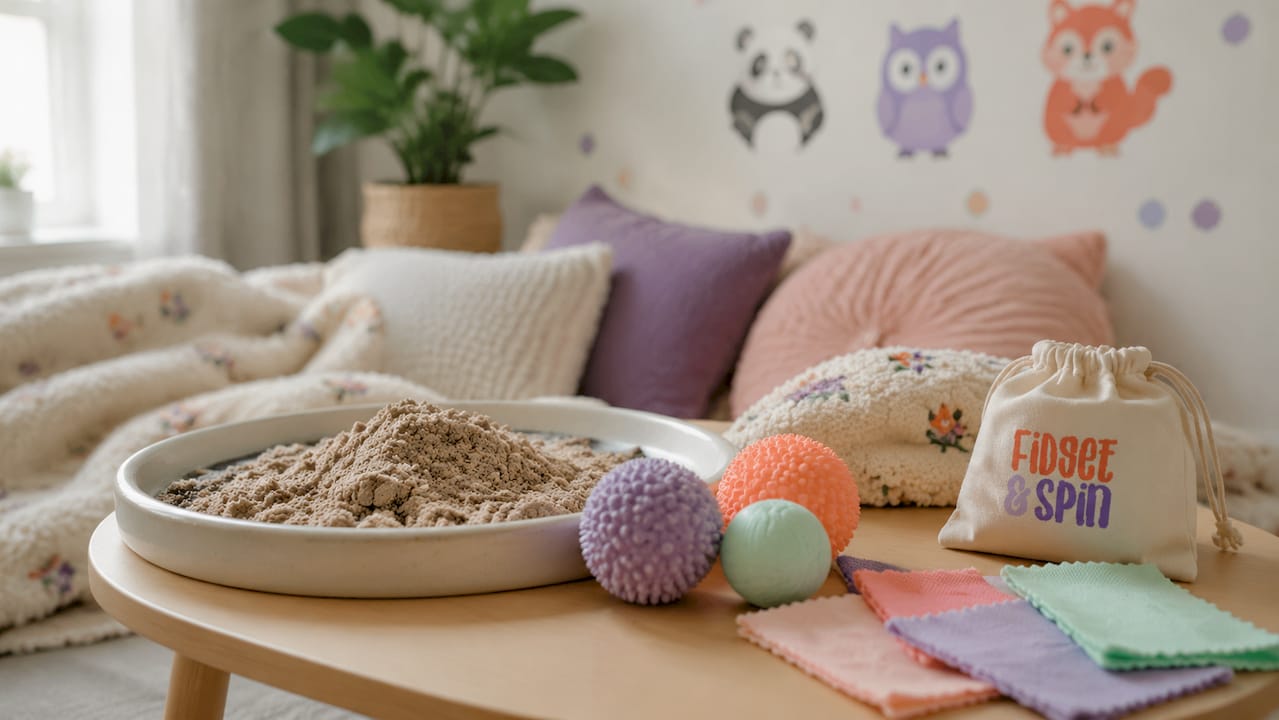
You do not need a dedicated sensory room. You need a consistent spot, a contained surface, and materials that suit your child’s current sensory profile.
| Setup element | What works | What to avoid |
|---|---|---|
| Container | Shallow tray, washing-up bowl, storage box | Deep bins that hide materials |
| Material quantity | 2–3 items to start | More than 5 items at once |
| Location | Same spot each time | Rotating locations that add uncertainty |
| Duration | Child-led, no time pressure | Forced endings mid-engagement |
| Supervision | Present but not directing | Hovering and correcting |
Safety matters too, particularly for children who mouth objects. Large, taste-safe materials and sealed sensory bottles are the right choice for children who explore with their mouths. Cooked pasta, large dried beans, and edible playdough all work well. Sealed bottles filled with water, glitter, and small objects give visual sensory input without any mouthing risk.
Pro Tip: Build sensory play into an existing routine rather than treating it as a separate activity. After lunch, before bath, or as part of the wind-down before bed are all natural slots. Consistency reduces the negotiation and makes it easier for your child to anticipate and accept.
For more ideas on organising your space, our creative sensory zone ideas post has practical layouts that work in small homes.
What creative sensory activities can you try this week?
The best creative sensory activities for kids are the ones you can actually set up in five minutes on a Tuesday afternoon. Elaborate Pinterest setups are lovely, but they are not the reality of most SEN family life. These ideas are quick, adaptable, and suit a range of sensory profiles.
Calm and tactile:
- Sensory bottles. Fill a sealed plastic bottle with water, glitter glue, and small objects. Shake and watch. Brilliant for visual regulation and calming.
- Pom-pom sorting. Sort by colour, size, or texture into egg boxes or muffin tins. Quiet, focused, and satisfying for children who like order.
- Playdough with tools. Add a rolling pin, some cutters, and a fork. The resistance and texture do the sensory work without any mess.
Active and proprioceptive:
- Icy orbs. Freeze water balloons overnight, peel off the balloon, and let your child explore the cold, smooth surface. Brilliant for children who seek cold or pressure input.
- Digging bins. Bury small objects in kinetic sand or dried rice and let your child find them. The searching and digging provides deep pressure to the hands.
- Yoga ball rolling. Lie your child face-down across a yoga ball and roll them gently forward and back. This proprioceptive input is regulating for many children with ADHD and autism.
For communication and connection:
Sensory play is a genuinely good vehicle for language. When you sit alongside your child and narrate what you see, “cold, smooth, heavy, wet,” you are building vocabulary without pressure. Multi-sensory play forms stronger memory links for language and emotional regulation by engaging multiple calming inputs at once. That is why the words tend to stick.
Adapting activities for different ages is mostly about scale and complexity. A two-year-old needs fewer materials and more time. A six-year-old like Remy might want to add a narrative, “this is a volcano, the red playdough is lava.” Follow their lead and the activity adapts itself.
Key takeaways
Engaging kids in sensory play works best when materials are open-ended, setups are simple, and the activity is built into an existing daily routine rather than treated as a separate task.
| Point | Details |
|---|---|
| Start with 2–3 materials | Overloaded sensory bins overwhelm neurodiverse children; simplicity produces longer engagement. |
| Repetition is regulation | Squeezing, pouring, and pressing are not just play; they actively lower stress and build fine motor skills. |
| Environment shapes engagement | A consistent, intentional setup acts as a third teacher and increases how long children stay with an activity. |
| Sensory play supports language | Multi-sensory activities build stronger memory links for vocabulary and emotional understanding. |
| Build it into routine | Sensory play embedded in daily transitions is more effective than occasional, standalone sessions. |
What I have actually learned from doing this with Remy
I spent a long time trying to make sensory play look like the photos online. Colour-coordinated bins, themed materials, everything labelled. Remy ignored all of it and went straight for the kitchen sink.
That was the lesson. He already knew what his nervous system needed. My job was to stop getting in the way and start paying attention.
The hardest part of sensory play with a neurodiverse child is not the mess or the setup. It is the patience required to observe without directing. I am a fixer by nature. Watching Remy pour water onto the floor for the fifteenth time while I sat on my hands was genuinely difficult. But those sessions were the ones where he was most regulated afterwards. The ones where he came to the table for dinner without a meltdown. The ones where he said something new.
I also want to say this plainly: not every session works. Some days Remy walks away after thirty seconds. Some days the texture is wrong, the light is too bright, or he is simply too dysregulated to engage with anything. That is not failure. That is information. You are learning your child’s nervous system, and that takes time.
What I have found is that the sensory play strategies that work consistently are the boring ones. The same bowl. The same spot. The same three materials. Predictability is not boring to a neurodiverse child. It is safety.
— Caitlin
Try sensory play with other families who get it
Anthony and I built Fidget and Spin because we kept leaving groups early. Remy would be overwhelmed, we would be apologising, and everyone would be miserable. We wanted a space where none of that happened. Where the noise level was managed, the lighting was considered, and nobody gave you a look when your child needed to lie on the floor for a bit.
Our weekly sensory stay and play sessions in Brighton and Hove are designed around exactly the principles in this article. Three zones, Wiggle and Bounce, Snuggle and Chill, and Squish and Squeeze, so children can move between big movement, low-stim rest, and tactile play as their nervous system needs. No pressure, no performance, no side-eye.
If you are thinking about a birthday party, our SEN sensory birthday parties are built for neurodiverse children aged 1–7, with packages starting at £220. Every detail is considered. Because your child deserves a party that actually works for them.
FAQ
What are the benefits of sensory play for neurodiverse children?
Sensory play supports emotional regulation, neural development, fine motor skills, and language acquisition. For neurodiverse children, it also provides a low-pressure way to build focus and process sensory input at their own pace.
How do I introduce sensory play to a child who resists new textures?
Start with materials your child already tolerates, like water or dry rice, and keep the setup very simple. Sit alongside them without directing, and let them lead the pace of exploration entirely.
What are the best sensory play materials for children who mouth objects?
Large, taste-safe materials like cooked pasta, edible playdough, and large dried beans are the safest choices. Sealed sensory bottles provide visual and tactile input with no mouthing risk.
How long should a sensory play session last?
Follow your child’s lead rather than a clock. Water-based sensory activities typically hold toddlers’ attention for 10–30 minutes, but any duration of genuine engagement is worthwhile.
Can sensory play help with transitions and meltdowns?
Yes. Brief sensory activities used before or after demanding tasks, like a squeeze ball before homework or water play after school, help regulate the nervous system and reduce the likelihood of overload.
Recommended
- Effective sensory play strategies for neurodiverse kids | Fidget and Spin Brighton
- Sensory play best practices for neurodiverse kids | Fidget and Spin Brighton
- Sensory play explained for neurodiverse children | Fidget and Spin Brighton
- Effective early years play strategies for neurodiverse children | Fidget and Spin Brighton