Why fidgeting for focus is a real thing, not a bad habit
Remy used to get told off for wriggling. Every group, every session, every well-meaning adult with a hand on his shoulder. “Can you sit still, sweetheart?” And I’d be across the room, jaw tight, knowing that sitting still was exactly what was making it harder for him to listen.
Fidgeting for focus is not a behaviour problem. It is the body’s way of self-regulating attention when the brain needs more input to stay engaged. Clinical psychologist Roland Rotz describes it plainly: “Fidgeting is our body’s way of self-regulating. At times when we’re under-focused, or having a hard time concentrating, this is the body’s natural way of stimulating itself.” Research into children with ADHD shows that hyperactive movements increase prefrontal cortical arousal and alertness during cognitive tasks. That is not misbehaviour. That is the nervous system doing its job.
The key distinction is between natural regulation and distraction. Subtle, rhythmic movement keeps the brain alert. A spinning, flashing gadget pulls attention away from the task entirely. Getting that distinction right is everything.
Benefits of fidgeting for concentration, when managed well:
- Increases alertness and cortical arousal during listening and mental tasks
- Channels excess energy without disrupting peers
- Reduces the need for more overt, disruptive movement
- Supports emotional regulation and sensory processing
- Helps neurodiverse children participate more fully in learning
Table of Contents
- How to choose fidget tools that actually help concentration
- Using fidgeting deliberately to support learning
- What sensory needs actually have to do with focus
- Practical steps for parents and educators
- Key takeaways
- FAQ
How to choose fidget tools that actually help concentration
I spent a fortune on the wrong things before I worked this out. The spinner Remy begged for lasted about four days before it became a projectile. The stress ball he barely noticed is still in his school bag two years later.
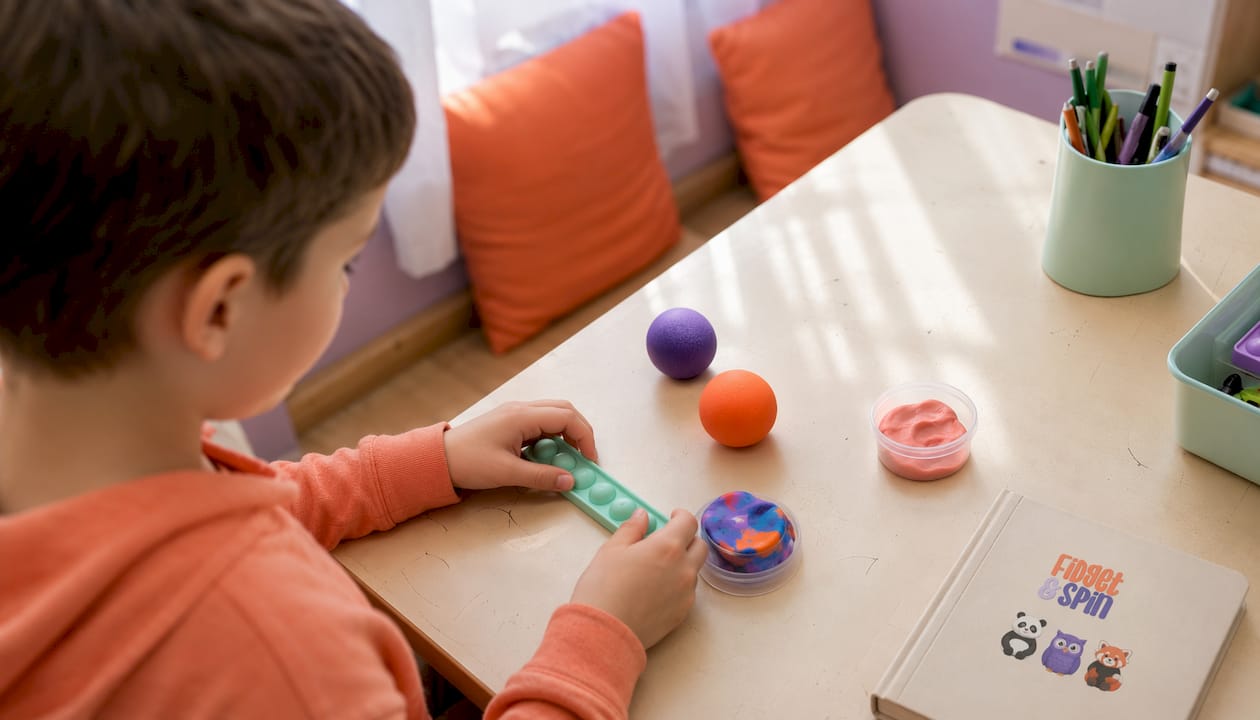
The research is clear on this. Fidget spinners double the number of “attention violations” compared to baseline in children with ADHD. They are visually engaging, which means the child watches the tool instead of the teacher. Professor Sydney Zentall of Purdue University puts it well: the goal is focusing, not fidgeting in itself. The most effective tools, she argues, “don’t require the person to look at what he or she is doing.”
That is the test. If your child has to look at it, it is a toy. If they can use it without looking, it might be a focus tool.
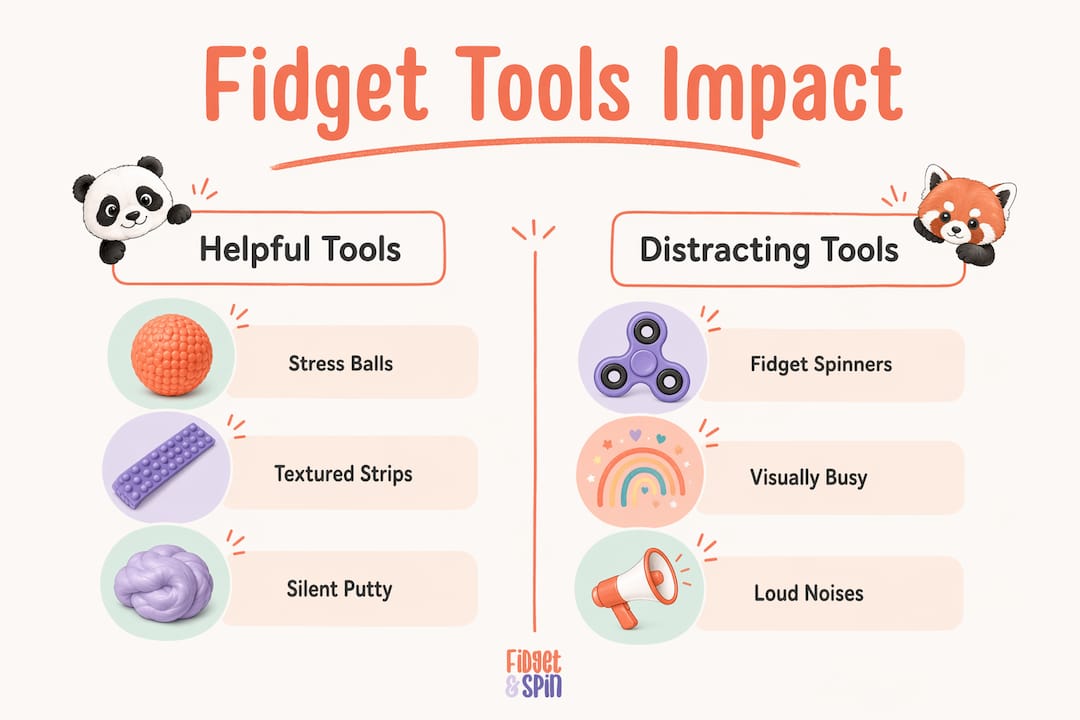
Good fidget tools (low-profile, tactile, quiet):
- Stress balls and koosh balls
- Silent putty or blu-tac
- Textured strips stuck to the underside of a desk
- Chair resistance bands (pushed against with feet)
- Tangle toys and twisting blocks
- Small smooth pebbles
Tools that tend to distract rather than help:
- Fidget spinners (visually demanding, associated with poorer attention)
- Pop-it toys and large, brightly coloured gadgets
- Anything that makes noise
- Anything that encourages sharing or trading
Schools that allow silent, discreet sensory tools rather than flashy toys consistently report better outcomes. The tool should be invisible to everyone except the child using it.
Using fidgeting deliberately to support learning
The other thing nobody tells you is that when your child uses a fidget tool matters as much as what they use. I learned this the hard way when Remy tried to squeeze a stress ball while writing and ended up with a page of illegible squiggles.
Dr. Zentall is specific on this: fidget tools work best during listening tasks or mental computation. When hands need to write, the tool gets in the way. That is not a failure of the tool. It is just the wrong moment for it.
The concept of “managed fidgeting” is worth understanding here. It means teaching children when the tool helps and when to set it down, rather than leaving it as a free-for-all. Many schools now use a simple fidget agreement with the child: “I use this when I’m listening; I put it away when I’m writing.” That kind of explicit agreement prevents the tool from becoming a distraction.
Pro Tip: Introduce the fidget tool during a low-stakes listening task first, not during a test or group work. Let the child build the habit of using it as a concentration aid before it goes anywhere near a pressured situation.
Dos and don’ts for using fidget strategies effectively:
- Do use during listening, story time, and mental maths
- Do teach the child to self-monitor (“Is this helping me or distracting me?”)
- Do pair the tool with a clear, simple agreement about when it comes out
- Don’t use during handwriting or tasks requiring both hands
- Don’t allow the tool during transitions or break time, where it becomes a toy
- Don’t let it be shared or traded, which creates social dynamics that derail focus
Subtle motor activities like light doodling or pen tapping can serve the same purpose when a physical tool is not available. The most effective doodles for focus involve a rapid, rhythmic movement, not an elaborate drawing that becomes its own project.
What sensory needs actually have to do with focus
Here is something I wish someone had explained to me when Remy was three. His fidgeting was not random. It was information-seeking. His nervous system needed more input than the environment was providing, so his body went looking for it.
Children who are under-responsive to touch seek out tactile input through fidgeting, touching surfaces, or moving constantly. Children who are over-responsive may find certain textures overwhelming, which creates anxiety and avoidance rather than engagement. Both profiles affect focus, just in different directions.
Proprioceptive input, the deep pressure feedback from muscles and joints, is particularly useful for regulation. That is why resistance bands around chair legs work so well. The child pushes against them with their feet, gets that grounding input, and their nervous system settles enough to attend. It is quiet, invisible, and it does not require the child to think about it.
Matching sensory profile to fidget approach:
- Under-responsive to touch: firmer textures, more resistance, varied tactile options like koosh balls or textured strips
- Over-responsive to touch: smooth, predictable textures; avoid scratchy or unexpected surfaces
- Seeking proprioceptive input: chair resistance bands, foot pedals, weighted lap pads
- Seeking oral input: chew tools (separate category, but worth knowing about)
- General alertness support: any quiet, hand-based tactile tool used consistently
A variety of tactile fidget aids with different textures and firmness levels gives children the best chance of finding what genuinely regulates them, rather than what just keeps their hands busy.
Practical steps for parents and educators
Getting a fidget tool into school without it being confiscated on day one takes a bit of groundwork. I have been through this. Here is what actually works.
Start with the SENDCo. Most schools require SENDCo agreement before a sensory tool is used in class, and a brief trial period before it becomes part of the child’s routine. That is not bureaucracy for its own sake. It means the tool gets introduced properly, with guidelines, rather than turning up in a pencil case and confusing everyone.
Schools that introduce fidget tools with clear rules report better engagement and fewer disruptions than those that either ban them outright or allow them without structure. The rules matter as much as the tool.
Practical support strategies:
- Involve the child in choosing their tool; buy-in improves consistent use
- Agree a written or visual fidget plan with school staff, reviewed every four weeks
- Keep the tool at school, not in a shared bag, to reduce the chance of it becoming a toy at home
- Fidget tools should not be shared or traded during class time
- Address the misconception directly with teachers: fidgeting during listening is often a sign of engagement, not inattention
- If the tool stops helping or starts distracting, swap it out rather than removing fidgeting support entirely
For families navigating support plans and understanding core support services, sensory tools often sit within broader regulation strategies worth discussing with your child’s support team.
At Fidget and Spin, our weekly sessions in Brighton give children a space to explore exactly this kind of sensory regulation through play, across our Squish & Squeeze zone where tactile tools and fidgets are part of the environment, not an afterthought. If you want to see how sensory play sessions can support your child’s regulation in a genuinely welcoming space, we would love to have you.
Our SEN-friendly birthday parties are built on the same principles: low-stim options, sensory zones, and no pressure to perform. Because every child deserves a party that works for them.
Key takeaways
Fidgeting for focus works when the tool is low-profile, the task is passive, and the child has a clear agreement about when and how to use it.
| Point | Details |
|---|---|
| Tool type determines outcome | Tactile, quiet tools aid focus; visually engaging ones like spinners increase attention violations. |
| Task timing matters | Fidget tools help most during listening and mental tasks, not during handwriting. |
| Sensory profile guides choice | Match the tool’s texture and resistance to the child’s specific sensory needs. |
| Agreements prevent misuse | A simple fidget plan with the child and SENDCo keeps the tool as a support, not a toy. |
| Review regularly | Reassess every four weeks; a tool that helped at six may not work the same way at seven. |
FAQ
Can fidgeting actually improve focus in children?
Yes, particularly for neurodiverse children. Research shows that subtle, tactile movement increases prefrontal cortical arousal and helps children maintain alertness during cognitive tasks.
Are fidget spinners good for concentration?
No. Studies show children with ADHD commit more than double the number of attention violations when using fidget spinners compared to their baseline. Low-profile tactile tools are far more effective.
What fidget tools work best in a classroom?
Stress balls, textured strips, silent putty, and chair resistance bands are consistently recommended. They are quiet, discreet, and do not require the child to look at them.
How do I get a fidget tool approved at my child’s school?
Speak to the SENDCo first. Most schools require a brief trial and a simple written agreement before a sensory tool becomes part of a child’s classroom routine.
Does fidgeting help children without ADHD too?
Yes. Fidgeting is a self-regulatory behaviour that benefits a broad range of neurodiverse children, including those with autism, anxiety, and sensory processing differences, not only those with ADHD.
Recommended
- How fidget toys help focus in neurodiverse children | Fidget and Spin Brighton
- Benefits of fidget toys for neurodiverse children | Fidget and Spin Brighton
- Benefits of fidget tools for neurodiverse children | Fidget and Spin Brighton
- The real impact of fidget toys on neurodiverse children | Fidget and Spin Brighton