
A short burst of heavy work before a party can calm many children. Do it proactively, 5 to 7 minutes, and watch how they respond. Pick resistance-based jobs first, and if energy climbs rather than settles, swap to slower, deep-pressure options instead of pushing on.
TL;DR:
- Heavy work activities should be brief, ideally lasting 5 to 7 minutes, and repeated consistently to prevent escalation and promote calmness.
- Picking two or three resistance-based tasks such as carrying heavy objects or wall push-ups prior to events helps regulate a child’s nervous system effectively.
- Watching the child’s body for signs of calm versus escalation can inform whether the activity is appropriately timed and intensity; distress indicates a need to lower effort.
- Incorporating simple, purposeful jobs before leaving the house, like pushing a trolley or squeezing a pillow, creates a routine that stabilizes sensory needs without overwhelming the child.
- For children with sensory-seeking tendencies, multiple repetitions of heavy work are often necessary, and tailored sensory plans may be needed if distress persists.
Table of Contents
- What is heavy work before parties, exactly?
- Why does heavy work calm the nervous system?
- Ten heavy work activities to try before you leave the house
- The 15-minute door-to-car pre-party routine
- Is it working, or is it winding them up?
- What we actually do before Fidget & Spin parties
- A note from one tired parent to another
- Book a session or party built around this
- Sources
- FAQ
What is heavy work before parties, exactly?
Heavy work means anything that pushes, pulls, or presses against the body with real resistance. Occupational therapists call the input it gives the nervous system “proprioceptive input”, which is a fancy way of saying your muscles and joints send a signal to the brain saying “here you are, here’s your body, here’s where it ends.”
You don’t need equipment. Carrying the laundry basket to the car. Pushing a loaded shopping trolley. Wheelbarrow walks across the lounge. Squeezing a pillow between two flat hands, hard, five times. All of it counts.
This isn’t the same as calling a child “naughty” for climbing the sofa arm for the ninth time. That’s sensory seeking, the body asking for input it needs, not a behaviour to correct. Heavy work gives that seeking somewhere useful to go, before the party, rather than mid-meltdown in someone’s hallway.
Why does heavy work calm the nervous system?
Because deep pressure and resistance give the brain something clear to process. A body under load, pushing a heavy trolley, carrying books, gets organised feedback: this much weight, this much effort, this is where I am in space. That’s a steadier signal than the flickering noise of a party, balloons popping, thirty voices layered on top of each other, the smell of someone else’s kitchen.
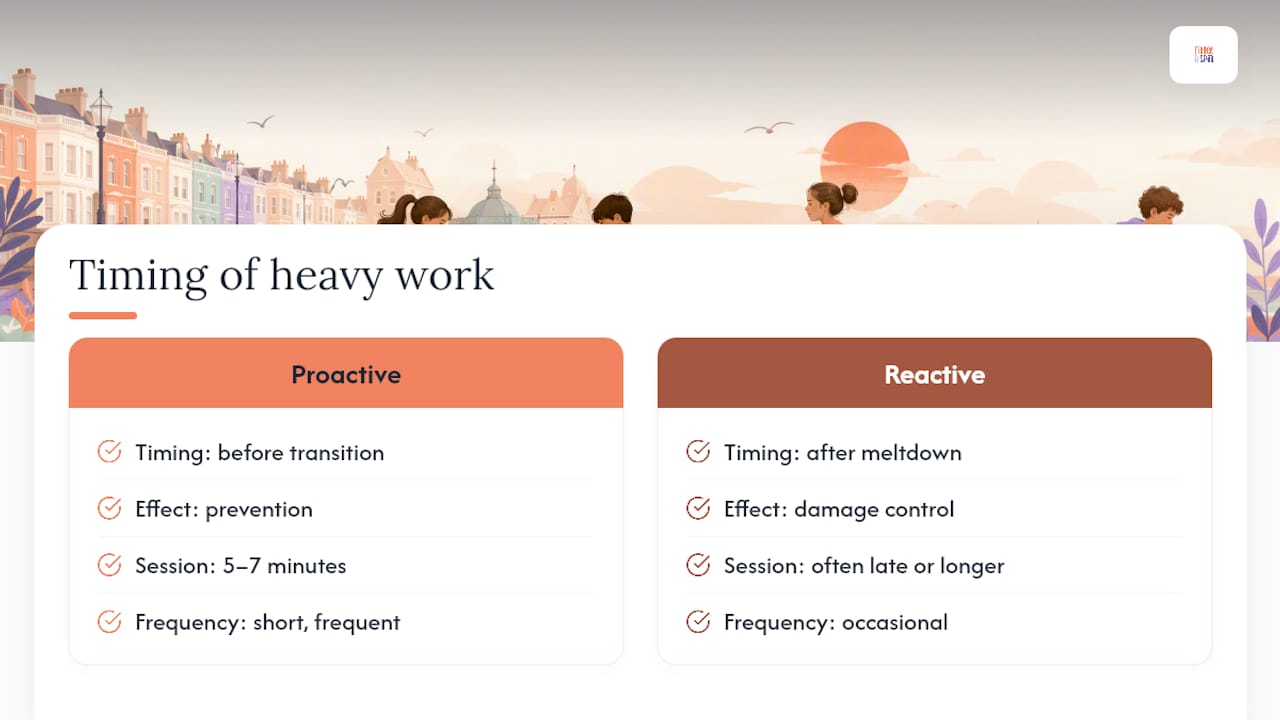
NHS Borders guidance on heavy work supports doing it proactively, before the transition, rather than only once a child is already struggling. That timing matters more than most parents expect. A session offered after the meltdown starts is damage control. The same session offered in the hallway before you’ve even got shoes on is prevention.
Pro Tip: Short and frequent beats long and occasional. Consistency in the dose matters more than the intensity of any single session.
Here’s the figure worth pinning to your fridge: effective sessions can be brief, often just 5 to 7 minutes. You don’t need a 40-minute obstacle course before every birthday party. You need one reliable, boring, repeatable job that gives the body a clear physical signal before it walks into a room full of unclear ones.
A systematic review of proprioceptive feedback methods for sensory-seeking children has looked across different intervention types, and the general shape of the evidence lines up with what OT handouts already say: this is a legitimate, well-studied strategy, not a parenting hack dreamed up on a Facebook group. That doesn’t mean every child responds the same way. It means the odds are genuinely in your favour if you try it.
Ten heavy work activities to try before you leave the house
Pick two or three from this list rather than attempting all of them. The point is a quick dose, not a full circuit session.
- Carry the shopping bags to the car and back, twice. Any age, indoors or out, about 2 minutes.
- Wheelbarrow walks across the hallway carpet. Ages 3 and up, needs floor space, 1 to 2 minutes.
- Wall push-ups, ten of them, leaning hard into the wall. Works from age 4, tiny space required, under 1 minute.
- Push the empty wheelie bin to the end of the drive and back. Outdoor only, any age who can reach the handle, 2 minutes.
- Pillow squeeze, pressing a cushion between flat palms as hard as they can. Any age, anywhere, 1 minute.
- Animal walks, bear crawl or crab walk across the room. Ages 3 and up, needs a bit of floor space, 2 minutes.
- Firm bear hug, giving and receiving, three long squeezes. Works at any age including toddlers, anywhere including the car park, 30 seconds.
- Carry a laundry basket of books or towels up the stairs and down. Ages 4 and up, indoors, 2 to 3 minutes.
- Being “squished” gently between two sofa cushions, NHS-recommended deep pressure for calming rather than activating. Any age, sofa needed, 1 to 2 minutes.
- Rolling a therapy ball or a rolled-up duvet firmly over the back while lying down. Works well for younger children, needs a soft surface, 2 minutes.
Some children need more input, not less. If your child is a strong sensory seeker, don’t ration this. Let them repeat the pushing or carrying job several times before you assume it hasn’t worked. Watch their body, not the clock.
The 15-minute door-to-car pre-party routine
Turn the list above into a rhythm you can run on autopilot, because autopilot is what you’ll need when you’re also hunting for the birthday present you bought three weeks ago and immediately lost.
- 10 minutes before leaving: one heavy job, wheelbarrow walks or carrying something heavy up the stairs. Frame it as a job, not a test: “Can you help me carry this? It’s heavy.” That phrasing works better than “let’s do a calming activity”, which, understandably, no six-year-old has ever wanted to do.
- At the door, shoes on: a firm hug or a pillow squeeze, 30 seconds, low pressure to invite rather than insist.
- At the car: pushing the car door shut with both hands, carrying their own bag to the boot. A quick cardoor routine like this is a genuinely low-effort last dose before a busy venue.
Pack a small kit before you leave: a cushion or two, a stress ball, something with a bit of weight to it like a folded blanket, and a spare jacket in case the party’s too warm or too cold for comfort. None of this needs to be expensive or specialist. Consistent, small routines beat one heroic effort every time.
Is it working, or is it winding them up?
Watch the body, not the behaviour chart. Calming looks like slower breathing, softer movements, a child who settles into the job rather than speeding up through it. That’s the “just right” resistance you’re after, the point where effort brings a child back to baseline rather than pushing them further from it.
Escalation looks different: louder vocalising, faster and more frantic movement, or a refusal to stop that has an edge of panic rather than enjoyment. If you see that, the activity’s too intense or too fast for right now. Swap immediately to something lower and slower: a firm hug, rolling a ball gently over the back, sitting with a weighted cushion on the lap. Jumping and running are heavy work too, but they raise arousal for some children rather than lowering it, so they’re the wrong tool if calm is the goal.
If heavy work consistently increases distress rather than easing it, however you dose it, that’s worth raising with a GP or an occupational therapist. Some children need a properly tailored sensory plan, and there’s no shame in asking for one.
What we actually do before Fidget & Spin parties
I still leave the house fifteen minutes earlier than I need to, every single time, because Remy needs the car door routine and I need the buffer for when it doesn’t go to plan. Old habit. Never dies.
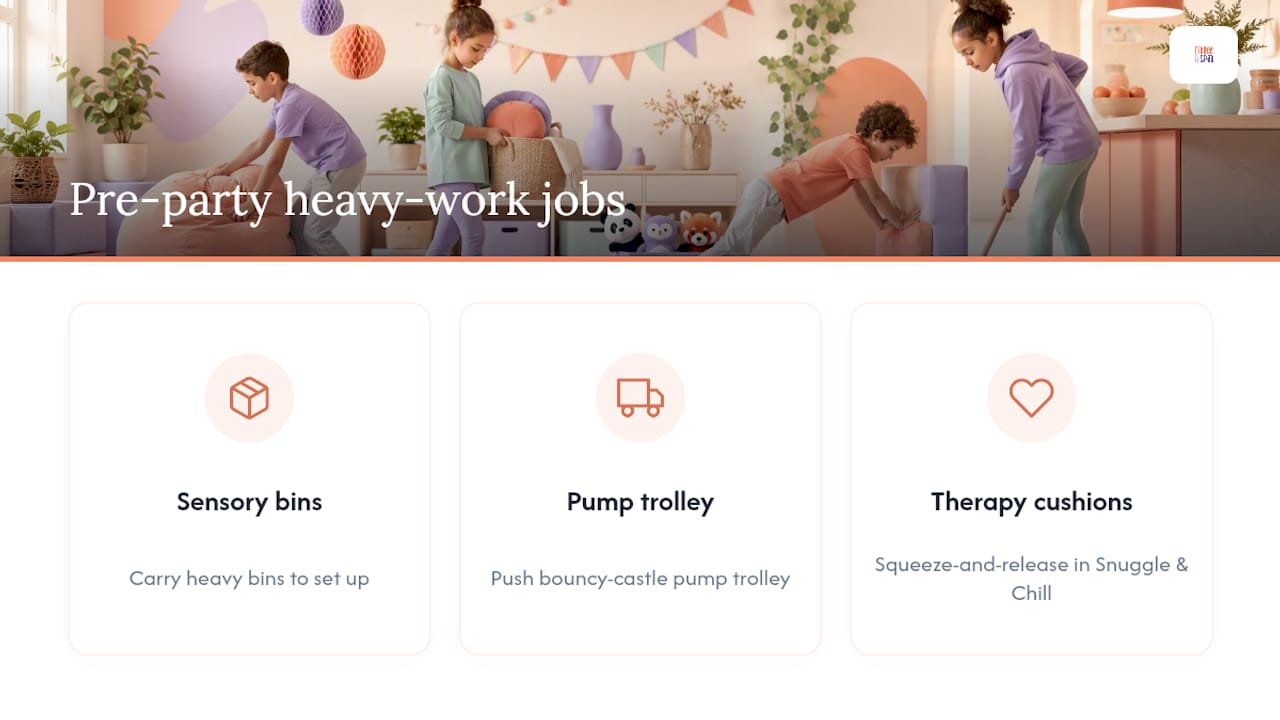
At sessions and parties, three jobs come out constantly: carrying the sensory bins to set them up (genuinely heavy, genuinely useful), pushing the bouncy castle pump trolley, and squeeze-and-release with the therapy cushions in Snuggle & Chill before the noisier bit starts. They’re not “exercises.” They’re jobs with a purpose the kids can see.
You can borrow this anywhere, another venue, your own front room. Give the job a reason, keep it short, and do it before the door opens, not after.
A note from one tired parent to another
I know the dread before a party. The mental checklist. The “will we make it through the first ten minutes” feeling before you’ve even got your coat on.
Small, boring routines beat big, heroic efforts. They just do. If you take one thing from this, make it a single 5-minute heavy work habit you do before every party, the same one, every time. Not perfect. Just repeated.
— Caitlin
Book a session or party built around this
There are other ways to prep for a party, home routines, borrowed venue tricks, a quiet car park pep talk. But if you want the regulation built into the day itself rather than bolted on beforehand, that’s exactly what Fidget and Spin was built for. We’re designed and run by SEN parents, so sensory zoning and low judgement aren’t an afterthought retrofitted onto a normal party format, they’re the whole point.
Our weekly SEN Stay and Play sessions give children regular practice with proprioceptive input across three zones, Wiggle & Bounce for the big carrying-and-pushing jobs, Squish & Squeeze for deep pressure, and Snuggle & Chill for the comedown, at £7.50 a session. For birthdays, our SEN-friendly party packages run from The Wee One at £220 through to The Whole Shebang at £530, each one already zoned so the heavy work and the calm-down space exist without you having to build them yourself. If low-stim parties are new territory for you, our low-stimulation party ideas guide is worth a read too. Have a look at dates on the sessions page or check package availability on the parties page for Brighton, Hove and wider Sussex.
Sources
- Heavy Work Activities for School — NHS Borders
- Heavy work exercises — Bedfordshire and Luton children’s occupational therapy service
- Proprioception activities handout — WUTH sensory clinic
- Methods for the provision of proprioceptive feedback for children exhibiting sensory-seeking behaviours — systematic review (OSF)
FAQ
Is heavy work good for ADHD?
Yes, many children with ADHD respond well to heavy work because the resistance and deep pressure give the nervous system clear input to organise around. It won’t work identically for every child, so watch the response rather than assuming it, and adjust the intensity if energy rises instead of settling.
What is proprioceptive heavy work?
Proprioceptive heavy work is any activity that pushes, pulls, or presses against the body, like carrying, pushing, or squeezing something with resistance. It gives the brain feedback about where the body is in space, which many children find organising and calming.
What does “proprioceptive seeking” mean?
Proprioceptive seeking describes a child actively looking for that resistance input, crashing into cushions, climbing furniture, gripping things tightly. It’s the body’s way of asking for the sensory feedback it needs, not a behaviour to discourage, and heavy work gives that seeking a clear outlet.
What are some examples of heavy work activities for adults?
Adults get the same benefit from carrying shopping, gardening, resistance exercise, or pushing furniture into place. The principle is identical to the checklist above, just scaled to an adult body: sustained resistance against muscles and joints for a few minutes at a time.
How much does Fidget and Spin cost?
Weekly sessions run at £7.50, and SEN-friendly party packages start at £220 for The Wee One, rising to £530 for The Whole Shebang. Full pricing and add-ons are listed on the sessions and parties pages.