
TL;DR:
- Fidget toys have a long history rooted in ancient Chinese calming objects like Baoding balls, evolving into modern sensory tools. They are now a multimillion-pound industry used for regulation across various settings, supported by scientific research. The effectiveness of fidget toys depends on choosing quiet, discreet designs that support focus and sensory regulation without causing distraction.
Fidget toys are handheld tools designed to provide controlled, repetitive sensory stimulation, helping the brain stay regulated and focused. The history of fidget toys stretches back further than most people realise. Baoding balls from Ming Dynasty China, stress balls from the 1980s, and the fidget spinner craze of 2017 are all part of the same long story. What began as cultural and spiritual objects has evolved into a recognised category of sensory regulation tools used in classrooms, therapy rooms, and workplaces. The global fidget toy industry is valued at approximately £7.15 billion as of 2026. That figure tells you this is no longer a playground fad.
What is the history of fidget toys and where did they begin?
The earliest evidence of fidget-like objects dates to around 3500 BC, when simple string toys and tactile objects were used across ancient cultures for calming and ritual purposes. These were not toys in the modern sense. They were tools for managing the body’s restless energy, which is exactly what we still use them for today.
The most significant early example is the Baoding ball, originating in Baoding, China, during the Ming Dynasty (1368–1644). These hollow iron spheres were designed to be rotated in the palm, producing a gentle chiming sound. The practice drew from traditional Chinese medicine, which held that stimulating the hand’s meridian points supported overall health and mental calm. Buddhist monks used similar objects during meditation, rolling beads or smooth stones to anchor attention without disrupting prayer.
Battle walnuts offer another fascinating chapter. In imperial China, pairs of walnuts were selected for their symmetry and texture, then polished over years of handling until they developed a deep, lacquered sheen. Owning a prized pair became a status symbol among scholars and officials. The act of rolling them in the hand was considered both calming and intellectually respectable. That social legitimacy is something fidget tools have spent centuries trying to reclaim.
Key features of these ancient sensory tools:
- Repetitive, rhythmic motion as the core mechanism
- Tactile feedback through weight, texture, and temperature
- Cultural and spiritual framing that made their use socially acceptable
- Portability, allowing use during other activities such as conversation or study
- Connection to traditional Chinese medicine and mindfulness practices
The pattern is consistent across cultures and centuries. When people need to regulate their nervous systems, they reach for something to hold and manipulate. The objects change. The need does not.
How did fidget toys evolve through the 20th century?
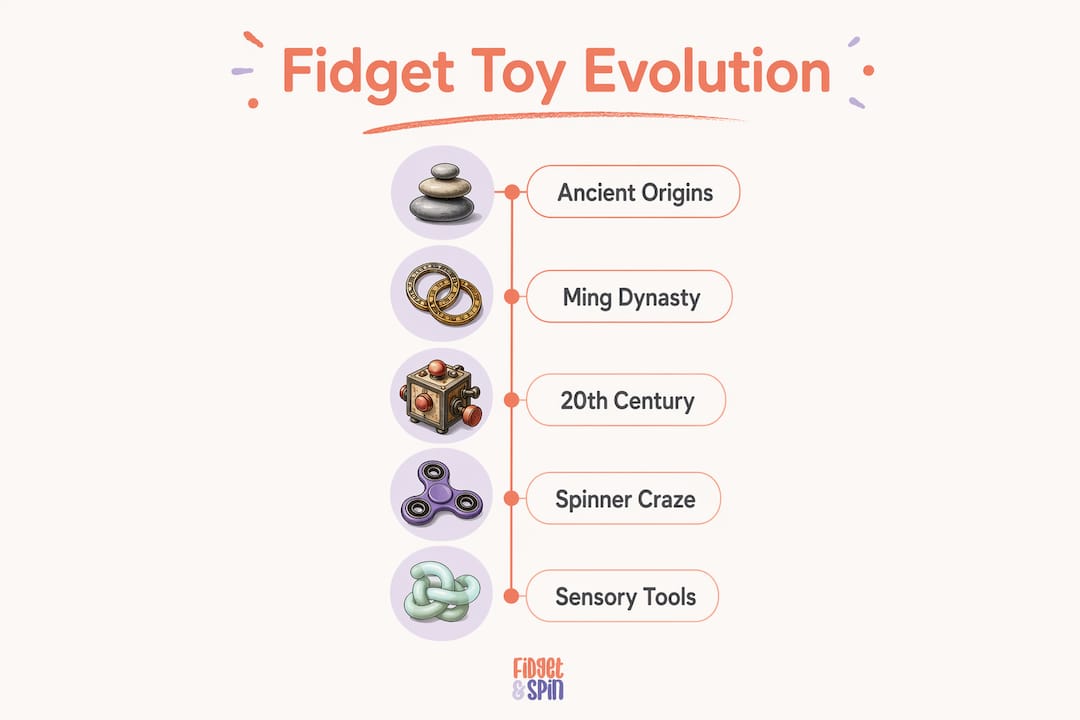
The 20th century brought a new vocabulary for stress and a new market for managing it. Stress awareness grew significantly from the 1930s onwards, as industrialisation and two world wars made anxiety a mainstream concern rather than a private failing. By the 1980s, the stress ball had arrived: a squeezable foam or gel-filled sphere marketed to office workers and executives as a desk-side pressure release.

The 1980s and 1990s also introduced magnetic toys and clacking metal balls, which were popular but noisy. They were the fidget tools of the boardroom, not the classroom. Then, in 1993, a Florida inventor named Catherine Hettinger filed a patent for a spinning toy designed to help children channel restless energy. Her original design was simple and plastic. The patent lapsed in 2005 due to unpaid renewal fees, a detail that would later become significant when the fidget spinner became a global phenomenon.
The modern fidget spinner as most people know it was refined by Scott McCoskery, who created the Torqbar in 2014 as a precision-engineered tool for managing his own fidgeting during conference calls. The Torqbar used quality bearings and weighted arms to produce a smooth, satisfying spin. It was aimed at adults, not children.
- 1930s onwards: Stress recognised as a widespread condition, creating demand for physical relief tools.
- 1980s: Stress balls enter mainstream consumer markets, marketed to working adults.
- 1980s–90s: Magnetic and clacking toys gain popularity, though their noise limits discreet use.
- 1993: Catherine Hettinger patents an early spinning toy concept in the United States.
- 2014: Scott McCoskery creates the Torqbar, a precision fidget spinner for adult professional use.
- 2016–17: Mass-produced plastic fidget spinners flood the market, triggering a global craze.
Pro Tip: If you are choosing a fidget tool for a child with ADHD or sensory processing differences, look at the Torqbar’s original design principles: low noise, smooth motion, and satisfying weight. These qualities matter far more than novelty features.
What was the real impact of the fidget spinner craze?
The fidget spinner craze of 2016–17 was genuinely extraordinary in scale. Sales peaked at over 50 million units in 2017. At the height of the boom, fidget spinners accounted for 17% of all online game sales. That is a staggering market share for a single product category that barely existed two years earlier.
The crash was equally fast. By 2019, the market had largely collapsed under the weight of cheap imitations, school bans, and public fatigue. The spinner had become a symbol of distraction rather than regulation, which was deeply frustrating for families who had found genuine benefit in them.
“The spinner craze did something useful despite itself. It put the words ‘sensory tool’ into mainstream conversation. Parents who had never heard of proprioceptive input were suddenly reading about why their child needed something to hold.”
What happened next was more interesting than the craze itself. A dedicated community on Reddit’s r/fidgettoys began driving product evolution away from novelty and towards quality. The shift from spinners to sliders was led by users demanding discreet, high-quality tools for professional and educational settings. Specifications got precise: Grade 5 titanium bodies, N52 magnets, linear action with no visual distraction.
| Era | Dominant Product | Key Feature | Primary Market |
|---|---|---|---|
| Pre-2016 | Baoding balls, stress balls | Tactile, rhythmic | Adults, wellness |
| 2016–17 | Plastic fidget spinners | Visual, rotational | Children, mass market |
| 2018–20 | Pop It, silicone toys | Tactile, quiet | Children, SEN |
| 2021–present | Linear sliders, precision tools | Discreet, weighted | Adults, neurodiverse users |
Over 12 million Pop It fidget toys were sold during 2020–2021, marking a clear shift towards silicone tactile tools. The Pop It succeeded where the spinner failed in schools: it is quiet, flat, and does not require visual attention to use.
How have fidget toys become serious sensory tools?
The fidget toys evolution from playground novelty to professional sensory aid is largely a story about materials and manufacturing. 3D printing has enabled multi-functional, customisable designs that would have been impossible or prohibitively expensive to produce a decade ago. Designers can now create personalised tools matched to a specific user’s sensory profile, hand size, and preferred motion type.
Premium fidget tools now use heat-blued brass and stainless steel to provide satisfying weight and tailored sound profiles. These materials deliver tactile feedback that mass-produced plastic simply cannot replicate. The difference matters. A tool that feels good to use gets used consistently. One that feels cheap gets abandoned in a drawer.
The adult market has grown considerably. Sensory tools are now used by executives, surgeons, and teachers as well as by neurodiverse individuals. Sensory tools support focus and nervous system regulation not only for diagnosed individuals but for anyone managing sustained attention demands. That normalisation is genuinely welcome.
Current trends in modern fidget tool design include:
- Biodegradable and sustainably sourced materials entering the market
- Customisable resistance levels and interchangeable components
- Tools designed specifically for one-handed, discreet desk use
- Sensory kits combining multiple input types (tactile, auditory, proprioceptive)
- Occupational therapist collaboration in product development
Pro Tip: When selecting a fidget tool for classroom use, prioritise silent operation and single-hand function. A tool that requires visual attention or makes noise will create more disruption than it resolves.
What does research say about the benefits of fidget toys?
Research confirms what many parents and educators already know from experience. Fidget toys work by redirecting movement into controlled, repetitive motion that maintains brain engagement without demanding conscious attention. For children with ADHD, this background stimulation keeps the nervous system sufficiently activated to sustain focus on a primary task.
The key phrase is “background stimulation.” Effective fidget use is low-effort sensory input that runs alongside a task rather than competing with it. A child rolling a textured ball under their palm while listening to a teacher is using the tool correctly. A child spinning a visually complex toy and watching it is not.
The research also carries clear warnings. Noisy or visually engaging toys may undermine learning in classroom settings, particularly for children who are not the ones using them. The tool that regulates one child can distract three others. That is a real tension, and it deserves honest acknowledgement.
What the evidence supports:
- Tactile, non-visual fidget tools improve on-task behaviour in children with ADHD
- Anxiety reduction through repetitive sensory input is documented across multiple studies
- Benefits extend to neurotypical individuals under high cognitive load
- Intentional, regulated use produces better outcomes than unrestricted access
- Fidget tools complement therapeutic approaches but do not replace occupational therapy or other interventions
The real impact of fidget toys on neurodiverse children depends heavily on the right match between child, tool, and context. There is no universal solution. What works brilliantly for Remy on a car journey might be useless at a table.
Key takeaways
The history of fidget toys is a continuous thread from ancient Chinese calming objects to precision-engineered modern sensory tools, shaped by cultural need, neuroscience, and community-driven design.
| Point | Details |
|---|---|
| Ancient origins matter | Baoding balls from Ming Dynasty China established the core principle: repetitive tactile motion aids regulation. |
| The spinner craze had lasting value | Despite its collapse, the 2016–17 boom put sensory tools into mainstream awareness and drove quality innovation. |
| Materials define effectiveness | Premium tools using brass, steel, or quality silicone outperform cheap plastic for sustained sensory regulation. |
| Intentional use is everything | Low-effort, non-visual fidget tools support focus; noisy or visually complex ones can undermine it. |
| The market reflects genuine need | A £7.15 billion industry in 2026 signals that fidget tools have moved well beyond novelty into everyday life. |
What i’ve actually learnt from years of fidget tools in our house
I will be honest with you. Before Remy was diagnosed, I thought fidget spinners were a fad for bored kids. I was wrong, and I am glad I was.
What changed my mind was watching him at a table. Without something in his hands, he was gone within two minutes. With the right tool, a small weighted slider or a knobbly textured ball, he could sit through a whole story. Not because the toy was magic. Because his nervous system had something to do that was not the story, which paradoxically meant he could actually hear the story.
What I have also learnt is that the wrong tool is worse than no tool. We went through a phase of brightly coloured spinners that he watched obsessively instead of using passively. They were visually stimulating in a way that pulled his attention rather than anchoring it. The benefits of fidget tools are real, but they are not automatic.
I am sceptical of anyone who sells a fidget toy as a solution. It is a support. The difference matters. And I am equally sceptical of schools that ban them wholesale because one child was disruptive with a spinner. That is like banning pencils because someone threw one. The history of sensory toys is partly a history of society misunderstanding what regulation actually looks like in a body that processes the world differently.
What gives me genuine hope is the design evolution. The move towards quiet, weighted, discreet tools means children like Remy can use them without drawing attention or being told to put them away. That quiet dignity is worth more than any clinical study.
— Caitlin
Sensory play at fidget and spin: where fidget tools come to life
At Fidget and Spin, we built our sessions around exactly this history. The Squish & Squeeze zone at our weekly stay-and-play sessions in Brighton and Hove is stocked with tactile tools chosen for their sensory quality, not their novelty value. Anthony and I chose every item with Remy’s regulation needs in mind, which means they work for children with autism, ADHD, PDA, and sensory processing differences.
Our sessions run weekly for neurodiverse children aged 1–6, with three sensory zones designed to meet different regulation needs. No side-eye. No pressure to perform. Just children doing what their bodies need. If you are ready to find a space that was built for your child, come and book a sensory session with us. We would love to see you there.
FAQ
What is the origin of fidget toys?
The origin of fidget toys traces back to ancient China, with Baoding balls used during the Ming Dynasty (1368–1644) for relaxation and health. Simple tactile objects for calming purposes date back to approximately 3500 BC.
Who invented the fidget spinner?
Catherine Hettinger filed a patent for an early spinning toy in 1993, though her patent lapsed in 2005. Scott McCoskery refined the modern design with the Torqbar in 2014 as a precision tool for adult use.
Do fidget toys actually help with ADHD?
Research shows fidget toys redirect movement into low-effort, repetitive sensory input that maintains brain engagement without distraction, supporting focus in children and adults with ADHD when used intentionally.
Why did fidget spinners become so popular?
Fidget spinners became popular through social media virality and mass retail availability from 2016 onwards, peaking at over 50 million units sold in 2017 before rapid market saturation caused an equally fast decline.
Are fidget toys only for children with SEN?
Fidget toys support focus and nervous system regulation for a broad range of people, including neurotypical adults under high cognitive load. Sensory tools are used in workplaces, therapy settings, and classrooms across all age groups.
Recommended
- Why kids need fidget toys: a parent’s honest guide | Fidget and Spin Brighton
- Benefits of fidget toys for neurodiverse children | Fidget and Spin Brighton
- The real impact of fidget toys on neurodiverse children | Fidget and Spin Brighton
- Benefits of fidget tools for neurodiverse children | Fidget and Spin Brighton