
Sensory play is any activity that stimulates one or more of your child’s senses — touch, movement, sound, sight, smell, taste, and the internal senses of body awareness and balance. You can start right now, with what you have at home:
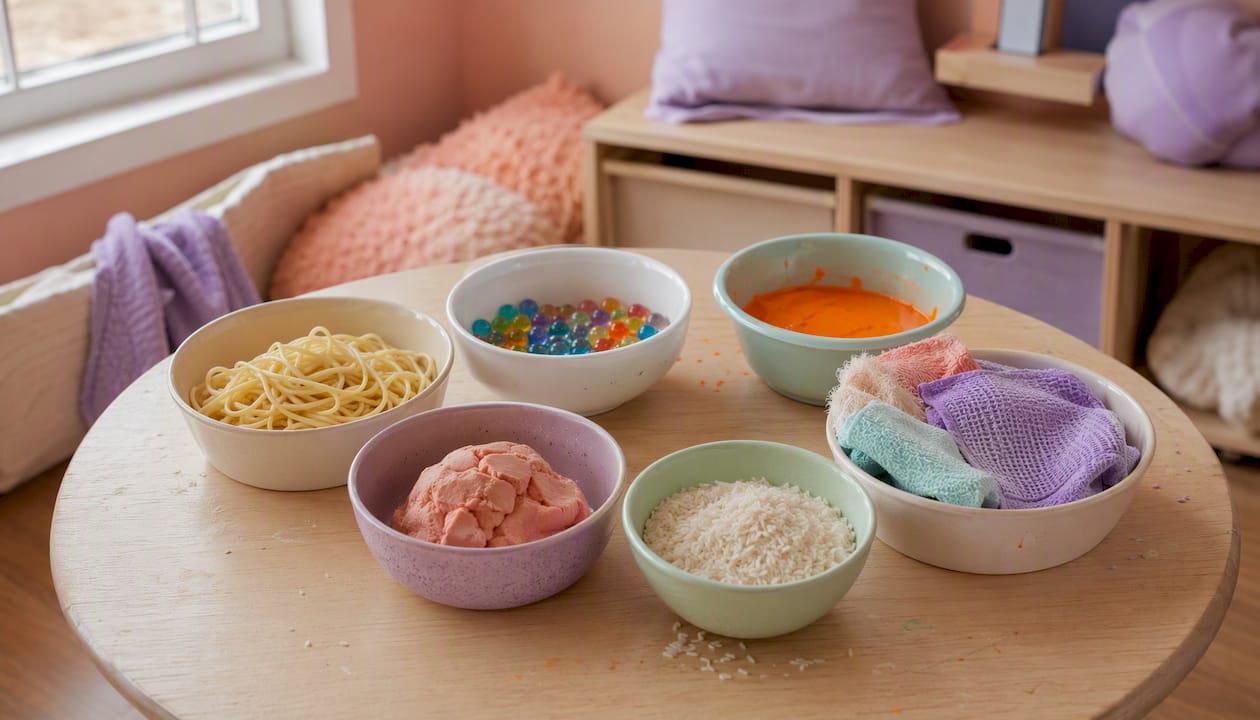
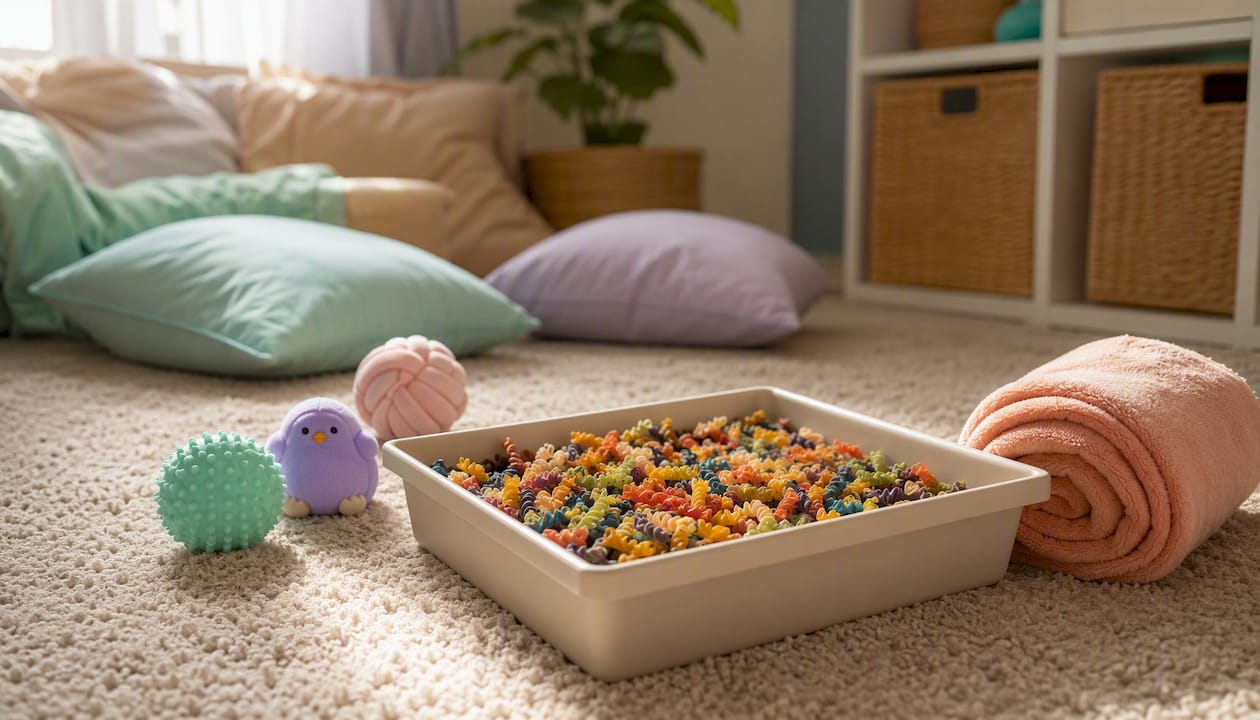
- Fill a washing-up bowl with dry rice or pasta and let your child pour, scoop, and bury their hands.
- Roll a heavy blanket firmly over their legs while they sit on the floor.
- Put on a song they love and sway together, or jump on the spot ten times.
Those three things take under five minutes and they already do the work: they give the nervous system the input it needs to feel organised, which supports attention, communication, and emotional regulation.
Key takeaways
Sensory play works best when it’s short, regular, and led by the child — a few minutes of the right input at the right time does more than an hour of structured activity.
| Point | Details |
|---|---|
| Start simple | A tray of dry rice or a firm blanket roll takes under two minutes to set up and costs nothing. |
| Short and frequent | Five to ten minutes of sensory play several times a day regulates better than one long session. |
| Follow the child | Watch for engagement and overstimulation cues; adjust the activity rather than pushing through. |
| Safety first | Check for allergens, choking risks, and water depth; stay within arm’s reach for under-threes. |
| Fidget and Spin | Weekly sessions and SEN-friendly birthday parties in Brighton and Hove, designed for neurodiverse children aged 1–7. |
Table of Contents
- Why sensory play matters for your child’s development
- When can you start sensory play, and what suits each age?
- How to set up sensory play at home safely
- Practical sensory activity ideas grouped by sense
- How to build sensory play into your daily routine
- How to adapt sensory play for neurodivergent children
- What EYFS guidance says about sensory play
- Short sensory activities for when time is limited
- What to watch for during sensory play
- A note from me, honestly
- Fidget and Spin sessions and SEN-friendly parties in Brighton and Hove
- Sources
- FAQ
Why sensory play matters for your child’s development
Picture this: it’s 4pm, your child has just come in from school, and instead of the usual meltdown, they spend ten minutes squishing playdough, then sit down and eat their tea. That’s regulation in action. The sensory input gave the nervous system what it was looking for, and everything else got easier.
Sensory play builds more than calm. It supports fine and gross motor skills, strengthens hand-eye coordination, and gives children a low-pressure way to practise language (naming textures, describing what they feel). For children with sensory processing differences, it can be one of the most consistent tools a parent has.
Systematic reviews of sensory-focused approaches show some short-term improvements in sensory and motor outcomes for children with autism. The evidence base is still growing and longer-term effects are less clear, so it’s worth holding realistic expectations. What the research does support is the value of regular, parent-led practice at home alongside any professional support your child receives.
The Early Years Sensory Awareness Toolkit recommends movement and heavy work during the day, followed by quieter, low-stimulation activities at least one hour before bed — a simple structure that most families can build into an existing routine without buying anything new.
When can you start sensory play, and what suits each age?
I remember putting Remy in a shallow tray of cold cooked spaghetti when he was about nine months old. He stared at it for a full minute, then very carefully touched it with one finger. That was enough. He wasn’t ready for more, and that was fine. Starting early doesn’t mean pushing hard.
The table below gives a rough guide to age-appropriate activity types and the supervision points that matter most at each stage.
| Age band | Recommended activity types | Typical attention span | Key supervision notes |
|---|---|---|---|
| 0–9 months | Textured fabrics, gentle rocking, soft sounds, tummy time on different surfaces | 2–5 minutes | Constant adult contact; no small parts; avoid strong scents |
| 1–2 years | Water play, sand, finger painting, sensory bottles (sealed), simple obstacle courses | 5–10 minutes | Mouthing risk is high; check all materials are non-toxic and pieces are large |
| 2–4 years | Playdough, messy play, sensory bins, movement circuits, simple musical play | 10–20 minutes | Choking risk reduces but remains; supervise water depth; check for food allergies in materials |
| 4–6 years | More complex sensory bins, cooking activities, outdoor nature play, balance and climbing | 15–30 minutes | Water safety if depth increases; introduce transition warnings before ending |
The Early Years Sensory Awareness Toolkit is a useful reference for matching activity intensity to the time of day as well as the child’s age.
How to set up sensory play at home safely
We used to leave soft play within twenty minutes. The noise, the chaos, the other parents watching Remy throw himself at the crash mat while their children queued politely. I started setting up a small corner at home instead, and it changed everything. You don’t need much space or money.
The basics of a safe, low-stress play space:
- Lay a cheap shower curtain or a wipe-clean tablecloth on the floor to contain mess.
- Use a shallow plastic tray or a storage box lid as the main play surface.
- Keep a damp cloth and a bin bag within arm’s reach before you start.
- Dress your child in clothes you don’t mind getting dirty, or strip them down if the weather allows.
- Remove trip hazards and make sure there’s nothing breakable nearby.
Supervision and hygiene rules worth keeping:
- Stay within arm’s reach for under-threes, and in the same room for older children.
- Check all materials for allergens before use — many playdough recipes contain wheat; some sensory bin fillers contain nuts.
- Wash hands before and after, especially with sand, soil, or water play.
- Discard any material that has been mouthed or that looks contaminated.
- Never leave water play unattended, even in shallow trays.
You genuinely don’t need specialist equipment. Simple household items like dried lentils, kitchen utensils, and a tray will do more than most expensive kits.
Pro Tip: Sit beside your child and watch before you join in. Follow their lead rather than directing the play. Children who feel observed without pressure tend to explore more freely and stay engaged longer — this is one of the most effective things you can do, and it costs nothing.
Practical sensory activity ideas grouped by sense
Action for Children’s guidance notes that many effective sensory activities use everyday household items — specialist kit is not needed. The activities below are grouped by the sense they primarily target, with a simple three-step format and a time estimate each.
Tactile (touch)
Playdough squish Purpose: Calming deep-pressure input for hands.
- Make a simple salt-dough (flour, salt, water) or use shop-bought playdough.
- Offer tools — a fork, a rolling pin, small cutters — but don’t insist on using them.
- Pack away by pressing all the dough into one ball together. Time: 10–20 minutes. Adaptation: For tactile-sensitive children, offer gloves or tools first; for sensory seekers, add dried herbs or glitter for extra input.
Sensory bin Purpose: Open-ended exploration of texture and temperature.
- Fill a tray with one base material (rice, oats, kinetic sand, shredded paper).
- Bury a few small objects for finding.
- Tip the contents into a bag for storage and wipe the tray. Time: 10–15 minutes.
Proprioceptive (body awareness and heavy work)
Cushion crash Purpose: Alerting and organising input through impact.
- Stack sofa cushions against a wall or on the floor.
- Let your child run and crash into them, roll on them, or be rolled up inside one.
- Transition out with a firm squeeze or a “sandwich” between two cushions. Time: 5–10 minutes.
Wheelbarrow walking Purpose: Upper body strengthening and proprioceptive input.
- Hold your child’s ankles while they walk on their hands.
- Keep it short — two or three lengths of the room.
- Follow with a calming activity. Time: 3–5 minutes.
Vestibular (balance and movement)
Blanket swing Purpose: Organising and calming linear movement.
- Two adults hold the corners of a blanket with the child lying inside.
- Swing slowly and rhythmically, side to side.
- Lower gently to the floor and allow the child to roll out. Time: 3–5 minutes. Note: Rotational movement (spinning) is alerting; linear movement (swinging back and forth) tends to be calming.
Auditory (sound)
Homemade shakers Purpose: Exploring cause and effect through sound.
- Fill sealed plastic bottles or tubs with different materials (rice, buttons, dried peas).
- Shake, tap, and compare sounds together.
- Store in a labelled box for repeated use. Time: 10 minutes.
Visual and gustatory (sight and taste)
Sensory bottles Purpose: Calming visual tracking.
- Fill a clear plastic bottle with water, a little washing-up liquid, and glitter or small beads.
- Seal the lid with strong tape or glue.
- Tip and watch together; narrate what you see. Time: 5 minutes to make; open-ended use.
Taste exploration tray Purpose: Gentle gustatory input and vocabulary building.
- Offer small amounts of contrasting flavours and textures (sour, sweet, crunchy, smooth).
- Let your child smell, touch, and taste at their own pace — no pressure to eat.
- Name each sensation together. Time: 10 minutes. Check allergens carefully before setting this up.
Quick sense-to-activity reference
| Sense targeted | Quick activity example | Alerting or calming? |
|---|---|---|
| Tactile | Playdough, sensory bin, finger painting | Calming (slow) / Alerting (fast) |
| Proprioceptive | Cushion crash, wheelbarrow walks, heavy lifting | Organising and calming |
| Vestibular | Blanket swing, rocking, rolling | Calming (linear movement) |
| Auditory | Shakers, drumming, singing | Alerting (loud) / Calming (quiet) |
| Visual | Sensory bottles, light play, sorting colours | Calming |
| Gustatory | Taste tray, cooking activities | Varies by child |
How to build sensory play into your daily routine
The after-school hour in our house used to feel like defusing a bomb. Remy would come through the door and within minutes everything was too loud, too bright, too much. I didn’t need a formal programme. I needed ten minutes of the right input at the right time.
That’s essentially what a sensory diet is: a proactive, regular schedule of short sensory activities designed to keep the nervous system regulated throughout the day, rather than responding to crisis. The term comes from occupational therapy, but the concept is straightforward. Short, frequent sensory breaks prevent meltdown or shutdown by keeping the nervous system “topped up.”
Practitioner guidance recommends sequencing activities as alerting → organising → calming. Think of it as warming up, then settling. A sensory circuit can be as short as five to ten minutes and still make a real difference to how a child moves through the next part of their day.
Simple morning routine before school:
- 3 minutes: jumping on the spot or bouncing on a small trampoline (alerting).
- 4 minutes: carrying a heavy bag of books from room to room, or pushing a laundry basket (organising).
- 3 minutes: slow rocking in a chair or a firm blanket wrap (calming).
After-school routine upon arrival home:
- 3 minutes: cushion crash or rolling on the floor (alerting/releasing).
- 4 minutes: playdough or a sensory bin (organising).
- 3 minutes: sensory bottle, quiet music, or a weighted blanket (calming).
Over two weeks, note when your child seems most dysregulated and what they seek or avoid. Build the routine around those windows. A child who wakes up sluggish needs alerting input first; one who arrives home wired needs organising input before anything calming lands.
How to adapt sensory play for neurodivergent children
I’ve been in a group session where another child’s shriek sent Remy straight under a table. We left. I’ve also watched him spend forty-five minutes contentedly pouring water from one container to another, completely absorbed. The same child, two very different sensory states.
The most important thing to understand is that sensory processing differences are individual. A child who is sensory seeking needs more input to feel regulated; a child who is sensory sensitive needs less, or needs it delivered more slowly and predictably. The same activity can regulate one child and overwhelm another, which is why practitioners advise observing the child’s response and adapting input accordingly.
Practical adaptations:
- Reduce stimuli: start with one material in a quiet room before adding layers of input.
- Offer choices: “Do you want the rice or the oats today?” gives the child agency and reduces demand.
- Use predictable routines and transition warnings: “Two more minutes, then we tidy up” said calmly, twice, reduces the shock of stopping.
- Provide alternative equipment: ear defenders for noisy activities, chewable jewellery for oral seekers, gloves for children who find direct texture contact distressing.
- Use slow, linear movement (rocking, swinging back and forth) when a child is overexcited; it tends to calm the nervous system more reliably than stillness.
At Fidget and Spin sessions, we’ve learned most of this from the families themselves. Parents told us their children needed a visual schedule before entering the room. They told us the music needed to be lower. They told us the lighting mattered. We adjusted. The adaptations in our three sensory zones — Wiggle & Bounce, Snuggle & Chill, and Squish & Squeeze — came directly from that feedback. Our approach to sensory play for neurodiverse children reflects what we’ve seen work in practice, week after week.
Research from a parent-engagement sensory play programme supports this: home-based parent involvement in sensory activities can meaningfully improve a child’s participation when parents are coached in what to look for and how to adjust.
When to seek specialist support: if your child regularly shuts down or melts down during sensory activities, shows extreme distress around everyday sensory input (clothing, food textures, sound), or their sensory needs are significantly affecting daily life, ask your GP for a referral to a paediatric occupational therapist. Your child’s school SENCO can also refer for an EHCP assessment if sensory processing differences are affecting learning.
What EYFS guidance says about sensory play
A parent once told me her child’s nursery teacher had asked whether they did “sensory work” at home. She wasn’t sure what to say. The answer is: yes, and it’s exactly what the Early Years Foundation Stage framework expects.
The EYFS statutory framework for England places sensory and physical exploration at the heart of early learning. Under Physical Development, children are expected to develop their movement, balance, and fine motor skills through active, hands-on play. Under Personal, Social and Emotional Development, self-regulation — the ability to manage feelings and behaviour — is a core goal. Sensory play directly supports both strands.
The Early Years Sensory Awareness Toolkit, developed by NHS practitioners, provides practical activity suggestions for early years settings and home use, including outdoor play, water play, and messy play. It also gives guidance on how to sequence activities across the day — movement and heavy work during waking hours, quieter activities in the hour before bed.
For practitioners and SENCOs wanting to go further, the Fidget and Spin early years play strategies guide covers EYFS-aligned approaches for neurodiverse children in detail.
Short sensory activities for when time is limited
Tea is on. You have ten minutes. Here’s what works.
- Rice pour: tip dry rice into a tray with two cups. Pour, scoop, bury hands. Prep: 1 minute. Calming.
- Sock skating: put thick socks on a smooth floor and slide. Prep: 0 minutes. Alerting.
- Ice cube tray: fill with water and food colouring; freeze the night before. Explore melting. Prep: 1 minute active. Calming.
- Cushion obstacle course: arrange sofa cushions to crawl over and under. Prep: 2 minutes. Alerting and organising.
- Bubble wrap stomp: lay a sheet of bubble wrap on the floor. Prep: 0 minutes. Alerting.
- Cornflour gloop: mix cornflour and water to a thick paste. It’s solid when pressed, liquid when still. Prep: 2 minutes. Organising.
- Feather tickle: use a feather or soft paintbrush on arms and hands. Prep: 0 minutes. Calming.
- Heavy work carry: fill a small backpack with books and ask your child to carry it to another room. Prep: 1 minute. Organising and calming.
- Sensory bottle: shake a glitter bottle together and watch it settle. Prep: 0 minutes (if made in advance). Calming.
- Outdoor mud kitchen: a patch of garden, some water, and a few old pots. Prep: 0 minutes. Alerting and organising.
Transition scripts help. Rather than “stop now,” try: “One more pour, then we wash hands.” Or count down together: “Five, four, three, two, one — all done.” It sounds small, but it genuinely reduces the resistance at the end of an activity.
What to watch for during sensory play
You don’t need a checklist to read your child. But when you’re new to sensory play, it helps to know what you’re looking for.
Signs of good engagement: sustained attention on the material, returning to it after a break, relaxed body posture, slower breathing, spontaneous vocalisation or commentary, eye contact with you or the activity.
Signs of overstimulation: covering ears or eyes, pulling away from the material, increased movement or agitation, flushing, crying, or a sudden shutdown (going very still and quiet). These are signals to reduce the input — lower the noise, remove one element, or offer a calming alternative. They are not signs that sensory play isn’t working; they’re information.
Calming cues: a child who has had the right input often shows a visible shift — slower movements, a softer face, willingness to sit. Some children hum quietly. Some go to a favourite spot. Learning your child’s specific calming cues takes a few weeks of observation, but once you know them, you can time activities to land just before the window closes.
Following the child’s lead and mirroring their play is often the most effective adult intervention during sensory play. You don’t need to teach. You need to be present and pay attention.
A note from me, honestly
The first time I took Remy to a mainstream baby group, another mum asked if he was “always like this.” He was eighteen months old and spinning in circles next to the craft table. I smiled and said yes, and we left before the singing started.
I spent a long time trying to find spaces that were built for him. Not spaces that tolerated him, or spaces where I had to apologise for him, but spaces where the setup assumed he might need to move, or be loud, or need a quiet corner, or leave early without it being a whole thing. We couldn’t find one. So Anthony and I built Fidget and Spin.
Everything I’ve written here comes from that. The activity ideas, the observation tips, the sensory diet routines — they’re things I’ve tried at home with Remy, or things families at our sessions have taught us. Sensory play doesn’t have to be perfect or Pinterest-worthy. It just has to happen. Start small. Follow your child. Adjust as you go.
Fidget and Spin sessions and SEN-friendly parties in Brighton and Hove
Walk into a Fidget and Spin session and you’ll find three distinct sensory zones: Wiggle & Bounce for big movement, Snuggle & Chill for children who need low stimulation and a cosy corner, and Squish & Squeeze for tactile play and fidgets. No queuing. No expectation of sitting still. No side-eye.
Weekly sessions run in Brighton and Hove for neurodiverse children aged 1–6. Our SEN-friendly birthday parties are available across Brighton, Hove, and wider Sussex for ages 1–7, with three packages starting at £220. Every setup is flexible — we adjust the layout, the lighting, and the noise level based on what the children in the room actually need. We also offer Pay-It-Forward concession spots at checkout so cost doesn’t have to be a barrier.
If you’d like to see how our sessions work before booking, the details are all there. We’d love to see you.
Sources
- Early Years Sensory Awareness Toolkit v3
- Sensory processing differences
- Interventions incorporating sensory-focused modalities: evidence review
- How to create a sensory diet for your neurodivergent child
- What is sensory play and why is it important?
FAQ
How do you start sensory play with a young child?
Start with one simple material — dry rice in a tray, playdough, or a bowl of water — and sit beside your child without directing the play. Five minutes is enough to begin; follow their lead and add materials gradually as their confidence grows.
What does the EYFS say about sensory play?
The EYFS statutory framework supports sensory play through its Physical Development and Personal, Social and Emotional Development strands, both of which emphasise hands-on exploration, movement, and self-regulation as core early learning goals.
What are some quick sensory play ideas for busy parents?
Sock skating on a smooth floor, cornflour gloop (cornflour mixed with water), a sealed glitter bottle, or a tray of dry rice with cups for pouring — all take under two minutes to set up and can be done in ten minutes or less.
What is a sensory diet and how does it help?
A sensory diet is a proactive daily schedule of short sensory activities — alerting, organising, and calming — that keeps the nervous system regulated throughout the day and can reduce the likelihood of meltdown or shutdown.
How do I know if my child is overstimulated during sensory play?
Watch for covering ears or eyes, pulling away from materials, increased agitation, flushing, or a sudden shutdown. These are signals to reduce the input — lower the noise, remove one element, or move to a calming activity — rather than to stop sensory play altogether.
Recommended
- Sensory play best practices for neurodiverse kids | Fidget and Spin Brighton
- Sensory play best practices for neurodiverse children | Fidget and Spin Brighton
- Effective sensory play strategies for neurodiverse kids | Fidget and Spin Brighton
- Sensory play explained for neurodiverse children | Fidget and Spin Brighton