TL;DR:
- Following a child’s lead in a sensory-safe space fosters genuine connection for neurodiverse children. Simple, child-led activities like parallel play, offering choices, and creating predictable environments build trust and joint attention. Supporting social interaction through low-pressure, sensory-friendly settings encourages natural connection without forcing it.
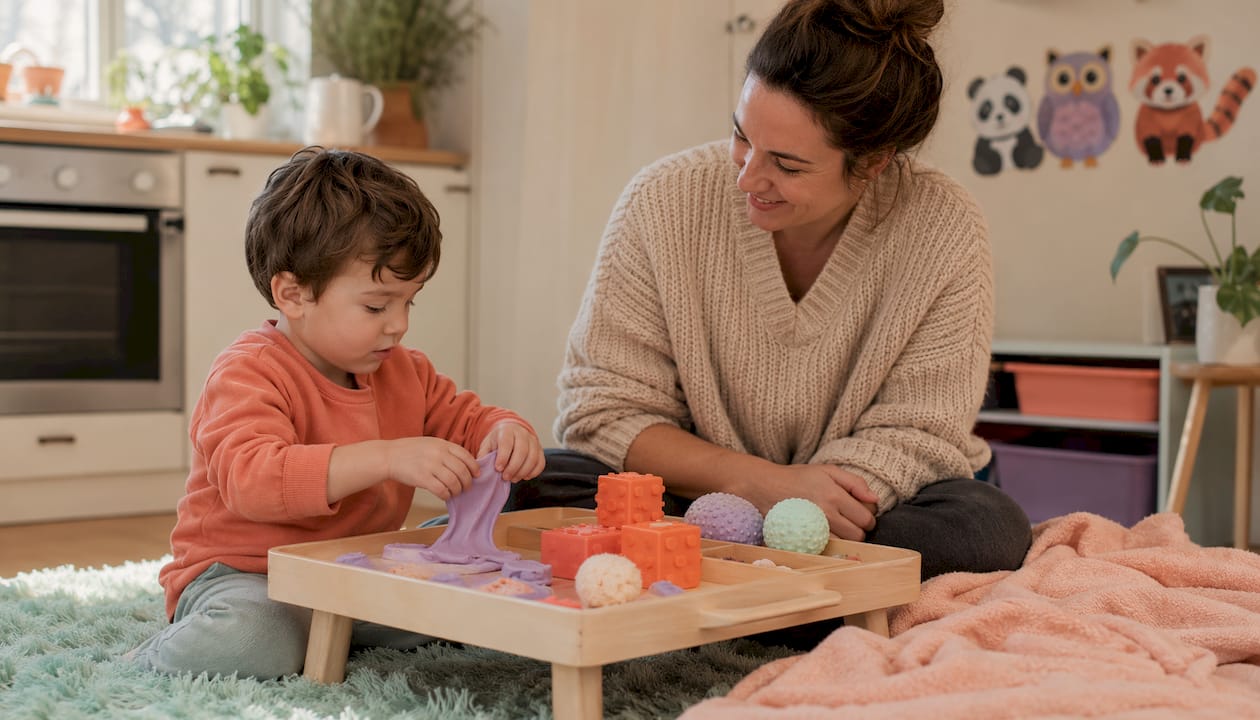
Start by following your child’s lead in a sensory-safe space. That single shift, sitting beside them, copying what they do, saying less, is the fastest route to genuine connection for neurodiverse children.
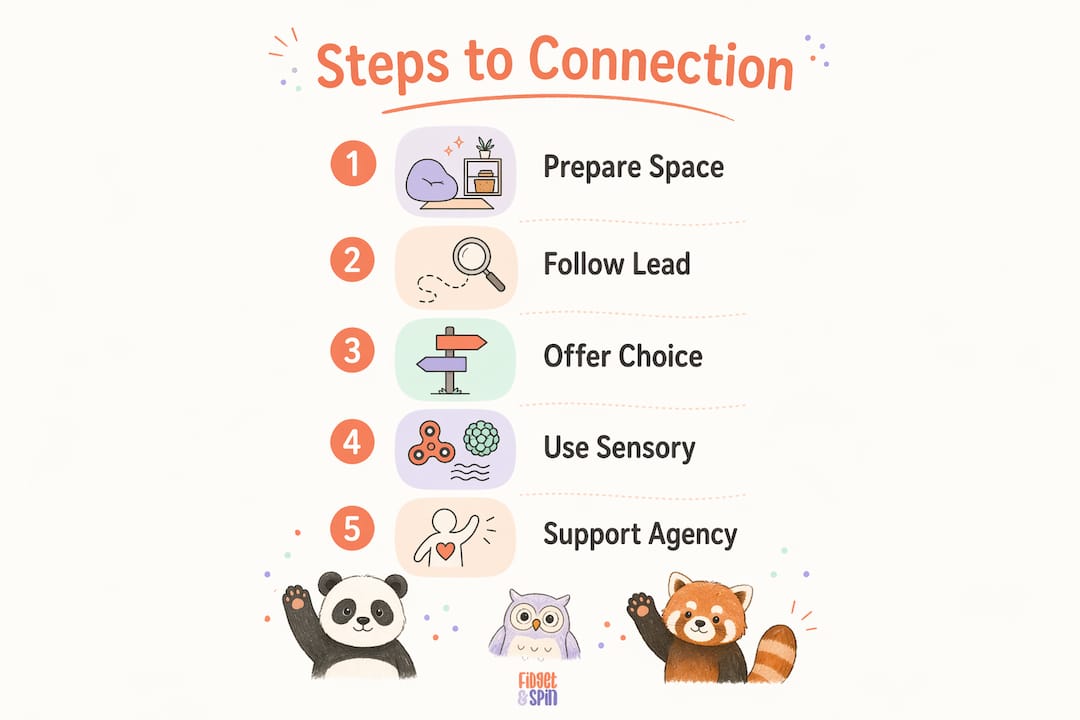
Here is what you can try this afternoon:
- Follow their lead. Get on the floor. Copy the motion, the sound, the rhythm. Don’t redirect.
- Reduce your language. One word or a short phrase beats a question every time. “Car.” “Spinning.” “Splash.”
- Offer a choice, not a direction. “Red or blue?” gives control without pressure.
- Add a quiet corner. A beanbag, a blanket, a low-lit spot. Somewhere to retreat that isn’t failure.
- Use a visual now-and-next. Two pictures. What’s happening now, what’s coming next. Anxiety drops when the world is predictable.
Pro Tip: Hand your child control of one sensory element, the lamp switch, the music volume, the texture they touch first, and watch how quickly their attention sharpens.
Connection, for many neurodiverse children, looks like sitting side by side, both absorbed in the same thing. That counts. That is success.
Table of Contents
- Why following your child’s lead builds real connection
- How to make the environment feel safe before anything else
- Concrete activities that encourage connection through play
- How to plan a party or group event without the dread
- When to seek extra support and who to contact
- Key takeaways
- What I actually think, as a SEN parent
- Sensory play and SEN parties in Brighton, Hove and Sussex
- Further reading and trusted UK sources
- FAQ
Why following your child’s lead builds real connection
Picture a child lining up cars along the skirting board, absorbed, methodical, completely in their own world. Now picture a parent quietly picking up another car and doing exactly the same thing, no commentary, no correction, just mirroring. That moment of parallel action is often where connection begins.
Joint attention is the shared focus on the same object or event, and it is foundational for social communication. You build it not by directing play but by joining it. Sheffield Children’s NHS Foundation Trust describes the core technique as “observe, wait and listen”: watch what your child is interested in, wait for them to lead, then follow.
The practical tools are simple: see MHRC’s therapy and SEN strategies for more ideas. Imitate what they do. Use single words to narrate what you both see. Offer a choice without pressure. Then wait. The waiting is the hardest part, especially when you’re used to filling silence. But that pause is where your child finds space to respond.
“Consider a specific social-communication intervention for the core features of autism that includes play-based strategies with parents, carers and teachers to increase joint attention, engagement and reciprocal communication.” NICE guideline CG170, autism support and management
NHS guidance and NICE recommendations consistently favour play-based, child-led strategies over structured social drills. The evidence makes sense: you cannot teach connection by forcing it. You create the conditions for it to arrive.
Research published via PMC found that 30% of school teachers report sensory differences affect their pupils’ learning all of the time. That figure matters because it tells us how many children are trying to connect through a fog of sensory discomfort. Addressing that discomfort first is not a detour. It is the route.
How to make the environment feel safe before anything else
A child flinching at the music in a soft play. A parent frantically scanning for the volume control that doesn’t exist. I know that moment. It’s the one where you start calculating how quickly you can leave without a scene.
Before you try any social activity, run through this sensory checklist:
- Sound: Can you lower it, muffle it, or offer ear defenders or noise-reducing headphones?
- Light: Is there a dimmer, a lamp alternative, or a spot away from flickering overhead strips?
- Smell: Strong cleaning products, food smells, other children’s snacks. Can you position away from the source?
- Movement: Is there a space to move freely and a space to be still? Both matter.
- Seating: Floor, chair, beanbag, standing? Let them choose.
Keep these regulation tools within reach: a weighted lap blanket, a chewing fidget or hand fidget, a visual timer, and a clearly marked quiet zone. Movement breaks before and during an activity reduce overload before it builds.
A controlled study of 41 autistic children aged 4–12 found that giving children agency over multi-sensory environment equipment increased their attention and reduced repetitive motor behaviours. The control itself was the intervention, not just the sensory input. Let your child turn the light on. Let them choose the texture. That act of choosing is regulating.
Pro Tip: Before entering any new space, narrate it briefly: “It might be loud near the door. We’ll find a quieter spot first.” Predictability is its own form of sensory support.
Concrete activities that encourage connection through play
Two children at a water tray, both pouring, neither speaking, both calm. That is parallel play. And according to Whittington Health NHS, side-by-side play is a valid, developmentally appropriate way autistic children explore. It is not a lesser version of connection. It is connection.
These activities for SEN child connection work well at home and in sessions:
Parallel painting (ages 2+): Set up two trays side by side. No shared canvas, no pressure to interact. Narrate your own painting in one or two words. Wait. Imitation often follows naturally.

Bubble tube turn-taking (ages 1+): One child controls the colour change, the other watches. Swap. No words needed. Eye contact and shared focus emerge without being demanded.
Large block construction (ages 2+): Build near each other. Add one block to their structure only when invited by their gaze or gesture. Scaffolding gently means waiting for that signal.
Sensory treasure hunt (ages 3+): Hide objects with different textures in a tray of rice or sand. Finding together, not competing. A shared “ooh” over a smooth stone is joint attention in action.
Cause-and-effect switches (ages 1+): A switch that triggers a light or sound. Take turns pressing. The anticipation of the effect creates natural shared focus.
Small-world tray (ages 2+): Dinosaurs, farm animals, vehicles in a sand or grass tray. Play alongside. Add one character. Wait for a response.
Fold these into daily routines too. Mealtimes offer turn-taking with spoons and cups. Dressing offers choice and imitation. The walk to school is full of cause-and-effect moments. You do not need a special session to build relationships with SEN children. You need consistent, attuned moments.
How to plan a party or group event without the dread
Arriving at a birthday party with an exit plan already agreed. Knowing exactly where the quiet room is. That relief is real, and planning for it is not pessimism. It is good parenting.
Before you book:
- Keep the guest list small. Fewer people means less noise and fewer unpredictable interactions.
- Ask the venue about lighting, sound, and layout before you commit.
- Bring one familiar object from home: a fidget, a comfort toy, a preferred snack.
- Share a visual schedule with your child the night before and again on the morning.
On the day:
- Set up clear zones: one active, one calm, one tactile.
- Use a now-and-next board or a sand timer for transitions.
- Agree an exit signal with your child in advance, a word, a gesture, something private between you.
- Designate a chill-out spot and make sure your child knows it’s there before they need it.
Visual supports such as now-and-next boards and sand timers reduce transition anxiety and support turn-taking. The Brain Charity also emphasises factoring in recovery time after social events. A quiet evening, a favourite regulation activity, lower stimulation. Recovery is not failure. It is part of the plan.
For supported playdates, keep them short: 45–60 minutes maximum. One or two shared activities only. Your role is facilitator, not director. Follow both children’s lead and scaffold gently when needed.
When to seek extra support and who to contact
There is a particular kind of stuck. You have tried the strategies. You have adjusted the environment. Months pass and the same patterns repeat, and your child is distressed, not just different. That is when to ask for more.
Seek extra support if you notice: persistent distress around social situations, safety concerns, no progress after consistent play-based strategies, or regression in communication or regulation.
Who to contact:
- SENCO at your child’s school or nursery. They can observe, advise, and refer.
- GP for referral to speech and language therapy (SALT) or occupational therapy (OT).
- NHS SALT services for communication support, including AAC, PECS, and Makaton.
- Local charities and support groups via your council’s Local Offer page.
When you see your GP or SENCO, bring specific examples: what you have observed, what strategies you have tried, and what you want from the support. Vague concerns get vague responses. Concrete examples get referrals.
NICE guidance CG170 recommends that every autistic child has a case manager or key worker coordinating their care. If that is not in place, ask for it directly. Fidget and Spin’s weekly sessions can sit alongside statutory support, not instead of it.
Key takeaways
Following your child’s lead in a sensory-safe space, before any structured social teaching, is the single most effective way to help a neurodiverse child connect.
| Point | Details |
|---|---|
| Follow their lead first | Imitate, reduce language, and wait. Joint attention builds from there. |
| Sensory safety before social goals | Run a sensory checklist and offer regulation tools before any group activity. |
| Parallel play counts | Side-by-side play is valid connection, not a lesser stage to push through. |
| Plan events with an exit strategy | Visual schedules, quiet zones, and agreed exit signals make parties feasible. |
| Fidget and Spin sessions | Weekly sensory stay-and-play in Brighton and Hove offers a supported space to practise all of the above. |
This week’s micro-plan:
- Today: Try one imitation activity at home. Copy what your child does for five minutes without redirecting.
- Mid-week: Run the sensory checklist on your main play space and make one adjustment.
- Weekend: Plan one short supported playdate or attend a sensory session, and schedule recovery time afterwards.
What I actually think, as a SEN parent
I remember leaving a soft play when Remy was about two. He had lasted eleven minutes. The music was too loud, the lights were too bright, and another child had grabbed his car. We walked back to the car in silence and I sat there thinking: this is just going to be hard forever, isn’t it.
It isn’t. But the mainstream version of it often is.
What changed things for us wasn’t a social skills programme or a structured intervention. It was slowing down. Getting on the floor. Copying what Remy was doing instead of trying to redirect him towards what I thought he should be doing. The first time he looked up from his cars and made eye contact because he was curious about what I was doing with mine, I nearly cried. That was joint attention. That was connection. It took about three weeks of consistent, quiet following.
We built Fidget and Spin because we needed a space where that kind of slow, attuned play was the whole point. Not a bonus. Not an accommodation. The actual design. Three sensory zones, no pressure to perform, adults who follow the child’s lead. Remy choosing the colour on the bubble tube and then glancing sideways to check if I’d noticed. That glance is everything.
My honest advice: stop trying to teach connection and start creating the conditions for it. The connection will come. Often when you’ve stopped watching for it.
Sensory play and SEN parties in Brighton, Hove and Sussex
If you are looking for a space where your child can practise connection without pressure, Fidget and Spin runs weekly sensory stay-and-play sessions in Brighton and Hove for neurodiverse children aged 1–6. Three zones: Wiggle & Bounce for big movement, Snuggle & Chill for low-stimulation cosy time, and Squish & Squeeze for tactile play and fidgets. Early exits are always fine. Quiet spots are always available.
For birthdays, our SEN-friendly party packages cover ages 1–7 across Brighton, Hove and wider Sussex. Packages start at £220 (The Wee One), with The Big One at £320 and The Whole Shebang at £530. Private venue hire, sensory activities, flexible setup, and a team who understand that your child might need to leave the main room for twenty minutes. That is not a problem. That is the plan.
Pay-It-Forward concession spots are available at checkout if cost is a barrier. Book a session or get in touch to talk through what your child needs. We are happy to advise on planning inclusive parties too.
Further reading and trusted UK sources
A parent bookmarking the NHS page at midnight, just in case. We have all been there. These are the sources worth saving:
- NHS: supporting a child with autism — practical guidance on sensory needs, communication, and managing daily life. A solid first read.
- Sheffield Children’s NHS: joint attention resource — clear explanation of joint attention techniques with practical scripts for parents.
- The Brain Charity: social wellbeing for neurodivergent children — guidance on social connection, recovery time, and chill-out planning.
- PMC: multi-sensory environments and autistic children — the research behind giving children control of sensory input and why it increases attention.
- NICE guideline CG170 — the clinical framework for autism support, including referral pathways and intervention recommendations.
- Whittington Health NHS: play and autism — accessible guide to play differences and why they are valid, not deficits.
For local SALT and OT referrals, start with your GP or SENCO, or search your council’s Local Offer page.
FAQ
What does connection look like for a neurodiverse child?
Connection often looks like parallel play, shared focus on the same object, or a brief glance to check you noticed something. It rarely looks like a long conversation, and that is completely fine.
How do I help my SEN child connect with other children?
Start with supported, short playdates built around a shared interest. Follow both children’s lead, keep the environment sensory-safe, and treat side-by-side play as a genuine success rather than a stepping stone to something better.
What is joint attention and why does it matter?
Joint attention is shared focus on the same object or event. It underpins social communication development, and adults build it by imitating, commenting briefly, and waiting rather than directing.
When should I ask for professional support?
Seek help from your SENCO or GP if your child shows persistent distress around social situations, if there are safety concerns, or if consistent play-based strategies have not shifted things after several weeks.
Can sensory play sessions help with social connection?
Yes. A sensory-safe, low-pressure environment where adults follow the child’s lead creates the conditions for joint attention and connection to develop naturally, which is exactly what Fidget and Spin’s weekly sessions in Brighton and Hove are designed around.
Recommended
- What is sensory play? a guide for SEN families | Fidget and Spin Brighton
- Sensory play best practices for neurodiverse kids | Fidget and Spin Brighton
- Creative sensory zone ideas for neurodiverse children | Fidget and Spin Brighton
- Why mainstream play groups don’t work for SEN families | Fidget and Spin Brighton