

TL;DR:
- Creating inclusive play environments focuses on designing spaces where neurodiverse children can participate comfortably as their authentic selves. Visual supports, small groups, sensory-friendly modifications, and respecting various communication styles foster joyful, regulated, and engaging play experiences. Observing progress through signs of connection and joy encourages ongoing adaptation, and child-led interactions build trust and confidence in play.
Play is supposed to be joyful. But if you have a neurodiverse child, you know how quickly a playdate or group session can unravel — the noise, the unpredictability, the pressure to join in when every sensory alarm bell is firing at once. Figuring out how to make play inclusive is something I’ve been working out in real time as a Brighton mum to a six-year-old with autism and ADHD. And what I’ve learned is this: inclusive play isn’t about lowering the bar or compensating for difference. It’s about designing an environment where every child can show up as they are and actually enjoy themselves.
Table of Contents
- Key takeaways
- How to make play inclusive: setting up your space
- Strategies for inclusive play interactions
- Reducing sensory overload in the play environment
- Handling common challenges during inclusive play
- Recognising progress in inclusive play
- My honest take on all of this
- Fidgetandspin: sensory play sessions in Brighton
- FAQ
Key takeaways
| Point | Details |
|---|---|
| Visual supports matter most | First-then boards and choice boards reduce anxiety and support positive play more reliably than any specific toy. |
| Start small, go slow | Small groups and parallel play remove social pressure and let neurodiverse children engage at their own pace. |
| Sensory design is non-negotiable | Soft lighting, quiet zones, and rotating toys prevent overwhelm and support self-regulation during play. |
| Communication takes many forms | PECS, AAC, gestures, and observation are all valid ways children participate — honour all of them. |
| Progress looks different here | Signs of success include comfort, joy, and regulation, not just social interaction in its most obvious form. |
How to make play inclusive: setting up your space
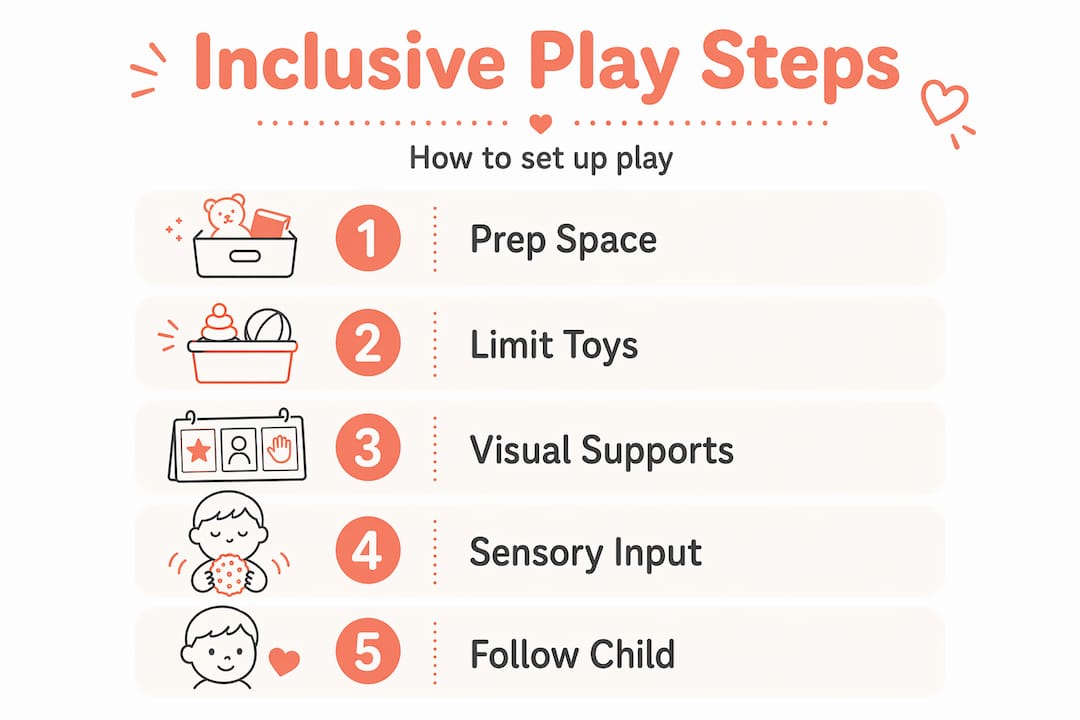
Before anything else, preparation makes the difference. Not the sort of frantic prep where you clear the living room and regret it immediately, but thoughtful, low-effort tweaks that tell your child’s nervous system: this place is safe.
Visual supports are where I’d start every single time. First-then boards and choice boards reduce unpredictability and break play into manageable steps. My son used to shut down completely at transitions. A simple “first sandpit, then snack” board changed the entire shape of our mornings. These tools are often more impactful than any fancy toy you could buy.
Here’s a quick toolkit to get you started:
- ️ Visual schedules and first-then boards to signal what’s coming next
- Fidget toys and sensory tools (putty, textured balls, chewy jewellery) to support regulation during play
- Noise-cancelling headphones or ear defenders for busy or noisy environments
- Adjustable or warm lighting to soften harsh overhead lights
- Soft textures and weighted items like cushions, blankets, or lap pads for calming
- Switch-adapted or large-activation toys, which increase participation for children with motor or sensory differences
Physical accessibility deserves a mention too. Floor-level play removes barriers for children with mobility differences, and keeping pathways clear means everyone can move freely and safely. Public play spaces are governed by accessibility route standards, but at home, even just clearing a generous floor space makes a real difference.
Pro Tip: Don’t overwhelm the space with too many toys at once. A stripped-back environment with three or four quality options is far less dysregulating than a room bursting with choice.
| Tool | Purpose |
|---|---|
| First-then board | Provides predictability and reduces transition anxiety |
| Ear defenders | Reduce auditory overwhelm in louder settings |
| Fidget tools | Support regulation and sensory processing during play |
| Soft lighting | Decreases visual overstimulation and creates calming atmosphere |
| Choice board | Gives agency, builds confidence, and reduces demand |
Strategies for inclusive play interactions
Getting the space right is one thing. Supporting the actual play, the messy, beautiful, sometimes confusing business of children engaging with each other and the world around them, is where the real work happens.
My biggest tip? Keep groups small. Two or three children is often enough. Larger groups amplify sensory input — more voices, more movement, more unpredictability — and that can tip a child from regulated to overwhelmed before you’ve even opened the playdough. Small groups and parallel play let neurodiverse children engage at their own pace without the pressure of direct interaction.
Here are strategies that have genuinely worked for us and for many families we’ve connected with through Fidgetandspin:
- Offer genuine choice. Ask “do you want to play with water or sand?” rather than directing. Agency in play supports emotional regulation and builds independence. Children who feel in control are far more likely to stay engaged.
- Incorporate sensory-friendly activities. Water play, nature-based activities, and tactile exploration (think kinetic sand or cloud dough) work brilliantly because children can engage at different depths. One child pours, another just watches and touches. Both are participating.
- Support communication in all its forms. PECS (Picture Exchange Communication System), AAC devices, gestures, pointing, and even watching quietly are all valid ways of engaging. Neurodiversity-affirming play means respecting how each child communicates, not nudging them toward the version we find easiest to read.
- Let parallel play count. Two children playing side by side with their own materials, in their own worlds, is not a failed playdate. It is meaningful, socially-rich time together.
- Scaffold gently, then step back. Adults can model, narrate, and encourage without directing. “I wonder what would happen if the car went up that ramp” is an invitation. “Now play with him” is a demand. Only one of those works.
Pro Tip: If a child uses AAC, talk to them the same way you’d talk to any child. Address them directly, give processing time, and resist the urge to fill the silence. That pause is often them composing their response.
A note on neurodiversity-affirming OT approaches: many occupational therapists recommend sensory-informed strategies for home play too. If you’re not already connected with an OT, it can be genuinely useful.

Reducing sensory overload in the play environment
Here’s something I didn’t understand at first: the environment is doing as much heavy lifting as the adult in the room. A dysregulated space produces a dysregulated child. And trying to coax a flooded nervous system back into play is, to use a phrase I’m rather fond of, like trying to push jelly uphill with a toothpick.
Designing for calm doesn’t mean sterile or boring. It means thoughtful.
- Create a quiet corner or sensory den. A pop-up tent, a bean bag behind a curtain, or even a pile of cushions in the corner gives children somewhere to retreat without leaving the social space entirely. Sensory-friendly corners with soft lighting and minimal clutter genuinely support self-regulation.
- Rotate toys regularly. Novelty sustains engagement, but too many options at once creates overwhelm. Swap toys in and out every week or so. You’ll find children engage more deeply with fewer things.
- Acknowledge sensory triggers explicitly. Loud music, flickering lights, strongly-scented craft materials — these are all worth eliminating or reducing before play begins rather than troubleshooting during it.
- Introduce ‘break’ signals. Teach children a simple way to signal they need a pause: a card, a gesture, or even moving to a designated spot. Break signals and sensory tools enable self-regulation without forcing a child out of the space entirely.
- Use sensory-informed home strategies to create routines around play that signal to the nervous system it’s a safe, predictable time.
Pro Tip: Before a play session, offer some proprioceptive input: jumping, pushing against a wall, or carrying something heavy. This kind of ‘sensory diet’ can bring a child into a calmer, more regulated state before social play begins.
Handling common challenges during inclusive play
Even with the best-planned environment and the kindest intentions, things will go sideways. That’s not failure. That’s just play with neurodiverse children.
Meltdowns happen. When they do, the most useful thing you can do is reduce demands, lower your voice, and get close to floor level. Remove audience pressure where possible. Avoid asking questions during the peak of distress. Later, when everyone’s calm, you can reflect and adjust.
Managing group dynamics is trickier. Visual supports and processing time help children understand fairness in play, but some children will need explicit, concrete explanations rather than abstract social expectations. “It’s Maya’s turn to choose the game” lands better with a visual timer running alongside it.
“Inclusive play isn’t about making every child play the same way. It’s about creating enough flexibility that every child’s way of playing has a home.”
Avoid pushing. If a child withdraws and watches from the edge, that is valid engagement. Observing is learning. Pushing them into the centre of the action before they’re ready breaks trust and rarely produces the connection you were hoping for. Adjust your expectations, and you’ll often find that children surprise you entirely.
Children learn fairness and social skills most effectively through play that respects how they communicate and process information. Make room for that, and the social growth follows.
Recognising progress in inclusive play
Success in inclusive play rarely looks like a Pinterest photo. I’ve learned to look for different signals, and once I started noticing them, I realised my son was making brilliant progress all along.
Watch for these signs that things are working:
- A child who previously refused to enter the room is now sitting near the activity
- Less time spent in the quiet corner, or more choice about when to use it
- Increased eye contact, reaching towards toys, or vocalising during play
- Fewer meltdowns at transitions between activities
- A child initiating contact with another child, even briefly
- More joy. Genuine, body-shaking, giggling joy.
Inclusive play reduces isolation and supports sensory, motor, language, and emotional regulation development. Those gains are real, even when they’re quiet. Celebrate the child who lined up the cars in perfect silence next to another child doing the same. That is connection. That counts.
As children grow, their sensory thresholds and social interests shift. What works at three may not work at five. Keep observing, keep adapting, and let the child lead you.
My honest take on all of this
I’ll be straight with you. When I first started trying to create inclusive play for my son, I did everything wrong. I over-planned, over-directed, and spent enormous energy trying to get him to play the way I thought he should. I genuinely believed that if I just found the right toy or the right group, something would click into place.
What actually clicked was the moment I stopped managing his play and started following it. I sat on the floor next to him while he lined up his vehicles in order of size, and I did the same with mine. No agenda. And he looked up at me and smiled in a way that felt like a door opening.
The best inclusive play I’ve witnessed, in our own home and in the sessions at Fidgetandspin, is child-led. Adults create the conditions. Children find the way in.
Conventional play expectations set a very narrow idea of what engagement looks like. Throw those out. What you want to see is a regulated, comfortable, curious child, and that can look a hundred different ways. Trust your child. Trust the process. And be patient with yourself too, because this is genuinely one of the harder things to get right.
— Caitlin
Fidgetandspin: sensory play sessions in Brighton
If you’re looking for a space where all of this comes built in already, where the lighting is considered, the noise level is managed, and every child’s way of engaging is welcomed without question, then Fidgetandspin might be exactly what you need.
Fidgetandspin runs sensory stay-and-play sessions in Brighton and Hove, designed specifically for neurodiverse children aged 1 to 7. Every session features themed sensory zones covering tactile, vestibular, and calming sensory experiences, alongside gentle guided group activities that support communication, regulation, and confidence through play. Nothing is forced. Everything is adapted.
You can find out more about how our sessions work, or if you’re ready to get your little one into a session, you can book a session directly. Spaces are limited, and the waitlist moves, so if you’ve been on the fence, now is a good time to join the waitlist and secure your spot. We’d love to see you there.
FAQ
What does inclusive play actually mean for neurodiverse children?
Inclusive play means creating environments where children can engage in ways that suit their sensory needs, communication styles, and regulation capacity, without pressure to conform to a single model of participation. Neurodiversity-affirming play values each child’s unique approach over social conformity.
How do visual supports help with inclusive play?
Visual supports like first-then boards, choice boards, and social stories reduce unpredictability and help children understand what is happening and what comes next. These tools often do more to support positive play behaviour than any specific toy.
Is parallel play a valid form of inclusive play?
Yes. Playing alongside others without direct interaction is a meaningful and developmentally appropriate form of engagement for many neurodiverse children. It should be respected and encouraged, not treated as a sign that something has gone wrong.
How do I handle a meltdown during a playdate?
Reduce demands immediately, lower your voice, and remove audience pressure where possible. Avoid questions until the child has returned to a calmer state. Afterwards, reflect on what triggered the meltdown and adjust the environment or routine accordingly.
At what age should I start working on inclusive play?
You can start from very early, even from age one. Inclusive play strategies such as sensory exploration, parallel play, and visual supports are appropriate from toddlerhood and can be adapted as your child grows.