
TL;DR:
- Fidgeting is a natural self-regulation strategy that improves focus and cognitive performance in people with ADHD.
- Research shows that subtle, rhythmic movements support attention during longer tasks by stimulating the nervous system and maintaining arousal.
Fidgeting is not a bad habit. For many people with ADHD, it is a genuine self-regulation strategy, one the brain reaches for when arousal drops and attention starts to slip. The research backs this up. A study from the UC Davis MIND Institute found that adults with ADHD performed better on cognitive tasks when they fidgeted, and the effect grew stronger the longer the task went on. That is not restlessness. That is the nervous system doing its job.
Here is what the evidence tells us, in plain terms:
- Fidgeting raises physiological arousal, compensating for the under-stimulation that makes sustained attention so hard in ADHD.
- Subtle, rhythmic movements like foot-tapping, doodling, or hair-twirling tend to support focus better than vigorous or erratic movement.
- Fidgeting naturally increases as a task lengthens, acting as the brain’s own alertness mechanism.
- It can reduce stress and support emotional regulation, particularly for sensory-sensitive individuals.
- The benefits are real for children and adults alike, though the research in adults is more recent.
If you have ever been told to sit still and concentrate, or watched your child get shushed for rocking in their chair, this article is for you.
What does the science actually say about fidgeting and focus?
Professor Julie Schweitzer, a faculty member at the UC Davis MIND Institute, has spent years studying the link between ADHD and movement. Her findings are striking.
“We found that adults did better on cognitive tasks with intrinsic fidgeting. What was really interesting was the longer the task went on, the greater the effect of the fidgeting. So, as attention wanes, people fidget more and perhaps this helps maintain focus and regulation.” — Julie Schweitzer, Professor of Psychiatry and Behavioural Sciences, UC Davis
Her lab’s 2024 study of 70 adults with ADHD measured movement using actigraphy devices while participants completed a cognitive control task. Those who fidgeted more during the later, harder stages of the task showed better sustained attention and lower reaction time variability. The pattern held across both children and adults in her earlier work.
A separate peer-reviewed study published in Frontiers in Psychiatry confirmed this picture. Participants with low reaction time variability fidgeted more during the final trials of a sustained attention task, supporting the theory that movement actively compensates for flagging alertness rather than reflecting distraction.

The neurological explanation centres on the locus coeruleus-norepinephrine (LC-NE) system. Research suggests that individuals with ADHD show decreased tonic firing of this system, which reduces cortical arousal and weakens attentional performance. Physical movement may stimulate the LC-NE system, bringing arousal back to a level where focused work becomes possible.
How different types of fidgeting compare
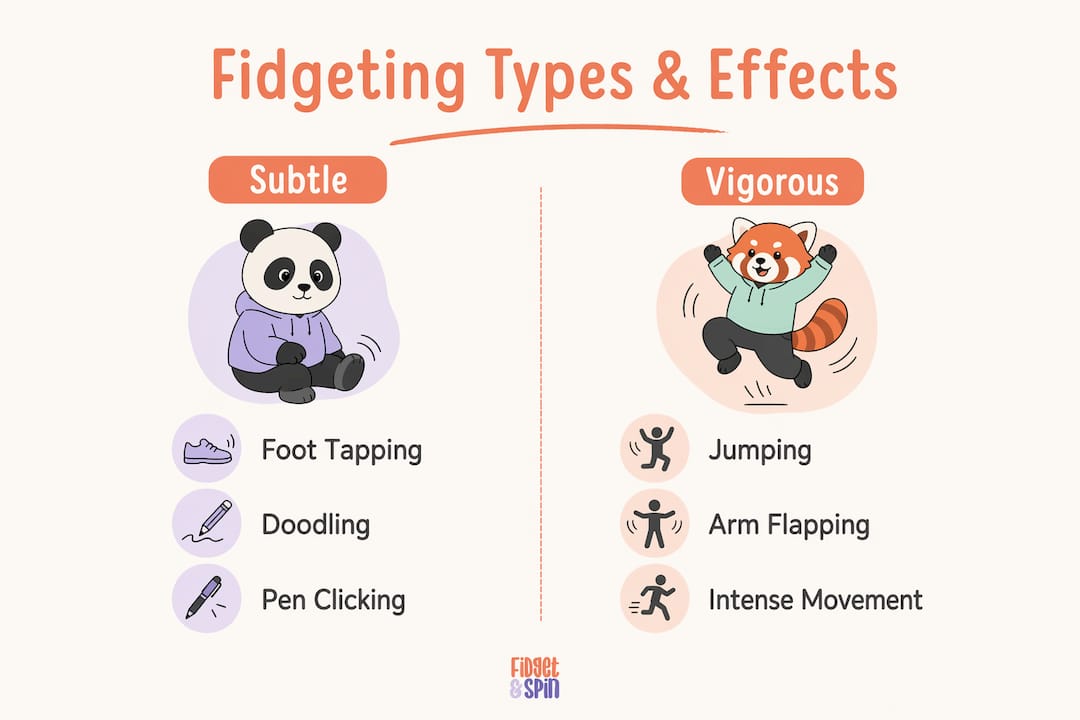
Not all movement delivers the same benefit. The research draws a clear line between intrinsic fidgeting and more vigorous or disruptive activity.

| Fidgeting type | Examples | Effect on focus |
|---|---|---|
| Subtle rhythmic | Foot-tapping, doodling, pen-clicking | Supports sustained attention |
| Sensory-seeking | Hair-twirling, rocking, chewing | Aids arousal regulation |
| Vigorous/erratic | Jumping, loud tapping, pacing | Mixed; may distract others |
| Commercial devices | Spinner toys, stress balls | Inconsistent; may distract |
The key finding from Schweitzer’s lab is that intrinsic fidgeting aligns with a person’s natural processing rhythm in a way that many commercial tools do not. A fidget spinner that captures a child’s visual attention is doing something quite different from the unconscious foot-tap that keeps them anchored to a task.
A trial examining leg fidgeting during prolonged sitting found that leg fidgeting for one minute in every five improved executive function completion time and reduced errors compared to uninterrupted sitting. The effect was specific to executive function rather than processing speed, which points to fidgeting’s particular relevance for the kinds of tasks that demand planning and self-control.
Research with children also shows that more intense movement during correct trials in ADHD groups correlates with better cognitive performance, while the same pattern does not appear in typically developing children. This suggests the compensatory mechanism is specific to ADHD rather than universal.
Pro Tip: If your child fidgets more as a lesson or task goes on, that escalation is likely the brain working harder to stay engaged, not a sign they have given up.
How to use fidgeting to actually help with concentration
Remy, my six-year-old, cannot sit through a story without moving. He rocks, he taps, he chews his sleeve. For a long time I thought I was supposed to stop him. Then I read the research and realised I had been trying to take away the very thing keeping him in the room.
Dr Roland Rotz, who has written extensively on ADHD and sensory regulation, describes the approach as “fidget to focus.” The idea is that rhythmic sensory stimulation anchors the nervous system in a way that erratic movement cannot. It is not about any movement. It is about the right kind of movement, at the right intensity, matched to the person.
“It’s a paradigm shift. We need to stop the shame and acknowledge that movement, as long as it is not disruptive to other students, can be very helpful to students with ADHD.” — Julie Schweitzer, UC Davis MIND Institute
Here is what actually helps, based on the research and on what I have seen work with Remy and the children who come to our sessions:
- Encourage low-level rhythmic movement during tasks: foot-tapping under a desk, rocking on a wobble cushion, or doodling on a notepad.
- Build in real movement breaks for longer tasks. Schweitzer specifically recommends a short walk rather than scrolling a phone, which can pull attention away entirely.
- Distinguish productive from disruptive fidgeting. Tapping a foot quietly is very different from banging a table. The test is whether it helps the person focus without pulling others out of theirs.
- Avoid shaming the movement. A child told repeatedly to sit still learns that their body is a problem. That message sticks.
- Explore sensory accommodations at school. Children with a diagnosed ADHD can access movement accommodations in many UK schools. A SENCO conversation is a good starting point.
For sensory-sensitive children, movement also helps regulate emotional states and can reduce anxiety before or during demanding tasks. The overlap between focus and emotional regulation in ADHD is real, and fidgeting seems to support both.
Pro Tip: Doodling during a phone call or meeting is not rudeness. Research suggests it keeps the mind present rather than wandering. Keep a notepad handy.
Why do people fidget? The psychology and neurology behind it
The short answer is that the brain is trying to stay awake. Not literally, but in terms of arousal: the level of neural activation needed to engage with a task. When that level drops below what a task demands, the body reaches for movement to compensate.
Fidgeting serves as sensory-seeking behaviour that helps regulate nervous system arousal. For people with ADHD, who often experience under-arousal in the prefrontal cortex, this is not a quirk. It is a coping mechanism the nervous system has developed on its own.
Common myths worth addressing
- “Fidgeting means you are not paying attention.” The opposite is often true. Fidgeting tends to increase precisely when a person is working hardest to stay focused.
- “Fidget toys solve the problem.” Commercial devices can help, but they can also become a distraction in themselves. Schweitzer’s lab notes that intrinsic fidgeting, the kind the body generates naturally, tends to be better calibrated to individual need.
- “Only children with ADHD fidget.” Everyone fidgets to some degree. The difference in ADHD is that the behaviour is more frequent, more intense, and more functionally necessary.
- “Stopping the fidgeting will improve focus.” Restricting movement in children with ADHD may actually worsen cognitive performance, according to the trial-by-trial analysis from the PMC research.
Fidgeting and stress relief
Movement creates sensory input that can regulate emotional states, not just cognitive ones. For neurodiverse individuals dealing with sensory overload or anxiety, low-level repetitive movement offers a calming outlet. This is why rocking, hand-flapping, or pacing often appear during moments of stress. These are not behaviours to eliminate. They are the nervous system’s way of managing an overwhelming moment. Understanding the difference between a meltdown and a tantrum can help carers respond to these moments with the right kind of support rather than the wrong kind of intervention.
What we have learned running sensory play sessions in Brighton
I started Fidget and Spin because Remy was three years old and I had run out of places to take him. Soft play was too loud, too bright, and too full of people who stared. Baby groups expected him to sit in a circle. He could not do that. He needed to move, and he needed to move in a way that felt safe.
Anthony and I built what we could not find. Three sensory zones, each designed around a different kind of regulation need. The Wiggle & Bounce zone is for big movement, the kind that gets the body’s arousal up. Snuggle & Chill is low-stimulation, for children who need to come down. Squish & Squeeze is tactile play and fidgets, which is where a lot of our ADHD children find their groove.
What I have watched, session after session, is this: a child arrives dysregulated, bouncing off the walls or completely shut down. They find their movement. They settle. They start to engage. That is not magic. That is the nervous system doing exactly what the research describes.
At Fidget and Spin, we see children arrive overwhelmed and leave regulated. The movement is not the problem. It is the solution.
A few things I have noticed that align with what the science says:
- Children who are given space to move on their own terms tend to engage with activities longer.
- Rhythmic, repetitive movement (rocking on a balance board, squishing putty) seems to support focus better than random high-energy play.
- Sensory-seeking children often self-select the input they need, if you let them.
- Parents relax when the environment is built for their child, not the other way around.
The benefits of fidget toys for neurodiverse children are real, but they work best when they are part of a broader sensory environment rather than a standalone fix. A spinner handed to a child in a chaotic room is not the same as a spinner used in a calm, structured space where the child already feels safe.
| Session zone | Movement type | Regulation goal |
|---|---|---|
| Wiggle & Bounce | Large motor, high arousal | Raise alertness, release energy |
| Snuggle & Chill | Minimal, low-stim | Calm, reduce sensory overload |
| Squish & Squeeze | Tactile, rhythmic | Anchor focus, sensory regulation |
For families navigating emotional regulation for SEN children, understanding that movement is part of the toolkit, not a distraction from it, changes everything.
Come and see it in action
Fidget and Spin runs weekly sensory play sessions in Brighton and Hove for neurodiverse children aged 1–6. Every session is built around the idea that movement is regulation, not misbehaviour. If your child needs to rock, tap, bounce, or squeeze their way through the morning, they are in the right place.
We also run SEN-friendly birthday parties across Brighton, Hove, and wider Sussex, with three packages starting from £220. No overwhelming noise, no pressure to perform, no side-eye from other parents.
Book a sensory play session and bring your child somewhere that was built for them.
Key takeaways
Fidgeting is a scientifically validated self-regulation strategy that improves sustained attention and cognitive performance in ADHD, particularly during longer tasks.
| Point | Details |
|---|---|
| Fidgeting supports focus | Research on 70 adults with ADHD showed better cognitive task performance with intrinsic fidgeting. |
| Effect grows over time | The benefit of fidgeting increases as tasks lengthen and attention naturally wanes. |
| Rhythm matters | Subtle, rhythmic movement like foot-tapping or doodling outperforms vigorous or erratic fidgeting. |
| Movement aids emotion too | Fidgeting helps regulate emotional states as well as cognitive arousal in neurodiverse individuals. |
| Stopping it can backfire | Restricting movement in children with ADHD may worsen rather than improve cognitive performance. |
FAQ
What are the benefits of fidgeting for people with ADHD?
Fidgeting raises physiological arousal to compensate for under-stimulation, improving sustained attention and reducing reaction time variability during cognitive tasks. Research shows the benefit is strongest during longer tasks, when attention naturally begins to decline.
Are fidget devices as effective as natural fidgeting?
Not necessarily. Professor Julie Schweitzer at the UC Davis MIND Institute notes that intrinsic fidgeting aligns better with an individual’s natural processing rhythm than most commercial devices, which can sometimes become a distraction rather than a support.
Do I have ADHD if I fidget a lot?
Fidgeting is common in everyone, but in ADHD it tends to be more frequent, more intense, and more functionally necessary for maintaining focus. Frequent fidgeting alone does not indicate ADHD; a formal assessment from a qualified clinician is needed for a diagnosis.
What is the psychology behind fidgeting?
Fidgeting is a sensory-seeking behaviour driven by the nervous system’s need to regulate arousal. When the brain is under-stimulated, the body generates movement to stimulate the locus coeruleus-norepinephrine system, raising cortical arousal to a level where focused work becomes possible.
Can fidgeting help with stress and anxiety?
Yes. Movement creates sensory input that can calm the nervous system during moments of overload or anxiety, particularly for neurodiverse individuals. Low-level repetitive movement such as rocking or tapping offers a grounding outlet when emotional regulation is under pressure.
Recommended
- How fidget toys help focus in neurodiverse children | Fidget and Spin Brighton
- Benefits of fidget tools for neurodiverse children | Fidget and Spin Brighton
- Do fidget toys improve attention in young children? | Fidget and Spin Brighton
- The real impact of fidget toys on neurodiverse children | Fidget and Spin Brighton