
Here is the plan, in full, before anything else: prepare the day before, agree a signal before you arrive, and leave the second that signal comes without apology or negotiation. That’s it. That’s the whole thing. Everything else in this article is just the detail underneath those three steps.
The one-line script you need is this: “We’re heading off now, thanks so much, see you soon!” Said while already moving towards the door, bag on shoulder, child’s hand in yours. Not a question. Not an apology. A statement, delivered warmly, that gives nobody room to argue you out of it.
- Prepare — protect sleep, food and quiet time before you even leave the house.
- Signal — agree a private cue with your child that means “I need to go now.”
- Exit — move towards the door the moment you see that cue, using the script above.
Three steps. One sentence. That’s what you need tonight. The rest of this covers the why and the how, drawing on neurodivergent-affirming guidance and on what Anthony and I have learned the hard way with our own son, Remy, at more birthday parties than I care to count.
Key Takeaways
Leaving a party calmly works best when preparation, a rehearsed signal and a landing pad are treated as one connected plan, not three separate ideas.
| Point | Details |
|---|---|
| Prepare the day before | Protect sleep, offer a protein-rich snack, and build in twenty quiet minutes before you leave the house. |
| Agree the signal early | Rehearse a non-verbal or AAC-friendly cue at home so your child can use it even when speech is hard. |
| Take micro-breaks | Step outside for a few minutes on a schedule, before your child actually needs it, not after. |
| Watch for stacking signs | Two or more warning signs together mean it’s time to move from break to exit, not wait it out. |
| Prepare the landing pad | Dim lights, comfy clothes and a quiet activity ready before you arrive home speeds up recovery. |
| Choose sessions built around calm | Fidget & Spin designs weekly sessions and birthday parties with quiet zones and rehearsed exits already in place. |
You have permission to leave whenever your child needs you to. That’s not failure. That’s parenting well.
Table of Contents
- Preparing the day before for leaving a party calmly
- What goes in the sensory go-bag and how to agree an exit signal
- How to pace the party so exits aren’t dramatic
- Spotting the signs it’s time to leave a party calmly
- Scripts and logistics for the actual exit
- The landing pad: recovering in the hour after you get home
- A printable mini-plan you can fill in before you arrive
- What I do when I dread a party
- Sessions and parties built with the exit already planned in
- Sources
- FAQ
Preparing the day before for leaving a party calmly
Last Tuesday I packed Remy’s bag at 8pm, the night before a party he’d been half dreading, half excited about for a week. Spare t shirt. Headphones. His squishy fox. I do this the night before now, always, because doing it in the morning means doing it badly, rushed, while he’s already asking questions I can’t answer yet.
Sleep the night before matters more than almost anything you do on the day itself. So does food. Protecting sleep, eating protein and salt before you leave, and building in twenty quiet minutes before you even set off all do more heavy lifting than any clever trick you might try once you’re there. I wish someone had told me this years ago instead of me discovering it through several ruined afternoons.
The day before:
- Keep bedtime consistent, even if it feels boring.
- Mention the party lightly, once or twice, without building it into a big deal.
- Lay out clothes and pack the bag so morning has one less decision in it.
The hour before:
- Feed a protein and salt snack, not just something sweet.
- Give twenty minutes of quiet, screen-free time before you leave the house.
- Confirm the exit signal with your child one more time, gently, like a reminder rather than a test.
Pro Tip: Take two cars if you can, or agree who leaves with the child while the other adult stays. Tell one trusted person at the party, quietly, that you might leave early — a heads-up costs nothing and saves you an awkward conversation later.
This is the same logic PDA parents use over the festive season: dropping demands and bringing familiar comforts makes gatherings survivable, and travelling separately makes the getaway simple.
What goes in the sensory go-bag and how to agree an exit signal
Remy squeezes my hand twice. That’s it. That’s our whole signal. No words, no fuss, just two squeezes and I know we’re leaving within the next five minutes. We built that signal together over a wet Saturday afternoon of practice, and it has saved more parties than I can count.
Go-bag essentials:
- Noise-reducing headphones or earplugs.
- A favourite snack, something salty rather than sugary if you can manage it.
- Tinted glasses if bright lights are a struggle.
- One familiar small toy or chew.
- Spare clothes, because spills happen and meltdowns sometimes come with them.
A non-verbal signal works because it needs no speech at exactly the moment speech gets hard. Agreeing something clear beforehand, a double hand-squeeze, a pointed finger, a card with a picture of a front door, gives your child agency without demanding a sentence they may not have in them by that point. For children using AAC or PECS, the same principle applies: a dedicated “home” symbol on the device, rehearsed beforehand, does the same job a spoken word can’t.
Rehearse it. Role-play the whole sequence at home, a quick social story the night before, or even a thirty-second phone video of you walking through the front door together saying the script out loud. Children who’ve practised the exit tend to use the signal more readily than children hearing about it for the first time mid-party.
How to pace the party so exits aren’t dramatic
I slip outside for two minutes most parties now. Just me, standing by someone’s bins, breathing. Nobody notices. It resets me enough to go back in.

Micro-breaks work the same way for children. Taking short breaks before you actually need them cuts the cumulative load far more than waiting until things have already gone wrong. A simple schedule helps: fifteen minutes in, five minutes somewhere quiet, repeat. Set a phone timer if it helps you remember, because in the noise of a party you will forget.
Pacing tips that actually help:
- Choose one or two deeper conversations over ten shallow ones.
- Scout the quiet corners and the chairs near exits as soon as you arrive.
- Sit near a door, not because you’re planning to run, but because options reduce anxiety.
When your child does start to wobble, co-regulation beats conversation. Lowering your voice, slowing your own breathing, and sitting quietly alongside them tells their nervous system it’s safe without adding a single demand. Avoid questions (“what’s wrong?”), avoid instructions (“calm down”), and avoid explaining the social rules of the room. None of that helps a dysregulated child. Presence does.
Spotting the signs it’s time to leave a party calmly
The lights start to buzz. That’s usually my first sign something has to change, and often I notice it before Remy says a word.
Watch for the following, and treat two or more together as your cue to move from a micro-break to a full exit:
- Sensory tolerance visibly dropping — flinching at noise that didn’t bother them an hour ago.
- Words slowing down, getting shorter, or stopping altogether.
- A shortening fuse over small things that wouldn’t normally register.
- A child physically trying to shrink, hide, or get behind you.
- Repetitive movements increasing, or stimming becoming more intense.
A tiered response saves you from jumping straight to full exit every time. Quiet corner, then step outside, then leave is a proportionate ladder, not a panic button. But once two or more signs stack up, stop climbing the ladder and go. Regret about leaving too early fades fast. Regret about staying too long tends to linger, sometimes for days.
Scripts and logistics for the actual exit
I stand near the chair by the door, coat already half on, bag on my shoulder, before I ever say a word to anyone. That positioning does half the work. Nobody argues with a woman clearly already leaving.
Scripts that work, for different people:
- To the host: “This has been lovely, thank you so much, we’re going to head off now.”
- To another parent: “He’s had a brilliant time, we’re just going to slip out.”
- To a curious relative: “We’re off, see you soon!” (No further explanation required. None.)
None of these apologise. None of them explain sensory overwhelm to someone who hasn’t asked and doesn’t need to know. A quick note to the host beforehand that you might leave early makes the whole thing socially frictionless, so nobody’s surprised when you go.
Plan the physical exit like a small operation: know your nearest door, know who’s carrying which bag, know where the car is parked. If you’re travelling in separate cars, agree beforehand who leaves with the child.
Pro Tip: Tell one trusted adult at the party, quietly, before you even sit down, that you might need to leave suddenly. Having an ally who understands means you’re not managing a room and a meltdown alone.
The landing pad: recovering in the hour after you get home
I switch the lamp on before we’re even through the door. Soft light, not the overhead one. Something quiet plays already, low, in the background. Remy pads in and knows exactly what’s coming next, because it’s the same every time.
Landing pad checklist:
- Dim lighting, ready before you arrive.
- Comfy clothes laid out, so changing takes seconds.
- Water and a snack, ideally something salty or protein-rich.
- One quiet activity already set up, no decisions required.
- Phones and screens away from the immediate space.
Recovery starts before you’re even home, which is why preparing the landing pad in advance matters more than scrambling once you’re through the door. For the first 24 hours, defer big decisions, keep meals simple, and let the household know: today is a quiet one. If the social hangover stretches on for days rather than hours, that’s worth mentioning to whoever supports your child’s wider care.
A printable mini-plan you can fill in before you arrive
I keep one of these folded in my bag, filled in with pencil so I can change it party to party. Two minutes to complete, and it takes the guesswork out of the actual moment.
Photograph it once it’s filled in, keep a copy on your phone, and consider laminating a blank version so you can reuse it with a whiteboard pen. Rehearse filling it in together with your child before big events, so the fields become familiar rather than clinical.
What I do when I dread a party
We left a party early three weeks ago. Remy had done brilliantly for forty minutes, then the bouncy castle got too loud and too crowded, and I saw his hand come up towards mine before he’d said a single word. Two squeezes. We were in the car within four minutes. He cried a bit in the back seat, then fell asleep before we’d even left the road. I didn’t feel like a failure driving home. I felt relieved.
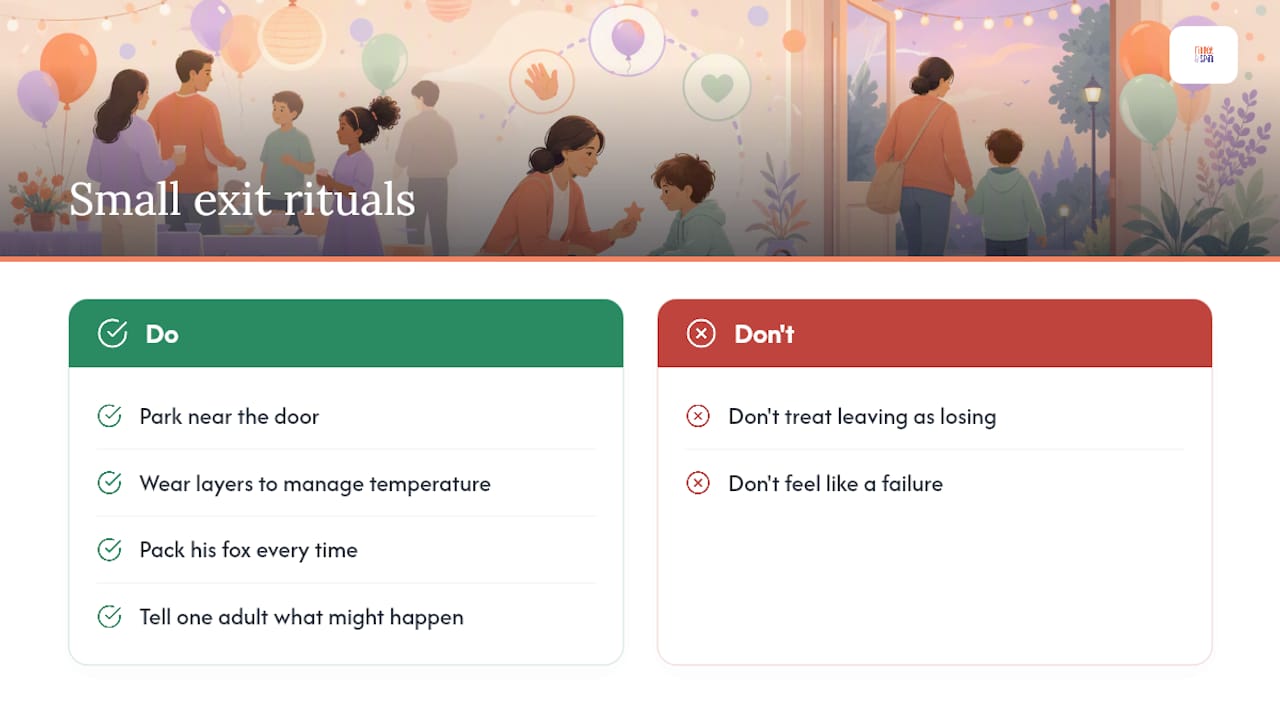
That took years to learn. My small rituals now: park near the door, wear layers so temperature never becomes one more thing to manage, pack his fox even when he insists he won’t need it, and always, always tell one adult at the party what might happen.
Leaving early isn’t losing. It’s a decision that puts your child’s regulation ahead of anyone’s expectations, and that’s a success, not a retreat. I built Fidget & Spin partly because I got tired of parties that never had an exit built in from the start. That’s a different conversation, for a different section.
Sessions and parties built with the exit already planned in
We built Fidget & Spin because Remy needed somewhere the exit wasn’t an afterthought bolted onto a bouncy castle and a sugar rush. Anthony and I designed our sessions and parties around calm from the first minute, not just damage control at the end.
Our SEN-friendly birthday parties across Brighton, Hove and wider Sussex come with three distinct sensory zones, including a genuinely quiet space to retreat to, small guest lists that keep the noise manageable, and staff who understand that a child slipping out mid-party isn’t a problem to solve. If you’d rather not build the exit plan from scratch every single time, our weekly sessions and party packages already have it built in. Concession spots are available through our Pay-It-Forward scheme at checkout, so cost needn’t be the reason a family misses out. Have a look at our SEN birthday party packages and get in touch to check dates for Brighton, Hove and Sussex.
Sources
- Sensory‑friendly party planning: Autism party tips to help anxious children enjoy birthdays — They Are The Future
- Preventing social hangover: pre and mid‑event — NeuroDiversion
- When the event didn’t go as planned: the exit strategy nobody talks about — Sensory Safe Events
- Dropping demands this holiday season — PDA North America
FAQ
What is the best way of leaving a party calmly with an autistic child?
Agree a private, non-verbal exit signal beforehand, watch for two or more warning signs together, then use a short, neutral script and move towards the door without explaining or apologising.
How do I stop my child melting down when we leave a party?
Prevention matters more than the exit itself: protect sleep the night before, feed a protein-rich snack beforehand, and take micro-breaks throughout so overwhelm never builds to a peak.
What should go in a sensory go-bag for parties?
Pack noise-reducing headphones, a favourite salty snack, tinted glasses if light is an issue, a familiar toy or chew, and spare clothes.
Is it okay to leave a children’s party early?
Yes. Leaving early is a neurodivergent-affirming choice that puts your child’s regulation ahead of social expectation, and regret about staying too long usually lasts far longer than regret about leaving.
How does Fidget & Spin help with party exits?
Fidget & Spin builds quiet zones and rehearsed exit plans directly into its SEN-friendly birthday parties and weekly sessions across Brighton, Hove and Sussex, so the exit is never an afterthought.
Recommended
- How to throw a quiet birthday party for neurodiverse kids | Fidget and Spin Brighton
- Birthday party for a non verbal child: a real guide | Fidget and Spin Brighton
- How to help SEN children connect through sensory play | Fidget and Spin Brighton
- Sensory activities guide for SEN families in Brighton | Fidget and Spin Brighton