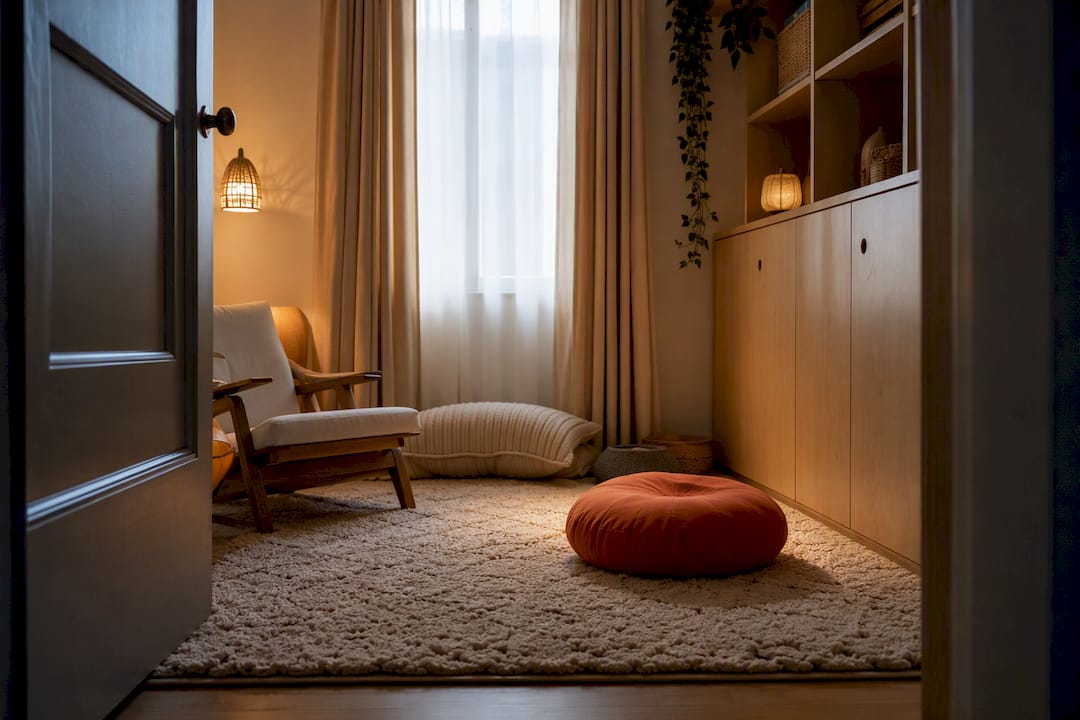
A low arousal play space is a deliberately predictable, low-stimulus retreat that strips out sensory triggers so a child can settle their nervous system rather than fight it. It helps neurodiverse children, especially those with autism, ADHD or PDA, who get overwhelmed by noise, light or unpredictable movement. Start now: spend three minutes walking your usual play space and noting every flicker, buzz and clash of colour. That list is your starting point.
TL;DR:
- Creating a low arousal space involves minimizing unpredictable noise, flickering lights, and unpredictable textures, which often cause distress in neurodiverse children.
- Key modifications include using dimmable warm lighting, soft furnishings to absorb sound, predictable textures, and separating calming from stimulating movement.
- Conduct a thorough audit of the space, then prioritize fixes for the highest distress triggers such as lighting and noise, and customize based on individual sensory profiles.
- Caregivers should reduce demands and manage their own tone and posture, especially during signs of rising arousal, and involve professionals if patterns of distress persist.
- Many organized sessions and birthday parties incorporate these low arousal principles, providing ready-made environments that limit sensory triggers and support neurodiverse children.
Table of Contents
- What makes a space “low arousal” in the first place?
- How do you actually set one up?
- Why does the same space work for one child and not another?
- The behaviour behind the space: what carers need to do too
- What this looks like in a real Fidget and Spin session
- What I’d tell any parent dreading the next birthday party
- Want help building one, or a party that already has it built in?
- Sources
- FAQ
What makes a space “low arousal” in the first place?
Every sense is a doorway for overwhelm, and each one needs its own fix. I learned this the hard way, watching Remy melt down in a soft play centre that looked perfectly calm to me and sounded like a fairground to him.
Sound is usually the biggest offender. Unpredictable noise, a toilet flushing, a tannoy, another child shrieking, spikes arousal fast because the brain can’t prepare for it. Ear defenders help enormously, as do rugs, curtains and soft furnishings that soak up echo. White noise is trickier than people assume: it can genuinely help some children with ADHD, particularly those with inattentive traits, by improving the signal-to-noise ratio in their environment, but it can just as easily overstimulate a hyperactive profile. Test it, don’t assume it.
Sight matters more than most people realise. Flickering fluorescent tubes, high-contrast patterns and anything moving in the periphery (spinning fans, flashing toys) keep the nervous system on alert. Warm, dimmable lighting and a visually quiet room, plain walls, closed storage, do far more heavy lifting than any calming poster ever will.
Touch needs predictability. Scratchy labels, stiff seams and unexpected textures can derail a child before play even starts. Offer soft, familiar fabrics and proprioceptive options like weighted lap pads (only under proper guidance, more on that below) or dense cushions to push against.

Movement (vestibular and proprioceptive input) splits into calming and stimulating, and mixing them up is a common mistake. A gentle rock in a hammock swing settles a nervous system; a fast spinning chair winds it up. Offer both, but clearly separate them.
Smell and taste are the most overlooked domain. Adopt a scent-lite policy: no strong cleaning products or diffusers, and use one familiar, comforting smell sparingly rather than layering several.
- Sound: ear defenders, soft furnishings, cautious white noise
- Sight: dimmable warm lighting, no flicker, plain visual field
- Touch: predictable textures, proprioceptive options
- Movement: separate calming input from stimulating input
- Smell: scent-lite, one familiar comfort smell
Pro Tip: Test one sensory change at a time. If you swap the lighting and the flooring in the same week, you won’t know which change actually helped.
How do you actually set one up?
Most parents I talk to overthink the design and underthink the audit. Do this instead: walk the room, list every unpredictable stimulus (buzzing lights, echoey floors, cluttered shelves), then rank them by how often they cause distress. That ranking tells you where to spend your time and money first.
- Audit the space for noise, light, clutter and texture over a normal session.
- Zone it. You need a retreat den (soft, enclosed, low light), a regulated play spot (calm activities within reach), and clear sightlines so a supervising adult can see in without hovering over the child.
- Fit it out using the checklist below, then observe and adjust.
Lighting comes first because it’s cheap to fix and makes an outsized difference: swap fluorescent tubes for warm, dimmable bulbs, and check nothing flickers, even faintly, under phone camera slow motion. Sound comes next: rugs, curtains, soft furnishings, and cautiously placed ear defenders on a hook by the door so a child can self-select them.
- Warm, dimmable lighting, no fluorescents
- Rugs, curtains and soft furnishings to absorb sound
- Closed storage to reduce visual clutter
- A small toolkit of calming items: liquid timers, soft fidgets, familiar comfort object
- Clear floor space with no trip hazards near the retreat corner
A Worcestershire tip sheet on low arousal spaces recommends items like ear defenders and weighted teddies, but flags that weighted blankets and similar items need proper guidance on safe use, weight limits, supervision, and never as a restraint substitute. If you’re considering weighted equipment, check with an occupational therapist first. For more layout ideas that work in real sessions, our guide to creative sensory zone ideas covers zoning in more depth.
Why does the same space work for one child and not another?
No two sensory profiles are the same, and that’s the whole point of tailoring rather than templating. Run a simple 48 to 72 hour audit: jot down what triggers distress (a specific sound, a texture, a transition) and what your child actively seeks out (spinning, pressure, chewing). Patterns show up fast once you’re looking for them.
Change one variable at a time and watch what happens. Add the ear defenders on day one. Swap the lighting on day three. Note whether your child seems calmer, more engaged, or unchanged. This is slow, unglamorous work, but it beats guessing.
The ADHD noise question deserves its own paragraph because it trips people up constantly. Some children with ADHD, particularly those with inattentive presentations, concentrate better with background noise because it helps regulate an understimulated system, a pattern the Moderate Brain Arousal model helps explain. Others, often those with more hyperactive presentations, find the same noise pushes them over the edge. There’s no universal answer here. Test it on your own child and trust what you observe over what worked for someone else’s.
- Track triggers and seeking behaviours for 48 to 72 hours
- Change one variable, then observe before changing another
- Test white noise carefully rather than assuming it helps
- Give your child a non-verbal way to request the space (a PECS card or a quiet token)
- Loop in an OT, therapist or SENCO if patterns are unclear or distress is frequent
Our guide to sensory processing differences goes further into how these profiles differ. If ADHD arousal patterns feel confusing, The Pursuit Counseling’s explainer on ADHD diagnosis is worth a read too.
Pro Tip: Give the space a name your child chooses. “The Den” or “Snuggle Corner” turns it into something they ask for, not something adults impose.
The behaviour behind the space: what carers need to do too
A calm room with a stressed adult in it doesn’t work. Studio 3’s low arousal approach, developed by Andrew McDonnell in the 1990s, builds on this exact point: the environment is only half the job. Its four core components are demand reduction, avoiding known triggers, managing your own non-verbal cues (tone, posture, distance), and reflecting afterwards on what worked.
In practice, that means softening your voice and backing off physically the moment you spot early signs of rising arousal, rocking, jaw clenching, repetitive questions, rather than waiting for a full meltdown. Drop demands temporarily. Don’t ask a dysregulating child to also make eye contact and use their words.
- Reduce demands when arousal starts climbing
- Avoid known triggers rather than pushing through them
- Watch your own tone, posture and physical distance
- Reflect afterwards: what helped, what didn’t
Predictability itself lowers what I think of as the daily sensory cost. A child who knows a retreat exists carries less baseline anxiety into every outing, because they know there’s an exit if things get too much.
What this looks like in a real Fidget and Spin session
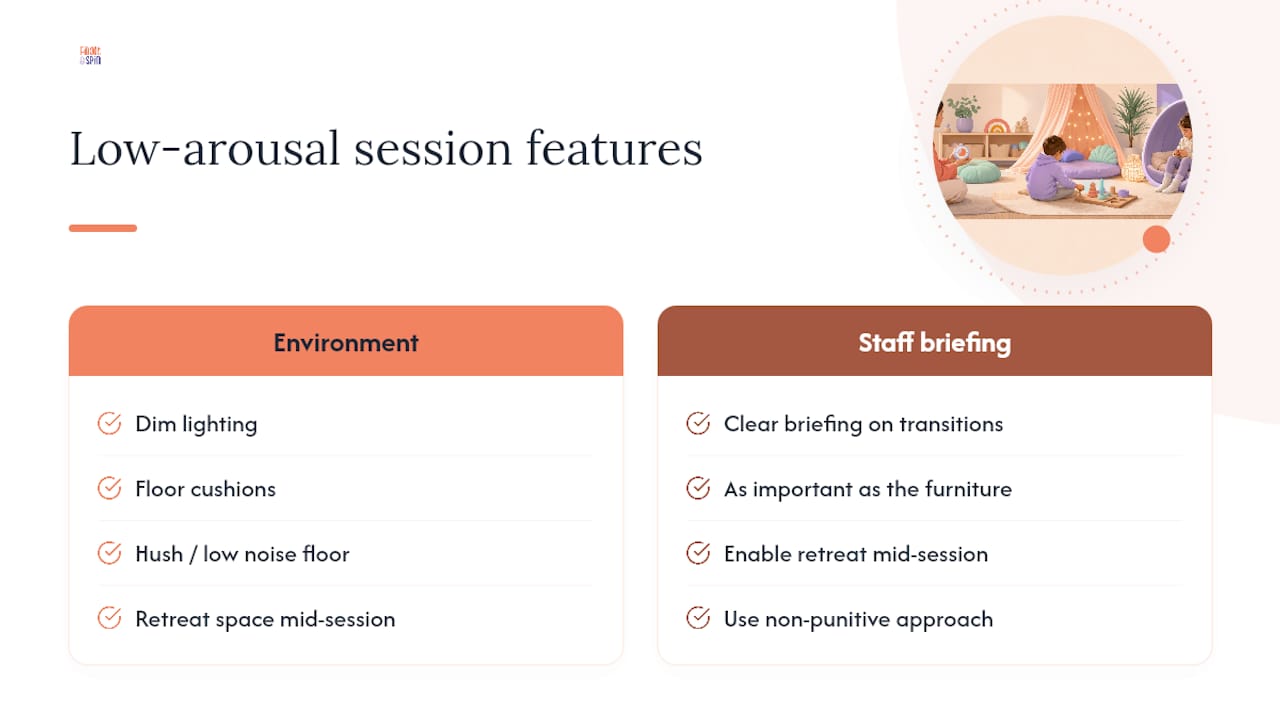
A mum once told me she’d stopped taking her son anywhere with a soft play frame because the noise floor alone made him bolt for the door. That’s exactly why Snuggle & Chill exists. Fitted with dim lighting, floor cushions, and a hush that’s rare in most kids’ venues, it gives children somewhere to retreat mid-session, not as a punishment, just a pressure valve. We’ve learned that clear staff briefing on transitions matters as much as the furniture.
What I’d tell any parent dreading the next birthday party
I’ve left more groups early than I can count, and caught the side-eye in soft play more times than I’d like. My one tip: pick one small change this week, ear defenders on a hook, one dimmer switch, and try it without guilt if it doesn’t fix everything immediately. Progress here is never linear, and that’s fine.
— Caitlin
Want help building one, or a party that already has it built in?
If reading all this has you wondering whether you’ve got the time, energy or spare corner to build a low-stim space from scratch, you’re not alone, and you don’t have to. Fidget and Spin runs weekly sensory stay-and-play sessions across three zones, Wiggle & Bounce for big movement, Snuggle & Chill for exactly the low-stim retreat described above, and Squish & Squeeze for tactile play, so your child gets a ready-made regulated environment without you sourcing a single dimmer bulb.
We also run SEN-friendly birthday parties for ages 1 to 7 across Brighton, Hove and wider Sussex, with three packages depending on what you need: The Wee One, The Big One, or The Whole Shebang. Every party is built around the same low arousal thinking covered here, so there’s no need to brief a venue on ear defenders or lighting; it’s already sorted. Concession spots are supported through Pay-It-Forward donations at checkout, and membership gives priority booking if weekly sessions suit your family. Have a look at our sensory birthday party packages and check dates for Brighton, Hove and Sussex.
Sources
Studio 3’s low arousal approach and the PMC study on ADHD and white noise informed most of this guide.
- Sensory white noise in clinical ADHD: Who benefits from noise, and who performs worse? - PMC
- What is the low arousal approach - Studio 3
- Low arousal space ideas — Worcestershire tip sheet
- Arousal, ADHD and cognitive performance — Frontiers Psychiatry
FAQ
What is a low arousal sensory environment?
It’s a space deliberately stripped of unpredictable noise, harsh light and sensory clutter so a child’s nervous system can settle rather than stay on alert. It works because it removes triggers rather than trying to teach a child to tolerate them.
How does low arousal affect ADHD?
Arousal regulation in ADHD is inconsistent rather than simply low or high, which is why the same stimulus, like background noise, can help one child and hinder another. Some children with inattentive traits benefit from mild background stimulation, while others with more hyperactive traits may find it overstimulating.
What is a low arousal approach in autism?
It’s a practitioner framework built around reducing demands, avoiding known triggers, and adjusting your own tone and body language rather than confronting distress head on. Studio 3’s model treats this as an active, ongoing practice, not a one-off room design.
What does it mean to have low arousal?
In this context, low arousal describes a calmer physiological state, rather than a personality trait, brought on by removing unpredictable sensory input. A low arousal space aims to help a dysregulated child move towards that calmer state.
Does Fidget and Spin have a low arousal space?
Yes. A dedicated low-stim retreat zone is used during weekly sessions and birthday parties. Current prices for sessions and party packages are listed on the Fidget and Spin parties page.