A low stimulation party is short, small and predictable, with one quiet room the birthday child can escape to without being noticed. That’s it. If you do nothing else, cap the guest list, book somewhere with a spare room or corner, and stock it with three calm activities before anyone arrives.
Here’s what to reach for first:
- A craft table with one finished-example piece, so nobody’s guessing what to do
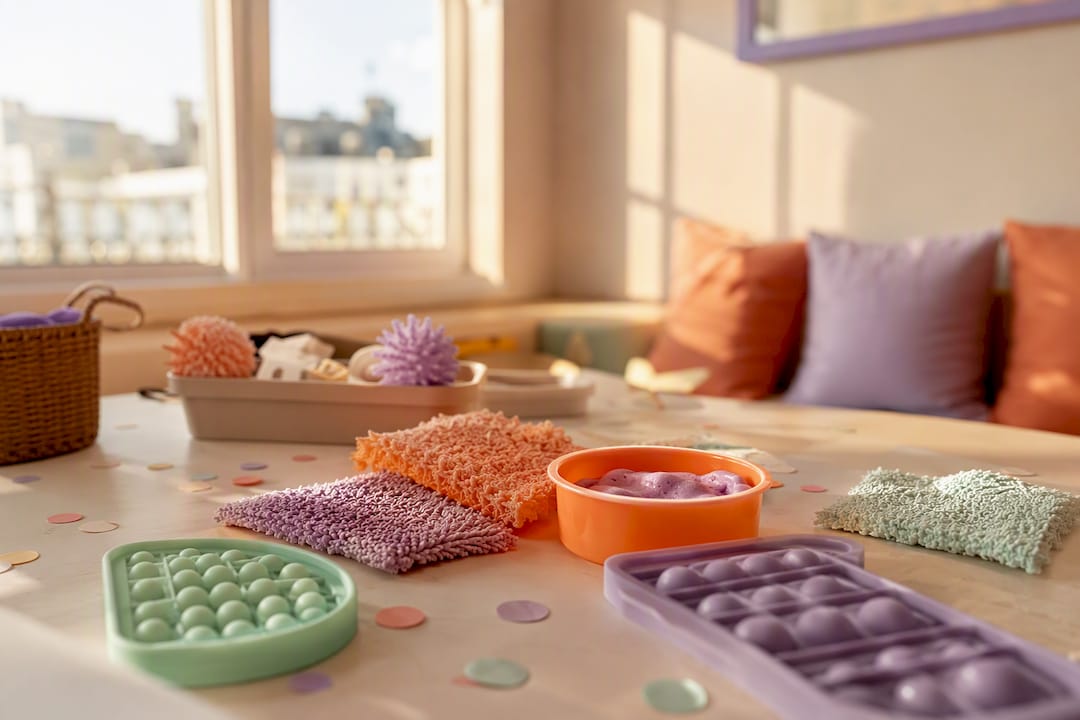
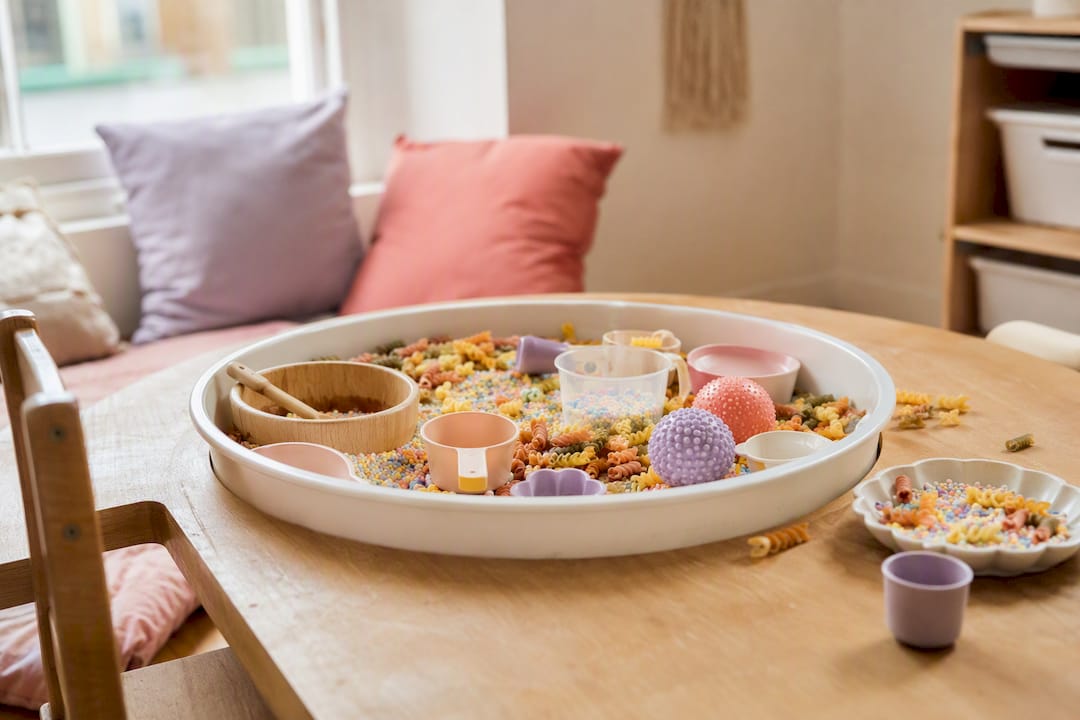
- A sensory bin (practical examples of calming sensory interventions like dry rice, pom poms, or whatever your child tolerates)
- A film nook with headphones and a loop of familiar clips
- Solo movement turns on a timer, not a free-for-all
- A slow scavenger hunt with picture clues, not shouted ones
- A simple tactile craft, like playdough with no expectation of a “finished” result
I’ve run enough of these at Fidget and Spin to know the difference between a party that limps to the end and one where the birthday child is still smiling at pack-up. The rest of this piece is everything I’ve learned getting there, including three timelines you can lift straight into your own planning.
Key Takeaways
A low stimulation party succeeds when the guest list stays small, the schedule stays visible, and a chill-out space is offered before anyone needs to ask for it.
| Point | Details |
|---|---|
| Keep it small and short | Six to eight guests and sixty to ninety minutes reduces the chance of regulation fatigue setting in. |
| Pre-identify a chill-out zone | Stock it with calming items and offer it to everyone, not just the birthday child. |
| Use visible timers and scripts | Countdown prompts and repeated phrasing make every transition foreseeable, not sudden. |
| Make cake and singing optional | A single candle, a quiet family moment, or skipping the song entirely all work. |
| Consider Fidget and Spin for the whole thing | Their SEN-friendly party packages in Brighton, Hove and Sussex build these principles into the venue from the start. |
Table of Contents
- Getting the low stimulation party ideas planning basics right
- Setting up the room so it stays calm
- Low stimulation party activity ideas that hold attention
- Food, cake and the candle moment without the panic
- Making transitions predictable
- What to pack in your sensory kit
- Sample timelines you can copy today
- What I’ve learned running these parties every week
- Getting the dress code right for sensory comfort
- Communicating calmly and reading the room
- Handling gatecrashers, latecomers and surprises
- What the research actually tells us about calm parties
- Where Fidget and Spin fits into your party planning
- Sources
- FAQ
Getting the low stimulation party ideas planning basics right
Six to eight children is my rule of thumb for a calm gathering. Beyond that, noise multiplies faster than fun does, and you lose the ability to notice one child sliding towards overwhelm. Sixty to ninety minutes is plenty. A short party, generally under 90 minutes, is easier to manage for children who tire out on regulation before the cake even arrives, and I’ve never once wished a party had run longer.
Here’s the sequence I’d follow:
- Set the guest list first, before the venue or theme.
- Write invitations that include a rough visual timeline, so parents know what’s coming.
- Add an RSVP line asking about sensory needs. Something like “any sounds, foods or textures to avoid?” works. Asking directly about singing, candles and character visits upfront saves an awkward moment on the day.
- Visit the venue beforehand if you can, even for twenty minutes.
- Confirm timings with anyone helping, so nobody freelances a surprise entrance.
Pro Tip: Invite fewer, familiar children rather than a bigger, more “impressive” list. A party with four kids who know your child beats one with fifteen who don’t, every single time.
Setting up the room so it stays calm
Every parent who’s stood in a soft play doorway watching their child’s shoulders creep up knows the moment I mean. The room itself does half the work, before a single game starts.
- Pick a chill-out corner before the party, not during a meltdown. It needs a beanbag, dim light and no toys that shout “come and play.” A pre-identified decompression space, never framed as punishment, is the single biggest calmer I’ve seen work.
- Swap overhead strip lighting for lamps or warm bulbs. Flickering fluorescents are a genuine trigger, not a preference.
- Keep music low and instrumental, and skip the PA-style announcements entirely. A quiet word beats a shouted “everyone gather round!” every time.
- Arrange seating in small clusters rather than one big circle, so children can drift without it being visible.
- Ditch balloons that might pop and noisemaker favours. Predictable, contained activities beat loud surprises for almost every child on the spectrum I’ve hosted.
Pro Tip: Test the lighting and music levels in the empty room before guests arrive. What sounds fine to an adult brain often isn’t fine to a six-year-old’s.
Low stimulation party activity ideas that hold attention
The best low stimulation party ideas aren’t about entertaining a crowd. They’re about giving each child something they can do at their own pace, without a queue forming behind them.
Calming and hands-on:
- A craft table with individual kits, so nobody has to share glue or wait their turn for scissors
- Simple visual art, like colouring or sticker scenes, with no “correct” outcome
Tactile stations:
- Sensory bins with dry pasta, kinetic sand or water beads (check for allergies and choking risk first)
- Playdough or slime, laid out on a wipeable mat with a helper nearby for cleanup
Gentle movement:
- A soft obstacle course taken one child at a time, timed rather than raced
- Bubble machines or a parachute game with turns marked by a visible timer
Quiet-group options:
- A short film nook with headphones for anyone who needs to step back but stay in the room
- A slow scavenger hunt using picture cards rather than shouted clues
- A tabletop cooperative game, like building a tower together, where nobody “loses”
Structured turn-taking with timers genuinely settles children who either chase sensory input or flinch from it. A visible sand timer or phone countdown tells a child exactly when their turn ends, which matters more than most parents expect. For more turn-based formats that work well at this age, our guide to autism friendly party games has a longer list.
Food, cake and the candle moment without the panic
Cake time is where I’ve seen more parties wobble than anywhere else. Twenty children singing loudly at a child who hates surprise noise is not a celebration, it’s an ambush with icing.
- Serve labelled finger food: things a child can identify by sight, not mystery dishes under sauce.
- Skip anything heavily scented or with an unfamiliar texture. Plain crisps beat a fancy dip every time.
- Make singing optional. Some children want it, some want a countdown instead, some want nothing at all.
- Try a single candle instead of a full sparkler production, or blow it out with immediate family only, quietly, before the group arrives.
- Label allergens clearly on a small card by each dish.
- Pack a take-home slice for children who can’t manage food in a noisy room. Nobody misses out just because they needed five minutes of quiet.
Making transitions predictable
Nothing derails a calm afternoon faster than an unannounced change. Kids who thrive on predictability read a sudden “right, everyone outside now!” as a small emergency.
- Draw or print a simple visual schedule and send it with the invitation, then stick a copy up at the party itself.
- Use a visible timer for every activity change, so the end is seen coming, not announced as a shock.
- Say transitions the same way each time: “two more minutes, then we tidy up.” Scripted, calm, repeated.
- Give the birthday child a small job, like holding the timer or choosing the next game, so they feel steady rather than swept along.
- Agree an exit code word with your child beforehand, something like “pineapple,” that means “get me out of here now” without a scene.
Pro Tip: Rehearse the cake moment at home first, even just once. A dry run removes the one surprise most children dread most.
What to pack in your sensory kit
A friend of mine calls this her “go bag,” and that’s about right. Half of managing a low stimulation party is having the right thing in your pocket at the right second.
- Ear defenders, for the moment the room gets loud without warning
- A couple of familiar fidgets, the ones already worn smooth from home use
- Snacks your child already trusts, in case the party food doesn’t land
- A visual schedule card, laminated, so it survives sticky fingers
- Spare headphones, charged, for the film nook
Brief whoever’s helping with three lines: “Watch for hands over ears or going quiet, that’s overwhelm starting. Point to the chill-out corner, don’t ask questions. If they want out, just let them go.” Arrive fifteen minutes early so your child meets the room before the room fills with noise.
Sample timelines you can copy today
Here are three timelines I’ve actually run. Adjust the middle chunk, never the arrival or exit.
Toddler party (indoor small room, 6 guests, 60 minutes): Arrival and free play (10 min) → sensory bin station (15 min) → snack, no singing (10 min) → gentle movement turns (15 min) → quiet wind-down with bubbles (10 min) → exit.
Preschool party (garden, 8 guests, 75 minutes): Arrival with name badges (10 min) → craft table (15 min) → scavenger hunt (15 min) → food and optional cake moment (15 min) → tabletop game (10 min) → chill-out zone offered to all, not just the birthday child (10 min) → exit.
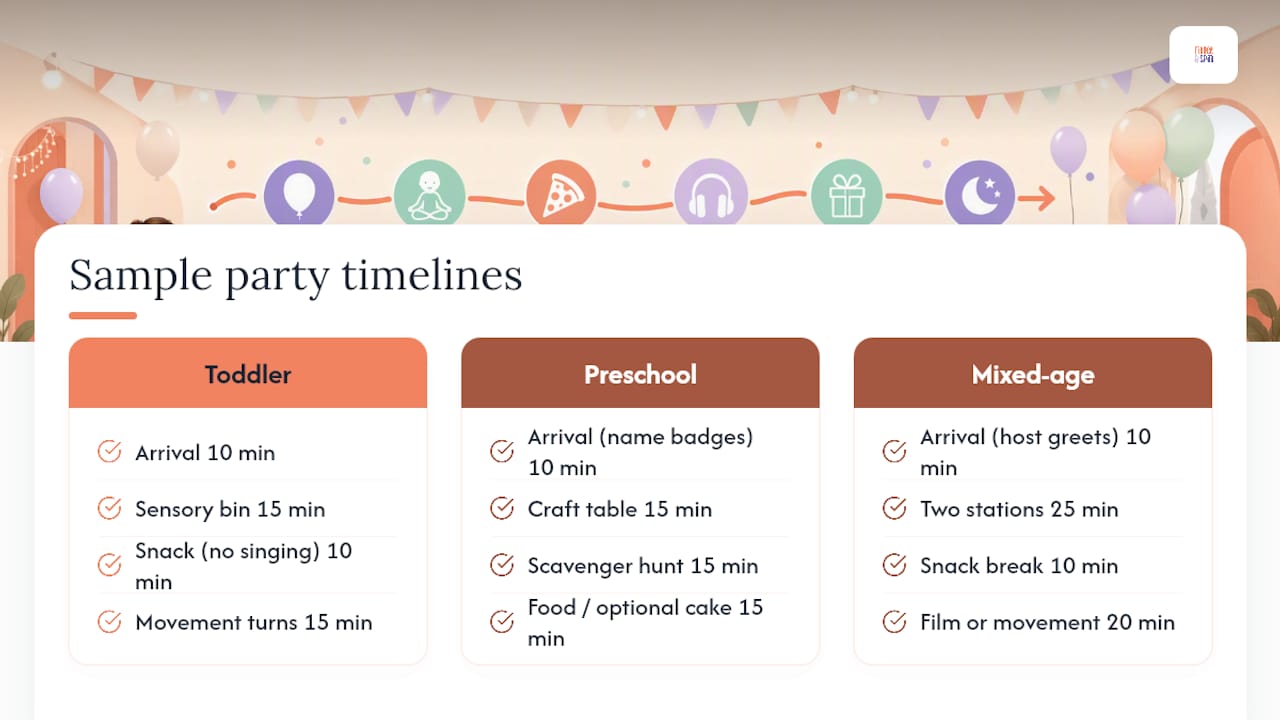
Mixed-age short venue hire (10 guests, 90 minutes): Arrival, host greets each child by name (10 min) → two activity stations running in parallel (25 min) → snack break (10 min) → film nook or movement turns, child’s choice (20 min) → cake moment, family-only or full group depending on the day (15 min) → free play and gradual goodbyes (10 min).
If the regulation tank looks low that morning, cut the middle activity block, not the arrival routine or the exit. That’s the bit doing the actual holding.
What I’ve learned running these parties every week
Late arrivals throw the whole schedule, every time, so I now build a ten-minute buffer into every timeline before anything “starts.” The candle moment causes more meltdowns than any other single event, which is why we default to a quiet, family-only blow-out at Fidget and Spin unless a family tells us their child loves the big sing-song.
Three rules of thumb I go back to constantly:
Shorter and smaller beats bigger and better, every single time. A party that ends on a high at sixty minutes is a success. A party that limps past ninety with a meltdown at the end is not, no matter how good the cake was.
The chill-out space works best when every child knows it’s there, not just the birthday child. Otherwise it looks like a punishment corner, and nobody uses it.
Adults following the script matters more than the script itself. A calm, repeated “two more minutes” from a frazzled parent still lands better than a cheerful surprise announcement.
Getting the dress code right for sensory comfort
Nobody plans a party outfit around seams, but you probably should. A child who’s spent the morning fighting a scratchy waistband arrives at their own party already halfway to overwhelmed, before a single balloon’s been popped.

Ask parents on the invitation to let children wear whatever they’re already comfortable in, not “party clothes” for the sake of photos. Soft, tagless fabrics, familiar shoes, and no stiff collars if you can help it. If your child has a favourite jumper worn thin from washing, that’s the party outfit, not the new one still stiff from the packet.
For the birthday child specifically, resist any pressure toward a costume or themed outfit that adds new textures or tightness on the one day you need everything else predictable. A cape over normal clothes works fine. A full costume that itches by hour one doesn’t.
Tell helpers and guests, gently, that trainers and comfortable layers are the dress code, not smart shoes. Cold hands or hot faces from an overly warm jumper tip a child towards distress faster than most sensory triggers people plan for. If the venue runs warm, ask about layering options in advance rather than discovering it mid party.
Communicating calmly and reading the room
A shouted instruction lands completely differently to an autistic child than it does to a neurotypical one, even when the words are identical. Volume and tone carry as much information as the sentence itself, so I keep my voice low and my sentences short at every party I run.
Give one instruction at a time, and wait. “Come and sit down, please, then we’ll start the game” is two instructions stacked into one breath, and it often means neither lands. Say “come and sit down,” wait for it to happen, then say the next thing.
Watch hands, not just faces, for the early signs of overwhelm. Hands over ears, fists clenching, or a sudden stillness after a lot of movement, these usually arrive before tears do. That’s the moment to offer the chill-out space quietly, without making it a group event, and without asking “are you okay?” in front of everyone.
Avoid rhetorical questions like “wouldn’t you like to join in?” They invite a decision a child might not have the words for in that moment. A statement, “there’s a space at the craft table whenever you want it,” gives the same option without demanding a verbal answer under pressure.
Handling gatecrashers, latecomers and surprises
A sibling always brings a friend nobody mentioned. A cousin turns up forty minutes late, mid activity, wanting a big hello. It happens at nearly every party I’ve run, so plan for it rather than hoping it won’t.
Agree with whoever’s helping that latecomers get a quiet, low-key welcome, not a “everyone say hello to Jamie!” moment that stops the room. A wave and a name badge does the job without derailing whatever’s already running.
For uninvited extras, decide in advance whether your venue and numbers can flex, and say so kindly if they can’t. “We’re keeping it small today, but thanks so much for asking” is a complete sentence, and you don’t owe anyone more explanation than that.
If something genuinely disrupts the flow, a delivery at the door, a dog barking outside, a fire alarm test, don’t wait to see if it passes. Move straight to the chill-out zone with your child, then assess. You can always come back to the party. You can’t always undo the ten minutes it takes to settle again after ignoring the signs.
What the research actually tells us about calm parties
The conventional advice on this topic obsesses over removing stimulation entirely, dim everything, silence everything, cancel the cake. That’s not what works. Predictability outperforms minimalism every time I’ve seen it tested against a real room of children. A party can have music, cake and a group game and still feel calm, provided every one of those moments was foreseeable in advance.
Where most advice falls short is treating the chill-out space as a backup plan rather than a built-in feature. It shouldn’t be the thing you scramble for once a child’s already overwhelmed. It should be visible from the moment guests walk in, used by whoever fancies it, birthday child or not.
If you take one thing from this, prioritise the guest list and the schedule before you touch decorations or games. Get those two right, and most other choices become easier. Get them wrong, and no amount of sensory bins will save the afternoon.
— Caitlin
Where Fidget and Spin fits into your party planning
If you’ve read this far wondering how you’ll actually pull off a chill-out zone, a visual schedule and staff who understand overwhelm without a rehearsal, that’s precisely why we built Fidget and Spin. Every party package already has the calm baked in: a quiet space that’s never treated as punishment, staff who know the signs of overwhelm before a parent has to explain them, and activity zones designed around regulation, not just entertainment.
Our SEN-friendly birthday parties run across Brighton, Hove and wider Sussex for ages one to seven, with three packages depending on how much you want handled for you, from The Wee One right through to The Whole Shebang. If you’d rather test the waters first, our weekly sensory sessions across Wiggle & Bounce, Snuggle & Chill and Squish & Squeeze let your child get familiar with the format before their actual party day. Check available dates and get a quote for your child’s next celebration.
Sources
Guidance drawn from the Child Mind Institute, Main Line Parent and They Are The Future, alongside our own Fidget and Spin party guides.
- Sensory-friendly party ideas — Child Mind Institute
- How to throw a sensory-friendly birthday party that’s fun for every kid — Main Line Parent
- Sensory-friendly party planning: autism party tips — They Are The Future
- Sensory-friendly birthday party planning guide — Chuck E. Cheese
FAQ
How do you keep young children entertained at a low stimulation party?
Offer a small menu of self-paced stations, a craft table, a sensory bin, a film nook, rather than one big group game everyone must join at once.
What are good sensory play ideas for a party?
Dry sensory bins, playdough, water beads and bubble stations all work well, provided each child gets their own kit or a clearly timed turn.
What are some low budget party theme ideas?
A garden scavenger hunt with picture clues, a home craft table, or a film nook with a favourite film cost almost nothing and reduce stimulation far more than a hired entertainer.
What sensory group activities work well together?
Parachute games, cooperative tower building and slow scavenger hunts let children participate together without the noise and competition of typical party games.
Does Fidget and Spin run low stimulation birthday parties?
Yes, Fidget and Spin runs SEN-friendly birthday parties across Brighton, Hove and Sussex, built around designated calm spaces and predictable, low-stimulation activity zones.
Recommended
- Picky eater party food that actually works for SEN birthdays | Fidget and Spin Brighton
- Creative fidget devices for SEN parties and play sessions | Fidget and Spin Brighton
- How to help SEN children connect through sensory play | Fidget and Spin Brighton
- SEND party venue Sussex: what actually makes one work | Fidget and Spin Brighton