
A meltdown is a loss of control that spills outward. A shutdown is the same overwhelm turned inward, until a child (or adult) goes quiet, still, and hard to reach. Both are the nervous system past its limit, not bad behaviour, and both need the same first response: less pressure, more safety, and someone calm nearby.
TL;DR:
- Meltdowns are outward episodes of loss of control caused by sensory or emotional overwhelm, often involving physical energetic expressions like shouting or hitting.
- Shutdowns are internal responses marked by silence, stillness, and dissociation, often overlooked because they appear calm outwardly but are signs of deep distress.
- Common triggers include sensory overstimulation, social demands, routine changes, and unmet basic needs, with the total daily load influencing reactions more than individual triggers.
- In emergencies, responses should focus on safety, reducing stimulation, and offering comfort, without attempting to negotiate or force speech during shutdowns.
- Preventative strategies include tracking accumulated stress, visual schedules, rehearsed exits, and pacing routines to lower overall daily load and reduce the frequency of episodes.
Table of Contents
- Meltdowns vs shutdowns: what’s actually happening
- What does a meltdown or shutdown actually look like?
- What triggers a meltdown or shutdown?
- What should you actually do in the moment?
- How can you prevent meltdowns and shutdowns?
- When does this become burnout, and when do you get help?
- What I actually do with Remy when the bucket’s full
- Why does this happen? The neurology behind it
- How does it feel from the inside?
- How this affects relationships and communication
- Where the common advice on this gets it wrong
- Sources
- FAQ
Meltdowns vs shutdowns: what’s actually happening
Here’s what nobody tells you at baby group: your child isn’t “kicking off” for attention. Their nervous system has hit capacity and it’s spilling out however it can.
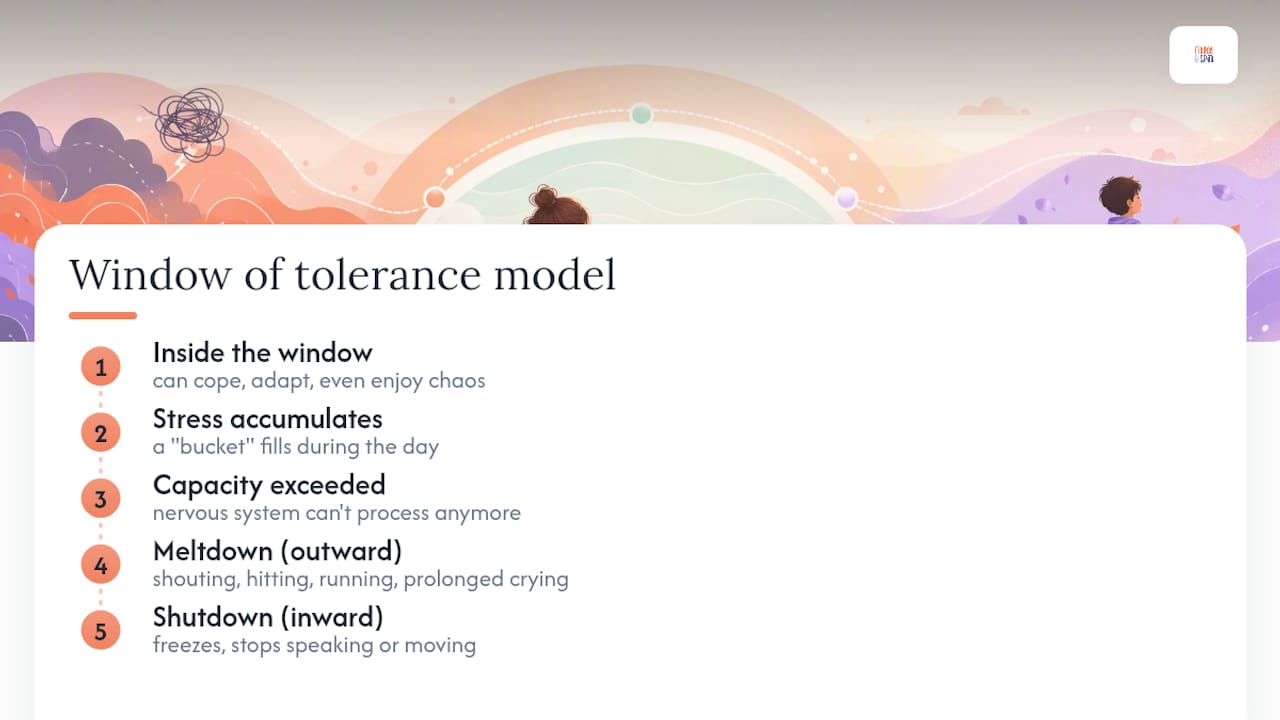
A meltdown is an outward loss of control, usually triggered by sensory or emotional overwhelm. Think shouting, hitting, running, crying that doesn’t stop when you’d expect it to. A shutdown is the opposite direction of the same problem: the person goes inward, freezes, and may stop speaking or moving altogether, as Leicestershire Partnership NHS Trust explains. Same overwhelm, different exit route.
I find the “window of tolerance” idea useful for explaining this to grandparents. Picture a window: inside it, a child can cope, adapt, even enjoy chaos. Outside it, in either direction, the system can’t process anymore. Some people talk about a “bucket” filling with stress all day until one small thing tips it over. It’s rarely the last thing that caused it. It’s everything before it.
Neither of these is a tantrum. Tantrums usually have an audience and an achievable goal. Meltdowns and shutdowns happen whether anyone’s watching, and stopping them doesn’t get anyone a biscuit.
What does a meltdown or shutdown actually look like?
You’ll usually know a meltdown when you see one. What catches parents out is the shutdown, because it looks like calm from three feet away.
Meltdown signs tend to include:
- Shouting, crying, or repetitive vocalising that intensifies rather than settles
- Flapping, rocking, or other big physical movement
- Hitting, biting, or throwing (aimed at the situation, not usually at a person)
- Trying to bolt or escape the space
- A visible burst of physical energy that has to go somewhere
Shutdown signs are quieter and easier to miss:
- Silence, or single-word answers when there were full sentences a minute ago
- Going still, staring, or appearing to “switch off”
- Increased stimming that’s more repetitive or intense than usual
- Struggling to make even small decisions (“do you want juice or water?” becomes impossible)
- A kind of dissociation, like they’re present in the room but not really there
Adults often mask harder, so a shutdown might just look like someone going quiet in a meeting and being told they seemed “fine.” They weren’t fine. Seattle Children’s makes the point plainly: silence in a shutdown is not calm, and it’s not compliance either.
What triggers a meltdown or shutdown?
Nobody has a meltdown over “nothing.” It just looks that way from the outside, because you didn’t see the eight things that happened before it.
Common triggers include:
- Sensory input: strip lighting, hand dryers, tags in clothes, crowded rooms, smells
- Social demands: unstructured play, being asked to make eye contact, group instructions
- Routine disruption: a different route to school, a cancelled plan, a new supply teacher
- Unmet basic needs: hunger, tiredness, pain, or needing the toilet and not being able to say so
Autistica frames both meltdowns and shutdowns as responses to extreme distress from sensory overload, social overwhelm, and unexpected change, not wilful behaviour. What matters more than any single trigger is the total load carried that day. Practitioners increasingly talk about tracking cumulative “load” rather than treating each episode as a one-off, because the trigger everyone remembers is usually just the final straw on a pile that started at breakfast.
What should you actually do in the moment?
You don’t get to choose whether it’s a meltdown or a shutdown. You just get to respond to whichever one shows up, ideally without panicking, which is easier said than done in the queue at Tesco.
For a meltdown, in order:
- Get everyone safe first. Move breakable things and other people, not necessarily the child.
- Cut stimulation where you can. Dim lights, lower your voice, step back from the crowd.
- Offer a known sensory outlet if one’s to hand: a chewy, a weighted item, a fidget toy.
- Keep language short and literal. “We’re going to the car” beats “Come on then, let’s not make a scene.”
- Wait it out. Don’t negotiate mid meltdown; there’s no one home to negotiate with yet.
For a shutdown:
- Create distance from noise and people. A corner, a car, a toilet cubicle all count.
- Drop any demand for speech or eye contact entirely.
- Offer comfort that doesn’t require a response: a hand near theirs, a blanket, sitting quietly nearby.
- Give choices only if you must, and make them binary and low stakes.
- Let recovery take the time it takes.
Ambitious about Autism notes that meltdowns often need space to release big energy, while shutdowns need an even lower stimulation environment to recover in. Co-regulation, meaning a calm adult who isn’t demanding anything, helps in both.
Pro Tip: Don’t try to talk a meltdown down to silence, and don’t try to jolly a shutdown up into chat. Match the energy that’s actually needed instead: room to move for a meltdown, room to disappear for a shutdown.
How can you prevent meltdowns and shutdowns?
You can’t prevent every one. Anyone who tells you they’ve “cracked it” is either lying or hasn’t left the house in a while. But you can lower the odds and soften the landing.
Useful tools include:
- A triggers log kept on your phone (three lines is enough: what happened, what was different, what helped)
- A small sensory toolkit you carry everywhere: ear defenders, a fidget, something to chew
- A rehearsed exit strategy so leaving doesn’t need a decision made under pressure
- Visual schedules so the day isn’t a surprise
- A “pre-visit” to new places when possible, even just photos on your phone
Ambitious about Autism points to pacing and realistic expectations as genuine protective factors, not just nice-to-haves. Rehearsed, low-drama routines cut the number of decisions a child has to make in the moment, and fewer decisions under pressure means less chance of tipping past capacity, a point echoed in the youth-led BIMS research. Our emotional regulation guide has more on building this into daily life, and tactile play ideas that double up as toolkit staples.
When does this become burnout, and when do you get help?
If meltdowns or shutdowns are happening weekly rather than occasionally, that’s not “just how they are.” That’s a system running on empty.
Autistic burnout tends to show up as more frequent shutdowns, loss of skills that used to be manageable (speech, self-care, eating), and a flatness that doesn’t lift with rest. Youth-led research describes burnout, inertia, meltdown and shutdown as connected, not separate problems, and stresses compassion and personalised strategies over generic advice.
Speak to a GP, paediatrician, or mental health service if episodes are increasing, involve self-harm or harm to others, or come with regression in skills. That’s a conversation worth having, not a failure to manage things yourself. If there’s any immediate risk of injury, get emergency help; the goal afterwards is always less restriction and more support, not more control.
What I actually do with Remy when the bucket’s full
I’ve left more soft play sessions early than I’ve finished. There’s a specific kind of side-eye you get walking out five minutes after paying, child under one arm, ear defenders half on. I’ve stopped explaining myself to strangers about it.
What actually helps is boring, repeatable stuff. We keep a “load log,” just notes on my phone about what wore Remy down that week, so I’m not guessing. We do pre-visit photo tours before anywhere new. We practise exits when he’s calm, not mid crisis, so leaving isn’t a negotiation, it’s just a thing we do. None of it stops every meltdown. It just means fewer surprises. For spaces built with exactly this in mind, our sensory sessions and our guide to supporting an autistic toddler go into more of what we’ve learned.
Why does this happen? The neurology behind it
This isn’t a discipline problem, whatever your nan thinks. It’s a nervous system with a different threshold and, often, less warning before it hits the edge.
Autistic brains frequently process sensory input more intensely and filter it less automatically than non autistic brains, so ordinary environments (a supermarket, a classroom) can register as genuinely overwhelming rather than just annoying. Anxiety compounds this. When a child spends the day braced for unpredictable sensory input or social demands they can’t fully decode, their baseline stress sits higher before anything “goes wrong.” That’s why the same trigger doesn’t produce the same reaction twice; it depends what else has already used up the day’s capacity.
Meltdowns tend to relate to the body’s fight or flight response tipping into action: adrenaline looking for an outlet. Shutdowns relate more to freeze, where the system essentially cuts power to conserve resources when fight or flight hasn’t resolved the threat. Neither is a choice being made consciously in the moment. That’s the bit that’s hardest for outsiders to accept, because both look, at a glance, like they could be stopped with the right telling off. They can’t. NHS Inform Scotland frames this through the window of tolerance model precisely because it moves the explanation away from willpower and towards capacity.
How does it feel from the inside?
Ask an autistic teenager what a shutdown feels like and you rarely hear “peaceful.” You hear “trapped,” or “like the volume’s turned down on everything except the panic.”
During a meltdown, the internal experience is usually described as flooding: too much, too fast, no way to sort it or slow it. There’s often distress about losing control itself, layered on top of whatever caused it, which is part of why shouting “calm down” so reliably makes things worse. During a shutdown, people more often describe a kind of disconnection, watching themselves from a distance, or simply not being able to access words or movement even though they can still hear and understand what’s happening around them. That gap between “I can hear you” and “I cannot answer you” is one of the most important things carers need to grasp.
The youth-led BIMS study captures this directly: young autistic people describe both states as multifaceted and exhausting rather than simple “on or off” switches, and they consistently ask for compassion and collaboration over correction. Recovery timelines vary a lot. A meltdown might pass in twenty minutes once the demand drops. A shutdown can last from minutes to the rest of the day, and sometimes longer if it’s tangled up with broader burnout. There’s no fixed clock, and pushing for a faster return to normal usually backfires.
How this affects relationships and communication
Friends stop inviting you to things. Not out of cruelty, usually, but because nobody explained what actually happened last time, and awkward silence filled in the gaps.
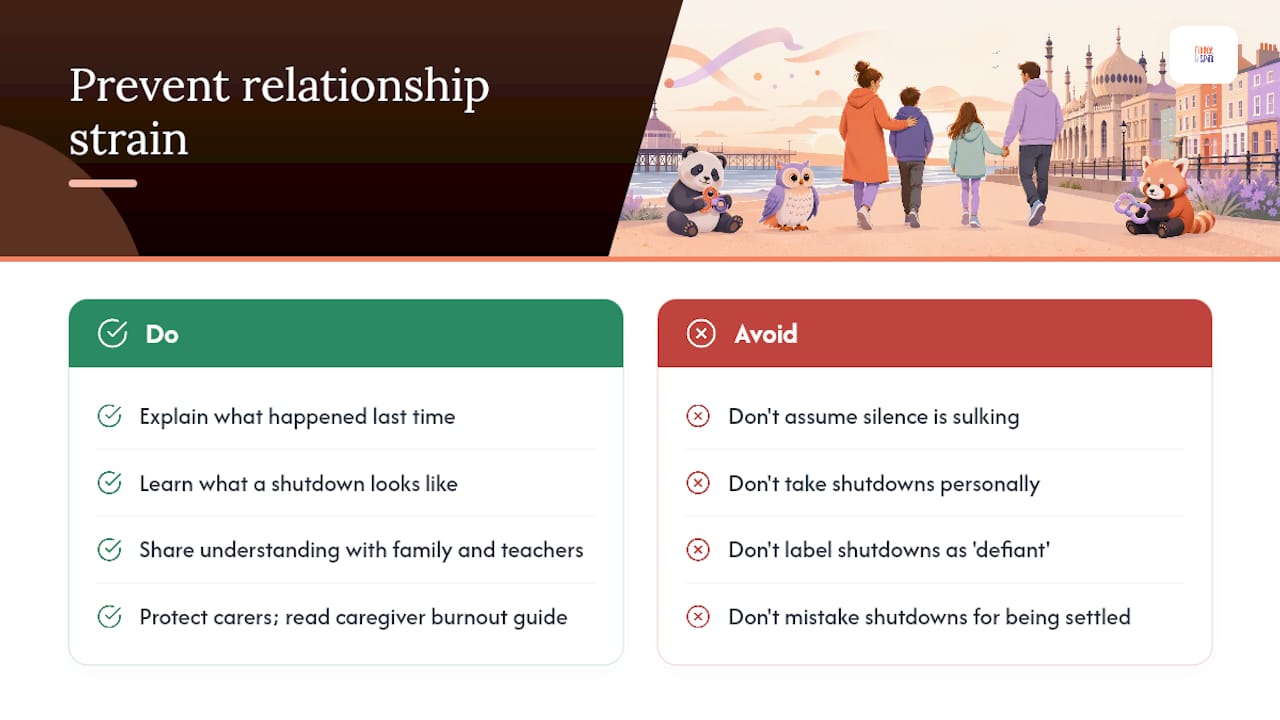
Meltdowns and shutdowns put real strain on relationships, mostly because they’re so often misread. A partner might take a shutdown personally, as withdrawal or rejection, when it’s a nervous system protecting itself. A sibling might feel embarrassed by a meltdown in public and carry resentment that has nowhere honest to go. Teachers sometimes label a child as “defiant” for shutting down mid lesson, when the accurate word is “overwhelmed.” Seattle Children’s points out that shutdowns are frequently missed entirely in public settings, mistaken for a child being unusually settled, which can mean the actual distress goes unsupported for far longer than it should.
The fix isn’t more resilience from the autistic person. It’s better shared understanding: everyone in the family or classroom knowing what a shutdown actually looks like so nobody mistakes silence for sulking. That kind of understanding also protects the carer relationship itself; burnout on the supporting side is real, and Opulent Private Care’s guide to caregiver burnout is worth a read if you’re the one holding it together at 2am. Our parent support guide covers more on protecting family relationships through this.
Where the common advice on this gets it wrong
Most of what gets shared about meltdowns focuses on stopping them, fast, ideally before anyone notices. That’s the wrong target. You’re not managing a PR incident. You’re supporting a nervous system that’s telling you something true.
The advice I’d bin first is anything that treats a shutdown like a smaller, quieter version of good behaviour worth leaving alone because it’s not disruptive. It’s not calm. It’s a child in genuine distress who happens to be silent about it, and that silence has let real needs go unnoticed for years in classrooms and clinics alike. If I could get one thing to land with every new parent, it’s this: stop timing how long an episode lasts and start tracking what led up to it. The pattern matters more than the moment.
What I’d prioritise first, always, is reducing demand before trying to teach a coping skill. You cannot regulate a system that’s still under active load. Calm comes after safety, not instead of it. Everything else, the toolkits, the visual schedules, the rehearsed exits, only works once that order is right.
— Caitlin
This article is general information, not a substitute for advice from a qualified doctor. Consult a qualified healthcare professional about your own circumstances before acting on anything here.
Sources
- Understanding autistic meltdowns and shutdowns | Leicestershire Partnership NHS Trust
- Meltdowns and shutdowns | Ambitious about Autism
- What I Wish You Knew: Insights on Burnout, Inertia, Meltdown, and Shutdown From Autistic Youth
- Supporting autistic people who are overwhelmed or having a meltdown | Autistica
FAQ
Can autistic people have shutdowns instead of meltdowns?
Yes. Some autistic people mostly experience shutdowns, some mostly meltdowns, and many experience both depending on the trigger, their energy levels, and how much masking they’ve been doing that day.
What does an autism shutdown look like?
A shutdown usually looks like withdrawal: going quiet, still, or unresponsive, sometimes with increased stimming and real difficulty making even small decisions, as Leicestershire Partnership NHS Trust describes.
How can you tell if it’s an autistic meltdown?
Look for outward signs: shouting, crying, physical movement like flapping or bolting, and a loss of control that intensifies rather than settles when you try to reason with it.
How long do autistic shutdowns usually last?
There’s no fixed length. Some shutdowns pass in minutes once demands drop, while others last hours or longer, particularly when they’re linked to broader burnout.
Struggling with the day-to-day of this, not just the theory? Some local groups run weekly sensory stay-and-play sessions across different zones for neurodiverse children, where a shutdown or meltdown isn’t something you need to apologise for. Some groups offer SEN-friendly birthday parties for young children, built around the same principle: no forced eye contact, no judgement, and a quiet space always on hand. Take a look at our sensory birthday parties or how our sessions work to see what that actually looks like.