
Ten cooperative, non competitive party games that actually work: parachute play, a printable cooperative board game, Copy Cats, a role based scavenger hunt, team balloon keep up, human camera, marble roll, pass the bowl, hoop squeeze musical chairs, and story circle. They work because nobody gets eliminated, nobody loses, and no child has to sit out feeling like the odd one out. The Child Mind Institute and a PMC systematic review both back structured, collaborative play for reducing overload and building real social engagement. Pick two or three for a 60 to 90 minute party and you’re set.
Key Takeaways
Cooperative games remove winners and losers entirely, which is the single change that keeps every child included from start to finish.
| Point | Details |
|---|---|
| Pick by age band | Match games to young children, early elementary ages, or older elementary ages for smoother participation. |
| Keep pods small | Split groups of eight or more into pods of three or four to cut waiting time. |
| Assign roles, not races | Give nervous children a job like Clue Reader instead of a starting line. |
| Build in a chill out zone | A visible, low stimulation space reduces overload before it starts. |
| Fidget and Spin runs it for you | Our parties use the same sensory zones and role based approach across Sussex. |
Table of Contents
- What are non competitive party games, and why do they matter?
- Quick prep: ages, space, timing and kit
- Ten ready to run games for any birthday
- No equipment games you can run anywhere
- How to run games so nobody is left out
- My checklist for an SEN friendly party that actually works
- A simple 60 to 90 minute timeline
- Why “just be nice” isn’t a party plan
- Prefer to book rather than run it yourself?
- Sources
- FAQ
What are non competitive party games, and why do they matter?
I’ve stood in soft play watching my son Remy freeze at the start line of a relay race, and I’ve watched other parents’ faces do that thing. You know the thing. The slight wince, the “oh dear” smile. Non competitive party games, sometimes called cooperative party games, are simply games with no winner and no loser built into the rules. Everyone works toward one shared outcome instead of racing each other to it.
That’s the whole trick. Remove the finish line and you remove the reason a child gets left behind, singled out, or quietly humiliated in front of their mates. Research on game based social skills work backs this up: collaborative structures with built in turn taking give autistic children real practice at negotiation and shared planning, not just the appearance of joining in.
Quick prep: ages, space, timing and kit
Sort games by rough age band before you sort anything else. Two to four year olds want repetition and simple physical movement. Four to six year olds can follow two step instructions and enjoy a bit of pretend. Six to eight year olds can hold roles and rules for longer stretches.
Space matters less than you’d think. Most of these games work in a living room, a garden, or a hired hall. For groups bigger than eight, split into pods of three or four rather than one big scrum. Smaller pods mean shorter waits, which matters enormously for a child who finds waiting genuinely painful.
- Games typically run several minutes each
- A party of about an hour to an hour and a half comfortably fits multiple games plus a snack break
- Keep a small kit ready: a parachute or old bed sheet, a soft ball or balloon, some pom poms, string, and a printable cooperative game
- Several games on this list need no equipment at all
| Age band | Best fit |
|---|---|
| 2 to 4 years | Parachute play, Copy Cats, story circle |
| 4 to 6 years | Balloon keep up, pass the bowl, marble roll |
| 6 to 8 years | Scavenger hunt with roles, human camera, cooperative board game |
Ten ready to run games for any birthday
1. Parachute or blanket play. Ages 2 to 8. No equipment beyond a parachute or old sheet. Everyone grips an edge and lifts together, sending a soft ball bouncing in the middle. Setup takes seconds: spread the sheet, hand out edges, count to three. Sensory tweak: drop the “big waves” for gentle ripples if the noise or motion feels like too much.
2. Cooperative board game. Ages 3 to 7. You’ll need a printed cooperative game, like the spring theme printable where players work together to collect ducklings before time runs out. Walk the first two turns yourself so nobody’s guessing the rules. HABA’s My Very First Orchard works the same way if you’d rather buy than print.
3. Copy Cats. Ages 2 to 6, no equipment. One child leads a movement, everyone copies. Swap the leader every 30 seconds so nobody’s stuck performing.
4. Role based scavenger hunt. Ages 5 to 8, needs a simple list and a few hidden objects. Assign roles: Clue Reader, Item Finder, Bag Carrier. Nobody races anyone. The group only wins when every item is found together.
5. Team balloon keep up. Ages 3 to 8, one balloon. The group counts together how long they can keep it off the floor as one team score, not individual points.
6. Human camera. Ages 5 to 8, no equipment. One child closes their eyes, a partner “clicks” them open for two seconds to see something, then closed again, describing what they remember. Wonderfully calm for a child who needs a lower stimulation moment.
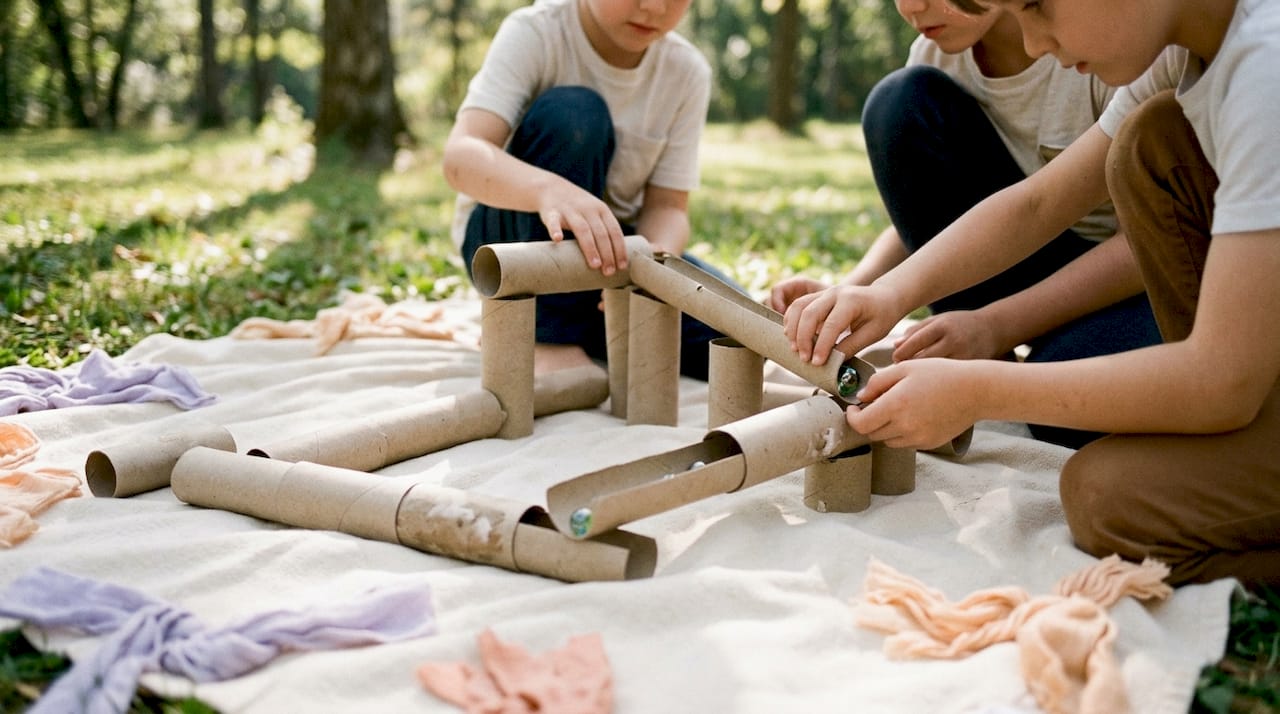
7. Marble roll. Ages 4 to 8, needs cardboard tubes or a length of guttering. Children hold sections in a line, passing a marble from one end to the other without dropping it.
8. Pass the bowl. Ages 2 to 6, needs a bowl and some small scoops (ice cream, pom poms, whatever’s to hand). Children pass it round, each adding or taking a scoop, working toward a shared amount.
9. Hoop squeeze (modern musical chairs). Ages 4 to 8, needs one hula hoop or a chalk circle, plus music. When the music stops, everyone squeezes inside the shrinking circle together. Nobody’s out, ever, according to Mindful Teachers, which recommends this exact swap for traditional musical chairs.
10. Story circle. Ages 3 to 8, no equipment. Sit in a circle, one sentence each, building a daft group story. Great as a closing, lower energy game.
Pro Tip: Scale any of these for a pod of three, a group of eight, or a full class of twenty by running two or three parallel circles instead of one huge one. Smaller pods almost always beat bigger ones for keeping quieter children engaged.
No equipment games you can run anywhere
Nothing in the boot of the car? These need nothing but bodies and voices.
- Copy Cats: one leader, everyone mirrors the movement
- Follow the Leader: walk in a snaking line, leader sets silly moves
- Circle storytelling: one sentence each, building a group tale
- Freeze dance (quiet version): music, then silence, everyone holds still, no elimination
- Human camera: eyes closed, quick peek, describe what you saw
- Name and purpose: pair up, describe an object by feel alone
For a quieter version of any of these, drop the music volume, swap claps for hand signals, and always keep a chill out corner in view, as Understood suggests for indoor sensory activities.
How to run games so nobody is left out
Picture the host, halfway through explaining the rules, watching one child edge toward the door. That’s the moment that matters most, not the game itself.
- Say the opt out line early: “You can pass if you like, or just watch for now.” Say it once, mean it, don’t repeat it like a warning.
- Offer roles, not just participation: “Try being the Clue Reader instead” gives a nervous child a job with edges around it.
- Build in enforced collaboration: shared objects (one parachute, one bowl) mean nobody can succeed alone, which quietly removes the pressure to perform.
- Watch for red flags: hands over ears, pacing, avoiding eye contact. Fix fast: shrink the group, offer a break, or swap them into a calmer role like Bag Carrier.
- Keep adult helpers gentle and present, not refereeing. Their job is to notice, not to judge.
Pro Tip: A scavenger hunt built around shared roles rather than a race changes everything. Nobody’s “losing” if the group finds all six items together, no matter who spotted which one.
My checklist for an SEN friendly party that actually works
I’ve left more parties early than I can count. Not because Remy was having a meltdown exactly, just that slow, grinding overwhelm that builds when nobody’s thought about the noise, the lighting, or the fact that “everyone join in the game” isn’t a real option for every child. The dread before a party invite lands is real, and I built this checklist because I was tired of hoping for the best.
- A chill out zone, clearly signposted, before the party starts
- A lower lighting option, even just one lamp instead of the big light
- Noise management: headphones on hand, music kept low
- Small play pods rather than one big group
- A visual schedule so nobody’s guessing what happens next
- A clear, spoken opt out signal everyone in the room understands
At Fidget & Spin, our sessions run across three zones, Wiggle & Bounce, Snuggle & Chill and Squish & Squeeze, with visual timers and choice cards so children can swap roles or step back whenever they need to, something the Child Mind Institute also flags as central to sensory regulation at parties.
Pro Tip: Print the visual schedule the night before. A five minute job saves an hour of “what’s happening now?” on the day.
A simple 60 to 90 minute timeline
Here’s the order that’s worked for us more times than not.
- 0 to 15 mins: arrival, free play, no pressure to join anything yet
- 15 to 40 mins: two or three games (parachute, Copy Cats, scavenger hunt)
- 40 to 50 mins: snack break, low stimulation
- 50 to 70 mins: a calmer game (story circle, marble roll) or open sensory table
- 70 to 90 mins: cake, quiet goodbye, no rushed exits
Short on time? Cut to two games and stretch free play. Longer party? Add a second calmer round before cake.
Why “just be nice” isn’t a party plan
Most party advice tells you to “include everyone” and leaves it there, as if kindness alone rewrites the rules of a relay race. It doesn’t. A child who freezes at a starting line isn’t being unkind to themselves, the game is unkind to them, and no amount of gentle encouragement changes the structure underneath it.
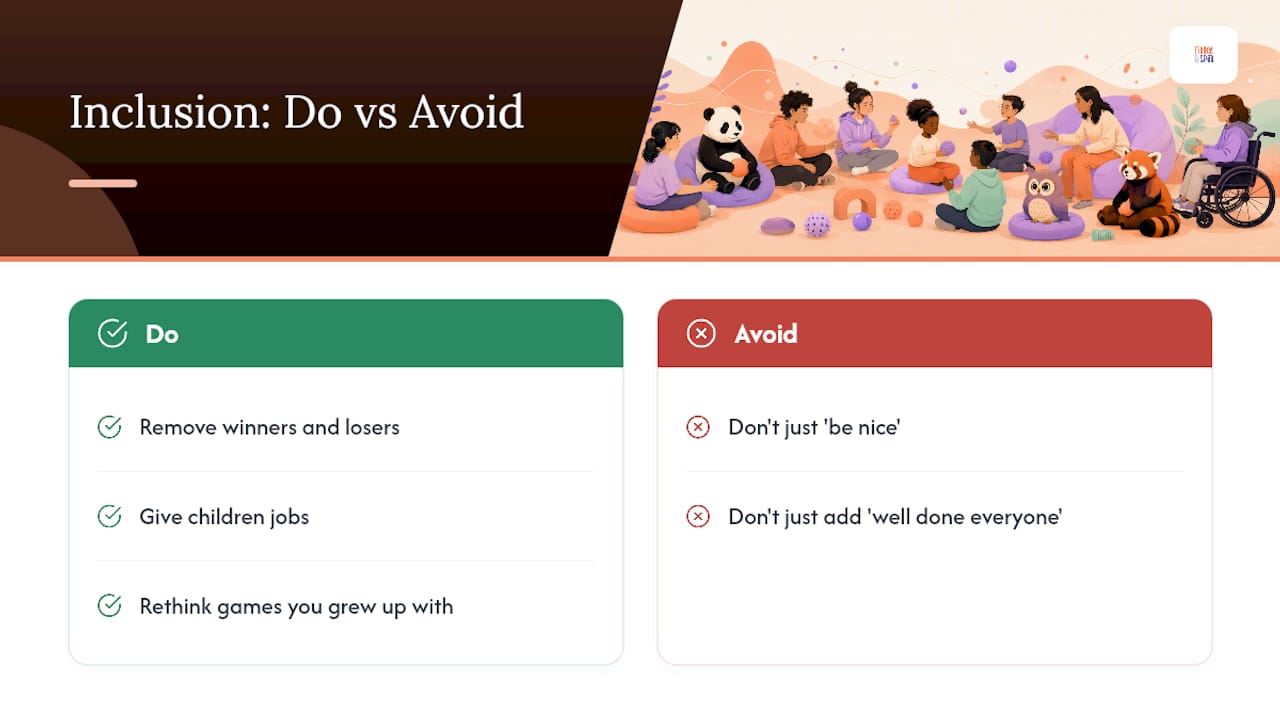
What the evidence actually supports is structural change, not attitude change. Remove the winner, remove the loser, and you remove the mechanism that excludes a child in the first place. That’s not a soft option. It’s the harder, more deliberate choice, because it means rethinking games you grew up with rather than just adding a “well done everyone” at the end.
The bit conventional advice skips entirely is roles. Giving a child a job, Clue Reader, Bag Carrier, Circle Keeper, does more for confidence than any sticker chart. Start there before you start anywhere else.
Prefer to book rather than run it yourself?
Some parents want to plan every game themselves, and that’s brilliant. Others are exhausted before the invites even go out, and honestly, that’s most of us most of the time. If that’s you, we run the whole thing for you. At Fidget & Spin, we already know the red flags, we hold small pods rather than one overwhelming group, and our three sensory zones mean your child’s mates can move between big movement, tactile play, and a quiet corner without anyone having to ask permission.
Our sensory birthday parties run across Brighton, Hove and wider Sussex in three packages, and you can see exactly how our sessions work before you commit to anything. Concession spots are supported through Pay It Forward donations at checkout, so cost needn’t be the reason you don’t book. Have a look at dates and see what fits.
Sources
- Systematic scoping review of game‑based interventions for social skills among autistic children and youth — PMC
- Sensory‑friendly party ideas — Child Mind Institute
- No Winners or Losers: Noncompetitive Games for Kids — Mindful Teachers
- 8 sensory‑friendly indoor games and activities — Understood
- Spring theme printable cooperative game — Stay At Home Educator
FAQ
What are some non competitive games for kids?
Parachute play, Copy Cats, cooperative board games, and hoop squeeze musical chairs all remove winners and losers so every child is includedstays involved throughout.
What are some fun easy party games with no prep?
Copy Cats, Follow the Leader, and circle storytelling need no equipment and almost no setup time, making them ideal for last minute parties.
What are examples of games that aren’t competitive?
Team balloon keep up, marble roll, and pass the bowl all work toward one shared group outcome rather than an individual winner.
What’s the best game for a group party with no equipment?
Copy Cats works well for almost any group size and age, since it needs nothing but one leader and space to move.
Does Fidget and Spin run non competitive parties?
Yes. Our SEN friendly birthday packages across Brighton, Hove and Sussex use the same role based, sensory friendly approach described throughout this guide.