
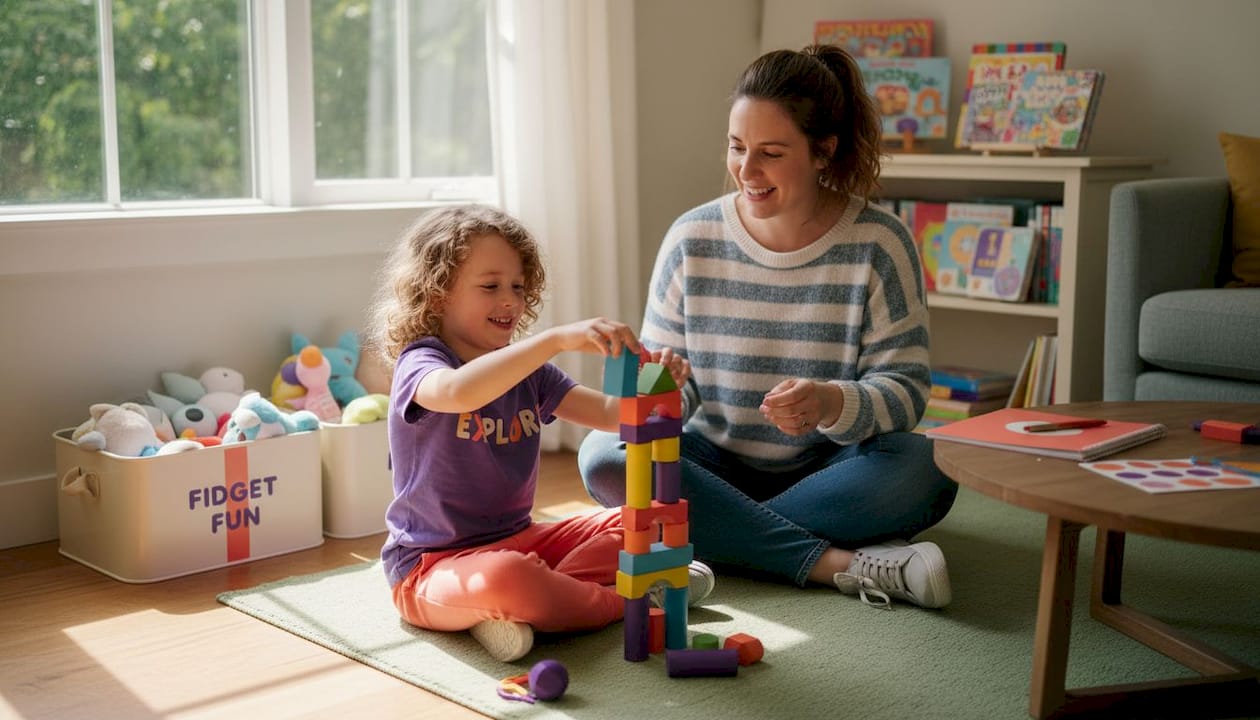
TL;DR:
- Occupational therapy helps neurodiverse children participate in everyday activities with more ease.
- Play-based OT uses movement and sensory experiences to promote social, emotional, and motor development.
- Parental involvement and flexible strategies amplify progress and support lasting changes at home.
Many parents first hear about occupational therapy and picture a child learning to grip a pen or build hand strength after an injury. It’s a common misconception, and honestly, an understandable one. But for families raising neurodiverse children, OT can be something far more transformative. It’s the difference between a child who dreads getting dressed each morning and one who can move through that routine with a little more ease. This article unpacks what occupational therapy really involves for children aged 1 to 7, what the research shows, and how you as a parent can actively support your child’s progress every single day.
Table of Contents
- What is occupational therapy and why does it matter for neurodiverse children?
- How play-based OT supports sensory and social development
- What does the evidence say about OT outcomes for neurodiverse children?
- How can parents collaborate with OTs and boost progress at home?
- Sensory frameworks and approaches: which OT strategies are right for your child?
- Why parent partnership and flexible OT approaches matter more than labels
- Explore sensory play opportunities with Fidget and Spin
- Frequently asked questions
Key Takeaways
| Point | Details |
|---|---|
| Play powers progress | Occupational therapy uses play as a main tool to help children build independence and social skills. |
| Parental involvement matters | Working closely with your child’s OT, and practising strategies at home, leads to better and faster outcomes. |
| Choose evidence-based, flexible approaches | Look for OT frameworks that validate your child’s sensory needs and work across multiple senses, not just one. |
| Early and accessible support | Starting OT as early as possible and using available home or group strategies makes a measurable difference. |
What is occupational therapy and why does it matter for neurodiverse children?
Let’s start with the basics, because “occupational therapy” is one of those phrases that sounds clinical but is actually beautifully practical. For children, an “occupation” isn’t a job. It’s everything they do: eating, playing, dressing, socialising, sleeping. OT helps children participate in those everyday activities more fully and confidently.
For neurodiverse children specifically, the brain processes sensory information, movement, and social cues differently. That means the ordinary stuff, like putting on shoes or sitting at a table for lunch, can feel genuinely overwhelming. OT doesn’t try to “fix” your child. It works with their strengths and adapts the environment and activities to meet them where they are.
As the Child Development Authority puts it:
“OT is holistic, function-first (not diagnosis-first), using play as the primary medium for children aged 1 to 7 to build independence via sensory-motor strategies; parents implement home programmes for generalisation.”
That phrase “function-first” is important. OT practitioners aren’t focused on a diagnosis label. They’re focused on what your child wants and needs to do, and what’s getting in the way. They also create a playful home environment that supports those goals between sessions.
Here’s what OT typically addresses for neurodiverse children aged 1 to 7:
- Sensory processing: Helping children manage sensitivities to touch, sound, movement, or light
- Fine and gross motor skills: Supporting coordination, strength, and body awareness
- Self-care routines: Making dressing, feeding, and toileting more manageable
- Play skills: Building the ability to engage with toys, peers, and imaginative activities
- Emotional regulation: Teaching children to recognise and manage big feelings
- Social participation: Supporting turn-taking, waiting, and reading social cues
You can learn more about how OT sessions work for children to get a clearer picture of what to expect in practice. The crucial point is that parents aren’t just observers. You’re essential co-therapists, bringing strategies into your home every day.
How play-based OT supports sensory and social development
Now that you know what OT is, let’s look at the concrete strategies therapists use. Because when you see it in action, it genuinely doesn’t look like therapy. It looks like play. And that’s entirely the point.
Play-based OT uses movement, texture, sound, and imaginative scenarios to target specific developmental goals. For a child who struggles with sensory regulation, a therapist might use deep pressure activities (think weighted blankets, bear hugs, or rolling games) to calm the nervous system before attempting a more demanding task. For a child working on social skills, a structured play scenario with a peer gives them a safe, supported space to practise turn-taking without the unpredictability of a busy playground.

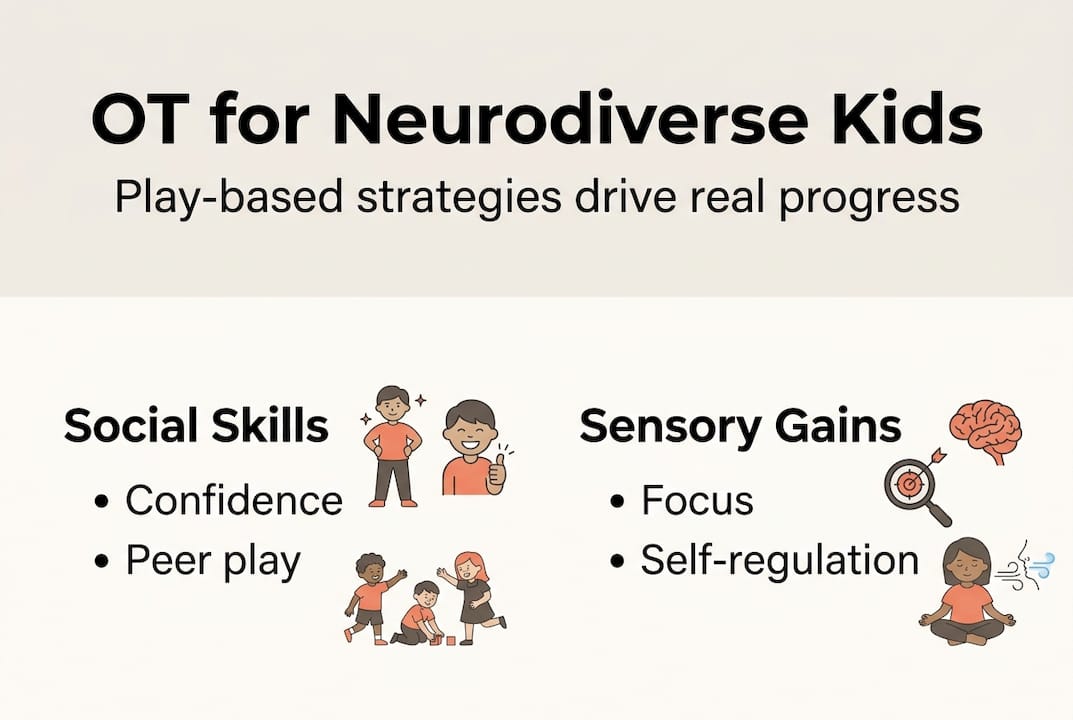
Research backs this up powerfully. A play-based OT intervention with children aged 4 to 5 with autism and ADHD found socialisation scores improved by 8.3 to 14.8% after 24 weeks. Those aren’t just numbers on a page. That’s a child who can now join in a game, or wait for their turn, or make eye contact with a peer for the first time.
Traditional classroom strategies vs play-based OT approaches
| Area | Traditional classroom approach | Play-based OT approach |
|---|---|---|
| Sensory needs | Minimise sensory input; ask child to focus | Integrate sensory input through movement and texture |
| Social skills | Direct instruction and role-play scripts | Embedded in meaningful play scenarios |
| Emotional regulation | Time-out or behaviour charts | Co-regulation through calm, predictable play routines |
| Motor skills | Worksheets and pencil practice | Obstacle courses, sand play, climbing activities |
| Learning engagement | Sitting still at a desk | Child-led, interest-driven activities |
For a child who finds sensory play sessions at a dedicated group helpful, the contrast with a traditional classroom approach can be remarkable.
Here’s what a typical play-based OT session might look like for a four-year-old:
- Arrival and regulation: A short movement activity (trampolining, swinging) to help the child’s nervous system settle
- Child-led exploration: The therapist observes and follows the child’s interest, whether that’s sand, water, or building blocks
- Guided challenge: The therapist introduces a small, playful challenge that targets a specific goal, such as squeezing playdough to build hand strength
- Social moment: If another child is present, a brief shared game is introduced with gentle facilitation
- Wind-down: A calming activity and transition preparation to help the child re-engage with the wider world
Understanding how sensory play can help kids with ADHD focus is part of why OT practitioners lean so heavily on movement and multi-sensory experiences. The nervous system needs input before it can settle.
What does the evidence say about OT outcomes for neurodiverse children?
Understanding the methods is one thing. But what actually happens to children who receive OT? This is where the research gets genuinely encouraging.
A randomised controlled trial involving 35 children aged 3 to 10 found that OT combining sensory integration with a home programme significantly improved both occupational performance (p=0.036) and satisfaction (p=0.034) compared to a home programme alone. That “p” value tells us the result wasn’t down to chance. The combination of clinic-based OT and home follow-through made a real, measurable difference.
OT outcomes: before and after key indicators
| Outcome measure | Before OT intervention | After 16 sessions |
|---|---|---|
| Occupational performance score | Baseline | Statistically significant improvement (p=0.036) |
| Satisfaction with performance | Baseline | Statistically significant improvement (p=0.034) |
| Goal Attainment Scale | Baseline | 31% of children achieved +1 improvement |
| Socialisation scores (play-based) | Baseline | 8.3 to 14.8% improvement over 24 weeks |
Statistic to note: 31% of children achieved a positive shift on the Goal Attainment Scale after just 16 OT sessions. For families who have been told progress will be slow, that’s worth sitting with for a moment.
Systematic reviews also show moderate evidence for sensory integration improving participation and goal attainment in autistic children, with strong evidence specifically for deep pressure tactile input and caregiver training. This matters because it means the strategies your OT teaches you at home aren’t just helpful suggestions. They’re evidence-informed tools.
One important caveat: OT isn’t a magic cure, and no single approach works for every child. Evidence is still growing, sample sizes in many studies are small, and what works beautifully for one child may need significant tweaking for another. That’s not a reason to be disheartened. It’s a reason to stay flexible and communicative with your OT team.
How can parents collaborate with OTs and boost progress at home?
So, what should you actually do with all this information? Because knowing OT is helpful is one thing. Knowing how to be an active participant in your child’s progress is quite another.
The most effective OT outcomes happen when parents are involved at every stage. That means collaborating on child-led goals rather than waiting for a therapist to hand you a list. It means bringing your knowledge of your child, what calms them, what excites them, what completely derails them, into the conversation. You know your child better than any professional ever will.
Here are practical strategies you can start using at home right now:
- Use visual schedules: Pictures or symbols that show the steps of a routine (wake up, get dressed, eat breakfast) reduce anxiety and increase independence, particularly for children who struggle with transitions
- Build in sensory breaks: A short movement activity before a demanding task, like jumping on a small trampoline or squeezing a stress ball, primes the nervous system for focus
- Follow your child’s lead: In play, let your child choose the activity and join in on their terms. This builds trust and creates a safe space for new skills to emerge
- Celebrate tiny wins: Progress in OT is often incremental. Noticing and naming small achievements (“You managed to put your coat on by yourself!”) reinforces confidence and motivation
- Communicate with your OT regularly: Share what’s working at home and what isn’t. Progress often accelerates when the OT can adjust their approach based on real-life feedback from you
Knowing what to expect in OT sessions helps you reinforce those same strategies during everyday routines. Consistency between the clinic and home makes a significant difference to how quickly skills generalise.
It’s also worth knowing that early intervention for children under three is particularly critical. The brain’s plasticity is at its peak in those early years, which means intervention before age three can have a disproportionately large impact. If you have concerns about your toddler, please don’t wait for a formal diagnosis before seeking support.
Pro Tip: If you’re on a waiting list and can’t access OT right now, don’t despair. Telehealth OT is increasingly available and has shown measurable goal improvements for children with neurodevelopmental differences. Ask your GP or paediatrician about this option, and explore sensory playgroup ideas in your community as a bridge while you wait.
Sensory frameworks and approaches: which OT strategies are right for your child?
With so many OT frameworks and approaches out there, it’s easy to feel overwhelmed. Let’s simplify things. The two main schools of thought you’ll likely encounter are traditional sensory integration (often called Ayres Sensory Integration or ASI) and more contemporary neuro-affirming, strengths-based approaches.
Comparing OT approaches: sensory integration vs neuro-affirming models
| Feature | Traditional sensory integration (ASI) | Neuro-affirming/strengths-based |
|---|---|---|
| Core philosophy | Improve sensory processing through repetition | Validate and accommodate sensory differences |
| Goal | Reduce sensory sensitivities | Build on strengths; adapt environment |
| Evidence base | Moderate; strongest for autism and participation | Growing; supported by autistic community voices |
| Limitations | Can feel deficit-focused | Fewer standardised protocols |
| Best suited to | Children with significant processing differences | Most neurodiverse children; particularly autistic children |
Current research is shifting the field. Evidence now favours multi-sensory approaches over single-system targeting, and there’s a clear move away from trying to “normalise” a child’s sensory experience towards validating and supporting it.
“The shift towards neuro-affirming OT reflects a deeper understanding: the goal is not to make a neurodiverse child seem neurotypical, but to help them thrive as themselves.”
This is important for you as a parent. When you’re choosing an OT or evaluating whether an approach feels right, ask whether it respects your child’s sensory needs or tries to override them. Both approaches have evidence behind them, but the philosophy matters for your child’s wellbeing and self-esteem in the long run.
Why parent partnership and flexible OT approaches matter more than labels
Here’s something that took me a while to really understand, and I suspect I’m not alone in this. When we first started looking into OT for our child, I spent a lot of time worrying about whether we were using the “right” approach. ASI or DIR Floortime? Sensory diet or strengths-based? I collected information like it was armour.
But the honest truth, backed by both research and lived experience, is that the approach matters far less than the relationship. The best progress I’ve seen, in our real-life playgroup experience and in everything I’ve read, happens when the OT and the parent genuinely adapt to the child in front of them. Not to a protocol. Not to a label.
Children change. A strategy that worked brilliantly at three years old may be completely irrelevant at five. That’s not failure. That’s development. The families who thrive are the ones who stay curious, stay flexible, and keep communicating with their OT rather than rigidly sticking to a plan that no longer fits.
Small daily adaptations often have a bigger cumulative impact than any formal session. Changing the order you do the morning routine. Offering a weighted lap pad during dinner. Letting your child wear their wellies inside for ten minutes before going out. These tiny tweaks, done consistently, create a life that’s calmer and more workable for everyone.
Progress, not perfection. Build in variety and joy. And trust yourself a bit more than you probably do.
Explore sensory play opportunities with Fidget and Spin
If you’ve found yourself nodding along to this article and thinking “yes, but where do I actually start?”, you’re not alone. Knowing the theory is one thing. Finding a safe, welcoming space to put it into practice is another.
At Fidget and Spin in Brighton and Hove, we’ve built something specifically for families like yours. Our sessions blend sensory exploration, imaginative play, and gentle social interaction in a space that truly gets neurodiverse children. Every session features themed sensory zones and guided group activities designed to support communication, emotional regulation, and confidence through play. It’s not therapy in the clinical sense, but it beautifully complements the OT work you’re already doing at home. You can book a sensory OT session directly, or if our sessions are full, join our playgroup waitlist to be first in line when a space opens up. We’d love to meet your little explorer.
Frequently asked questions
What age should my child start occupational therapy?
Early intervention is ideal and starting before age three offers the strongest developmental foundation, but OT is genuinely valuable at any age, and it’s never too late to begin.
How is OT different from speech or physical therapy for neurodiverse children?
OT targets daily life skills and independence using play and sensory strategies, whereas speech therapy focuses on communication and language, and physical therapy addresses movement and physical function specifically.
Can occupational therapy help with meltdowns and sensory overload?
Yes. OT uses sensory integration and emotional regulation strategies that improve participation and reduce distress, helping children manage overwhelming sensory experiences more effectively over time.
What if I can’t access OT due to waiting lists?
Over 50% of OTs cannot meet demand, so waiting lists are a real challenge. Telehealth OT is a growing and effective option, and home programmes combined with community sensory groups can provide meaningful support while you wait.
Do parents need to attend every OT session?
Parent involvement is crucial for generalising skills, and collaborating on goals and monitoring progress consistently leads to better outcomes, even if you’re not able to be present in the room for every single session.