
A sensory‑friendly party invitation is an accessibility tool, not a nice‑to‑have extra. The single most important thing to add is a “what to expect” line near the top, telling families the timeline, the noise level, and where the quiet space is. Everything else on the invite matters, but that one sentence is what lets a parent decide, calmly, whether their child can come.
TL;DR:
- Providing a clear “what to expect” statement at the top of the invite is essential to help parents decide if their child can attend comfortably.
- Every invitation should include specific start and end times, guest numbers, sensory details, allergen information, and a designated contact for adjustments.
- Attaching a visual schedule with photos or icons of the venue and key areas enhances understanding and reduces pre-party anxiety for children.
- Clearly stating logistics, sensory environment, and behavior expectations helps parents plan and ensures smoother party experiences.
- Ready-made party packages from services like Fidget and Spin include invitations and visual schedules, reducing host preparation time and increasing accessibility.
Table of Contents
- What to include on every SEN‑friendly invite
- How to write the invite: three templates worth stealing
- Attach a visual schedule or social story
- Logistics and behaviour expectations to state clearly
- Food, allergies and the cake moment
- Format and timing: email, paper, or printable PDF
- From the playroom: what I’ve learned proofing invites
- Helping siblings and neurotypical guests join in well
- Why the “just be flexible” advice misses the point
- If you’d rather hand this over: how Fidget and Spin helps
- Sources
- FAQ
What to include on every SEN‑friendly invite
I’ve filled in enough party invites to know the ones that work aren’t fancier. They’re just clearer. A good invite reads like a briefing, not a riddle, and it answers the questions a parent is already Googling at 11pm the night before.
Here’s what earns a place on the card or the email, every time:
- Start and end times, plus the realistic duration (60 to 90 minutes works well for most sensory‑friendly parties, according to guidance from Main Line Parent)
- Roughly how many children are expected, and their ages
- Headline items from the timeline: arrival, games, food, cake, goodbye
- Sensory notes: whether there’ll be music, flashing lights, or high‑energy games, and where the quiet space is
- Exact food on offer, with allergens clearly labelled
- Arrival logistics: where to park, which door to use, where the nearest toilet is
- A named contact and a plain way to ask for adjustments
That last point matters more than people think. They Are The Future makes the case plainly: a short, concrete invite that states timing, numbers, activities and quiet‑room availability, while actively inviting parents to flag needs, does most of the accessibility work before anyone even arrives.
How to write the invite: three templates worth stealing
Nobody wants to compose party wording from scratch while also finding a socket for the helium tank. Steal these.
-
Low‑stimulation party. “Ruby’s turning 5! Sunday 2 to 3:30pm at [venue]. Quiet party, no loud music, dimmed lights. A calm corner is available all afternoon. Cake at 3pm, singing optional. Let us know if Ruby needs anything to feel comfortable, big or small.”
-
Mixed guest list (SEN and non‑SEN children together). “Party from 1 to 3pm. Music will be background level, no surprises like poppers or sudden noise. There’s a quiet room by the front entrance if anyone needs a break. Food list attached. Tell us about any sensory needs or allergies when you RSVP.”
-
Family‑only gathering. “Small family do, just us. 11am to 1pm, home‑based, low‑key. Kitchen door will be open all morning if anyone needs to slip out for quiet.”
For a child‑facing version or a social story, keep sentences short and factual: “We will go to the party. There will be cake. I do not have to sing if I don’t want to.” RSVP lines should say plainly: “Reply by [date], and tell us if there’s anything we can do to help [child] enjoy the day.” Optional participation lines (“no pressure to join in games or blow out candles”) remove a surprising amount of pre‑party dread.
Attach a visual schedule or social story
Remy used to stand at the door of every party like he was casing the joint before he’d go in. A photo of the actual front door, sent the day before, fixed that almost overnight. He knew what he was walking into, so he walked in.
That’s the logic behind attaching a mini visual schedule to the invite. Fraser recommends turning the party timeline into photos or icons precisely because it converts an abstract plan into know‑before‑you‑go information the child can actually hold onto.
What to photograph:
- The front door and the route in
- The quiet corner or calm space
- The toilet
- The cake table
Caption each photo with one plain sentence: “This is the door. This is where we say hello.” If photographs aren’t possible, simple icons work just as well, and a visual schedule can turn birthday party dread into something genuinely manageable. For longer or more complex events, a short video walkthrough beats a stack of photos.
Pro Tip: Send the visual schedule 24 to 48 hours before the party, not on the morning. Kids process new information better with time to sit with it, not scramble to absorb it.
Logistics and behaviour expectations to state clearly
Parents don’t want vague reassurance. They want facts they can plan around, because “it’ll be fine” has burned every one of us at least once.
State these plainly on the invite or in a follow‑up message:
- Where the quiet space is, and who to ask for it on arrival
- Whether lighting and music are adjustable, and by how much
- What arrival looks like: is there a sign‑in table, any paperwork, a queue
- That leaving early is completely fine, with a specific phrase to use (“just wave at [host] on your way out, no goodbyes needed”)
Next for Autism puts it well: communicating logistics, duration and planned activities in advance, alongside something like a dedicated calmer time block, takes the guesswork out of attending. A quiet birthday party only works if guests know, before they arrive, that quiet is actually on offer.
Food, allergies and the cake moment
Nobody should have to interrogate a party host about what’s in the sausage rolls. List the actual food, not just “snacks provided.”
- Name exact dishes and label allergens clearly (nuts, dairy, gluten)
- Offer a same or similar alternative for children with dietary needs, and mention if things can be stored in a fridge
- Make the candle‑blowing and singing moment optional, with an alternative like a quiet high‑five instead
- Ask parents to note dietary needs directly on the RSVP, not as an afterthought at the door
Child Mind Institute recommends making the birthday song genuinely optional and normalising other ways to mark the moment. Dairy‑free options are increasingly easy to source too. Sites like The Best Dairy‑Free Party Food Ideas offer swaps that work for allergy and sensory reasons alike.
Format and timing: email, paper, or printable PDF
For a 60 to 90 minute party, send invites two to three weeks ahead, with a gentle reminder five days before. Longer events warrant a bit more lead time, closer to a month.
An email works best for most families because it lets you attach a PDF visual schedule alongside the wording, something a paper invite can’t do without extra printing. If you’re handing out invites in person, print a few extra visual schedule sheets to give parents on the day, four or five spares usually covers it.
- Reminder wording can be as simple as: “Quick reminder, Ruby’s party is Sunday. Visual schedule attached again in case it’s useful.”
- Print extras: aim for one spare schedule per family invited, plus two or three for last‑minute guests
From the playroom: what I’ve learned proofing invites
I once sent an invite without a photo of the front door, and a little boy stood frozen on the pavement because the building didn’t match what he’d pictured. His mum told me afterwards, gently, that a photo would have saved them both a rough ten minutes. I never sent an invite without one again.
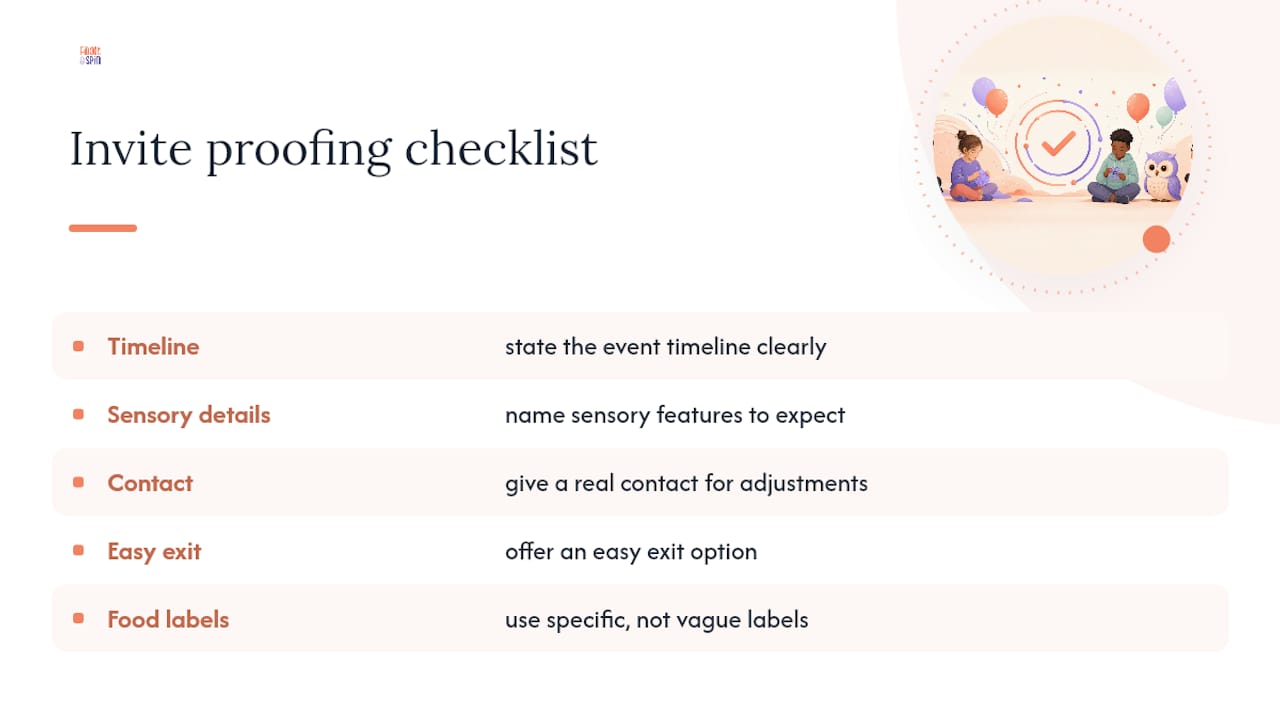
Now I run every invite through five checks before it goes out: does it state the timeline, does it name the sensory details, does it give a real contact for adjustments, does it offer an easy exit, and are the food labels specific rather than vague. If all five pass, the invite is doing its job. Our party games guide is worth a look too, since half the anxiety around invites is really anxiety about what happens once the child’s inside.
Pro Tip: Test your wording on one trusted family before sending it to everyone. If their child understands what to expect, yours probably does too.
Helping siblings and neurotypical guests join in well
Siblings often carry more of the emotional weight of these parties than anyone credits them for. They’ve watched a meltdown from the sidelines more times than most adults have, and they usually know exactly what helps, if someone bothers to ask.
Give them, and any neurotypical guests, a simple job. “Can you show people where the quiet corner is?” or “You’re in charge of handing out party bags” gives a child something concrete to do instead of hovering awkwardly, unsure whether to intervene. The Witherslack Group points out that giving children clear roles and the option to skip turn‑taking games reduces pressure on everyone, not just the autistic guest.

Brief guests in plain terms before the party, not during it. A short line to other parents works well: “If [child] doesn’t join a game, that’s completely fine, they’re still having a good time their own way.” Kids pick up on adult tension faster than adults think, so calm framing from a parent beats any amount of after‑the‑fact explaining.
Watch for early signs that a child, sibling or guest, is heading towards overwhelm rather than waiting for a full meltdown. The Mentor Well lists physical cues worth knowing, like covering ears or going very still, that give adults a chance to step in early with a break rather than a rescue.
Why the “just be flexible” advice misses the point
The advice I see most often is “just be flexible” or “keep an open mind.” It’s well‑meaning and almost useless. Flexibility isn’t a feeling a host can conjure on the day. It’s a set of decisions made in advance: what time things start, where the quiet space is, whether the cake song is compulsory.
What the evidence and my own experience both point to is specificity. A vague, warm invitation (“come along, no pressure!”) does less for an autistic child than a blunt one that states exact times, exact food, and exact noise levels. Parents don’t need reassurance. They need information they can act on.
If I had to tell a host one thing to prioritise, it wouldn’t be the decorations or even the guest list size, though keeping it small helps. It would be the single “what to expect” line at the top of the invite. Everything else on this page supports that one sentence. Get it right, and you’ve done most of the accessibility work before a single guest arrives.
— Caitlin
If you’d rather hand this over: how Fidget and Spin helps
Writing all this wording yourself, then chasing a printer, then hoping the venue actually dims the lights, is a lot to carry on top of everything else a birthday already asks of you. Fidget and Spin exists so you don’t have to build the invite, the schedule and the sensory setup from scratch every single time.
We run SEN‑friendly birthday parties for children aged 1 to 7 across Brighton, Hove and wider Sussex, in three packages: The Wee One at £220, The Big One at £320, and The Whole Shebang at £530. Every booking includes ready‑made invites and a visual schedule as standard, so the front‑door photo, the quiet‑space details and the food labelling are already sorted before you send a single message to a parent. We also run a Pay‑It‑Forward scheme at checkout, so concession spots are supported by other families rather than left to chance. If a done‑for‑you SEN party sounds like less of a headache than DIY invites at 11pm, take a look at our sensory birthday party packages and check dates for Remy’s birthday month, or yours.
Sources
- One easy way to make your party more sensory-friendly – Fraser
- Sensory‑friendly party ideas – Child Mind Institute
- Hosting a neuro‑affirming holiday event – Next for Autism
- Sensory‑friendly party planning – They Are The Future
FAQ
What should a sensory‑friendly party invitation include?
At minimum, list start and end times, expected guest numbers, sensory details like music and lighting, exact food with allergens labelled, and a named contact for adjustment requests.
How long should an autism‑friendly birthday party be?
Most sensory‑friendly parties work best at 60 to 90 minutes, according to Main Line Parent, since shorter events reduce overwhelm without cutting the fun short.
Should I attach a visual schedule to the invitation?
Yes. A photo or icon-based schedule of the venue, timeline and quiet space gives guests know‑before‑you‑go information that Fraser identifies as a genuine accessibility tool.
Is the birthday song and cake moment always required?
No. Making it optional, with an alternative like a quiet high‑five, is recommended by Child Mind Institute and removes unnecessary pressure from the child.
Does Fidget and Spin provide invitations for SEN birthday parties?
Yes, every Fidget and Spin party package for children aged 1 to 7 in Brighton, Hove and Sussex includes ready‑made invites and a visual schedule as part of the booking.