A pay-it-forward sensory session is a community-funded subsidised place at a sensory session, paid for by a donor so a family who needs it can attend for free or at reduced cost. If you want a sponsored place, the quickest route is to send a short, private email to the organiser. If you want to fund one, most schemes accept a one-off payment at checkout or via a donate button. Three places to start right now:
- Fidget and Spin concession spots (Brighton and Hove): confidential application by email, matched to weekly stay-and-play sessions
- Caudwell Trust and CrackerJacks Children’s Trust: grant routes for equipment and support for disabled and autistic children
- Coventry Sensory Library: borrow sensory items free with a library card, no application form needed
Key takeaways
Pay-it-forward sensory sessions are community-funded subsidised places matched to families with sensory needs, requiring no proof of income and no formal diagnosis in most UK schemes.
| Point | Details |
|---|---|
| How to apply | Send a short confidential email with your child’s name, age, sensory needs, and preferred session day. |
| Who qualifies | Children with sensory needs, processing differences, or neurodiversity indicators; financial strain is sufficient without proof. |
| Suggested sponsor amount | £25–£30 typically covers one full community session place; £26 is a commonly cited example. |
| UK grant routes | Caudwell Trust, CrackerJacks (£250–£1,000), Family Fund, SENIF Band A–C, and local council sensory aid funds. |
| Fidget and Spin | Offers concession spots at weekly Brighton sessions and partial party concessions; apply by email or donate at checkout. |
Table of Contents
- 1. How pay-it-forward sensory sessions actually work
- 2. Who can apply for a sponsored sensory place?
- 3. What to put in a request for a sponsored place
- 4. How to sponsor a sensory session place
- 5. Where to look in the UK for subsidised sensory sessions
- 6. What a sponsored sensory session typically looks like
- 7. Fairness, privacy and how places should be allocated
- 8. How we run concession spots at Fidget and Spin
- 9. A note from me, parent to parent
- Fidget and Spin concession spots: how to get help locally
- Sources
- FAQ
1. How pay-it-forward sensory sessions actually work
The model is simple. A donor pays for a place. An applicant claims it. Nobody needs to meet in the middle or explain themselves to each other.
Sponsor flow:
- Choose an amount (a single session, a bundle, or a monthly contribution)
- Pay at checkout or via a dedicated donate link
- Receive a brief confirmation; many schemes offer anonymous donation
- Get a short impact update when the place is used
Applicant flow:
- Submit a short private request (email or online form)
- Organiser matches you to an available sponsored space
- Attend the session; no public disclosure required
- Optional: share brief feedback to help the organiser report back to donors
Pay-it-forward schemes commonly operate without requiring formal proof of financial status. Donors reserve places; applicants register confidentially. The whole thing can move in a week.
Common allocation models include a fixed bundle (for example, four or twelve sessions), single-session sponsorship, and sliding-scale concessions where families pay what they can.
2. Who can apply for a sponsored sensory place?
Most organisers keep eligibility broad on purpose. The families who tend to benefit most are those with children who have sensory needs, processing differences, or a neurodiversity indicator such as autism, ADHD, or PDA, and those facing financial strain that puts regular sessions out of reach.
Typical eligibility signals organisers look for:
- Child has sensory processing differences, a SEND diagnosis, or is awaiting assessment
- Family is under financial pressure (no proof required in many schemes)
- A referrer such as a SENCO, health visitor, GP, or local charity supports the request
Referral sources worth approaching:
- Your child’s SENCO or early years key worker
- Health visitor or community paediatrician
- Local SEND support groups and parent carer forums
- Family support workers and social prescribers
Privacy matters here. Many schemes ask for the minimum possible information and keep applications confidential. You do not need a formal diagnosis. You do not need to prove your income. A short honest note about your child’s needs is usually enough.
3. What to put in a request for a sponsored place
The families who get a response quickly are the ones who keep it short and specific. Organisers are often volunteers. They do not need a medical history.
- Your contact details and your child’s first name and age
- One sentence on sensory needs: for example, “My daughter is autistic and finds loud, unpredictable environments very difficult to regulate in”
- Preferred session dates or days and any access requirements (AAC user, one-to-one support, quiet entry)
- Whether a referrer is supporting your request (optional but helpful)
- Consent for follow-up: a simple yes or no to receiving a brief check-in after the session
That is genuinely all most organisers need. You are not applying for a mortgage.
Pro Tip: If you are a SENCO or health visitor referring a family, a two-line note on headed paper or from your work email address carries real weight. It signals that a professional has already assessed the need, which speeds up matching considerably.
4. How to sponsor a sensory session place
Sponsoring a place is one of the most direct things you can do with a small amount of money. You are not funding a charity’s overheads. You are paying for one child to attend one session.
Common donation brackets in the UK:
- £10–£20: contributes to a single session or part of a sensory kit
- £25–£30: typically covers one full community session place (the Millers Way Project, for example, quotes £26 as a sponsor amount for sound therapy)
- £50–£100: funds a small bundle of sessions or a party concession contribution
- £100+: monthly sponsorship covering multiple families across a term
Payment options:
- One-off donation at checkout when booking your own session
- Dedicated “sponsor a place” button on the organiser’s website
- Monthly standing order for repeat sponsors
- Anonymous donation with no name attached to the gift
Organisers who keep donor reporting simple tend to attract repeat sponsors. A brief note saying “your donation funded two sessions this month” is more persuasive than a lengthy impact report, because people see the result without recipients having to prove hardship publicly.
5. Where to look in the UK for subsidised sensory sessions
There are more routes than most families realise. The trick is knowing which door to knock on first.
Charities offering grants or equipment:
Caudwell Trust and CrackerJacks Children’s Trust both offer grants and equipment for disabled and autistic children. CrackerJacks grants typically range from £250 to £1,000. Family Fund provides grants for sensory toys and equipment for families raising disabled or seriously ill children, working with specialist advisers including Learning SPACE to recommend suitable items.
Sensory libraries:
Coventry launched a sensory library at Central Library where anyone with a library card can borrow noise-cancelling headphones, weighted lap pads, and fidget toys free of charge. This model is spreading. Check your local library service or contact Grapevine Coventry and Warwickshire for guidance on replicating it locally.
Council funds and small grants:
The Special Educational Needs Inclusion Fund (SENIF) operates in Band A (up to £750 per child per block), Band B (up to £1,500 per child per year), and Band C (up to £3,750 per year for more complex needs), covering specialist equipment and adult support. Ask your child’s early years setting whether they have applied on your child’s behalf.
The Braintree District Council SEN Sensory Aiding Support scheme awarded £1,000 to provide sensory aid packs to families. Similar cost-of-living and community support funds exist in many districts. Search your local council website for “SEN sensory support” or “community grant fund.”
Community-run schemes also exist. A Portsmouth mum organised free sensory boxes for children with SEND, distributing them through local hospitals and support groups. These grassroots efforts are worth finding through local Facebook SEND groups and parent carer forums.

6. What a sponsored sensory session typically looks like

Sessions vary by organiser, but the format is usually child-led and low-pressure. A standard sensory session runs 45–60 minutes and uses a “just-right challenge” approach: activities are offered, never forced.
Typical session elements:
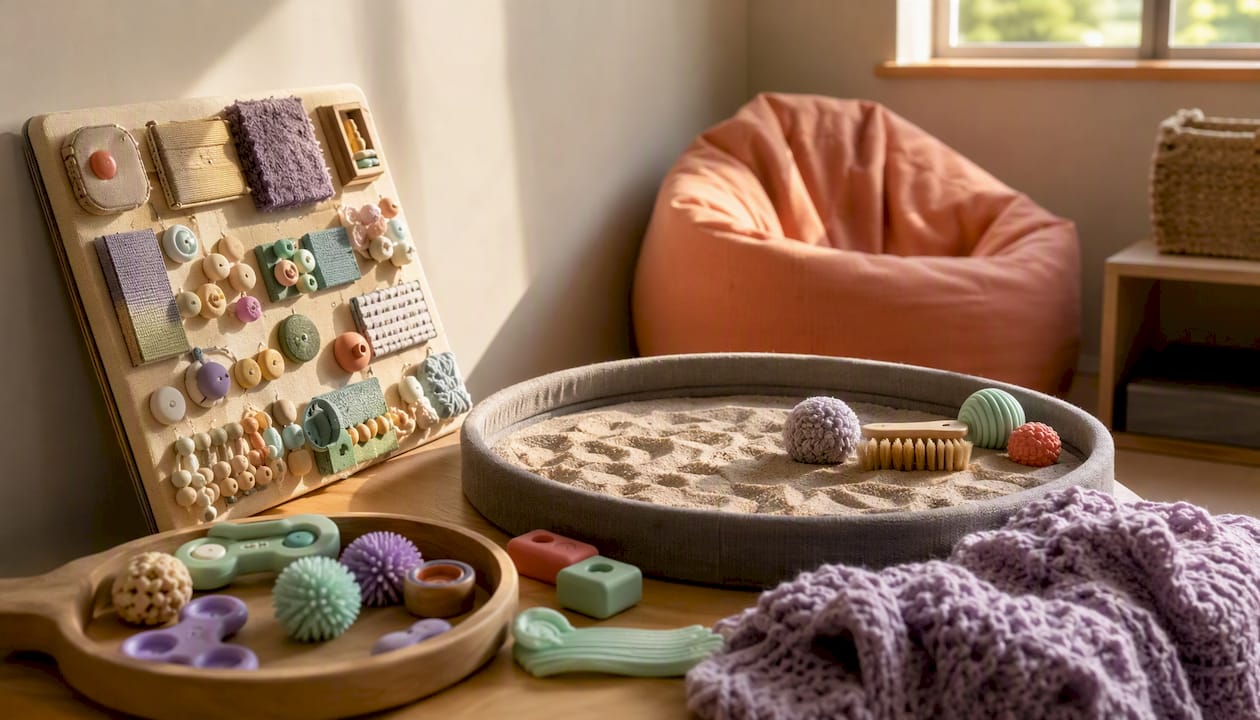
- Movement zone: crash mats, balance boards, tunnels, and vestibular equipment
- Tactile zone: sensory bins, fidgets, tactile cushions, and messy play
- Calm zone: low lighting, weighted items, sensory pods, and quiet corners
- Parent briefing: five minutes at the start to share your child’s needs and preferences
Accessibility notes:
- Ask about quiet arrival slots if transitions are hard for your child
- Bring any AAC device or PECS board your child uses; good organisers will follow your child’s communication lead
- One-to-one support is welcome at most community sessions; let the organiser know in advance
Pre-visit checklist for parents:
- Tell the organiser about your child’s sensory profile (what they seek, what they avoid)
- Mention any medical needs, dietary requirements, or physical access needs
- Bring a comfort item if your child uses one
- Ask whether photos are taken and whether you can opt out
The advantages of sensory play for neurodiverse children are well documented: regulation, body awareness, and social confidence all tend to improve with consistent access.
7. Fairness, privacy and how places should be allocated
Allocation is where schemes can go wrong if organisers are not careful. Here is what reasonable practice looks like, and what to ask about.
Common allocation models:
- First-come, first-served: simple but can disadvantage families with less digital access or confidence
- Referral panel: a small group reviews requests and prioritises by need; slower but fairer for complex cases
- Needs-assessed prioritisation: organiser weighs sensory complexity, financial strain, and waiting time together
Privacy safeguards every organiser should have:
- A confidential application form that collects only what is necessary
- GDPR-compliant data storage (even small community groups are bound by UK GDPR)
- No requirement to share financial documents or medical records
- A clear statement that donor and recipient identities are kept separate
Questions worth asking any organiser:
- How do you decide who gets a place when demand exceeds supply?
- Who sees my application?
- How long is the waiting list, and will you let me know where I am on it?
- What happens to my data after the session?
8. How we run concession spots at Fidget and Spin
Anthony and I built the concession system at Fidget and Spin because we know what it feels like to do the maths on whether a session is affordable this week. It is not a comfortable feeling.
Here is exactly how it works:
- Apply: send us a short, confidential email with your child’s name, age, a sentence about their sensory needs, and your preferred session day. No proof of income. No diagnosis letter required.
- Matching: we match your request to an available concession spot in our weekly stay-and-play sessions across our three zones (Wiggle and Bounce, Snuggle and Chill, Squish and Squeeze).
- What is covered: the session place itself. Travel is not covered, and we are honest about that.
- Donor reporting: donors who fund concession spots receive a brief, anonymous update confirming their donation was used. No recipient names are shared.
We also offer partial concessions on our SEN birthday party packages for families in genuine need. Ask us directly.
Pro Tip: If you are a local SENCO or charity worker in Brighton or Hove and you want to refer a family, a short email from your work address is all we need. We will take it from there.
9. A note from me, parent to parent
I left a soft-play session early once because Remy was dysregulated and I could feel every pair of eyes in the room. I did not ask for help. I just grabbed the bag and went. I know a lot of you have done the same thing.
Asking for a subsidised place feels enormous when you are already exhausted. It should not, but it does. So let me say plainly: sending a short email is not begging. It is using a system that was built for exactly this. Someone donated that place because they wanted a child like yours to have it.
If the email feels too hard, ask your SENCO to send it. If you want to sponsor a place and you are not sure how much to give, £26 is a real and meaningful amount. If you want to do something bigger, a monthly standing order funds multiple families across a term.
The neurodiverse play groups in Sussex guide has more local options if Fidget and Spin is not the right fit for your family. There is no wrong door here.
Fidget and Spin concession spots: how to get help locally
If you are in Brighton, Hove, or wider Sussex, Fidget and Spin offers concession spots at our weekly sensory stay-and-play sessions for neurodiverse children aged 1–6. A concession place covers your session fee in full. No sliding scale, no awkward conversation at the door.
Donors fund these spots at checkout when they book their own session, or by contacting us directly to sponsor a named programme or an anonymous pool. Either works. To apply for a concession place, email us with your child’s first name, age, a brief note on their sensory needs, and your preferred day. To donate, visit our sessions page and select the pay-it-forward option at checkout, or get in touch and we will sort it.
Sources
- Devon County Council – Other financial support (mentions Caudwell Trust, CrackerJacks Children’s Trust)
- North Northamptonshire Council – Special educational needs and inclusion fund (SENIF)
- Family Fund – Grants for sensory toys and equipment
- Millers Way Project – Pay It Forward (sound therapy initiative)
- Grapevine Coventry & Warwickshire – Sensory library launch in Coventry
- Braintree District Council – SEN Sensory Aiding Support (Family Solutions)
FAQ
What is a pay-it-forward sensory session?
A pay-it-forward sensory session is a subsidised place at a sensory play or therapy session, funded by a donor so a family with sensory needs can attend for free or at reduced cost. No proof of income is required in most UK schemes.
Can I get free sensory equipment for my autistic child?
Yes. Family Fund provides grants for sensory toys and equipment, and charities such as Caudwell Trust and CrackerJacks offer grants of £250–£1,000 for equipment. Local councils also run small sensory aid funds; the Braintree scheme awarded £1,000 per family for sensory aid packs.
What happens in a sensory session?
A typical session runs 45–60 minutes and is child-led across movement, tactile, and calm zones. At Fidget and Spin, these are Wiggle and Bounce, Squish and Squeeze, and Snuggle and Chill. Activities are offered, never forced, and parents receive a brief briefing at the start.
What does the EYFS say about sensory play?
The Early Years Foundation Stage framework recognises sensory and physical play as central to children’s development, particularly in the areas of physical development and understanding the world. Sensory play supports regulation, body awareness, and early communication.
How do I apply for a concession spot at Fidget and Spin?
Email Fidget and Spin with your child’s first name, age, a sentence about their sensory needs, and your preferred session day. No diagnosis letter or proof of income is needed. Visit the sessions page for full details.