TL;DR:
- PECS is a communication system where children hand pictures to request items, helping build functional speech. It progresses through six phases, starting with simple exchanges and expanding to commenting, with full mastery taking up to a year. Using real photos, keeping materials accessible, and integrating PECS into daily routines enhance success at home.
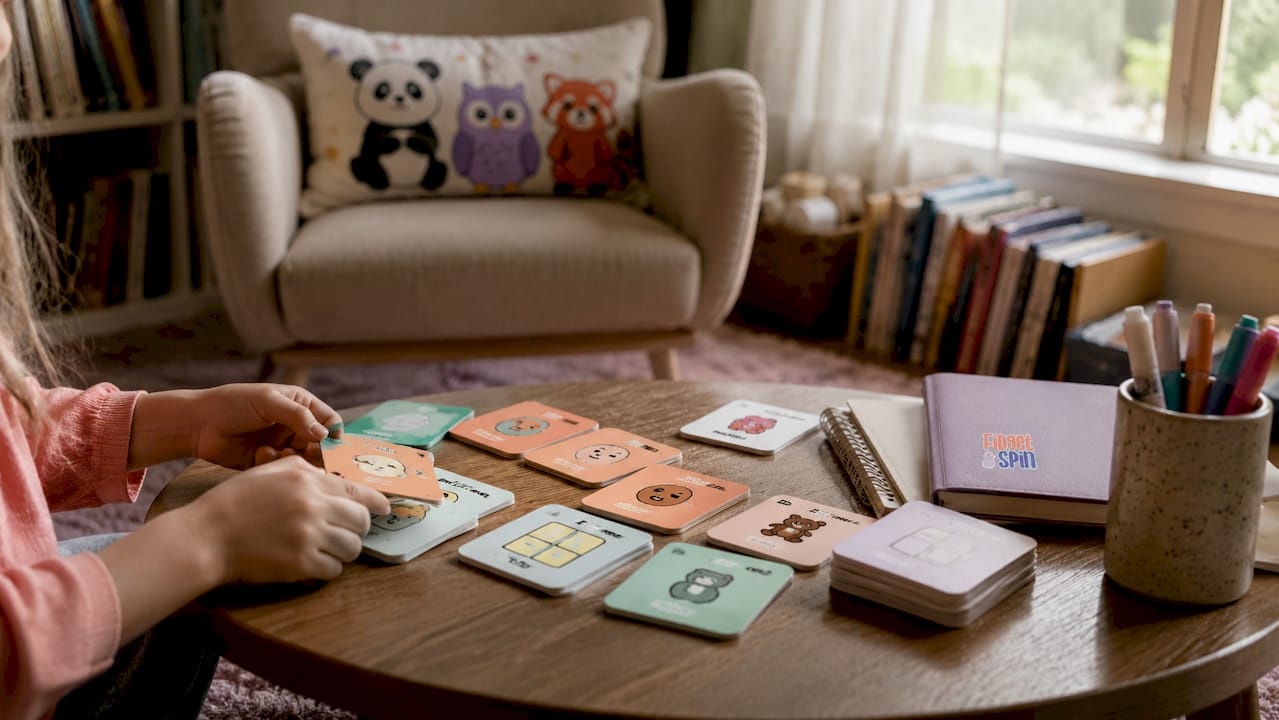
PECS, the Picture Exchange Communication System, is a structured AAC method where a child hands a picture to a communication partner to request something they want. It was developed by Andrew Bondy and Lori Frost in 1985 and has since become one of the most widely used communication approaches for autistic children and those with speech delays. The system works in six progressive phases, moving from a simple picture exchange to building sentences and commenting. What makes it genuinely powerful is that family involvement drives its success. You do not need a clinic. You need a kitchen table, some laminated cards, and a bit of patience.
What are the six phases of PECS at home?
The six phases of PECS give you a clear roadmap. You are not guessing what comes next. Each phase builds on the last, and knowing where your child is helps you respond to them rather than push them.
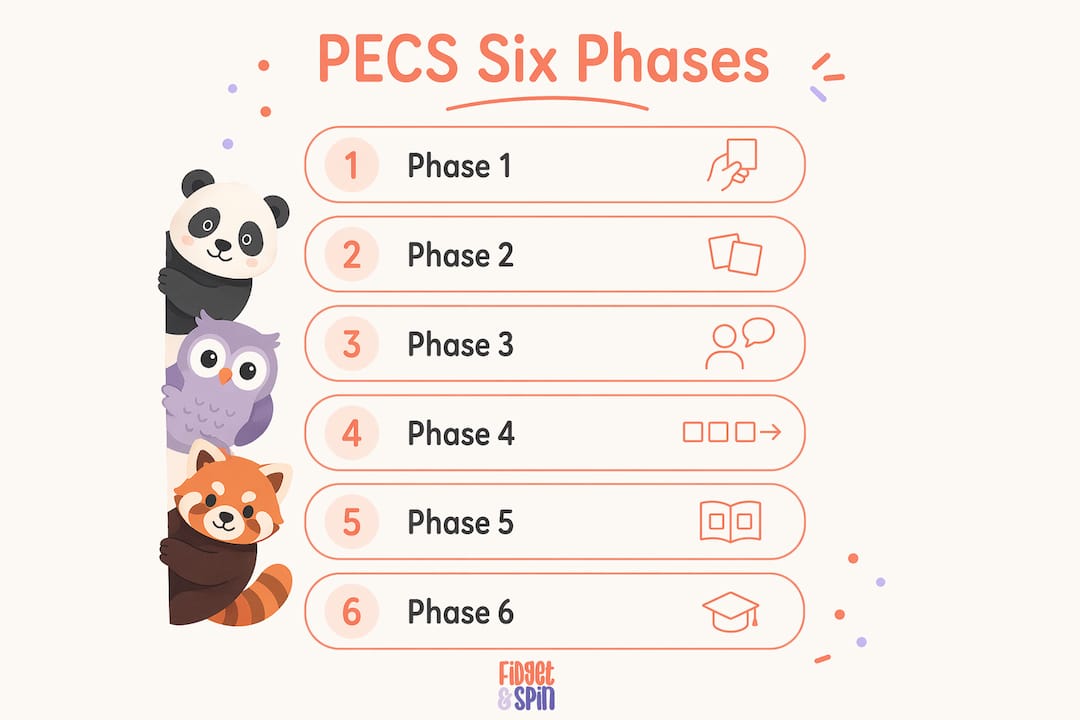
Phase 1 is the foundation. Your child picks up a picture and hands it to you. You immediately give them what the picture shows. That exchange is the whole point. Most children learn Phase 1 within 2–4 weeks, though this varies with consistency and developmental level.
Phase 2 builds persistence and distance. Your child learns to travel across the room to hand you a picture. This is where you start to see real initiation, not just responding to prompts.
Phase 3 introduces picture discrimination. Your child chooses between two or more pictures to request the right item. This is where a small, clear picture set matters most.
Phases 1–3 are the most essential for parents starting at home. Phase 4 and beyond, which involve sentence strips, responding to questions, and commenting, often benefit from formal clinical guidance. That is not a failure on your part. It is just a different kind of support.
Phases 4–6 at a glance:
| Phase | Skill | Typical support needed |
|---|---|---|
| Phase 4 | Building sentences with “I want” | SALT or specialist input helpful |
| Phase 5 | Responding to “What do you want?” | Formal guidance recommended |
| Phase 6 | Commenting on the environment | Usually clinic-led |
Full mastery across all six phases typically takes 6–12 months, depending on how consistently you use the system and where your child is developmentally. That timeline is not a pressure. It is a reassurance that this is a gradual process, not a sprint.
How to set up PECS at home: pictures, materials, and motivation
The setup is simpler than most people expect. You do not need expensive software or a specialist kit to get started.
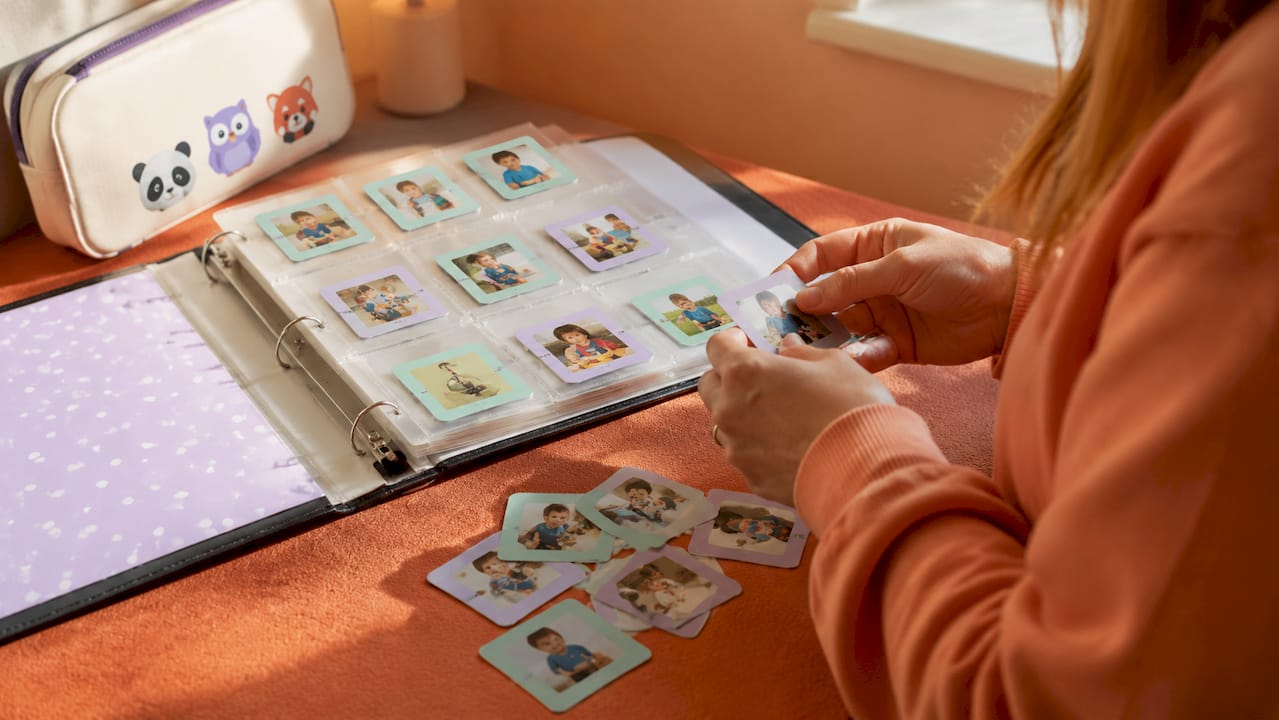
Many parents begin successfully at home with DIY materials: printed photos, a laminator, and Velcro dots. That is genuinely all you need for Phases 1–3.
Here is what works:
- Start small. Begin with 3–5 highly motivating items such as a favourite snack, a specific toy, or a preferred activity. Do not start with 30 pictures. Overwhelm kills momentum.
- Use real photos. Take pictures of your child’s actual biscuit tin, their specific toy car, their cup. Generic clip art symbols are harder for young children to connect to real objects.
- Laminate everything. Cards get chewed, dropped in cereal, and sat on. Print two copies of each card and laminate both. Keep spares.
- Use Velcro. Stick cards to a small ring binder or a piece of cardboard. Velcro dots on the back of each card mean they are easy to peel off and hand over.
- Place cards where life happens. Put the snack cards near the kitchen cupboard. Put the “swing” card near the back door. Velcro cards in multiple home locations encourage spontaneous requests rather than waiting for a formal session.
- Avoid a large vocabulary early on. Ten pictures is plenty to start. You can always add more once your child is confidently exchanging.
Pro Tip: Print your cards at a size your child can comfortably grip. For toddlers, roughly 5cm x 5cm works well. For older children, slightly larger cards are easier to find and hand over quickly.
The communication booklet does not need to be fancy. A small ring binder with Velcro pages does the job. The goal is that your child can access it without asking you first.
Best practices for daily PECS use and natural communication
The biggest shift in thinking is this: PECS is not a therapy activity. It is a communication tool, and it belongs everywhere your child goes.
AAC like PECS is most effective when it is available all day, not locked in a drawer between sessions. That means the booklet comes to the car, to the park, to the supermarket. If your child cannot reach it, they cannot use it.
The most powerful thing you can do as a parent is model the system yourself. This is called aided language stimulation. When you say “biscuit,” you also touch or hold up the biscuit card. You are showing your child that pictures carry meaning, not just telling them. Aided language stimulation is the single highest-value technique for helping a child learn PECS.
A few practices that make a real difference day to day:
- Use PECS across natural routines. Snack time, getting dressed, choosing a TV programme, asking to go outside. These moments are your sessions.
- Accept every attempt. If your child pushes a card vaguely in your direction, that counts. Honour it. Give them what they asked for. Communication attempts must lead to real outcomes or children stop trusting the system.
- Do not quiz. Holding up a card and asking “what’s this?” is a test, not communication. It teaches your child to perform, not to request. Let them initiate.
- Wait. Create a moment of need, then pause. Put the biscuit tin on the counter and wait. The pause is where communication happens.
- Reward immediately. The exchange works because it leads directly to the thing your child wants. Delay the reward and you break the link.
Family involvement during natural activities like snack time and play dramatically extends the effectiveness of PECS beyond anything a weekly clinic session can achieve. You are the most important person in this system.
Pro Tip: If you are on your own without a second adult, simplify. In early Phase 1, you can act as both the prompter and the communication partner. It is not the textbook method, but consistency matters more than perfection at this stage.
For more on weaving AAC into everyday routines, the Fidget and Spin blog has a plain-English guide written for parents, not clinicians.
Common challenges when using PECS at home
Let us be honest about the hard bits. Because there are hard bits.
The two-adult problem. The original PECS protocol uses one adult to prompt and one to receive the picture. Most of us do not have a spare adult standing in the kitchen at 7:30am. Consistency and immediate reward matter more than strict prompting in the early stages. Adapt the method to your reality.
Treating it like a quiz. This is the most common mistake, and it is completely understandable. You want to see what your child knows. But quizzing inhibits spontaneous communication. The moment PECS becomes a test, it stops being a tool. Keep it functional. Keep it real.
Keeping cards organised. Cards migrate. They end up under the sofa, in the dog’s mouth, or stuck to a jumper. A small binder with Velcro pages helps. So does having duplicates of the most-used cards. Accept that some chaos is part of the process.
Fluctuating motivation. Some days your child will use PECS brilliantly. Other days they will not touch a card. This is normal. Do not read a quiet day as regression. Keep the system available and keep your own expectations flexible.
When communication attempts do not lead to outcomes. If your child hands you the “biscuit” card and you say “not now,” you have just taught them that PECS does not work. Honour requests whenever you possibly can. If you genuinely cannot, swap the card out of reach rather than refusing the exchange.
When formal training is not accessible. Speech and language therapy waiting lists in the UK are long. You do not have to wait. Parents can initiate PECS effectively at home with a small set of motivating images and no formal training. Start where you are. Get support when you can. The two things are not mutually exclusive.
For broader SEN parenting support in the UK, including what services you can actually access, the Fidget and Spin guide is worth a read.
Key takeaways
PECS at home works best when it is woven into everyday life, started small, and treated as a communication tool rather than a therapy task.
| Point | Details |
|---|---|
| Start with Phases 1–3 | These phases are most achievable at home; later phases benefit from clinical support. |
| Use real photos and small sets | Begin with 3–5 motivating items using actual photos of your child’s belongings. |
| Keep PECS available all day | Cards should be accessible in every room and on every outing, not stored between sessions. |
| Model the system yourself | Use aided language stimulation by touching the card as you speak the word. |
| Honour every communication attempt | Immediate, real rewards build trust in the system and encourage your child to keep using it. |
What I have learned from using PECS with Remy
I will be straight with you. When we first started using PECS with Remy, I thought I was doing it wrong for about three months. The cards were everywhere. I was doing both jobs at once because Anthony was at work. Remy would use the biscuit card perfectly one morning and then look at me like I had invented a new language the next.
What shifted things was stopping treating it like a session. The moment I stopped sitting down with a purpose and just kept the cards on the counter, on the coffee table, in my bag, things started to click. Remy began handing me the “outside” card at the back door without any prompting. That was the moment I understood what PECS is actually for. It is not about the cards. It is about giving your child a way to tell you something when words are not available.
The consistency is genuinely hard when you are tired and the cards are under the sofa again. But the payoff, watching your child initiate communication, is worth every laminated square. If you are in the thick of it right now and it feels like nothing is working, I promise you it is working. You just cannot always see it yet.
Find your people too. Other SEN parents who are doing this alongside you are worth more than any manual. We share what works, what does not, and occasionally commiserate about the cards in the dog’s mouth.
— Caitlin
Sensory play and PECS: how Fidget and Spin can help
PECS gives your child a way to communicate. Sensory play gives them something worth communicating about.
At Fidget and Spin, our weekly sensory play sessions in Brighton and Hove are designed for neurodiverse children aged 1–6. The sessions are low-pressure, SEN-friendly, and built around the kinds of sensory experiences that get children engaged and regulated. That is exactly the environment where communication tools like PECS can shine. Your child can practise requesting, choosing, and initiating in a space that understands their needs. Come and see what play builds communication in a room full of children just like yours.
FAQ
What is PECS and how does it work at home?
PECS is the Picture Exchange Communication System, an AAC method where a child hands a picture to a communication partner to request something they want. At home, parents set up a small picture booklet and respond immediately to every exchange, building communication through natural daily routines.
How long does it take for PECS to work?
Most children learn the basic picture exchange in Phase 1 within 2–4 weeks. Full progression through all six phases typically takes 6–12 months, depending on consistency and developmental level.
Do I need formal training to use PECS at home?
Formal training is helpful but not required to begin. Many parents start successfully with printed photos, laminated cards, and a small set of motivating items, focusing on Phases 1–3 before seeking specialist support for later stages.
What pictures should I start with for home PECS activities?
Start with 3–5 real photos of your child’s most motivating items, such as a favourite snack, toy, or activity. Use actual photos of your child’s own belongings rather than generic symbols, and keep the initial set small to avoid confusion.
Why is my child not using their PECS cards consistently?
Inconsistent use is normal, especially early on. Check that cards are accessible at all times, that every exchange leads to an immediate real reward, and that you are not inadvertently quizzing your child. Treating PECS as a test rather than a communication tool is the most common reason children disengage.
Recommended
- PDA in toddlers: what parents need to know | Fidget and Spin Brighton
- Step by step early years inclusion: a parent’s guide | Fidget and Spin Brighton
- A practical guide to emotional regulation for SEN children | Fidget and Spin Brighton
- SEN parenting UK: what support is actually out there | Fidget and Spin Brighton