
TL;DR:
- Planning an autistic child’s birthday involves prioritizing their comfort over traditional decorations to create a safe, enjoyable environment. Success depends on understanding their sensory needs, preparing them in advance, and being flexible with the activities and schedule. Flexibility and listening to the child’s cues lead to a genuine celebration that respects their individual needs.
Planning a birthday for an autistic child means building a celebration around your child’s actual comfort, not a Pinterest board. A successful autism-friendly party is defined by one thing: your child feels safe enough to enjoy themselves. That might mean six children in your living room with the lights turned down, or a one-to-one afternoon doing their favourite activity. There is no correct version. What matters is that the environment, the activities, and the pace all work for your child, not against them. This guide walks through every stage, from setting up the space to handling the tricky moments, with practical tips drawn from lived experience.
What does planning a birthday for an autistic child actually involve?
The honest answer is: more thought, less decoration. Most traditional party formats were designed for children who can tolerate noise, unpredictability, and social pressure. Many autistic children cannot, and that is not a problem to fix. It is a starting point for planning differently.
There is no single ‘right’ way to celebrate an autistic child’s birthday. Success looks like your child feeling comfortable and experiencing authentic joy, not conforming to what a party is “supposed” to look like. That reframe is the most useful thing I can offer you before we get into the practical detail.
Start by asking your child, in whatever way works for them, what they actually want. Use visuals, PECS, AAC, or a simple choice board if verbal conversation is hard. Their answer might surprise you. Remy, our son, once asked for a party with no guests and a very specific brand of crisps. We obliged. It was genuinely one of the better afternoons we have had.
What sensory considerations matter most at a birthday party?
Sensory overload is the most common reason autistic children struggle at parties. Noise, bright lighting, crowds, unfamiliar smells, and unexpected touch all stack up fast. The environment is your first job.

Chill-out zones work best when they are designed deliberately, not treated as an afterthought. A corner with a tent, dim lighting, weighted lap pads, and noise-cancelling headphones gives your child somewhere to regulate without leaving the party entirely. Think of it as a pit stop, not a punishment.
When choosing decorations, go for muted colours over bright metallics and foil balloons. Avoid party poppers entirely. If you want music, keep it low and familiar, and have a clear off switch. Sensory-friendly lighting means lamps rather than overhead fluorescents, and definitely no strobes or flashing fairy lights.
Sensory play options woven into the party itself also help. A small table with kinetic sand, playdough, or water beads gives children something to do with their hands and their nervous systems. It is not a craft activity. It is regulation dressed up as fun.
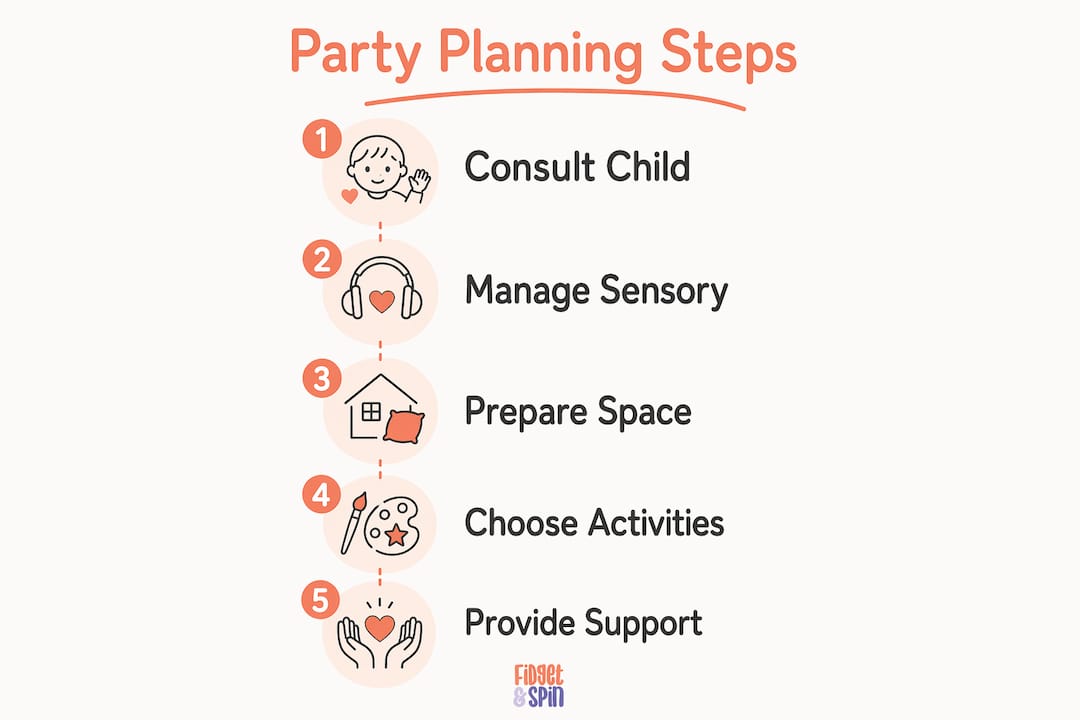
Pro Tip: Pack a sensory survival kit the night before. A well-stocked kit includes noise-cancelling headphones, familiar fidget tools, sunglasses for bright lighting, safe snacks, and a comfort item. Having it ready means you are not rummaging through a bag mid-meltdown.
How can you prepare your autistic child before the party?
Preparation is where you spend most of your effort, and it pays off more than any decoration ever will. Autistic children often struggle with transitions and unpredictability. Knowing what is coming reduces anxiety significantly.
Rehearsing a five-step picture schedule with your child in advance reduces party anxiety. Walk through it together several times in the days before. Show photos of the venue if it is somewhere new. If you can visit the space beforehand, do it.
Here is a simple preparation sequence that works well:
- Create a visual schedule. Use photos or symbols to show arrival, activities, cake, and going home. Laminate it so your child can hold it.
- Rehearse the birthday song. The “Happy Birthday” song is loud, sudden, and directed at your child. Practise it at home, quietly, so it is not a shock on the day.
- Set a realistic time goal. Decide in advance how long you are aiming to stay. One hour is fine. Forty minutes is fine. Build in a guilt-free exit.
- Agree on a signal. Give your child a way to tell you they need a break. A card, a gesture, or a word. Something that does not require them to articulate distress in front of guests.
- Brief the adults. Tell any other parents or helpers what the plan is. You do not need to over-explain. A short, warm note works well.
Your presence as a co-regulator matters enormously on the day. Stay close. Narrate calmly. If you are anxious, your child will feel it. (I know. Easier said than done.)
Pro Tip: Communicating sensory needs to other parents via a brief, friendly note reduces confusion and is almost always met with warmth. Frame it as “here is our plan” rather than a list of rules.
What activities work best at an autism-friendly birthday party?
The golden rule for birthday ideas for autistic children is this: avoid elimination games. Musical chairs, pass the parcel with forfeits, and any game where children are “out” create anxiety and distress. Nobody wins when a child is crying in the corner at their own party.
Cooperative activities like group art projects, sensory scavenger hunts, and building challenges work far better. They have no losers, no sudden endings, and no social pressure to perform.
Activities that work well:
- Special interest stations. Build the party around your child’s passion. Dinosaurs, trains, space, a specific film. Children engage more when the theme is genuinely theirs.
- Sensory art tables. Finger painting, collage, or stamping. Open-ended, low-pressure, and easy to leave and return to.
- Scavenger hunts. Keep clues visual and simple. Pair children up so no one is alone.
- Bubble machines and light tables. Passive sensory input that children can engage with at their own pace.
A visual schedule displayed at the party itself helps enormously. Children know what is coming next and do not have to ask or guess. For autism-friendly party games, the principle is always the same: low pressure, high sensory interest, and no sudden endings.
For the birthday cake moment, consider singing softly, skipping the song entirely, or letting your child blow out candles privately before bringing the cake out. There is no rule that says the song is compulsory.
| Activity type | Why it works |
|---|---|
| Sensory art table | Open-ended, no right or wrong, easy to step away from |
| Cooperative scavenger hunt | Visual, structured, no elimination |
| Special interest station | Intrinsically motivating, reduces social anxiety |
| Bubble or light play | Passive engagement, low demand, self-regulating |
How do you handle the tricky moments on the day?
Every party has peak stress moments. For autistic children, the three highest-risk points are arrival, the birthday song, and goody bag distribution. Knowing this in advance means you can plan specifically for each one.
Arrival is overwhelming because everything is new at once. Arrive early if possible, before other guests, so your child can settle into the space first. Let them explore without the social layer on top.
The birthday song is loud, sudden, and aimed directly at your child. Warn them it is coming. Offer headphones. Consider a quieter version. Or skip it. The cake is the point, not the performance.
Goody bags create confusion about ownership, fairness, and endings. Hand them out calmly, one at a time, with a clear explanation. Some children do better receiving theirs privately rather than in a group scramble.
Meltdowns during parties are communication, not failure. When your child reaches their limit, they are telling you something important. Moving to a quiet space and staying calm is the right response. Leaving early is not giving up. It is good parenting.
Keep a calm space available throughout. Not a locked room, just a quieter corner with familiar items. Check in with your child regularly, not just when things go wrong.
What venue and catering options suit autistic children’s parties?
Home is often the best venue. Familiar smells, familiar layout, familiar rules. The logistics are harder for you, but the sensory load on your child is lower. That trade-off is usually worth it.
If you want to go out, look for venues that offer sensory-friendly birthday parties specifically, or that are willing to adapt. Sensory gyms, therapy farms, and specialist SEN party providers understand the brief without needing a lengthy explanation from you.
Daisy Chain offers inclusive birthday parties for neurodivergent children at around £200 for a two-hour slot, supporting up to 12 children. That kind of specialist provision takes a significant amount of planning pressure off parents.
For catering, keep it simple and familiar. Offer your child’s safe foods alongside party food. Avoid strong smells, unfamiliar textures, and buffet-style layouts that require children to navigate choices under social pressure. Individual plates work better than a shared spread.
What I have actually learnt from planning Remy’s parties
The first birthday party we threw for Remy was a lesson in what not to do. Twelve children, a hired hall, a bouncy castle, and a playlist I thought he would love. He lasted twenty minutes before we were in the car park. I cried on the way home. He asked if we could go to the aquarium instead.
The year after, we did exactly that. Four children, the aquarium, fish and chips on the way back. He talked about it for months.
What I know now is that the pressure I felt to throw a “proper” party was entirely mine. Remy did not care about the hall or the bouncy castle. He cared about the fish. Listening to him, actually listening, was the thing that changed everything.
Flexibility is not a consolation prize. It is the whole point. If the party needs to end early, end it. If the cake moment needs to happen in a different room, do it there. If your child wants to spend their birthday doing something that does not look like a party at all, let them. You are not failing. You are paying attention.
Trust your instincts. You know your child better than any guide does, including this one.
— Caitlin
Fidget and Spin’s sensory birthday parties in Brighton and Sussex
If you are looking for a venue that already understands all of this, Fidget and Spin runs sensory birthday parties designed specifically for neurodiverse children aged 1–7 across Brighton, Hove, and wider Sussex.
Every party is built around sensory zones: big movement, low-stimulation cosy spaces, and tactile play. There are no flashing lights, no elimination games, and no expectation that your child will perform. Packages start at £220, with options to suit different group sizes and needs. Anthony and I built Fidget and Spin because we could not find what Remy needed. If that sounds familiar, get in touch and we will talk through what would work for your child.
FAQ
What is an autism-friendly birthday party?
An autism-friendly birthday party is one designed around a child’s sensory, social, and communication needs. It prioritises low stimulation, predictable structure, and flexible exits over traditional party formats.
How do I reduce meltdowns at my autistic child’s party?
Meltdowns reflect communication needs, not failure. Prepare a chill-out zone, rehearse the schedule in advance, and plan specifically for the three highest-risk moments: arrival, the birthday song, and goody bags.
What activities work best for birthday ideas for autistic children?
Cooperative, open-ended activities work best. Sensory art tables, scavenger hunts, and special interest stations avoid the social pressure and sudden endings that cause distress.
Can I host an autism-friendly party at home?
Home is often the best choice because the environment is already familiar. Reduce sensory load by keeping the guest list small, using lamps instead of overhead lighting, and avoiding party poppers or balloons.
Where can I find specialist sensory party venues in Sussex?
Fidget and Spin offers SEN birthday parties across Brighton, Hove, and Sussex, with packages from £220. Daisy Chain also provides inclusive birthday parties for neurodivergent children at around £200 for a two-hour session.
Key takeaways
Successful autism-friendly birthday planning centres on sensory preparation, flexible structure, and following your child’s lead rather than conventional party expectations.
| Point | Details |
|---|---|
| Reframe success | A good party is one where your child feels safe and genuinely enjoys themselves, whatever that looks like. |
| Design the environment first | Set up a deliberate chill-out zone with dim lighting, weighted lap pads, and noise-cancelling headphones before guests arrive. |
| Prepare with visual supports | Rehearse a picture schedule and the birthday song at home in the days before the party. |
| Plan for the three risk moments | Arrival, the birthday song, and goody bags are the highest-stress points; have a specific plan for each one. |
| Flexibility is the strategy | Leaving early, skipping the song, or changing the plan on the day is good parenting, not failure. |
Recommended
- Autism friendly party games: your 2026 guide | Fidget and Spin Brighton
- Autism friendly birthday party Sussex: your local guide | Fidget and Spin Brighton
- Birthday party for a non verbal child: a real guide | Fidget and Spin Brighton
- Supporting an autistic toddler: a practical parent’s guide | Fidget and Spin Brighton