
TL;DR:
- Play is a vital communication tool for neurodiverse children, supporting foundational skills like joint attention and turn-taking. Inclusive and adapted activities foster confidence and peer interaction while visual supports enhance understanding and expression. Consistent, loving practice and flexible environments are essential for meaningful progress in communication development.
If you’ve ever sat on a playroom floor watching your child line up cars instead of rolling them to you, you’ll know that particular mix of love and worry that lives quietly in a parent’s chest. Play looks simple from the outside. But for neurodiverse children aged two to seven, the right kind of play isn’t just fun. It’s one of the most powerful communication tools available to you, and most guides buried in clinical language never quite say that clearly enough. This article is here to change that.
Table of Contents
- Why communication skills matter for neurodiverse children
- The science behind inclusive play and confidence building
- Play activities that boost communication
- Using visual supports and alternative communication
- A simple roadmap for parents: putting inclusive communication strategies into action
- A reality check: what most communication guides miss
- Find support for your child’s communication journey
- Frequently asked questions
Key Takeaways
| Point | Details |
|---|---|
| Early support matters | Starting communication intervention as early as possible leads to stronger outcomes for neurodiverse children. |
| Inclusive play builds confidence | Structured and adapted group play boosts communication and self-esteem in diverse learners. |
| Visual supports work | Pictures, choice boards, and gestures help all children, including nonverbal, feel understood and included. |
| Isolate play sparks connections | Unexpectedly, crafts and puzzles in group settings often prompt more peer interactions for some children. |
| Consistency is key | Daily, achievable steps and patience make the biggest difference in long-term communication progress. |
Why communication skills matter for neurodiverse children
Communication is so much more than words. For neurodiverse children, building communication skills often starts long before a single word is spoken. It begins with a shared glance, a pointed finger, a moment of waiting for your turn. These are the building blocks.
What communication actually includes:
- Joint attention (following another person’s gaze or gesture)
- Turn-taking (the earliest form of conversation)
- Gesture use (pointing, waving, reaching)
- Facial expression recognition
- Vocabulary and sentence building (which come later)
Here’s something that surprises many parents: joint attention mastery typically precedes functional language by about a year in autistic children. So if your child isn’t speaking yet, it doesn’t mean communication development isn’t happening. It may simply mean the foundation is still being laid.
“The earlier a child receives targeted communication support, the more likely they are to develop functional language and social connection. Intervention in the earliest years isn’t optional. It’s transformative.”
That urgency is backed by paediatric guidance. The American Academy of Pediatrics recommends autism screening at 18 and 24 months precisely because early intervention significantly improves outcomes. The window between two and five years is not a deadline. But it is genuinely precious.
Common challenges parents face in this space include not knowing what to watch for, feeling uncertain about whether to seek assessment, or being told by well-meaning relatives to “just give it time.” Your instincts matter. If something feels like it needs attention, it probably does. Act on it.
After establishing the significance of early communication, we next consider the everyday activities that can nurture these skills.
The science behind inclusive play and confidence building
Inclusive play isn’t just a lovely idea. There’s real evidence behind it.
What makes play “inclusive” is less about having the right toys and more about adapting the environment and the activity to meet your child where they are. That might mean choosing softer lighting, reducing background noise, offering fewer choices at once, or making sure the pace is slow enough that every child can participate fully.

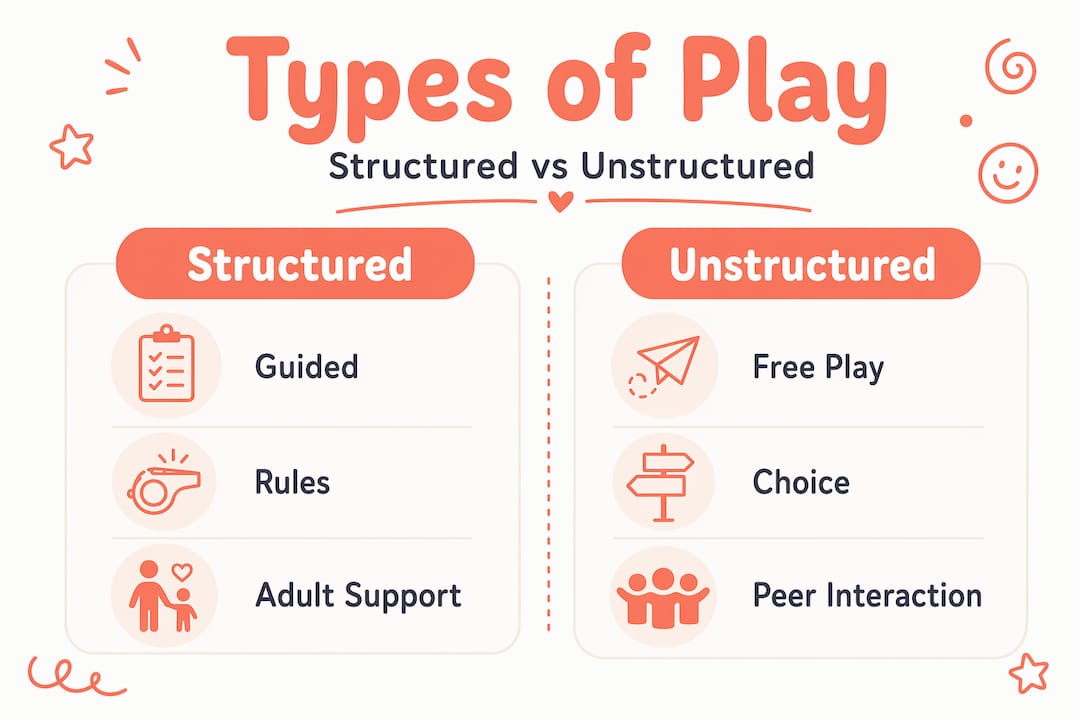
Structured vs unstructured play: a quick comparison
| Feature | Structured play | Unstructured play |
|---|---|---|
| Adult involvement | High: guided, scaffolded | Low: child-led |
| Communication opportunities | Consistent and predictable | Variable and spontaneous |
| Best for | Building specific skills (turn-taking, vocabulary) | Creativity and self-expression |
| Sensory considerations | Can be adapted deliberately | Unpredictable sensory input |
| Confidence building | High when child succeeds at clear tasks | High when child follows their own interest |
| Peer interaction | Structured and modelled | Organic but less reliable |
The research supports a blend of both. Inclusive group activities like parachute games, outdoor turn-taking games, and structured group play promote social interaction and confidence in measurable ways. When children experience a game designed so that everyone can succeed, something quietly shifts. They start to take risks. They look up from the ground. They reach out.
Peer-to-peer interaction is also naturally fostered in well-designed inclusive play settings. Children learn more from watching each other than we sometimes realise. A child who watches a peer point to a picture card and receive a joyful response will often try the same thing, not because an adult told them to, but because it looked worth doing.
This is also where structured group play benefits become most visible. When the environment is consistent and the social expectations are made clear through predictable routines, neurodiverse children can focus their energy on connecting rather than on managing anxiety.
Pro Tip: If your child has complex needs considerations such as hearing differences or sensory processing challenges, speak with your health team before introducing new group activities. Small environmental tweaks, like reducing echo in a room, can make an enormous difference to participation.
The sensory playgroup approach works on this principle: reduce the barriers, and children will often surprise you.
With the underlying science clear, let’s turn to specific play activities that work best in practice.
Play activities that boost communication
Here is something counterintuitive that research genuinely supports. Isolate play activities like painting or puzzling, which look like solitary experiences, actually facilitate more peer interactions for children with SEND in inclusive settings. The shared focus of a task gives children a reason to glance sideways, point, gesture, and communicate without the pressure of pure social interaction.
Activity to communication skill mapping
| Activity | Key communication skill supported |
|---|---|
| Parachute games | Joint attention, turn-taking, group awareness |
| Outdoor turn-taking games | Waiting, gesture, social anticipation |
| Collaborative puzzles | Joint attention, pointing, shared problem-solving |
| Sensory painting | Vocabulary (describing textures), peer commenting |
| Sand and water play | Requesting, labelling, parallel communication |
| Story-based group games | Narrative skills, listening, prediction |
How to adapt these activities at home:
- Start small. Pick one activity per week rather than overhauling your routine. Consistency beats variety every time.
- Set up the space deliberately. Reduce clutter and noise. A calm environment helps your child attend to you rather than their surroundings.
- Model before you expect. Do the activity yourself first and narrate simply: “My turn. I’m putting the piece here.”
- Wait with expectation. Give your child a long pause after your turn. Count silently to ten. That pause is an invitation, not a gap.
- Celebrate the attempt, not the outcome. A glance, a point, a sound counts. Say it out loud: “You looked at me. I love that.”
These evidence-based play interventions are most effective when they’re woven into daily life rather than treated as separate therapy sessions. Bath time, snack time, and even getting dressed are all opportunities when you know what to look for.
Pro Tip: Adapt activities for sensory sensitivities by offering alternatives. If your child dislikes the texture of paint, try a paintbrush through water on dark paper, or finger shapes in shaving foam. The communication opportunity remains; the sensory barrier is removed. Explore the practical play structure at Fidget and Spin for more ideas on adapting activities.
To maximise the benefit from play, understanding support tools is vital for breaking down communication barriers.
Using visual supports and alternative communication
Not every child communicates through speech. That’s not a failure. That’s just a different language.
For nonverbal children or those with limited verbal communication, alternative approaches can be genuinely life-changing. AAC (augmentative and alternative communication) refers to any method that supports or replaces verbal speech. This includes communication boards, picture exchange systems (PECS), speech-generating devices, and even low-tech options like pointing to pictures.
Visual supports to consider introducing alongside play:
- Picture cards for naming objects and actions during play
- Choice boards (two to three images) so your child can request what they want
- Routine charts with pictures showing what comes next (reduces anxiety and supports comprehension)
- Communication books that travel with your child and build vocabulary over time
- First-then boards to help manage transitions and set expectations
Using visual supports like pictures and choice boards alongside play meaningfully aids both understanding and expression. The key is consistency. Use the same images in the same places so your child learns that symbols carry meaning.
A note on gesture imitation, which is often underestimated. Before a child can use a picture card, many children benefit from learning to imitate gestures like waving, clapping, or pointing. These are the stepping stones. If you’re supporting a nonverbal child through new environments, building gesture imitation is a gentle and powerful starting point.
Pro Tip: Involve siblings and peers in using the same visual supports. When a brother reaches for a choice board too, it stops being a “special needs thing” and becomes just how communication works in your home. That normalisation is powerful for everyone.
Now that we’ve seen which tools and strategies foster communication, let’s put it all together with clear, actionable steps.
A simple roadmap for parents: putting inclusive communication strategies into action
Here is the honest truth: there is no perfect programme. There is only consistent, loving practice over time. Floortime play-based interventions show genuine gains in joint attention and social skills, but the research is clear that outcomes depend heavily on parent consistency. Small, regular efforts matter far more than occasional intensive sessions.
Your five-step action plan:
- Observe first. Spend five minutes watching your child play without directing them. What do they reach for? What holds their attention? That interest is your way in.
- Choose one activity that matches their interest and lends itself to a communication opportunity. Parallel play alongside them before you try to join in.
- Set up a visual support. Even one picture card that labels the main object in the activity is a start. Place it where your child can see and reach it.
- Model turn-taking. Take a turn. Then visibly wait. Use a gesture (open hand, expectant look) to signal it’s their turn. Keep it playful, not pressured.
- Celebrate every small progress. Out loud. With warmth. “You passed me the ball! That was your turn!” Small wins accumulate into something extraordinary.
After you’ve done this for a week, review. Did your child engage more on some days? What was different about those days? The answer usually lies in sensory conditions (tiredness, noise, hunger) rather than the activity itself.
Understanding how playgroup sessions work in a supported setting can also help you replicate the structure at home. Seeing how skilled facilitators prompt and respond can be genuinely eye-opening for parents.
Keep adjusting. What works at three may not work at four. Neurodiverse children grow and change, sometimes in ways that defy expectations entirely, which is something worth holding onto.
A reality check: what most communication guides miss
Most guides focus on method. Follow this approach. Use this tool. Apply this strategy. And while method matters, it’s not the whole story.
Here’s what I think gets missed. For some children, group activities genuinely do not spark the same communication growth that a quiet side-by-side puzzle might. The pressure of a group setting, even a well-run, inclusive one, can consume so much of a neurodiverse child’s cognitive and sensory energy that there’s nothing left over for communication learning. That doesn’t mean groups are wrong. It means they’re not always the answer.
The myth that group play always outperforms solitary play is worth letting go of. What matters is that the child is regulated, interested, and in an environment where communication feels safe to attempt. Sometimes that’s a group. Sometimes it’s just the two of you on the kitchen floor with a pot of dry pasta.
Flexibility is underrated. We get very attached to frameworks. We download the plan, we read the book, we book the course. And then our child does something completely unexpected that doesn’t fit any of it. That’s not failure. That’s your child communicating that they need something different. Listen to that.
Family wellbeing shapes outcomes as much as method. If you’re exhausted and stretched thin, the quality of the interaction drops regardless of which technique you’re using. Getting support for yourself, whether through community, respite, or spaces like Fidget and Spin’s sensory playgroup where you can connect with other parents who genuinely understand, is not a luxury. It’s part of the plan.
The children I’ve seen make the most surprising leaps weren’t always in the most structured interventions. They were in environments where someone believed in them, stayed curious about them, and kept showing up. Milestones are useful maps. But your child is not a milestone. They’re a person, discovering what they’re capable of, one small moment at a time.
Find support for your child’s communication journey
You don’t have to figure this out alone. Building communication skills in neurodiverse children is genuinely complex work, and the most effective progress usually happens when parents feel supported too.
At Fidget and Spin in Brighton & Hove, our sessions are designed around exactly the principles in this guide: inclusive sensory play, gentle group structure, visual supports, and an environment where neurodiverse children aged one to seven can communicate and connect at their own pace. Every session features themed sensory zones and guided activities tailored to support communication, confidence, and emotional regulation. When you book sensory play sessions, you’re not just finding a playgroup. You’re stepping into a community of people who get it. Come and see how our sessions work and find out if they’re the right next step for your family.
Frequently asked questions
What are the signs my child needs help with communication?
Look for limited eye contact, not responding to their name, or not pointing or showing objects by 18 to 24 months. The AAP recommends screening at these ages precisely because acting early makes a meaningful difference.
Can play-based activities work for nonverbal children?
Absolutely. Gesture imitation, sound play, and AAC are all effective starting points for nonverbal children, and many activities in this guide can be adapted to require no speech at all.
How do visual supports help with communication?
Pictures, choice boards, and routine charts give children a consistent visual language that reduces anxiety and makes it easier to express needs and understand what’s happening around them.
What types of play best support peer interactions?
Both structured group activities and isolate tasks like crafts and puzzles can spark peer interaction in inclusive settings, often in surprisingly natural and unforced ways.