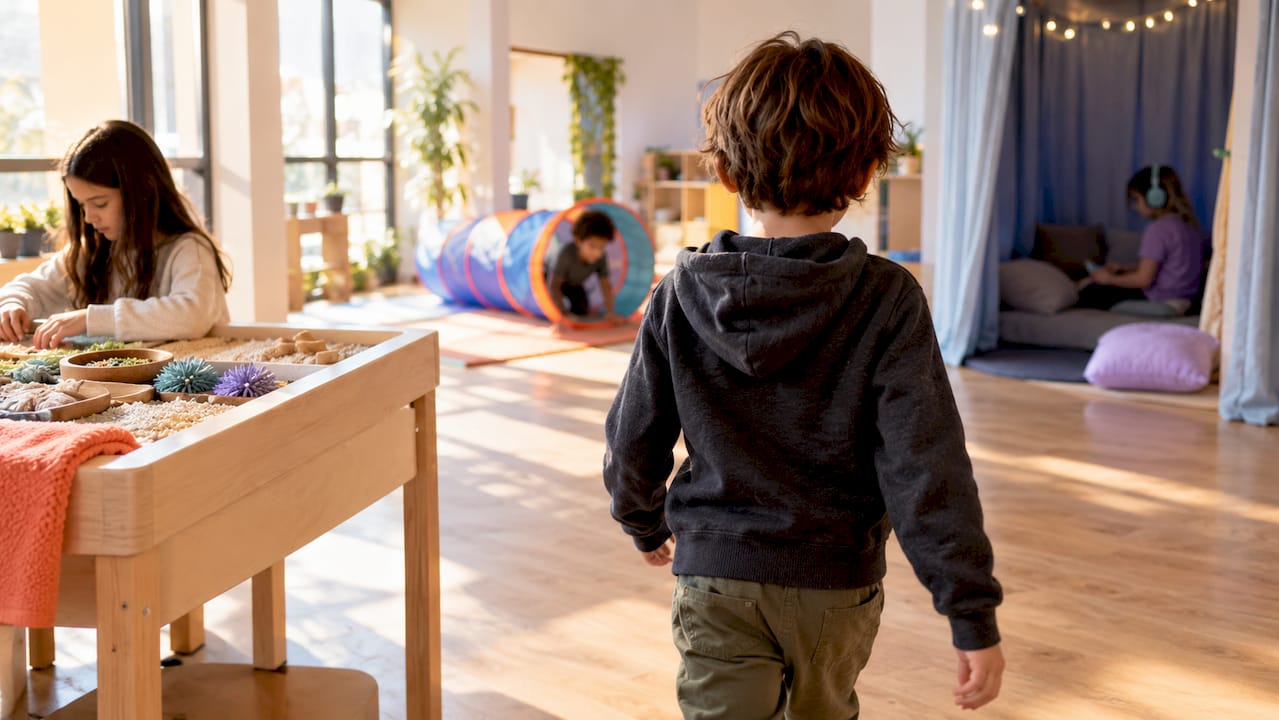
Three station types do the heavy lifting: tactile, movement and low‑stim. Pick one, gather two or three low‑prep materials, set a visual timer, and let your child lead. That’s it, that’s the whole starting move. I’m Caitlin, co‑founder of Fidget & Spin, and I’ve run enough sessions to know the ones that flop are always the ones with too much going on at once.
TL;DR:
- Limiting sensory stations to two or four with clear visual signs reduces overwhelm and increases participation.
- Using visual timers, simple schedules, and designated quiet corners helps children anticipate transitions and self-regulate effectively.
- Introducing new activities gradually and alongside familiar stations minimizes distress and builds confidence in sensory exploration.
- Choosing muted colors, soft lighting, and avoiding loud noises or strong scents creates a calm environment for sensory-sensitive children.
- Fidget toys, weighted items, and low-sensory materials are affordable options to support regulation at home or during sessions.
Table of Contents
- Portage play ideas for autism that actually work in practice
- 10 practical sensory play ideas you can set up fast
- How to set up sensory stations: zoning, flow and simple rules
- SEN‑friendly party checklist: pacing, guest list and transitions
- Safe materials and quick recipes (low cost, easy substitutions)
- Five quick game templates and timing for sessions or short parties
- Tips for involving neurotypical siblings and peers in inclusive play
- Guidance on adjusting play ideas based on individual sensory profiles and preferences
- Strategies for introducing new play activities to minimize distress
- List of recommended low-sensory toys and materials readily available
- Ideas for themed party decorations and ambience that support sensory comfort
- From my sessions: what I learned running sensory stay‑and‑play and SEN parties
- How Fidget & Spin can help with sessions and SEN‑friendly parties
- Sources
- FAQ
Portage play ideas for autism that actually work in practice
If you’ve searched “portage play ideas autism,” you’re probably after something specific: sensory activities that don’t need a therapist in the room, work for a six‑year‑old who can’t sit still and a toddler who wants to eat the rice. The word “portage” gets used loosely by parents to mean structured, home‑based play support, but the activities that actually help autistic children regulate and engage don’t need a formal programme behind them. They need three things: predictability, choice, and materials that respond to touch or movement without demanding eye contact or turn‑taking.
That’s the whole philosophy behind what we do at Fidget & Spin, and it’s why sensory stations that allow a child to explore in their own way tend to reduce repetitive behaviours and increase independent engagement, because the child controls the input rather than the input controlling them. You’re not teaching a skill. You’re offering a choice and stepping back.
The rest of this piece is the practical bit: ten stations you can set up today, how to zone a room so it doesn’t overwhelm, a party checklist that has saved more than one birthday from a meltdown, and recipes for the messy stuff that costs almost nothing.
10 practical sensory play ideas you can set up fast
These aren’t ranked by importance. They’re ranked by how fast you can get them running, because on a Tuesday afternoon with a toddler already halfway to a meltdown, speed matters more than perfection.
- Rainbow rice bin. Calming to look at, satisfying to scoop. Swap the dye for a single colour if your child finds too much visual noise distressing.
- Kinetic sand tray. Mouldable, low mess, stores flat on a shelf between sessions. Good for tactile seekers who like resistance under their hands.
- Bubble foam station. Visual and tactile at once. Use a tear‑free wash and keep a towel close by.
- Weighted lap pad corner. Simple deep pressure input for a child who needs to come down from movement play. Always supervise use with younger children.
- Movement tunnel or soft obstacle course. A proprioceptive outlet that burns energy fast. Keep bursts short rather than open‑ended.
- Parachute or fabric play in a small group. Gentle, low noise, and nobody has to talk to take part.
- Tactile art with shaving cream or cloud dough. Self‑contained mess that wipes off a tray in seconds.
- Soft light tent. A dim, textured hideout for a child who needs to opt out without leaving the room entirely.
- Fidget tray with labelled choices. Quick regulation with zero social demand attached.
- Water transfer and scoop station. Low‑tech, endlessly repeatable, and brilliant for short timed turns.
Rotate two or three of these per session rather than laying all ten out. Activity stations outperform whole-group activities precisely because they make participation optional, and optional is the whole point.
How to set up sensory stations: zoning, flow and simple rules
A room with ten choices in it is a room that overwhelms. A room with three feels like an invitation.
- Limit choices to two to four stations, each with a simple picture sign showing what happens there. No sign, no clarity, no calm.
- Use one wall schedule and one visual timer for the whole session. Children shouldn’t have to guess what’s coming next.
- Mark a visible quiet corner and make it genuinely optional, not a punishment zone. Cushions, dim light, nobody chasing them into it.
- Keep trays shallow and liners disposable. A hand‑wash station within reach saves you from a rice‑covered doorknob later.
- Sit alongside, then step back. Fading your presence gradually as a child’s play stamina builds is a proper technique, not just something parents do because they’re tired. Start close, move a little further away, and let independence grow at its own pace.
SEN‑friendly party checklist: pacing, guest list and transitions
Here’s the truth nobody tells you before your first SEN party: it’s not really one event, it’s a string of small transitions, and each one is a chance for things to go sideways. Arrival, cake, games, goodbyes. Plan for the joins, not just the middle.
- Keep the guest list small and offer early entry so your child can explore the space while it’s still quiet.
- Send a simple visual schedule or a short photo tour before the day. Pre-visits and social stories measurably lower anxiety for children who need to know what’s coming.
- Set up a designated quiet room with low lighting, soft seating, headphones and one or two familiar items from home.
- Skip the triggers you know are triggers. Group singing and surprise moments are the two most common ones, so offer silent candles or jazz hands instead of a chorus.
- Build in decompression time after the party, and agree an exit sentence with your child in advance so leaving doesn’t need to become a negotiation mid‑meltdown.
Loud group moments and unexpected smells are two of the fastest routes to sensory shutdown at a party, so naming them and planning around them in advance costs you nothing and saves everyone a rough afternoon.
Safe materials and quick recipes (low cost, easy substitutions)
You don’t need a craft cupboard. You need a saucepan, some cornflour, and twenty minutes.
- Rainbow rice: 1 cup rice, ½ teaspoon vinegar, a few drops of food dye. Dry flat on a tray overnight. Go single colour if your child finds too much visual variety distressing.
- Cloud dough: 2 cups cornflour, 1 cup hair conditioner. Mouldable, non‑edible, label the tub clearly so nobody mistakes it for pudding.
- Kinetic sand: buy a brand that doesn’t dry out, and keep it in a sealed tub between uses.
- Bubble foam: warm water plus a few drops of tear‑free baby wash. Supervise closely and keep it well away from eyes.
Materials like rice, pasta and shaving cream are genuinely low-cost and quick to prepare, and choosing non-edible or clearly labelled options matters if anyone at the session has oral sensitivities or is prone to mouthing objects.
Five quick game templates and timing for sessions or short parties
Short and predictable beats long and open‑ended, every single time, in my experience running sessions week after week.
- Scoop relay (5 minutes). Timed transfers between two containers. No pressure to hurry, just a gentle rhythm.
- Sensory art burst (7 minutes). Individual stations, no sharing required, optional take‑home piece.
- Calm box check (3 minutes). Child picks one calming object from a box, holds it, returns it.
- Movement minute (three bursts of one minute). Short, intense proprioceptive input followed by a calm pause.
- Parallel challenge (10 minutes). Same activity, side by side, no requirement to interact.
Pro Tip: Start with intervals shorter than you think your child needs, then praise every small increase in time. Shaping play stamina in thirty‑second steps works far better than expecting ten minutes on day one.
Tips for involving neurotypical siblings and peers in inclusive play
Siblings get forgotten in all this planning, and I say that as someone who’s forgotten mine more than once. The trick isn’t making everyone do the same activity. It’s giving every child a version of the same station that suits how they play.
At the rice bin, a sibling might build elaborate scoop‑and‑pour systems while your child just wants to run their hands through it. Both are using the same station, neither is doing it wrong. Parallel play, not shared play, is the goal for younger mixed groups, and it takes the pressure off everyone to perform friendship on demand.
Give siblings a small job if they want one. “Can you keep the water bin topped up?” turns a bored older sibling into a helper without forcing interaction nobody asked for. And when a sibling gets frustrated that their brother or sister won’t play “properly,” that’s a conversation worth having honestly rather than glossing over. Kids cope better with straightforward explanations than with vague reassurance. Something like “his brain needs different things from playing than yours does” tend to land better than “just be patient,” because it gives the sibling an actual reason rather than an instruction.
Peers at parties benefit from the same logic. A station‑based party, where children move at their own pace between activities, lets a neurotypical guest and an autistic host both have a genuinely good time without either one adapting to the other’s rhythm all afternoon.
Guidance on adjusting play ideas based on individual sensory profiles and preferences
Every checklist in this article is a starting point, not a script. I’ve watched two children who are both autistic want opposite things from the same bin of rice. One wants silence and dim light. The other wants music on and bright colours everywhere.
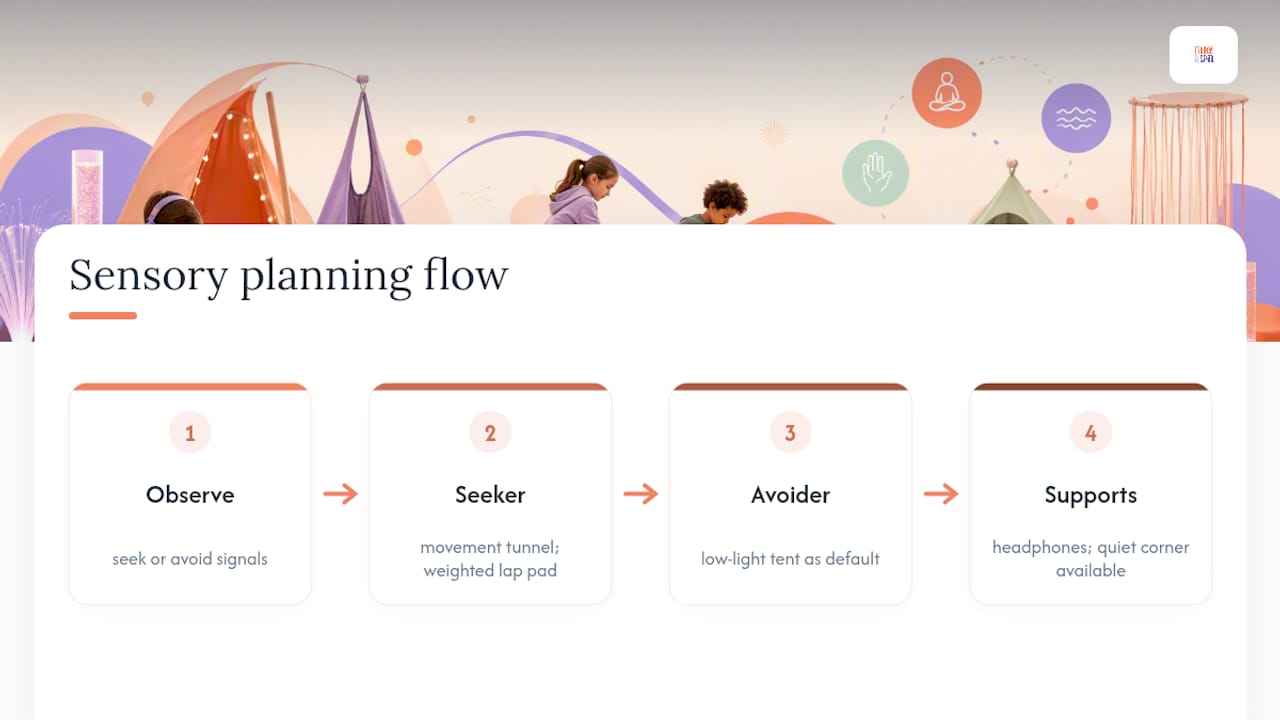
Watch before you plan. Does your child seek input (spinning, crashing, deep pressure) or avoid it (covering ears, refusing textures)? A sensory seeker often does better with the movement tunnel and weighted lap pad in longer bursts. A sensory avoider might need the low light tent as the default station, with everything else offered as an occasional extra rather than the main event.
Texture preferences shift too, sometimes week to week. A child who loved kinetic sand last month might refuse to touch it this month. That’s not regression, it’s just how sensory profiles work. Keep two or three station types in rotation and let go of the idea that any one activity has to be a permanent favourite.
Noise sensitivity deserves its own note. Bubble foam and water play are naturally quiet. Movement tunnels and group games generate more noise, so pair them with headphones nearby or a quiet corner your child can retreat to without asking permission. Adjusting for sensory profile isn’t about finding the one perfect activity. It’s about having enough variety on hand that you can read the room, literally, and switch fast when something isn’t landing.
Strategies for introducing new play activities to minimize distress
New things are hard. Not because autistic children dislike novelty on principle, but because unpredictability is exhausting when your nervous system is already working overtime to process everything else in the room.
Introduce one new station at a time, alongside two familiar ones your child already trusts. That way there’s always a safe fallback if the new thing doesn’t land. Show the activity yourself first, without asking your child to join in. Let them watch from a distance for as long as they need, even if that’s the whole session.
A photo or a simple line drawing of the new activity, shown a day or two beforehand, works the same way a pre-visit or social story works for parties: it turns an unknown into something rehearsed. Naming what’s about to happen, in plain words, beats surprise every time.
Never force touch or participation. If your child wants to stand at the edge and watch the cloud dough station for three sessions running before they’ll put a finger in it, that’s not reluctance to overcome, that’s exactly the right pace for them. Some of the calmest, most confident play I’ve seen has come after weeks of a child simply watching first.
List of recommended low-sensory toys and materials readily available
You likely already own half of this. Low-sensory doesn’t mean expensive, it means muted, predictable and easy to control.
- Fidget toys with a single simple action (a chewable pendant, a smooth worry stone, a quiet‑click fidget) rather than ones with lights, sounds or multiple functions.
- Weighted items, such as a small lap pad or a soft weighted animal, for deep pressure without a full sensory blanket.
- Plain wooden blocks or stacking cups over battery‑powered toys that beep or flash unpredictably.
- Noise-reducing headphones, kept on hand even at home, for moments when the environment gets loud without warning.
- Squishy or textured balls in a single muted colour rather than the bright multicoloured versions most shops stock by default.
- A small “calm box” of two or three chosen objects, kept the same every time, so your child always has a known retreat.
Most of these sit in the same aisle as ordinary toys, they’re just chosen for what they don’t do (flash, beep, overwhelm) rather than what they do. If you want more ideas built around this same logic, our tactile play activities for autistic children go into more detail on materials that work well for touch-sensitive kids specifically.
Ideas for themed party decorations and ambience that support sensory comfort
Balloons popping. Streamers rustling in a draught. A cake with sparklers nobody warned anyone about. Party decorations are usually designed for maximum visual impact, which is precisely the opposite of what a lot of autistic children need to feel settled.
Choose a soft colour palette over primary‑colour brights. Muted greens, blues and creams read as calmer than a room full of neon. Skip balloons entirely if you can, or use them only in a separate room away from the main play space, because the pop risk alone rules out a lot of children’s comfort. Fairy lights on a dimmer, rather than overhead fluorescents, change the whole feel of a room for almost no extra cost.

Pick a theme that lends itself to texture rather than noise. A “under the sea” theme with soft blue fabric, plush toys and gentle wave sounds at low volume works better than a theme built around musical toys or a bouncy castle blasting a playlist. If music is part of your plan, keep the volume low enough that conversation is still comfortable, and have it come from one speaker rather than surround sound.
Smell matters more than most parents expect. Skip strong air fresheners, scented candles and heavily perfumed party bags. A quiet, low-arousal zone away from strong smells and sudden noise gives any child who’s had enough somewhere to go that doesn’t mean leaving the party altogether.
From my sessions: what I learned running sensory stay‑and‑play and SEN parties
The best moment of most sessions happens before anyone’s even properly arrived, when a parent slips in early and just sits in the quiet corner, shoulders down for the first time all week. That’s the whole job, really: three zones, three different jobs for three different nervous systems, run by people who’ve lived it rather than studied it from the outside. Leaving early isn’t failure. If your child got fifteen good minutes and then needed to go, that’s a session that worked.
— Caitlin
How Fidget & Spin can help with sessions and SEN‑friendly parties
If reading all this has left you thinking “I don’t want to build this myself, I want someone to just have it ready,” that’s exactly the gap we built Fidget & Spin to fill. Every idea in this article, the zoning, the pacing, the quiet corners, is baked into how we run things week to week because Anthony and I built it around our own son first and everyone else’s children second.
Our weekly SEN Stay and Play sessions run across three sensory zones, Wiggle & Bounce for big movement, Snuggle & Chill for low‑stim cosy time, and Squish & Squeeze for tactile play, for children aged one to six. For birthdays, we offer three SEN‑friendly party packages for ages one to seven: The Wee One, The Big One, and The Whole Shebang, each built around flexible pacing and staff who’ve actually parented a sensory‑seeking, PDA or ADHD child rather than just read about one. If you’d rather hire the quiet corner than build it yourself, have a look at our party packages and get in touch to check dates.
Sources
- DIY Sensory Stations For Independent Play | Kids Club ABA
- Autism-Friendly Party Planning: Sensory-Sensitive Celebration Ideas
- Birthday Parties Without the Meltdown for Autistic Kids
- The Birthday Party Survival Guide: Strategies for Navigating Neurodiverse Social Events Linden Clinics
FAQ
What are the best sensory play ideas for autistic toddlers?
Tactile stations like rainbow rice or kinetic sand, movement stations like a soft obstacle course, and low‑stim options like a soft light tent cover most sensory needs. Child‑led sensory stations tend to work best because the child controls the input rather than being led through it.
How do I set up a sensory station for a stay‑and‑play session?
Limit the room to two to four stations, each with a picture sign, one visual timer, and a clearly marked quiet corner nearby. Keep trays shallow and disposable for easy cleaning between children.
How much does an SEN‑friendly birthday party cost?
Fidget & Spin’s party packages start at £220 for The Wee One, with The Big One and The Whole Shebang available for larger or longer celebrations. Extras like a bouncy castle, sensory play station or photo booth can be added on separately.
How do I introduce a new sensory activity without causing distress?
Introduce one new station alongside familiar ones, show it yourself first without requiring participation, and let your child watch from a distance for as long as they need. A photo shared in advance works the same way a pre-visit reduces party anxiety.
What should I avoid at an autism‑friendly party?
Group singing, surprise moments, balloon pops and strong smells are common triggers worth adapting around. A designated quiet, low-arousal zone gives any child who’s had enough a genuine option to step away.