
Quiet birthday songs are low-stimulation, predictable musical cues, not the usual sing-along hits, chosen to help autistic, ADHD and sensory-processing children stay regulated during a party. The single best move is this: pick sparse, slow, consistent tracks for hello, cake and goodbye, and test them at low volume before the big day. Everything else in party planning follows from that one decision.
TL;DR:
- Quiet birthday songs should feature sparse arrangements, steady tempo, and minimal percussion to reduce sensory overload for children.
- Test music at your child’s usual seating position before the party to ensure volume levels are comfortable and predictable.
- Use the same calm, predictable cues for arrival and departure to help children feel secure and avoid unnecessary distress.
- Build a small, labeled playlist with offline tracks for each party phase, avoiding streaming and videos to eliminate surprises.
- Stopping a song that upsets your child immediately and avoiding its reintroduction helps prevent negative associations and distress.
Table of Contents
- What makes a birthday song actually quiet, and which artists get it right
- When to play quiet music during each stage of the party
- Building a low-stimulation playlist you can actually control on the day
- How to test songs safely before the party starts
- A note from Caitlin, Fidget & Spin
- A 30-minute run-sheet I’d actually copy
- Ready-made SEN-friendly parties, if you’d rather not build it alone
- Sources
- FAQ
What makes a birthday song actually quiet, and which artists get it right
I used to think “quiet” just meant turning the volume down on whatever was already playing. It doesn’t. A loud song at a low volume is still a loud song. What matters is the shape of the music itself.
Sparse arrangement matters more than volume. A single voice and one instrument (guitar, piano, gentle strings) gives a child’s nervous system less to filter than a full band mix. Steady tempo matters too. Music that speeds up, slows down or drops in suddenly asks a listener to keep re-predicting what’s coming next, which is exhausting for a child already working hard to stay regulated. Minimal percussion, a natural (not shouted or cartoonish) singing voice, and simple, consonant harmonies all reduce the sensory load further. None of this is about dumbing music down. It’s about giving a child’s brain fewer surprises to process.
For genuine starting points, three names come up again and again in early-years and SEN circles: Raffi, Elizabeth Mitchell and Pete Seeger. Raffi’s catalogue is built almost entirely on sparse, repetitive, predictable structures. Elizabeth Mitchell’s folk recordings favour a warm, close-mic vocal over acoustic guitar, which feels like being sung to rather than performed at. Pete Seeger’s simplicity, often just voice and banjo, works because there’s nowhere for a jump-scare sound effect to hide. Simple baroque pieces (think unhurried Bach preludes or Pachelbel’s Canon) offer a non-vocal option with steady pulse and no lyrics to process, useful when even gentle singing is too much that day.
What to strip out of your search results entirely:
- Cartoon sound effects (boings, squeaks, sudden “ta-da!” stings)
- Sudden loud vocal calls or shouted choruses
- Heavy audio compression, which makes everything sound uniformly loud and flattens the quiet parts
- Layered production with lots of competing instrumental lines
A systematic review of music interventions in autism covering 75 studies found genuine improvements in attention, social engagement and behaviour, and active engagement, singing, playing, moving, tended to show bigger effects than passive listening. Worth remembering before you assume the answer is always “turn it off.”
When to play quiet music during each stage of the party
Nobody warns you that the hardest ten minutes of a birthday party are the first ten. Arrivals are chaos even at a calm party: coats, shoes, “say hello,” a room full of unfamiliar noise. A single, repeated hello cue, the same track every time a child arrives, gives your child something predictable to hold onto while everything else is new. Music Mark’s guidance backs this exactly: use the same hello and goodbye cues every time, and always warn before the music ends.
Here’s roughly how I’d sequence a party:
- Arrival — one calm hello track on repeat, low volume, no surprises.
- Free play — mostly music-free, or a barely-there instrumental in the background. Save short musical cues for the moments the whole group needs to shift together.
- Cake — a soft, optional cue rather than a full-volume chorus. Some children want to blow out candles in silence. Let them choose.
- Chill window — five unstructured minutes with no demands, no music, no expectations.
- Goodbye — the same goodbye track every single time, so leaving feels like a known ending, not another unpredictable event.
Practical leader guidance suggests calm hello and goodbye songs are often written in 3/4 or 6/8 time, that gentle waltz-like sway rather than a driving 4/4 beat, and that slowing the music to match the group’s energy works better than trying to lift it.
Pro Tip: Tell your child, out loud, before you press play: “This is the goodbye song, which means we’re nearly done.” The warning matters as much as the song itself.
Leaving early isn’t a failure. If your child is done at the cake stage, that’s the party working, not breaking.
Building a low-stimulation playlist you can actually control on the day
A friend once handed her phone to a parent’s teenager to “just put some music on” at her son’s party. Forty minutes of an algorithm-generated playlist later, there’d been three unskippable ads and one deeply unfortunate pop chorus. Never again, she said. Fair enough.
Build your own small, closed playlist instead:
- Pick 6 to 12 tracks total, audio-only, no music videos on first exposure. Visual stimulation adds on top of sound, so keep it out of the mix until a song is proven safe.
- Group and label them by function: “hello,” “background,” “cake,” “goodbye.” Labelled files mean you’re not scrambling to find the right one mid-party.
- Download tracks for offline, local playback rather than streaming. No ads, no autoplay surprises, no algorithm deciding what plays next.
- Normalise the volume across all tracks at a genuinely low listening level, then test at your child’s usual seat or spot, not from across the room.
- Rehearse the sequence with your child beforehand where you can. Familiarity is the whole point.
| Playlist step | What it solves |
|---|---|
| Audio-only, no video | Removes visual stimulation until the song is trusted |
| Labelled by party phase | No fumbling for the right track under pressure |
| Local playback, not streaming | No ads, no autoplay, no surprises |
| Volume tested at child’s position | What sounds fine across the room may not sound fine up close |
| Rehearsed in advance | Predictability starts before the party, not during it |
Keep a fallback ready regardless: headphones, a chill corner, or simply the option of silence. The playlist is a tool, not a script you’re locked into.
How to test songs safely before the party starts
Test everything at home first, days before, not that morning. Play a new track for thirty seconds at low volume and watch your child’s body: hands over ears, tensing shoulders, turning away. Those are answers, even from a child who can’t yet tell you in words. If they can tell you, ask.
- Offer a genuine choice, a simple choice board with two or three options works well, rather than assuming you know what they’ll like.
- Normalise leaving the room or reaching for headphones at any point, no explanation required.
- If a track becomes aversive, even after being fine before, stop it immediately and don’t reintroduce it for months. Forcing a second listen to “prove it’s fine” tends to cement the negative association rather than undo it, according to parent-focused guidance on sensory-friendly music.
- Keep music videos out of the rotation until a song has been tested and trusted in audio-only form.
Pro Tip: Keep a one-line note on your phone of which tracks worked and which didn’t. Six months from now you won’t remember which song made your child cover their ears at cousin’s third birthday, but you’ll be glad you wrote it down.
A note from Caitlin, Fidget & Spin
There’s a specific kind of dread that shows up a few days before a birthday party invitation. You know the one. Will the music be too loud. Will we last twenty minutes. Will we have to leave early again, past the same parents who’ll wonder why.
I’m Caitlin, Chief Play Officer and co-founder of Fidget & Spin with my partner Anthony. We’re both SEN parents to our autistic, ADHD son Remy, and we built Fidget & Spin because mainstream soft play and birthday venues simply weren’t built with kids like him in mind.
The party doesn’t need to be quieter for everyone. It just needs to be quieter for the one child who’s struggling to filter the room. Get that right and everyone else barely notices the difference.
For a fuller party structure alongside the music, our guide on throwing a quiet birthday party for neurodiverse kids and our piece on low-stimulation party ideas that actually work both go deeper into the run-sheet.
— Caitlin
A 30-minute run-sheet I’d actually copy
Arrival: five minutes, one hello track, low volume, coats off at their own pace. Choice activity: fifteen minutes, largely music-free, sensory table or fidgets out. Cake: a soft optional cue, some children want silence for candles, some want a hum, both are fine. Five-minute chill, no demands, no talking required. Goodbye: the same goodbye track every time.
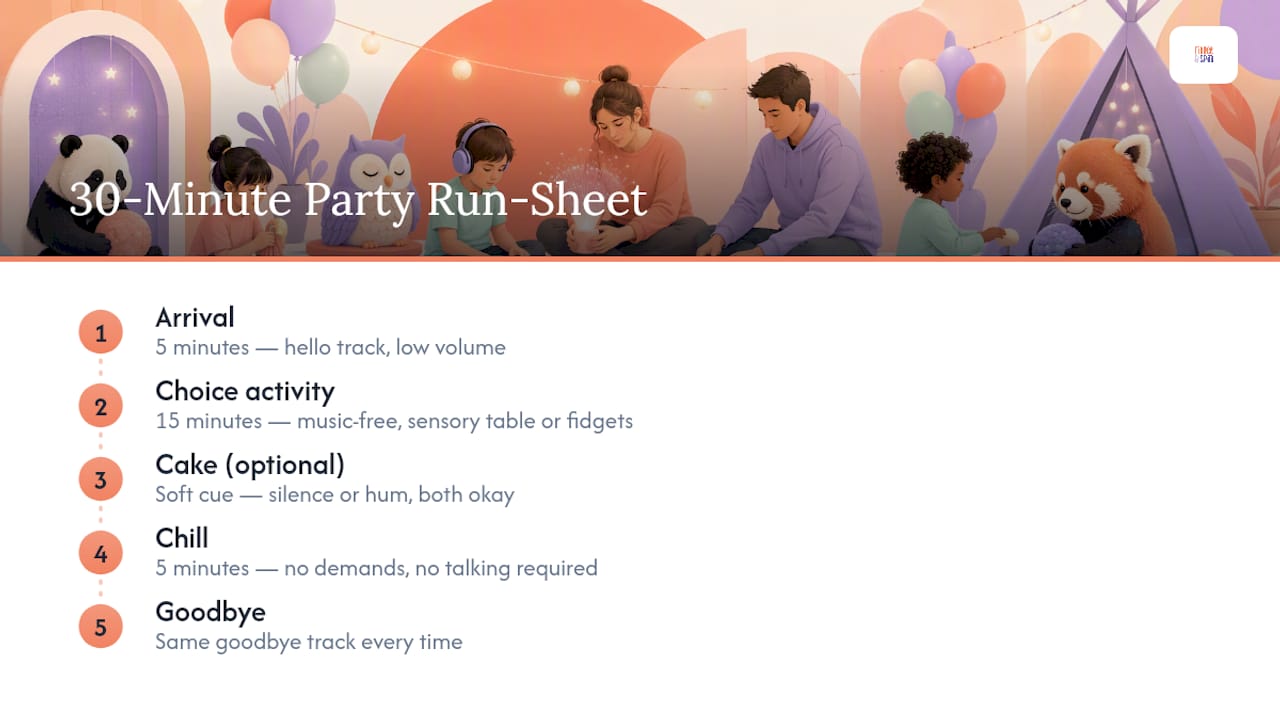
For younger or more sound-sensitive children, I’d shrink every phase by a third and add headphones on standby. For older ones who like structure, I’d let them help choose the cake cue themselves.
Stopping at the fifteen-minute mark isn’t failure. It’s the party doing its job.
Ready-made SEN-friendly parties, if you’d rather not build it alone
Building your own low-stimulation playlist is entirely doable, and plenty of parents do it brilliantly. But if you’d rather hand the whole thing over, our SEN-friendly birthday parties across Brighton, Hove and Sussex already run on exactly the principles above: predictable cues, sensory zones, and no pressure to stay a minute longer than your child wants to. You can also see how our regular sensory play sessions work if you fancy trying the sensory zones before booking a party outright.
Sources
- The effect of music interventions in autism spectrum disorder: a systematic review and meta-analysis — Frontiers in Integrative Neuroscience
- How to adapt music making for autism resource bases — Music Mark
- Music-making with young people on the autistic spectrum — Sound Connections (practical guide)
- Sensory-friendly music for kids: a parent’s framework — Music I Want
If catering is part of your planning too, The Sensory Chef’s guide to inclusive celebration menus is worth a read, since smell and food noise interact with sound in ways that catch a lot of parents out.
FAQ
What are the best quiet birthday songs for autistic children?
Sparse, slow tracks from artists like Raffi, Elizabeth Mitchell and Pete Seeger work well, alongside simple baroque pieces such as gentle Bach or Pachelbel, because they offer steady tempo and minimal percussion.
How loud should birthday music be for a sensory-friendly party?
Test the volume at your child’s usual seating position beforehand, not from across the room, and keep it at the level that lets conversation happen comfortably over it.
Can I still play a goodbye song if my child wants to leave early?
Yes. Use the same goodbye cue every time regardless of when you leave; the consistency of the cue matters more than the timing of the exit.
What should I do if a song suddenly upsets my child?
Stop it straight away and avoid reintroducing that track for several months, since forcing a repeat listen tends to strengthen the negative association rather than resolve it.
Do quiet birthday songs need to be instrumental only?
No. A natural, unshouted singing voice over sparse instrumentation works well; the goal is predictability and minimal layering, not silence or an absence of vocals.