If a rainy day hits and you need a plan fast, here is mine: pick one low-stim venue or set up a single contained activity at home, and decide your exit point before you leave the house. For a managed, sensory-first outing, Fidget and Spin sessions are built exactly for this. For a self-led trip, the Brighton Toy and Model Museum or Sea Life Brighton (during a quiet session) are the two venues I come back to most. Both are short-visit-friendly, and both have quieter corners when you need them.
- Book or call ahead: Check quiet-session times before you go. Sea Life Brighton runs dedicated SEND sessions with reduced capacity and adjusted lighting. Brighton Toy and Model Museum offers monthly SEN arts-and-crafts sessions. Fidget and Spin sessions can be booked online.
- What to bring: Headphones or ear defenders, a snack your child will actually eat, a visual timer, and one comfort object. Spare clothes if water or messy play is involved.
- Exit plan first: Agree a signal before you arrive. Two taps on the shoulder, a picture card, a simple word. When that signal comes, you leave. No negotiation, no “just five more minutes.” The exit plan is the whole plan.
Why does any of this matter? Sensory regulation is not a nice-to-have. When a child’s nervous system is already working hard to process a new environment, every extra stimulus (a sudden noise, a bright light, an unexpected crowd) costs them something. A low-stim venue or a contained at-home activity keeps that cost manageable.
Pro Tip: If you are unsure whether a venue will work, call and ask two questions: “Do you have a quiet area we can use if my child needs a break?” and “What is your busiest time on a weekday?” The answers tell you almost everything.
Key takeaways
Rainy day sensory play in Brighton works best when you pick one low-stim venue or one contained at-home activity, plan your exit before you leave, and call ahead to confirm SEN session availability.
| Point | Details |
|---|---|
| Pick by sensory profile | Seekers need movement (obstacle course, Wiggle & Bounce); avoiders need low-stim (calm corner, Snuggle & Chill, quiet sessions). |
| Call ahead every time | SEN and quiet sessions fill quickly; a phone call confirms capacity and any adjustments available. |
| One tray, one mat at home | Containment reduces parental stress and makes sensory play manageable without a full clean-up operation. |
| Exit plan before you arrive | Agree a signal with your child before entering any venue; leaving early is the plan working, not failing. |
| Fidget and Spin sessions | Weekly SEN-first sessions in Brighton for ages 1–6, with three sensory zones, small groups, and Pay-It-Forward concessions. |
Table of Contents
- Which Brighton venues work best for sensory families on a wet day?
- How to decide before you leave the house
- At-home sensory activities that actually work on a rainy day
- Planning a short sensory visit: timings, costs, and what to pack
- What to do if your child becomes overwhelmed while you are out
- Where to find live SEN session listings in Brighton
- The honest truth about rainy-day outings with a sensory-processing child
- When a Fidget and Spin session is the right call
- Sources
- FAQ
Which Brighton venues work best for sensory families on a wet day?
Choosing a venue when you have a sensory-processing child is not the same as choosing a venue for a rainy afternoon in general. The question is not “what is open?” It is “what will my child’s nervous system cope with today?” I have left enough places early to know the difference.
Here is a quick guide to the main venue types in Brighton, what they offer, and who they tend to suit.
Fidget and Spin (sensory stay-and-play sessions)
Built specifically for neurodiverse children aged 1–6, Fidget and Spin runs weekly sessions across three sensory zones: Wiggle & Bounce for big movement, Snuggle & Chill for low-stim cosy time, and Squish & Squeeze for tactile play and fidgets. Small groups, SEND-aware facilitators, and a space designed so children can move between zones at their own pace. No expectation of sitting still. No side-eye. This is the option I recommend for a first rainy-day outing if your child has not been to a public venue before, or if the last trip ended badly. How our sessions work is worth a read before you book.

Best for: Sensory seekers and avoiders alike, aged 1–6. SEN sessions: Every session is SEN-first. Cost: Check the booking page for current session prices; Pay-It-Forward concessions are available.
Sea Life Brighton (quiet/SEND sessions)
The aquarium runs pre-opening quiet hours and dedicated SEND sessions with reduced visitor numbers, adjusted lighting, and staff briefed on sensory needs. Outside those sessions, it can be loud and crowded, particularly near the touch pools and the tunnel. During a quiet session, though, it is genuinely calm. The low lighting in the main tanks is naturally soothing for many children. Best for: Sensory avoiders during quiet sessions; seekers who find moving water regulating. Trigger to watch: The tunnel can feel enclosed and echo-heavy. Visit length: 45–90 minutes is usually enough.
Brighton Toy and Model Museum
This is one of my favourite low-risk options. It is small, structured, and genuinely quiet on most weekday mornings. The SENlens assessment rates it highly for autism and SEN suitability, and it runs monthly SEND arts-and-crafts sessions. The displays are visually rich but contained behind glass, which means there is a lot to look at without the unpredictability of open play. Short visits work well here. Best for: Children who like order, pattern, and visual detail. Trigger to watch: Narrow corridors during busy periods. Visit length: 30–60 minutes.
Royal Pavilion and Brighton Museum & Art Gallery
These two share a site and are worth considering together. The Pavilion’s interior is visually intense (gold, pattern, colour everywhere), which some children find thrilling and others find overwhelming. The Museum next door is calmer, with more open space and quieter galleries. Both are free to enter for Brighton & Hove residents, which makes a short trial visit low-stakes. Best for: Children who seek visual stimulation (Pavilion) or need open, quieter space (Museum). Trigger to watch: Pavilion audio guides and tour groups can make it noisy unexpectedly.
Brighton Toy and Model Museum (SEN sessions)
Already covered above, but worth noting separately: the monthly SEN arts-and-crafts sessions are bookable and run at reduced capacity. If you can time a visit to one of those, the experience is noticeably different from a standard open day.
Blue Lagoon Warm Water Centre
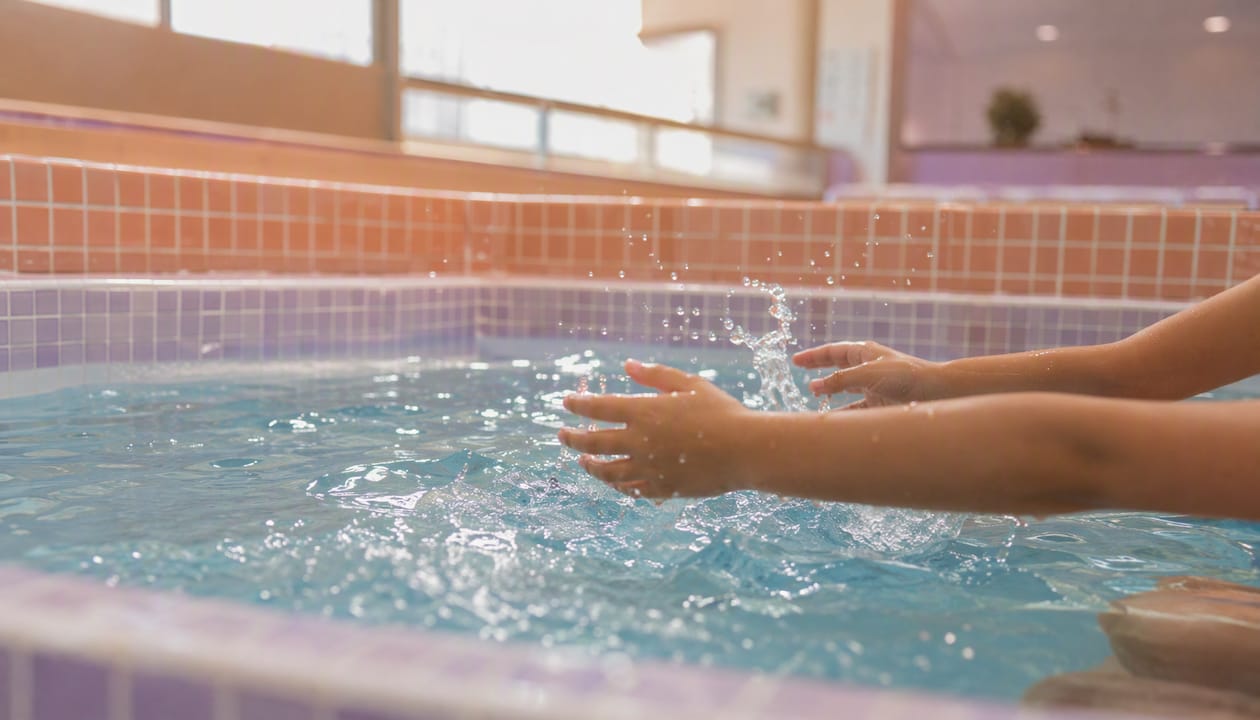
Warm water, a generally low-noise environment, and dedicated SEN swimming sessions make this one of the better options for children who find water regulating. Private hire is available, which gives you full control over group size and timing. The warmth of the water tends to be calming rather than alerting, which makes it a good choice for sensory avoiders who can tolerate water. Best for: Children who find hydrotherapy or warm water calming. Visit length: 30–60 minutes for a SEN session.
St Luke’s Swimming Pool
A more standard public pool, but worth knowing about for inclusive swim sessions that run at reduced capacity. Noisier than Blue Lagoon on a standard session, but the SEN swim slots are quieter. Check the timetable before you go, as times change by term.
Call ahead for all of these. Timetables shift, sessions fill up, and a two-minute phone call saves a wasted trip.
| Venue | Best for | SEN/quiet sessions | Typical cost | Visit length |
|---|---|---|---|---|
| Fidget and Spin | Seekers and avoiders, 1–6 | Every session is SEN-first | See booking page | 60–90 min |
| Sea Life Brighton | Avoiders (quiet sessions) | Yes, pre-opening SEND sessions | Varies; book online | 45–90 min |
| Brighton Toy and Model Museum | Visual detail seekers | Monthly SEN arts and crafts | Low/free entry | 30–60 min |
| Royal Pavilion | Visual stimulation seekers | Not listed; check ahead | Free for BH residents | 30–60 min |
| Brighton Museum & Art Gallery | Avoiders needing open space | Not listed; check ahead | Free for BH residents | 30–60 min |
| Blue Lagoon Warm Water Centre | Water-calmed children | SEN swim + private hire | Varies; book online | 30–60 min |
| St Luke’s Swimming Pool | Families needing a pool option | Inclusive swim sessions | Standard pool entry | 45–60 min |

How to decide before you leave the house
The worst moment is standing in a car park with a child who is already dysregulated, realising the venue is not going to work. I have been there. This checklist takes about three minutes and saves that moment.
Before you go, check:
- Does the venue have a quiet area or refuge space you can use without booking?
- What is the expected crowd level at the time you plan to arrive?
- Is there a SEN or quiet session available, and does it need pre-booking?
- Are there sensory adjustments (dimmed lighting, reduced music, lower capacity)?
- Is there accessible parking nearby, and does the venue have changing places or hoists if you need them?
- Is there a clear exit route that does not involve walking back through the busiest area?
Three questions to ask when you call:
- “Do you run quiet or SEN sessions, and are there spaces this week?”
- “Is there somewhere low-stimulus we can go if my child needs a break during the visit?”
- “What is the quietest time to visit on a weekday morning?”
Most venue staff are helpful when you ask directly. The ones who are not are telling you something useful about whether the visit will go well.
Pro Tip: Arriving 10–15 minutes before a session opens lets you check the refuge space and read the room before your child is committed to being there. It is the single most reliable risk-reduction habit I have found.
If the answers to the checklist are mostly “no” or “I don’t know,” that is a go-home day. One contained at-home activity is a better afternoon than a venue that was never going to work.
At-home sensory activities that actually work on a rainy day
Some of our best rainy afternoons have happened on the kitchen floor with a tray of rice and a spoon. Not because I planned it. Because I had given up on going out and needed something that would last twenty minutes without me losing my mind.

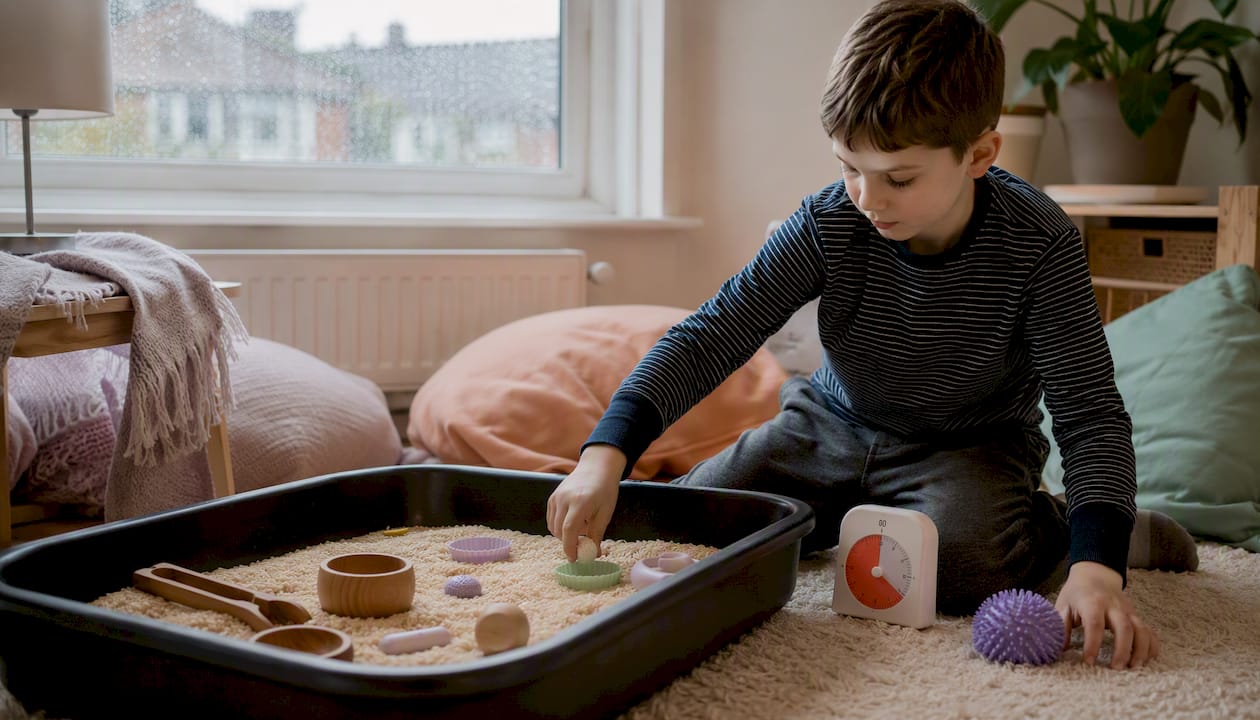
The rule Anthony and I use: one tray, one mat. Everything stays on the tray or the mat. Clean-up is predictable. The activity ends when the tray goes away. That containment is not just about mess. It gives the whole thing a shape, which helps with transitions.
Low-mess sensory activities like sensory bins, sensory bottles, and blanket burritos are consistently recommended for rainy-day regulation, and they genuinely work across a range of sensory profiles.
- Sensory tray (three low-mess variants): Dry rice or lentils with small objects buried inside (seekers love the digging); shaving foam on a tray covered with cling film so hands stay clean (avoiders can press without touching); kinetic sand on a mat. All three stay contained. All three can be stopped in under a minute.
- Indoor obstacle course for heavy work: Sofa cushions to jump between, a rolled blanket to crawl through, a wall to push against with both hands. Movement and proprioceptive input regulate sensory seekers faster than most tactile activities. This is the one I reach for when Remy is climbing the walls.
- Sensory bottles: An empty plastic bottle filled with water, glitter glue, and small beads. Shake it, watch it settle. Calming for avoiders. Takes five minutes to make and lasts for weeks.
- Blanket burrito or cushion nest: Roll your child tightly in a blanket (with their face free and their permission), or pile cushions around them for deep pressure. This is heavy work without movement, and it is one of the fastest regulation tools we have. Calm corners and cosy nests are consistently recommended for children with autism and ADHD on indoor days.
- Calm corner story time: A corner with a bean bag, a weighted blanket if you have one, dim lighting, and one familiar book. No expectation of interaction. Just presence. For avoiders who are already at capacity, this is often the only thing that works.
Safety note: If your child mouths objects, check everything in the tray for size and material before you start. PICA is a real consideration for some children, and no sensory activity is worth a choking risk.
Pro Tip: Set up the tray before your child sees it. The anticipation of “what’s in there?” is half the regulation. Reveal it like it is something good, because it is.
For more ideas on setting up a sensory-friendly space at home, the neurodiverse play areas design guide has practical layout suggestions that work even in small flats.
Planning a short sensory visit: timings, costs, and what to pack
The visits that go well are the ones I planned for. Not over-planned. Just: I knew when we were going, I knew what I was bringing, and I had a number in my head for how long we would stay.
Best times to visit by venue type:
| Venue type | Best time to visit | Expected visit length |
|---|---|---|
| Fidget and Spin sessions | Check weekly timetable; term-time slots often quieter | 60–90 min |
| Sea Life Brighton (SEND session) | Pre-opening quiet session; book in advance | 45–90 min |
| Brighton Toy and Model Museum | Weekday mornings, term-time | 30–60 min |
| Royal Pavilion / Museum | Weekday mornings; avoid school holidays | 30–60 min |
| Blue Lagoon (SEN swim) | SEN session slots; book ahead | 30–60 min |
| St Luke’s Pool (inclusive swim) | Check term-time timetable | 45–60 min |
Packing checklist:
- Ear defenders or noise-cancelling headphones
- A snack your child reliably eats (hunger and dysregulation are a bad combination)
- Spare clothes (always, even if you think you will not need them)
- A visual timer or a timer app on your phone
- One comfort object or fidget tool
- A picture card or simple word for “I need to leave now”
- A small sensory kit: a chew toy, a squeeze ball, a piece of familiar fabric
Budget pointers: Brighton Museum & Art Gallery and the Royal Pavilion are free for Brighton & Hove residents, making them genuinely low-cost options for a short trial visit. Sea Life Brighton and Blue Lagoon charge for entry and sessions; check their websites for current pricing and any concession rates. Fidget and Spin offers Pay-It-Forward concession spots funded by other families at checkout. For a full guide to local SEN activities and costs, the 2026 parent guide has up-to-date information.
Call ahead to confirm SEN or quiet session availability. Online timetables are not always current, and a two-minute call is worth it.
What to do if your child becomes overwhelmed while you are out
We have left a lot of places early. I stopped feeling bad about it somewhere around Remy’s third birthday. Leaving is not failure. Leaving is the plan working.
Immediate steps when overwhelm starts:
- Find the refuge first. Before anything else, move to the quietest space you identified on arrival. A corridor, a toilet, an empty room. Anywhere with less noise and fewer people.
- Give proprioceptive grounding. Firm pressure on the shoulders, a tight hug if your child accepts it, or ask them to push their hands against a wall. Movement and pressure bring the nervous system down faster than words.
- Lower the sensory load. Headphones on. Lights off if possible. Stop talking. Wait.
- Use the visual timer. “Two more minutes, then we go.” Show the timer. Keep the promise.
- Leave if necessary. Use the exit route you planned. Do not go back through the busy area.
Three short scripts for talking to staff or other adults:
These are not apologies. They are information. You do not owe anyone an explanation, but a calm, clear sentence stops most unhelpful interventions before they start.
For safety concerns at a venue, ask a staff member to locate the first aider or duty manager. Every public venue in the UK is required to have one on site. If you are at a Fidget and Spin session, our facilitators are trained for exactly this.
Where to find live SEN session listings in Brighton
Timetables change. Sessions fill up. The best way to avoid a wasted trip is to check the right places before you book.
Local directories and pages to check:
- Brighton & Hove Warm Welcome directory: lists free and low-cost indoor venues and activities across the city, useful for checking what is open during heavy rain or school holidays.
- SENlens venue pages: parent-reviewed SEN assessments for Brighton venues, including Brighton Toy and Model Museum and Blue Lagoon. Look for the SEN score and the “quiet session” or “private hire” tags.
- Individual venue websites: Sea Life Brighton, Blue Lagoon, and St Luke’s all publish session timetables online, though these are not always updated in real time.
- Autism-friendly play groups guide: local listings for community groups and managed sessions, updated for 2026.
- SEND play in Brighton and Hove: a local parent’s guide to SEN session listings and booking tips.
What to look for in a listing:
- Tags like “SEN,” “autism-friendly,” “inclusive swim,” or “quiet hour” indicate a session with some level of sensory adjustment.
- “Reduced capacity” means fewer visitors, which is usually the most important variable.
- “Private hire” means you can book the whole space, which gives full control over group size, timing, and environment.
Booking advice: Phone is almost always better than online for SEN sessions. You can ask about specific adjustments, confirm capacity, and get a name to follow up with. Online booking tells you a slot is available; a phone call tells you whether it will actually work for your child.
The honest truth about rainy-day outings with a sensory-processing child
I remember standing outside a soft play in Hove, Remy already melting down before we had even paid, thinking: why did I think this would be different? The noise hit us at the door. I could see it on his face. We turned around and went home.
That was the moment I stopped trying to make mainstream venues work and started asking a different question: what does he actually need from an outing? Not what do other children enjoy. What does this child, with this nervous system, need today?
The habit that changed things for us was the pre-visit scout. We arrive early, I walk in first if I can, I find the quietest corner and the nearest exit, and I set a visual timer before we start. Two minutes to check the room. That is all it takes to go from reactive to prepared.
Anthony and I built Fidget and Spin because we were tired of doing that mental gymnastics at every venue. We wanted a space where the environment was already sorted. Where the lighting, the group size, the noise level, and the transition plan were handled before we walked in. Where Remy could just play.
That is what a managed sensory session gives you. Not a perfect outing. But a predictable one. And on a rainy Tuesday in Brighton, predictable is everything.
When a Fidget and Spin session is the right call
Some rainy days, you want a venue you have already vetted. One where the environment is set up for your child before you arrive, the group is small, and someone else is holding the sensory plan.
Fidget and Spin weekly sessions run in Brighton for neurodiverse children aged 1–6. Three sensory zones, small groups, and SEND-aware facilitators who know what a meltdown looks like and do not make it worse. The Wiggle & Bounce zone handles the big movement needs. Snuggle & Chill is there when your child needs to come down. Squish & Squeeze covers tactile and fidget play. Children move between zones at their own pace. There is no script for how the session should go.
Pay-It-Forward concession spots are available at checkout, funded by other families in the community. If you need extra adjustments, note them when you book or drop us a message beforehand.
For families who want full control, SEN birthday party packages include private venue hire across Brighton, Hove, and wider Sussex, with packages from £220. Private hire means your group, your timing, your rules.
Book a sensory play session and check current availability. If you want to understand the session structure first, how our sessions work explains the zones, the format, and what to expect on your first visit.
Sources
These are the pages worth bookmarking before your next rainy day.
- Quiet at the aquarium (SEND sessions) - IGO East Sussex
- How to Make Rainy Day Breaks Sensory Inclusive
- Indoor Sensory Play Ideas for Rainy Autumn Days - Sensory Smart
- 10 Rainy Day Activities for Kids with Autism & ADHD | Sensory Play Ideas – Playinc
- Brighton Toy and Model Museum, Brighton and Hove | Autism Friendly Days Out | SENlens
FAQ
What can we do in Brighton with kids when it is raining?
Head to the Brighton Toy and Model Museum for a short, structured visit, or book a Sea Life Brighton SEND session for a quieter aquarium experience. For a fully managed sensory outing, Fidget and Spin weekly sessions are designed for neurodiverse children aged 1–6 and run whatever the weather.
Where can I find SEN or quiet sessions in Brighton?
Check SENlens venue pages for Brighton Toy and Model Museum and Blue Lagoon Warm Water Centre, and the IGO East Sussex page for Sea Life Brighton’s SEND sessions. Call venues directly to confirm current timetables, as online listings are not always up to date.
What is a good rainy-day activity for a child with autism or ADHD at home?
A sensory tray (dry rice, kinetic sand, or shaving foam under cling film) kept on a single mat is one of the most reliable low-mess options. For seekers, an indoor obstacle course using sofa cushions and wall pushes provides the proprioceptive input that regulates faster than most tactile activities.
What should I bring to a sensory-friendly venue visit?
Pack ear defenders, a reliable snack, spare clothes, a visual timer, and one comfort object or fidget tool. A picture card or simple agreed word for “I need to leave now” is the most important item, because having an exit signal in place before you arrive is what makes leaving feel manageable rather than chaotic.
What do I do if my child becomes overwhelmed at a venue?
Move immediately to the quietest space you identified on arrival, apply firm pressure (a hug or hands against a wall), put headphones on, and stop talking. Use a visual timer to signal the transition, then leave via the exit route you planned. Leaving early is not a failed outing; it is the plan working exactly as it should.
Recommended
- Sensory play Brighton: best sessions for neurodiverse kids | Fidget and Spin Brighton
- Stay and play Brighton: the neurodiverse family guide | Fidget and Spin Brighton
- Play groups for non-verbal children in Brighton | Fidget and Spin Brighton
- SEND play in Brighton and Hove: a parent’s local guide | Fidget and Spin Brighton