
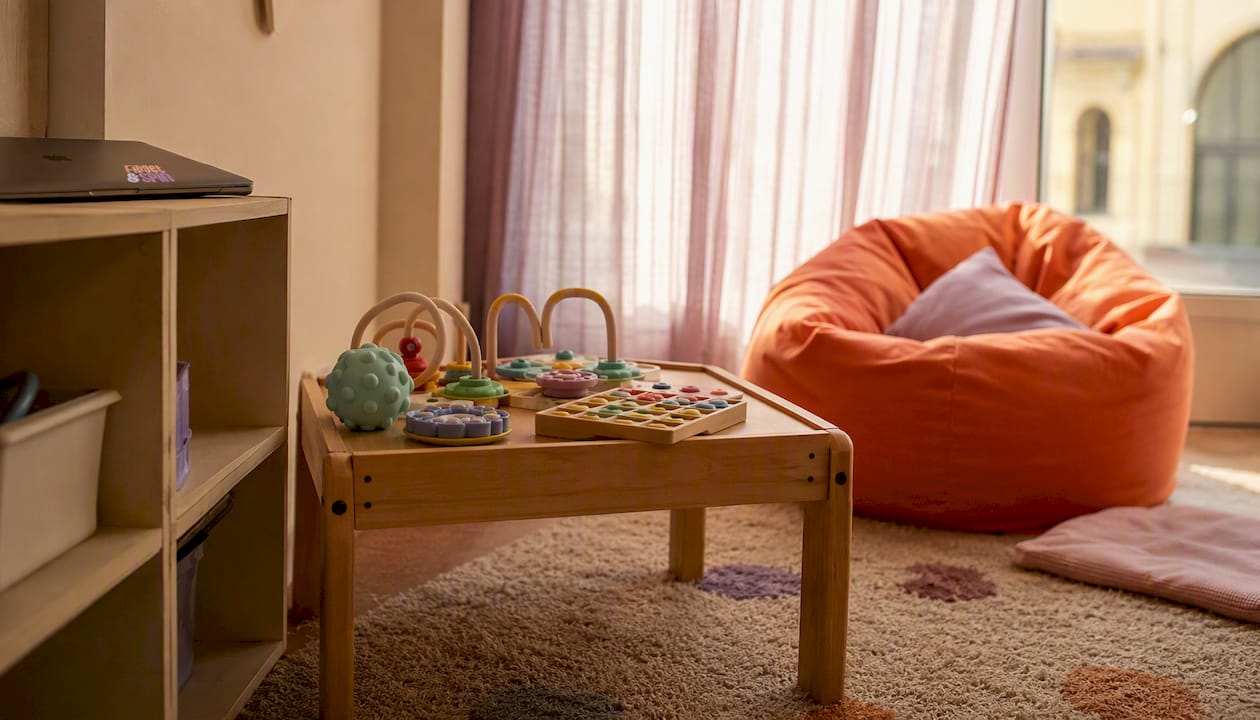
An OT assistant implements a registered occupational therapist’s plan, helping neurodiverse children manage routines, play and sensory regulation in day-to-day life. They are not registered with the Health & Care Professions Council (HCPC), which means they do not carry out formal assessments or set professional therapy goals. That distinction matters practically, and I’ll explain exactly what it means for your family below. The NHS Health Careers guidance describes this as providing practical day-to-day help so children can manage play, routines and everyday activities under a registered OT’s direction.
Table of Contents
- What does an OT assistant actually do in sensory sessions?
- How does an OT assistant differ from a registered OT?
- What should you expect during and after a session?
- How do you find and vet an OT assistant in the UK?
- What do sessions cost, and how can you fund them?
- When should you ask for a registered OT reassessment?
- How we use OT-assistant-style support at Fidget and Spin
- Key takeaways
- What I actually think about all this
- Sensory sessions and SEN parties in Brighton and Sussex
- FAQ
What does an OT assistant actually do in sensory sessions?
Picture a child arriving at a sensory session, coat still on, hovering at the door. The OT assistant is the person who crouches down, names what they see (“you’re checking it out, that’s sensible”), and waits. That’s the job in miniature.
More concretely, the occupational therapy assistant duties you’ll see in a sensory play or SEN-friendly party setting include:
- Setting up and checking sensory equipment before children arrive
- Modelling regulation strategies (deep pressure, proprioceptive input, breathing) for carers to watch and copy
- Supporting transitions between activities with consistent scripts or visual cues
- Observing and recording each child’s responses, including what triggered dysregulation and what helped
- Adjusting pacing, textures or noise levels in the moment based on what they notice
In a typical 20–30 minute stay-and-play slot, you might see an assistant guide a child from arrival through one sensory zone, notice the child starting to tip (jaw clenching, hands flapping faster), offer a proprioceptive swap, and then give the parent a one-sentence handover at the end: “She settled well in the tactile zone but needed a squeeze toy before the transition. Worth trying that at home before bathtime.”
Pro Tip: Watch for small, repeated wins rather than big breakthroughs. A child who previously bolted from a noisy room now pausing at the door for three seconds is meaningful progress. A good assistant will name it.
How does an OT assistant differ from a registered OT?
The clearest way I can put it: a registered OT assesses and decides; an OT assistant implements and observes. The Royal College of Occupational Therapists is explicit that assistants work under the direction of registered OTs and do not hold clinical responsibility for assessments or goal-setting.

Registered OTs must hold an approved degree and be listed on the HCPC register before they can practise. Assistants have no single mandatory qualification. The National Careers Service notes that employers typically value care experience, patience, flexibility and strong communication skills. Many assistants enter via a Level 3 apprenticeship or extended on-the-job training rather than a three-year degree, which gives them genuinely hands-on skills in sensory regulation and practical equipment use.
That’s not a weakness. It often means the assistant has spent more hours in direct activity with children than the registered OT has. The observation-to-therapy feedback loop works because assistants are the consistent face in a child’s care, noticing micro-signs and reporting them so the registered OT can adjust goals sensibly.
What should you expect during and after a session?
Arriving at a session with a child who’s already dysregulated from the car journey is its own kind of sport. A well-run OT-assistant-led session accounts for that.
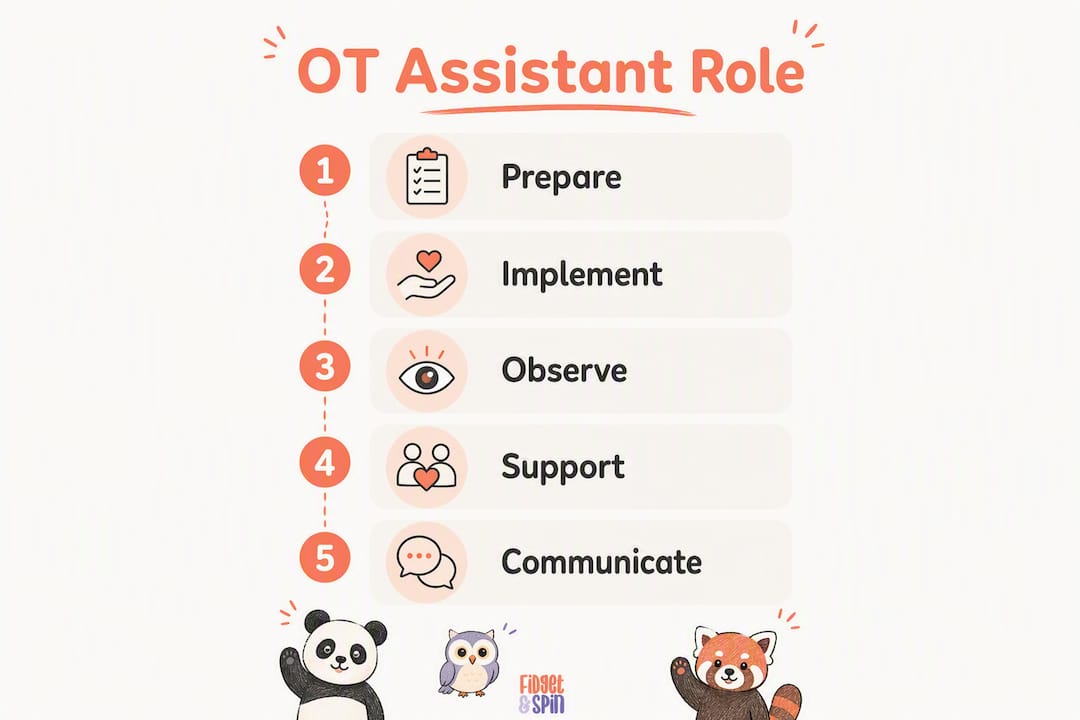
From a parent’s perspective, the flow usually looks like this: you arrive and share a quick handover (what’s happened that morning, any AAC or PECS updates, current sensory flashpoints). The assistant settles your child into the first activity while you stay close or step back, depending on what works. During the session, the assistant observes and adapts. At the end, you get a short verbal or written debrief.
A reasonable feedback note to expect or request after a session might include:
- What was practised: “Worked on proprioceptive input via the crash mat and squeeze tools.”
- How your child responded: “Settled after approximately five minutes; initiated a second turn independently.”
- Any notable observations: “Covered ears during the transition music — worth flagging to the OT.”
- Suggested home follow-up: “Try two minutes of wall push-ups before a tricky transition at home.”
If you use AAC or PECS, tell the assistant at drop-off. A good assistant will use your child’s communication system, not work around it. Ask directly: “Are you familiar with [your child’s AAC system]?” It’s a fair question and a useful signal.
How do you find and vet an OT assistant in the UK?
Common places to find OT assistants include NHS community paediatric teams, private therapy providers, school SEND teams, local authority early years services, and local sensory session providers like Fidget and Spin. Your child’s EHCP coordinator or SENCO is often the fastest route to a referral.
Before you book or agree to sessions, ask these ten questions:
- What experience do you have supporting children with sensory processing differences?
- Are you supervised by a registered occupational therapist, and how often?
- Do you hold a current enhanced DBS certificate?
- How do you record observations, and who sees those notes?
- Are you familiar with AAC or PECS systems?
- How do you support transitions between activities?
- What do you do if a child becomes distressed or dysregulated?
- How do you communicate with parents after each session?
- What safeguarding training have you completed, and when?
- Can you describe a time you noticed a change in a child and escalated it to the supervising OT?
Red flags: no named supervising OT, vague or dismissive answers about safeguarding, no record-keeping, and an inability to describe what they’d do in a dysregulation moment. In the UK, an enhanced DBS check is standard for anyone working with children. Safeguarding training should be current, not a one-off from five years ago.
What do sessions cost, and how can you fund them?
| Session type | Typical format | Typical length |
|---|---|---|
| One-to-one OT assistant support | Individual, community or clinic-based | 20–30 minutes |
| Group sensory stay-and-play | Small group, facilitated | — |
| SEN party facilitation | Private event, structured activities | 2–3 hours |
Exact costs vary considerably by area and provider. For funding routes, the main options are:
- NHS referral: Ask your GP or health visitor for a community paediatric OT referral. Waiting times vary by area.
- EHCP route: If your child has an Education, Health and Care Plan, OT support may be named in Section F. Contact your local authority SEND team.
- Private pay: Sessions with private providers are self-funded; costs differ by provider and location.
- Charity or concession schemes: Some local organisations and session providers offer subsidised places. Fidget and Spin runs a Pay-It-Forward scheme at checkout to support concession spots.
Check your local authority’s SEND Local Offer page for Brighton & Hove-specific pathways and waiting-time guidance.
When should you ask for a registered OT reassessment?
An OT assistant is not the right person to call when something bigger is happening. Ask for a registered OT reassessment if you notice:
- No meaningful progress after the agreed review period
- A new safety concern, such as postural issues, falls, or self-injury
- Significant regression in skills your child had previously consolidated
- A big change in behaviour that the assistant cannot explain or address
- Equipment needs that go beyond what the current plan covers
A simple script that works: “My child has been receiving OT assistant support for [X months]. I’d like to request a formal reassessment with the registered OT to review current goals.” You can say this to a school SENCO, a GP, or directly to the community OT team. The HCPC register lets you verify that any OT you’re referred to is currently registered.
How we use OT-assistant-style support at Fidget and Spin
At one of our weekly stay-and-play sessions, I watched a four-year-old with PDA arrive and immediately head for the exit. Our session facilitator didn’t redirect him. She picked up a piece of kinetic sand, sat near the door, and started playing. Within six minutes he was beside her, hands in the sand, completely absorbed. She noted it afterwards: “He needed to choose to come in. Once he did, tactile input held him for longer than last week.” That observation went straight back to his family and, through them, to his OT.
At a birthday party we ran in Hove, a child who uses AAC arrived overwhelmed by the balloons. The facilitator quietly removed three, dimmed the fairy lights, and handed the child their device so they could request what came next. The party ran beautifully. The parents cried a bit (the good kind). The practical takeaway for home: give your child a way to say “stop” or “next” before the activity starts, not during it.
These moments show how OT and play-based support works in practice. The assistant closes the gap between the written therapy plan and the child’s actual behaviour by noticing what’s happening in real time and adapting immediately.
Key takeaways
An OT assistant implements therapy plans and observes responses; they do not assess, set goals, or hold HCPC registration — that boundary is the single most important thing to understand about the role.
| Point | Details |
|---|---|
| Role boundary | OT assistants implement and observe; only registered OTs assess and set clinical goals. |
| No mandatory qualification | Employers value care experience, patience and communication skills over formal degrees. |
| Observation loop | Assistants are the consistent face in a child’s care, feeding real-time observations back to the registered OT. |
| When to escalate | Ask for a registered OT reassessment if progress stalls, safety concerns arise, or behaviour changes significantly. |
| Fidget and Spin | Runs weekly sensory stay-and-play and SEN-friendly birthday parties across Brighton, Hove and Sussex, with a Pay-It-Forward concession scheme. |
What I actually think about all this
I’ll be honest: before we started Fidget and Spin, I didn’t fully understand the difference between an OT assistant and a registered OT. I just knew Remy needed more than what mainstream sessions offered, and I was grateful for anyone who seemed to get it.
What I’ve learnt since is that the assistant role is often where the real magic happens, not because it’s more important than the registered OT’s work, but because it’s more frequent. The assistant is there every week. They’re the one who notices that Remy does better after five minutes of heavy work, not before. That consistency is what turns a therapy plan from a document into a lived habit.
The thing I’d say to any parent reading this: don’t be afraid to ask questions. Ask about supervision. Ask about DBS. Ask what the assistant will do if your child has a hard session. A good assistant will welcome those questions. If they don’t, that’s your answer.
Try one thing tomorrow: pick one of the vetting questions from the list above and ask it at your next booking. Just one. You’ll learn something useful either way.
Sensory sessions and SEN parties in Brighton and Sussex
If you’re looking for local support that puts sensory regulation at the centre, Fidget and Spin runs weekly sensory stay-and-play sessions for neurodiverse children aged 1–6 across three zones: Wiggle & Bounce for big movement, Snuggle & Chill for low-stim cosy time, and Squish & Squeeze for tactile play. We also run SEN-friendly birthday parties for ages 1–7 across Brighton, Hove and wider Sussex, with flexible setups designed around your child’s sensory and communication needs.
Sessions are designed with the kind of sensory play best practices that make a real difference for autistic, ADHD, PDA and sensory-processing children. We keep groups small, noise levels manageable, and exits always accessible. Concession spots are available through our Pay-It-Forward scheme. Check current availability and book directly at fidgetandspin.com.
FAQ
What is the role of an OT assistant with neurodiverse children?
An OT assistant implements a registered occupational therapist’s plan, carrying out practical activities, modelling regulation strategies, supporting transitions, and observing responses. They do not assess children or set therapy goals.
Do OT assistants need to be HCPC registered?
No. HCPC registration is required for registered occupational therapists, not assistants. The HCPC register is the place to verify a registered OT’s credentials before a formal assessment.
How do I know if my child needs a registered OT rather than an assistant?
If your child shows no progress after an agreed review period, has new safety concerns, or experiences significant regression, ask for a formal reassessment with a registered OT via your GP, SENCO, or community paediatric team.
Can an OT assistant support a child who uses AAC or PECS?
Yes, and they should. Tell the assistant about your child’s communication system at drop-off and ask directly whether they have experience using it. A good assistant will work with your child’s AAC or PECS, not around it.
How long does it take to see progress from OT assistant support?
Progress timelines vary by child and goal. Watch for small, repeated wins rather than large changes. If there is no meaningful shift after the period agreed with the supervising OT, that is the right moment to request a formal review.
Recommended
- OT and play-based support for neurodiverse children | Fidget and Spin Brighton
- Things to do with autistic toddler Brighton: 9 real picks | Fidget and Spin Brighton
- SEN activities in Brighton and Hove: 2026 parent guide | Fidget and Spin Brighton
- SEN community Brighton: your 2026 parent guide | Fidget and Spin Brighton