

TL;DR:
- SEN parenting in the UK involves advocating for neurodiverse children within systems that were not designed for them.
- Access to early support, community networks, and understanding new services like Experts at Hand can significantly improve the experience.
SEN parenting in the UK is defined by the daily work of advocating for a neurodiverse child within systems that were not built with them in mind. I know this because I live it. My son Remy is six, autistic, and has ADHD, and the early years were a particular kind of relentless. The soft play meltdowns. The baby groups where I’d spend the whole session near the exit. The birthday parties I’d dread for a week beforehand. What I wish I’d known sooner is that real, practical support does exist, and knowing where to look makes a genuine difference. This guide covers the most useful resources, services, and strategies available to parents of neurodiverse children right now.
What does SEN parenting UK look like in the early years?
SEN parenting, or SEND parenting as it’s formally known (Special Educational Needs and Disabilities), is the experience of raising a child whose processing, sensory, or developmental differences require additional support. The early years are often the hardest stretch. You’re simultaneously trying to understand your child, fight for assessments, manage your own exhaustion, and find spaces where your family actually feels welcome.
The good news is that the UK support landscape has shifted meaningfully in 2026. New government funding and services are making specialist support more accessible, and organisations like Contact charity and SOS!SEN have been quietly doing extraordinary work for years. The challenge is knowing they exist and knowing how to access them before you hit crisis point.
Schools also carry more responsibility than many parents realise. Schools must act on observed learning barriers without waiting for a formal diagnosis. That means you do not have to have a piece of paper before asking for classroom adjustments. Waiting for a diagnosis delays support that your child is legally entitled to right now.
What is the Experts at Hand service for SEN families?
The UK government is rolling out the Experts at Hand service as part of a £1.6 billion Inclusive Mainstream Fund over three years, alongside a £3.7 billion capital investment for inclusion bases. The aim is to put specialist SEND support directly into schools and early years settings, on demand, without families needing to wait for an Education, Health and Care Plan (EHCP) first.

This is a significant shift from how things have worked. Traditionally, accessing a speech and language therapist, occupational therapist, or specialist SEND adviser through school meant a referral, a wait, and often a requirement to have a formal diagnosis or EHCP in place. Experts at Hand changes that model.
Here is what the service is designed to do:
- Give schools and early years settings direct access to specialists when a child shows signs of needing support
- Remove the requirement for an EHCP before specialist input is triggered
- Support early intervention, which is consistently where the biggest gains happen
- Reduce the pressure on parents to fight for every single step of support
- Sit alongside existing EHCP rights, which remain legally protected
The practical implication for parents is real. If your child is in a nursery or reception class and showing signs of sensory processing differences, PDA, or communication needs, the setting should now be able to bring in specialist support without you having to initiate a formal assessment process first. That does not mean the system is perfect. It means there is a new lever you can ask about.
Pro Tip: Ask your child’s key worker or SENCO directly whether their setting has access to the Experts at Hand service. If they haven’t heard of it, share the GOV.UK announcement. You are allowed to be the person who brings information to the table.
How do you recognise SEN parenting burnout?
SEN parenting burnout is not the same as being tired. It is a specific state that builds when the demands of advocacy, caregiving, and emotional labour consistently outpace any recovery. Burnout manifests as emotional flatness, relentless exhaustion, and difficulties with your own nervous system regulation. Crucially, sleep does not fix it. You can have a full night and wake up feeling just as depleted.
I have been there. There was a period when I would get to the end of a day and feel nothing. Not sad, not angry, just flat. I thought I was failing. What I was actually experiencing was burnout, and recognising it was the first step to doing something about it.
Signs to watch for include:
- Emotional numbness or feeling disconnected from your child
- Physical symptoms like headaches or persistent tension that do not have a clear cause
- Difficulty making decisions, even small ones
- Resentment towards appointments, paperwork, or other parents who seem to have it easier
- Losing the ability to regulate your own emotions under pressure
The strategies that actually help are not the ones that sound good on a wellness poster. They are practical and often require someone else to step in. Sharing the advocacy load with a partner, another parent, or a support worker matters. Accessing peer support through groups like Contact or SOS!SEN reduces the cognitive weight of feeling like you have to know everything alone. And emotional regulation resources designed for SEN children often contain principles that are genuinely useful for the adults around them too.
Pro Tip: If you are supporting a child with regulation difficulties, your own nervous system is under constant pressure. Treating your recovery as a parenting strategy, not a luxury, is not self-indulgent. It is practical.
How do you access local authority support and community resources?
Registering as a carer with your GP is one of the most overlooked steps in SEN parenting. Early registration unlocks support schemes that many parents simply never hear about, including referrals to playschemes, short breaks, and childcare support for disabled children. Wait times for these schemes are often long. Registering early means you are in the queue before you are desperate.
Here is a practical sequence for accessing local support:
- Register as a carer with your GP and ask specifically what this unlocks in your local authority area
- Contact your local Family Information Service (FIS) for a list of funded playschemes and short breaks available to families of disabled children
- Reach out to Contact charity, which has helped over 268,000 parent carers with advice on benefits, education, and navigating services
- Contact SOS!SEN if you are facing a tribunal or dispute with your local authority. They handle 1,400 helpline calls yearly and report a 95% success rate supporting families at tribunals
- Ask your child’s nursery or school SENCO what local authority support they can refer you to directly
The difference between these resources and a Google search is that they are staffed by people who understand the system from the inside. SOS!SEN in particular operates with over 70 volunteers, many of whom are parent carers themselves.
| Route | Best for | What to expect |
|---|---|---|
| GP carer registration | Unlocking local schemes | Opens referral pathways, reduces wait time |
| Contact charity | Benefits, education advice | Free helpline, experienced advisers |
| SOS!SEN helpline | Tribunal and legal disputes | High success rate, volunteer-led |
| Local FIS | Playschemes and childcare | Area-specific, funded options |
| School SENCO | In-school support and referrals | First point of contact for education needs |

Current SEND legal protections remain in place despite ongoing reform discussions. Reforms are not fully implemented until 2029, and existing EHCP rights are legally unchanged. Act on what exists now, not on what might change.
How do you choose the right SEN support group?
The quality of a support group depends almost entirely on who runs it. Groups facilitated by parent carers with lived experience produce stronger engagement and more sustained participation than those led by clinicians alone. That is not a criticism of professionals. It is an acknowledgement that there is something specific about talking to someone who has also sat in a waiting room for two years and cried in a car park afterwards.
When choosing a group or training programme, look for:
- Facilitators who identify as parent carers, not just practitioners
- A mix of emotional peer support and practical information sharing
- Clear boundaries around confidentiality so parents feel safe being honest
- Flexibility between online and in-person options, because access matters
Online groups have expanded significantly and suit parents who cannot reliably leave the house (which, during the early years especially, is most of us). In-person groups offer something different: the physical presence of other people who get it, which is harder to replicate on a screen.
Training courses and workshops are also worth seeking out. Organisations like Contact run parent-focused training on topics including EHCP processes, tribunal preparation, and benefits navigation. These are not dry legal briefings. They are practical sessions designed to give parents confidence in rooms where they are often the least powerful person present.
Pro Tip: Before joining any group, ask whether parents with lived experience are involved in running it. If the answer is no, it does not mean the group is useless. It does mean you should manage your expectations about what kind of support it will offer.
Key takeaways
SEN parenting in the UK is most manageable when parents access early support, register as carers promptly, and connect with peer-led networks rather than waiting for the system to come to them.
| Point | Details |
|---|---|
| Schools act without diagnosis | Request SEN support based on observed barriers, not just formal assessments. |
| Register as a carer early | GP registration unlocks local schemes with long wait times, so act before you need them. |
| Experts at Hand changes access | Specialist support can now reach early years settings without an EHCP in place. |
| Burnout needs active management | Emotional flatness and exhaustion that sleep does not fix are signs to act on, not push through. |
| Peer-led groups outperform clinical-only | Choose support groups where parent carers with lived experience are involved in facilitation. |
What I’ve actually learned from six years of this
I want to be honest about something. When Remy was small and I was deep in the fog of early diagnosis, the advice I found online felt either too clinical or too cheerful. Neither helped. What helped was another parent telling me that she had also left a toddler group in tears and that it was fine to never go back.
The system is genuinely imperfect. The Experts at Hand service is promising, but it is new and unevenly implemented. Contact and SOS!SEN are brilliant, but they are charities propped up by volunteers, not a sign that the state has got this sorted. And the reform timeline stretching to 2029 means that right now, today, you are still navigating a system that was not designed for your child.
What I have found is that the parents who cope best are not the ones who have it easier. They are the ones who found their people sooner. A WhatsApp group, a local SEN play session, a parent who texts back at 11pm because she is also still awake. That community is not a nice extra. It is load-bearing.
Anthony and I built Fidget and Spin because we kept turning up to places that were not built for Remy. We wanted somewhere that was. But I also know that what we needed most in those early years was not just a sensory room. It was other parents who did not need us to explain ourselves. Find those people. Use the resources listed here. And if you are in Brighton, come and find us.
— Caitlin
Sensory play and community for SEN families in Brighton
If you are in Brighton, Hove, or wider Sussex and looking for a space where your child can move, explore, and regulate without anyone giving you a look, Fidget and Spin runs weekly sensory stay-and-play sessions designed specifically for neurodiverse children aged 1–6.
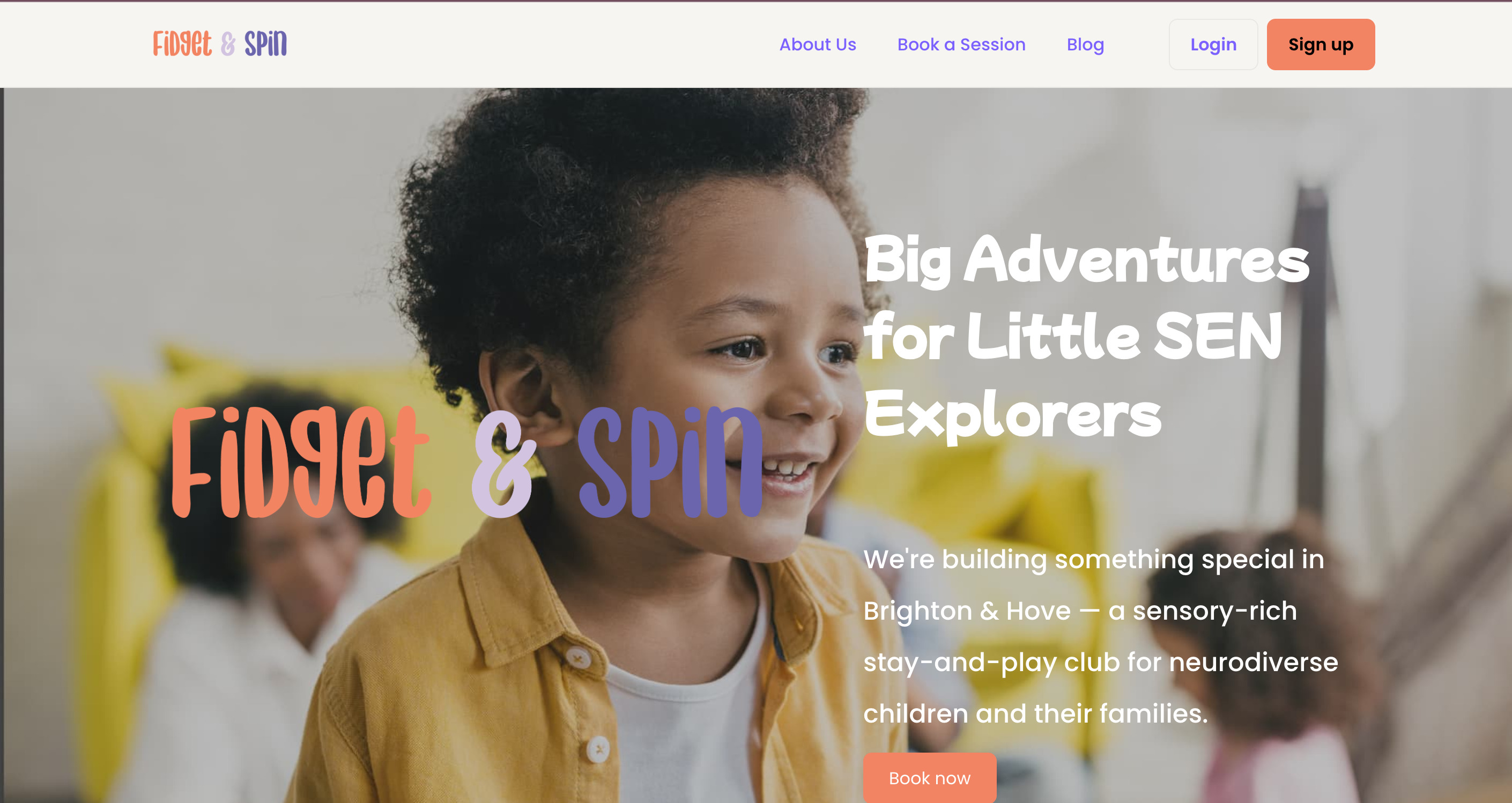
Sessions are split across three zones: big movement, low-stimulation cosy spaces, and tactile play with fidgets and squish toys. There is no pressure to stay in one area, no expectation that your child will sit nicely, and no one who needs you to explain why your child does what they do. Parents get to be in a room with other parents who get it. You can find out more and book a place on the sensory play sessions page. Fidget and Spin also runs SEN-friendly birthday parties for ages 1–7 across Brighton, Hove, and Sussex, if that particular annual dread is on your horizon.
FAQ
Do I need a diagnosis to get SEN support at school?
No. Schools are legally required to act on observed learning barriers without waiting for a formal diagnosis. Requesting support early avoids unnecessary delays in classroom adjustments.
What is the Experts at Hand service?
Experts at Hand is a UK government initiative backed by a £1.6 billion fund that places specialist SEND support directly into schools and early years settings, without requiring an EHCP first.
How do I know if I am experiencing SEN parenting burnout?
SEN parenting burnout includes emotional flatness, persistent exhaustion that sleep does not relieve, and difficulties regulating your own emotions. Recognising it early is the first step to getting the right support.
What does Contact charity do for SEN parents?
Contact provides free advice on benefits, education, and navigating services for families of disabled children. The charity has supported over 268,000 parent carers with practical guidance.
Should I register as a carer with my GP?
Yes. Registering as a carer with your GP unlocks referral pathways to local schemes, playschemes, and short breaks for families of disabled children. Register early because wait times are often long.
Recommended
- Parent support tips for raising neurodiverse children | Fidget and Spin Brighton
- What is SEN? Understanding support for your child in Brighton | Fidget and Spin Brighton
- What is SEN? Understanding support for your child in Brighton | Fidget and Spin Brighton
- Step by step early years inclusion: a parent’s guide | Fidget and Spin Brighton