

TL;DR:
- Sensory play is a child-led activity that stimulates senses to support development and emotional regulation. It benefits neurodiverse children by enhancing cognitive, motor, language, social, and emotional skills through simple, everyday materials. Matching sensory input to a child’s regulation state and following their cues improves engagement and outcomes without requiring specialized equipment.
Sensory play is defined as any open-ended, child-led activity that stimulates one or more senses, including touch, sight, sound, smell, taste, and body awareness, with the goal of supporting learning and regulation rather than producing a finished result. For parents of neurodiverse children aged one to seven, understanding sensory play means understanding one of the most direct routes into your child’s world. Activities like pouring water, pressing fingers into kinetic sand, or exploring translucent shapes on a light table are not just play. They are how young brains build connections, practise regulation, and make sense of a world that can feel overwhelming. If your child is autistic, has ADHD, PDA, or sensory processing differences, sensory play is not a nice extra. It is genuinely useful, and this article explains why.
What are the benefits of sensory play for neurodiverse children?
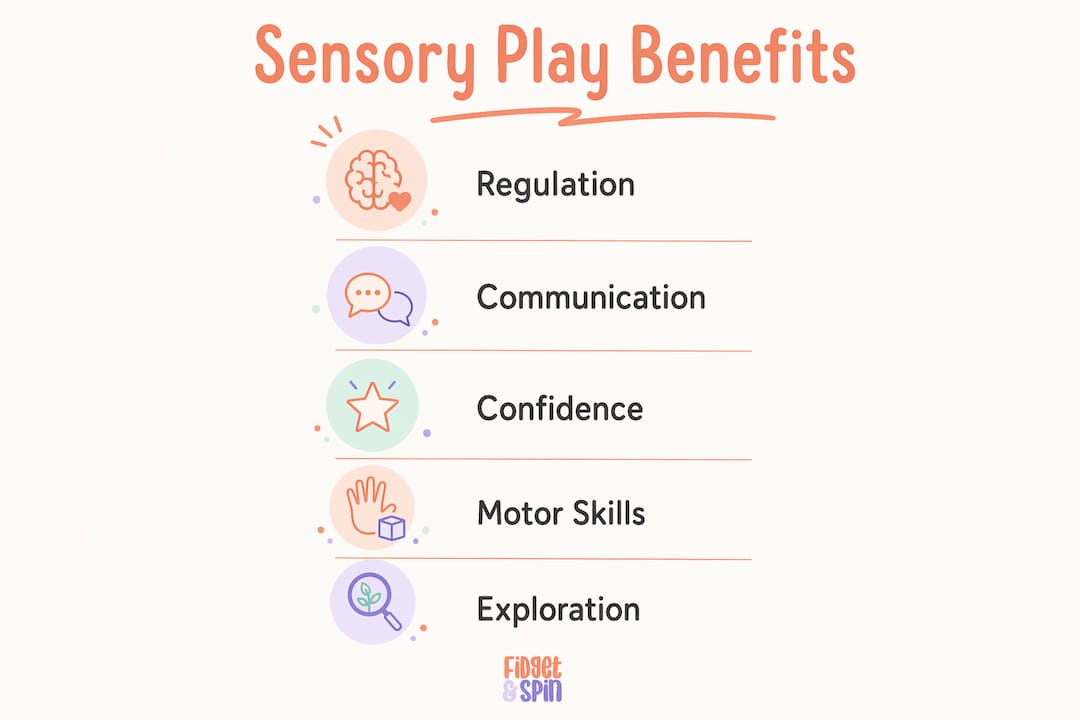
The developmental case for sensory play is not subtle. Sensory play supports cognitive development, motor skills, emotional regulation, social skills, and creativity at the same time. That is a lot of ground covered by a tray of dried pasta.
Here is what is actually happening across each domain:
- Cognitive growth. When a child pours water between containers, they are experimenting with volume, weight, and cause and effect. Problem-solving and early mathematical thinking happen without a worksheet in sight.
- Motor skills. Squeezing playdough builds hand strength. Scooping sand develops the fine motor control that later supports writing. Crawling through a tunnel or pushing a heavy box develops gross motor coordination and body awareness.
- Emotional regulation. Repetitive, predictable sensory input, like running fingers through rice or squeezing a stress ball, activates the body’s calming response. For children who cycle through dysregulation quickly, this is not trivial.
- Language development. Sensory play creates natural opportunities for narration. Describing what something feels like, smells like, or does gives children words for their experiences.
- Social skills. Shared sensory play, even parallel play beside another child, builds the foundations of turn-taking, communication, and cooperation.
- Creativity. Because there is no right answer, children follow their own curiosity. Open-ended, joyful, iterative play is where learning is strongest in young children.
Research backs this up. A 12-week creative play intervention with sensory elements showed significant reductions in ASD symptom severity compared to a control group, with particular improvements in sensory and cognitive awareness. That is a randomised controlled trial, not an anecdote.
“The most effective sensory play is not the most elaborate. It is the play that meets your child where they are, right now, in this moment.”
Pro Tip: Watch your child before you set anything up. Are they seeking input today, crashing into furniture, chewing everything? Or are they withdrawing, covering their ears, avoiding touch? Tune the activity to their current state, not your plan for the afternoon.
How to create sensory play at home for toddlers
You do not need a Pinterest board or a specialist kit. You need a washing-up bowl and permission to make a mess.
Intentional sensory play can begin around four to six months, with more structured activities becoming effective from nine months with supervision. The principle is the same at every age: follow the child’s lead, keep it short, and repeat often.
- Start with what you already have. A bowl of warm water and a few cups. Dry lentils in a tray. A piece of velvet fabric next to a rough sponge. Texture baskets with objects from around the house. Nature finds from the garden. None of this costs money.
- Keep sessions short and frequent. Sessions of five to ten minutes work well for babies. Ten to twenty minutes suits most toddlers. Long, infrequent sessions are less effective than short, repeatable ones. Stop before your child hits the wall.
- Add proprioceptive and heavy work activities. Pushing a laundry basket, carrying a bag of books, or pressing palms flat against a wall all provide organising sensory input that helps regulate the nervous system before transitions or seated activities. This is not a therapy technique reserved for clinics. It is something you can weave into the school run.
- Narrate what you see. When Remy was small, I used to commentate like a very tired sports presenter. “You’re squishing the playdough. It’s going flat. Now it’s a pancake.” Repeating and narrating a child’s actions builds shared attention and language, turning solitary exploration into communication.
- Prioritise safety without killing the fun. Supervise sensory play with water and food items, test temperatures before use with babies, and check for choking hazards with anything small. Common sense, applied calmly.
Pro Tip: You do not need to teach anything. Sit nearby, follow their lead, and narrate. Joint attention, where you and your child focus on the same thing together, is one of the most powerful language-building tools available, and it costs nothing.
Some children need more input to feel regulated. Others need less. A child who seeks sensation might love a deep-pressure weighted blanket, messy finger painting, or jumping on a trampoline. A child who avoids sensation might prefer a quiet texture basket, gentle water play, or fidget tools with predictable resistance. Neither profile is wrong. Both need play that fits them.

Why does sensory play matter differently for neurodiverse children?
Most children regulate their sensory systems without much conscious effort. For autistic children, children with ADHD, and those with sensory processing differences, that process is harder and less automatic.
Children with autism frequently experience sensory processing differences that are directly linked to emotional dysregulation. Sensory overload or underload can trigger emotional outbursts, and those outbursts then increase sensory sensitivity, creating a cycle that is genuinely exhausting for child and carer alike. Sensory play, when matched to a child’s current regulation state, can interrupt that cycle.
| Sensory profile | What it looks like | Useful sensory play approaches |
|---|---|---|
| Sensory seeker | Crashing, chewing, touching everything, seeking loud sounds | Heavy work, deep pressure, messy play, movement-based activities |
| Sensory avoider | Withdrawing from touch, covering ears, distressed by textures | Gentle water play, predictable textures, quiet low-stimulus environments |
| Mixed profile | Seeking in some areas, avoiding in others | Flexible setups with opt-in zones, child-led pacing |
The key predictor of effective sensory play for neurodiverse children is not the materials. It is timing and caregiver responsiveness. A beautifully set-up sensory tray offered to a dysregulated child is likely to end on the floor. The same tray offered after ten minutes of heavy work, when the child is calm and curious, can hold their attention for twenty minutes.
“Sensory play is most effective when it matches the child’s regulation state, not the adult’s schedule.”
Safe, familiar, predictable environments matter enormously here. Neurodiverse children often need to know what is coming before they can engage with it. Introducing new textures or activities gradually, without pressure, gives them the chance to build tolerance at their own pace. For a deeper look at how sensory activities connect to emotional regulation strategies, it is worth reading alongside this.
What challenges do parents face with sensory play, and how do you handle them?
The honest answer is: quite a few. Here is what comes up most often, and what actually helps.
- Your child refuses the activity. This is not failure. It is information. Try a different sensory channel, reduce the intensity, or just sit with the materials yourself and let curiosity do the work.
- Sessions end in meltdown. You probably went too long or the input was too much. Shorter sessions, clearer endings, and a calming transition activity afterwards (heavy work, a familiar routine) make a real difference.
- The mess feels unmanageable. A shower curtain under the tray, a designated play space, and lowered expectations about the carpet all help. The mess is part of the point.
- You feel like you need expensive kits. You do not. Occupational therapists use sensory integration strategies built around everyday materials. Commercial kits are convenient, not necessary.
- Your child only wants to do the same thing repeatedly. That repetition is regulating. Let them. Variety can be introduced slowly, alongside the familiar activity, not instead of it.
Pro Tip: If you are not sure whether a new sensory activity will land well, introduce it during a calm, connected moment rather than as a distraction during dysregulation. The nervous system needs to feel safe before it can explore.
The goal is not a perfect sensory play session. The goal is a child who feels safe enough to engage, and a parent who feels confident enough to try again tomorrow.
Key takeaways
Sensory play supports neurodiverse children most effectively when it is matched to their current regulation state, kept short and frequent, and led by the child’s own curiosity rather than a structured outcome.
| Point | Details |
|---|---|
| Definition and purpose | Sensory play is open-ended, multi-sense activity that supports development and regulation without a fixed outcome. |
| Developmental reach | A single sensory session can support cognitive, motor, emotional, language, and social development simultaneously. |
| Neurodiverse-specific benefit | For autistic and sensory-processing children, matched sensory input can interrupt dysregulation cycles and build regulation capacity. |
| Timing over materials | The most effective sensory play uses everyday materials offered at the right moment, not elaborate kits. |
| Seeker vs avoider | Sensory seekers and avoiders need different intensities and types of input; observing your child’s cues is the starting point. |
What I actually learned from doing this with Remy
I will be honest: the first time I read about sensory play, I thought it sounded like something you did in a specialist clinic with a trained professional and a laminated schedule. I did not think it was something I could do on a Tuesday afternoon with a baking tray and some dried chickpeas.
Remy was about eighteen months when I first noticed that certain textures sent him into a spiral and others seemed to physically settle him. Running his hands through dry rice while I sat next to him and narrated what he was doing, nothing fancy, just “cold, smooth, it’s moving, you’re pouring it,” became one of our most reliable ways back from the edge of a meltdown. It did not always work. Some days the rice went across the kitchen and we both needed a moment. But the days it worked were enough to keep going.
What I have learned, slowly and with a lot of mess, is that the setup matters far less than the presence. Remy does not need a sensory room. He needs me to be paying attention, to follow his lead, and to not panic when he does something unexpected with the materials. That is the whole thing, really. The research confirms it, which is reassuring. But I knew it from watching him first.
If you are feeling overwhelmed by the idea of sensory play, start with one thing your child already gravitates towards. Build from there. You are not behind. You are just getting started.
— Caitlin
Sensory play sessions built for children like yours
At Fidget and Spin, Anthony and I built the sessions we could not find anywhere else in Brighton. Every week, neurodiverse children aged one to six come to play across three zones: Wiggle and Bounce for big movement, Snuggle and Chill for low-stimulus downtime, and Squish and Squeeze for tactile exploration and fidgets. Sessions are informed by occupational therapy principles, designed around sensory regulation, and run by people who genuinely get it because we live it too. There is no pressure, no performance, and no side-eye. If you want to see how it all works, take a look at our sessions and find a time that suits you.
FAQ
What is sensory play?
Sensory play is any open-ended activity that engages one or more senses, including touch, sight, sound, smell, taste, and body awareness, without a fixed outcome. Examples include water pouring, kinetic sand, texture baskets, and light table exploration.
When should I start sensory play with my child?
Intentional sensory play can begin around four to six months, with more structured activities introduced from nine months with supervision. The key is following your child’s cues and keeping sessions short.
How does sensory play help autistic children specifically?
Research shows that creative play with sensory elements significantly reduces ASD symptom severity and improves sensory and cognitive awareness. Matched sensory input also helps interrupt the cycle between sensory overload and emotional dysregulation.
How long should a sensory play session last?
Five to ten minutes suits babies, and ten to twenty minutes works for most toddlers. Short, frequent sessions are more effective than long, infrequent ones. Stop when your child shows signs of fatigue or overload, not when the timer goes off.
Do I need special equipment for sensory play at home?
No. Everyday household items, including dried pulses, water, fabric scraps, and garden finds, are entirely sufficient. The quality of the experience comes from caregiver responsiveness and timing, not the materials used.
Recommended
- How to make play inclusive for neurodiverse kids | Fidget and Spin Brighton
- Effective early years play strategies for neurodiverse children | Fidget and Spin Brighton
- Educational games for neurodiverse kids: boost skills | Fidget and Spin Brighton
- Educational games for neurodiverse kids: boost skills | Fidget and Spin Brighton