
Yes, sensory stay-and-play sessions and birthday parties built for neurodiverse pre-walkers exist, and you don’t have to settle for a soft play centre that wasn’t designed with your child in mind. I’ve sat in enough car parks talking myself into going inside, and I’ve left enough sessions early, to know exactly what to check before you book anything. Before you hand over a deposit, ask for three things:
- A photo walkthrough of the space, including the route to the toilets
- The location of the calm or low-stim zone, and how to reach it quickly
- Confirmation that staff have had a briefing on sensory needs, not just a first aid certificate
Fidget and Spin was built around exactly this checklist, because we couldn’t find a session that met it either.
Key Takeaways
SEN-friendly sensory play for pre-walkers depends on zoned spaces, briefed staff, and pre-visit information reaching you before you ever walk through the door.
| Point | Details |
|---|---|
| Zoning reduces overload | Separate movement, tactile and calm areas with open sightlines rather than closed doors. |
| Pre-visit materials matter most | Photo walkthroughs and floor plans cut arrival anxiety more than any single activity choice. |
| Staff briefings beat certificates | Ask what SEN training staff have had, not just whether they’re DBS checked. |
| Choice-led activities support regulation | Free-choice, rotating stations help toddlers self-direct sensory input rather than follow a set routine. |
| Fidget and Spin offers a working model | Weekly sessions across three zones and SEN-friendly parties in Brighton, Hove and Sussex, with Pay-It-Forward concessions. |
Table of Contents
- What makes a sensory stay-and-play session genuinely SEN-friendly?
- Sensory activities that actually work for pre-walkers
- Getting ready: a pre-visit routine that actually reduces stress
- Booking an SEN-friendly birthday party without the dread
- Why I started Fidget & Spin and how our sessions actually work
- What the checklist gets wrong, and what actually matters most
- A session and party model built around what we needed
- Sources
- FAQ
What makes a sensory stay-and-play session genuinely SEN-friendly?
There’s a particular kind of dread that comes before a baby group. You know the one: scanning the room before you’ve even taken your coat off, working out where the exit is, watching your child’s shoulders creep up towards their ears. Most “sensory” sessions aren’t built with that dread in mind. They’re built for babies who’ll happily sit through a rendition of “Wind the Bobbin Up” surrounded by twenty other babies, a drum kit, and a strobing disco ball someone thought was a good idea.
Genuinely SEN-friendly sessions look different, and you can check for the difference before you book.
- Zoning with soft boundaries. Movement, tactile play, and calm space should be physically separate, not just labelled areas in one open room. Design research on inclusive early years environments recommends clear, predictable paths between zones precisely because unpredictable layouts increase anxiety in autistic and ADHD children. Ask whether the dividers are open sightlines rather than closed doors, so a child who feels trapped can still see an exit.
- Staff briefings, not just DBS checks. Ask directly: “Have your staff had SEN awareness training, and what does that cover?” A vague answer is your answer.
- Environment controls. Dimmable lighting, music that can be turned off (not just down), and a stated capacity limit for each session.
- Pre-visit materials. A photo walkthrough and arrival map, sent before the day, not handed to you at reception.
- Accessible facilities. Step-free access, an accessible toilet, and a clear re-entry policy if you need to step out and come back.
Pro Tip: Ring and ask “what happens if my child needs to leave the group?” before you ask anything about activities. The answer tells you more about a venue’s SEN awareness than their marketing ever will.
Sensory activities that actually work for pre-walkers
A baby who isn’t walking yet still needs movement, and pretending otherwise is how you end up with a toddler grizzling on a mat surrounded by toys they can’t reach. Vestibular input, tactile exploration, and proprioceptive play all matter before a single independent step is taken.
Vestibular input for pre-walkers works best low and slow: a gentle hammock swing, a soft rolling cushion, a shallow ramp to roll or bum-shuffle down. None of it needs height or speed to register with a developing nervous system.
Tactile play should be sealed where mouthing is likely. Sensory trays with dry rice or lentils are fine for a toddler who’s past that stage, but for younger pre-walkers, look for taste-safe dough, textured mats, or sealed sensory bags that squish without opening.

Proprioceptive play gives deep pressure and body feedback: push and pull toys, soft beanbags, gentle weighted lap items scaled down for toddlers rather than borrowed from an adult sensory kit.
The strongest sessions run these as free-choice stations on rotation rather than a single directed activity everyone must do together. That matters more than it sounds. Research on multisensory environments points to controllable, self-directed exploration as the thing that actually supports regulation, not the number or novelty of the toys on offer.
- Check cleaning regimes for shared tactile materials between sessions
- Ask about staff-to-child supervision ratios, especially at stations involving mouthing-risk materials
- Confirm materials are checked regularly for wear, not just replaced when visibly broken
Getting ready: a pre-visit routine that actually reduces stress
The morning of a group session used to involve me negotiating with my own nervous system as much as my son’s. Preparation is the only thing that ever reliably helped.
Before you go, ask the venue for photos of the route from car park to entrance to calm zone, plus the quietest session slot they run. Sensory Trust’s guidance on relaxed sessions is clear that pre-visit documents are one of the most effective single tools for cutting arrival anxiety, and it matches everything we’ve seen at our own sessions.
Pack for the visit, not just the journey there:
- Noise-reducing headphones
- A familiar fidget toy, not a novelty one
- A comfort snack you know they’ll accept
- Labelled AAC or PECS cards if you use them
- A small weighted lap pad, if that’s part of your child’s regulation toolkit
On arrival, agree a timeout cue with a member of staff before the session starts, and walk the route to the calm zone yourself first. Weekday mornings tend to run calmer than weekend afternoons, and always have a plan for an early exit that doesn’t feel like a failure. See our regulation activities guide for more on building this into a routine at home too.
Pro Tip: Screenshot the venue’s floor plan onto your phone before you leave the house. Signal drops, printed maps get left in the car, but a screenshot is always there.
Booking an SEN-friendly birthday party without the dread
Birthday parties are where the anxiety usually peaks, because there’s an audience, a schedule, and a child who’s supposed to be having the best day of their year while also coping with noise, crowds, and unfamiliar food on paper plates.
Ask these questions before you book anything:
- What’s the maximum group size, and is the party held separately from general public sessions?
- Have the staff running the party had the same SEN briefing as regular session staff?
- Is there calm-zone access built into the party time, not bolted on as an afterthought?
- Can we bring our own food or comfort items without it being treated as an inconvenience?
- Is there a reduced-capacity option, and what does it cost compared to the standard package?
A genuinely good package has zoned activities rather than one loud room, clearly assigned staff roles so nobody’s guessing who’s watching the door, and pricing that is stated upfront with no surprise add-ons. Ask too about concession models. Some venues, including ours, run a Pay-It-Forward system where other families’ donations subsidise a place for a family who couldn’t otherwise afford one, alongside straightforward sibling and carer entry policies.
Why I started Fidget & Spin and how our sessions actually work
We left a mainstream baby group after eleven minutes once. Remy was under a table, hands over his ears, and another parent asked if he was “always like this.” I said we had to go. We didn’t come back.
That’s why our sessions are split into three zones. Wiggle & Bounce is for big movement, away from anything fragile or overstimulating. Snuggle & Chill is low-stim, cushioned, and always has a staff member nearby who won’t rush a child out of it. Squish & Squeeze is tactile play and fidgets, sealed and swappable depending on what a child can tolerate that day.
We run weekly sessions for ages 1 to 6, birthday parties from age 1 to 7, staff briefings before every session, and Pay-It-Forward concession spots for families who need them. None of it is theoretical. It’s what we needed and couldn’t find.
If you want the thinking behind our activity choices, our post on OT and play-based support for neurodiverse children goes into more depth.
What the checklist gets wrong, and what actually matters most
Most advice on this topic focuses on activities: which toys, which textures, which swing. That’s the least important decision you’ll make. The activities are almost interchangeable once you’ve got the environment right, because a child who’s dysregulated won’t engage with the world’s best sensory tray anyway.
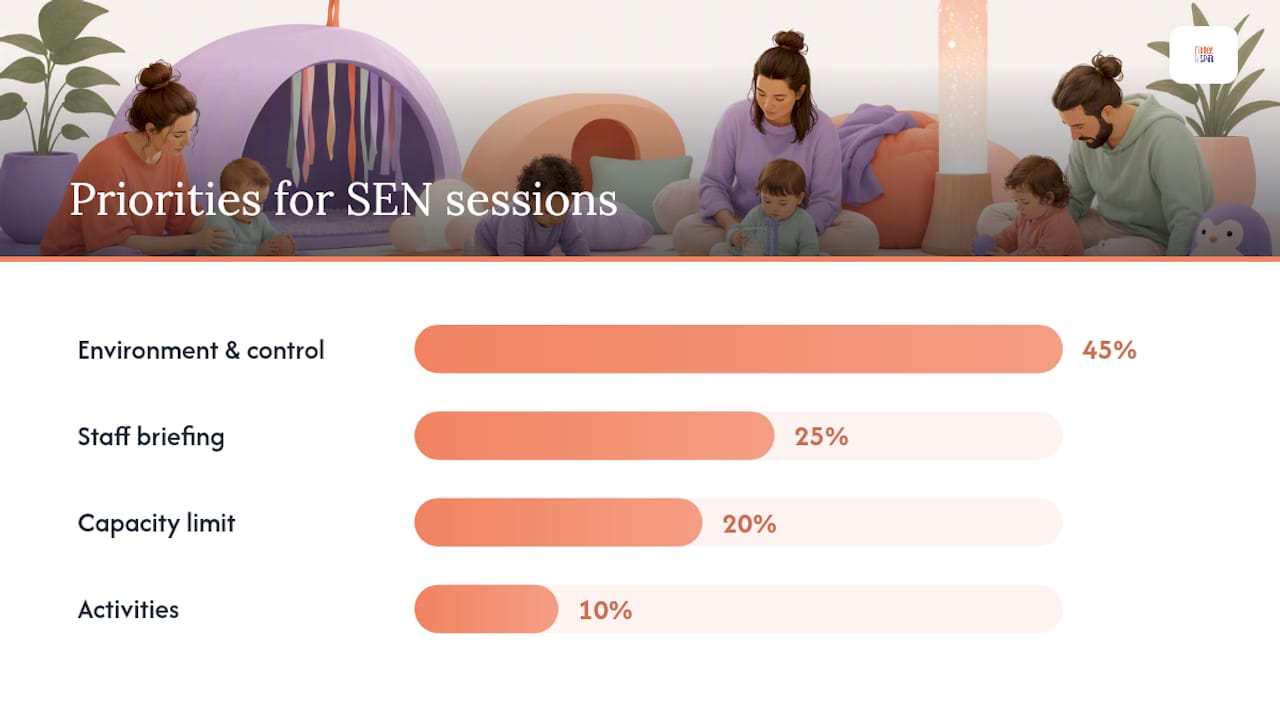
What the research keeps landing on, and what thirteen years of parenting groups has taught me directly, is control. A child needs to be able to turn the volume down themselves, leave a zone without asking permission, and know where the quiet space is before they need it. Venues that lead with a long list of “inclusive” activities but can’t answer a straight question about their calm zone are optimising for the wrong thing.
Prioritise the boring stuff first: the floor plan, the staff briefing, the capacity limit. The fun activities look after themselves once the environment doesn’t work against your child.
A session and party model built around what we needed
There are other routes to a sensory-friendly afternoon: a hired soft play slot on a quiet weekday, a private room booking, a DIY sensory party at home with borrowed equipment. Each takes hours of phone calls and guesswork about whether the venue will actually deliver what it promises.
Fidget and Spin removes that guesswork. Our weekly sessions run across three fixed zones every time, so you’re not relying on a venue’s best intentions on the day. Every party package, from The Wee One to The Whole Shebang, includes the zoning, staff briefing, and pre-visit information already covered here as standard, not as an upgrade.
If you’re planning a birthday and dreading the logistics as much as the day itself, have a look at our party packages and get in touch about dates. We’ll talk you through the calm zone, the staff on shift, and what’s included before you commit to anything.
Sources
FAQ
What age range do sensory sessions for pre-walkers cover?
Fidget and Spin’s weekly sessions run for children aged 1 to 6, covering pre-walkers through to early school age, with activities adjusted across that range.
How do I know if a venue’s staff are properly briefed?
Ask directly what their SEN training covers and how recently it happened. A specific answer about regulation and de-escalation is a good sign; a vague reference to first aid is not.
Are sealed sensory materials necessary for babies who still mouth objects?
Yes. Sealed sensory bags and taste-safe dough let mouthing toddlers explore texture safely without the hygiene risk of open trays.
What’s included in an SEN-friendly birthday party package?
A good package includes zoned activities, clearly assigned staff roles, and transparent pricing. Fidget and Spin’s party packages all include staff briefings and calm-zone access as standard.
Can we leave a session or party early if it gets too much?
Yes, and a genuinely SEN-friendly venue will have a clear re-entry policy so leaving early doesn’t mean missing the rest of the visit.
Recommended
- Creative sensory play ideas for parents and early years | Fidget and Spin Brighton
- How to engage in sensory play with your child | Fidget and Spin Brighton
- Sensory play best practices for neurodiverse children | Fidget and Spin Brighton
- How to adapt play for neurodiverse children: a practical guide | Fidget and Spin Brighton