
A short, small-group party with predictable structure, a quiet recharging space and controlled sensory input gives autistic children the best chance of actually enjoying their birthday. Keep the guest list to a small number of people your child already trusts, keep the party duration short, and guarantee a quiet space they can retreat to without asking permission. Everything else in this guide, formats, checklists, sensory tweaks, food, aftercare, hangs off those three things.
TL;DR:
- Keeping the guest list to four to eight familiar people reduces overload and creates a more manageable, predictable environment for the child.
- The party duration should be limited to avoid overstimulation, with a clear start and end time communicated to both guests and the child.
- The sensory environment must be carefully controlled by choosing warm lighting, low volume music, and avoiding unpredictable noises like balloons or poppers.
- Structured, parallel activities such as sensory bins or craft stations allow children to participate at their own pace without social pressure.
- An explicit, visual exit plan and dedicated quiet space should be prioritized to support emotional regulation and smooth transition at the end of the event.
Table of Contents
- Small group party ideas for autism: choosing the right format
- How to plan a small autism party: a step-by-step checklist
- Sensory-friendly party ideas: lighting, sound and layout
- Autism group activities that work for small parties
- Food and birthday rituals, done differently
- Preparing your child: visual schedules and meet-and-greets
- Managing the come-down: exit plans and aftercare
- How Fidget & Spin puts this into practice
- Communication strategies to support interaction among guests
- Inclusion techniques for mixed social comfort
- Involving caregivers and support workers at the party
- Getting siblings and peers ready beforehand
- Why most party advice still gets this backwards
- Book a sensory-friendly party with Fidget & Spin
- Sources
- FAQ
Small group party ideas for autism: choosing the right format
I’ve thrown parties in a soft play centre where the strip lighting made Remy cover his eyes before we’d even got his coat off. Never again. The venue matters as much as the guest list.
Five formats work consistently well for small, sensory-aware celebrations:
- Home with zones: your own space, full control over lighting and noise, but you’re also hosting, which is tiring.
- Small village hall with dividers: enough room to separate loud play from quiet play, and you can leave the overheads off.
- Sensory play venue: built-in low-stim areas and staff who already understand meltdowns aren’t drama.
- Private cinema hire for a short film: dark, predictable, low social demand, though the sound system needs checking beforehand.
- Garden picnic with stations: fresh air dampens noise, but weather and unpredictable insects are real variables.
Match the format to your child’s sensory profile, not the other guests’ expectations. A child who’s a sound-avoider does better in a hall with a closable door than an open garden where noise carries. A child who needs to move constantly needs somewhere with actual room to run before you even think about cake.
How to plan a small autism party: a step-by-step checklist
Right, the practical bit. This is the order I actually work through when Anthony and I plan Remy’s parties, or when a family books one of our sessions and asks where to start.
- Build the guest list first, not last. Start with four to eight people your child already knows and likes. Smaller guest lists paired with structured, parallel activities consistently reduce overload compared with the “invite the whole class” approach schools quietly push.
- Fix the duration before you fix anything else. A short duration is enough for cake, one or two activities and some free play, without tipping into overstimulation. Set a clear arrival window and a clear end time, and tell guests both.
- Decide who’s actually needed in the room. Keep unfamiliar adults to a minimum. One trusted adult per two or three children is usually enough. Every extra adult is another set of expectations your child has to manage.
- Give guests small jobs. A “helper” who hands out name labels, a “snack server” who passes plates. It gives shy or overwhelmed kids something to do with their hands instead of making small talk they don’t want to make.
Pro Tip: Write the exit time on the invite itself. “Party runs 2 till 3.30” removes the awkward hovering and gives your child a fixed endpoint to hold onto all week.
Sensory-friendly party ideas: lighting, sound and layout
Somebody always turns the big light on. Every single time. And you watch your child’s shoulders go up around their ears.
Lighting is the first thing to fix. Choose warm, steady light, lamps rather than overheads, and avoid anything that flickers or strobes. Curtain off a corner if the room only has one light switch and it’s the wrong one.
Sound is the second. Music should sit at a volume where normal conversation is still easy, and if an adult has to raise their voice over it, it’s already too loud. Keep headphones or ear defenders on hand for anyone who needs them, guest or host.
Decorations matter more than people expect. Keep visual clutter low, and avoid party poppers, balloons and anything with an unpredictable bang. Balloons popping unexpectedly has ended more than one party I’ve been to.
Set up clear zones: an active space, a tactile or craft table, and a chill-out corner. Introduce the chill-out zone as somewhere nice to go, not a punishment. That framing genuinely changes whether kids use it.
- Warm lamps, no overhead strip lighting or strobes
- Music at conversation volume, headphones available
- No balloons, poppers or surprise noises
- Three defined zones with visible boundaries
Autism group activities that work for small parties
Whole-group games ask a lot socially. Parallel activities ask much less, and they still feel like a party.
Set up sensory bins, individual craft packs and a tablet station with headphones, so children can dip in and out without waiting their turn in a circle. Structured, parallel stations let kids choose their level of participation instead of forcing eye contact and turn-taking on the spot. Use a visible timer for anything that does need turns, it removes the guesswork.
For low-social-demand moments, a movie corner or a guided baking and decorating table both work well, and both adapt easily for sensory-seekers who want more input, more mess, more texture. If you’ve got a mixed-age group, our autism friendly party games guide has age-flexible options that don’t need everyone playing the same rules at once.
Food and birthday rituals, done differently
Nobody needs a surprise. Least of all a child who’s already managing a room full of people.
Serve predictable finger food and label allergens and picky-eater options clearly, so nobody has to ask twice or guess what’s in something. If mocktails are on the table, simple, low-sugar options keep drinks predictable and free of strong smells that can throw a sensitive nose off completely.
- Make the birthday song optional, not compulsory
- Offer a quiet, family-only candle moment instead of a room singing at your child
- Skip the surprise party bag; choose transparent bags or sensory-friendly favours guests can see before they’re handed over
- Have cake-to-go ready if blowing out candles in front of a crowd is too much on the day
Our picky eater party food guide covers labelling and menu planning in more depth if food is the bit you’re dreading most.
Preparing your child: visual schedules and meet-and-greets
The dread before a party is real, and it’s usually worse than the party itself. Preparation is the antidote.
- Send a simple visual timetable with the invite, and put a copy up on the wall on the day. Knowing what’s coming reduces anxiety and improves participation, for the birthday child and their guests.
- Offer a meet-and-greet before the crowd arrives. Let your child and their closest adult settle into the space first, five or ten minutes of calm before anyone else walks in.
- Send a two-line heads-up text to other parents. Something like: “We’ll have a quiet room if anyone needs it, and the party finishes bang on 3.30.” That’s it.
- Introduce the quiet room as a cosy station, not a time-out, and have an adult use it too, so it reads as a nice place rather than a punishment.
Managing the come-down: exit plans and aftercare
Nobody warns you about the crash. Remy can be having the best time at a party and still fall apart in the car park ten minutes after we leave, because a full afternoon of input has to go somewhere.
The regulation crash is common after high-input events. It is not a sign the party went badly but rather a sign your child’s nervous system spent the last hour working hard. Plan for it before you leave the house: dim lighting in the car, a familiar snack, a quiet activity waiting at home.

Agree an exit code, a quiet spot and a leave time with your child in advance. Knowing there’s a way out, even if they never use it, makes staying easier.
Pro Tip: Pack ear defenders, a change of clothes and one favourite toy in the car before you leave for the party, not after. You will not want to be rummaging for them mid-meltdown in a car park.
How Fidget & Spin puts this into practice
We had a little girl arrive at one of our parties glued to her mum’s leg, refusing to make eye contact with anyone. We didn’t push. We showed her the quiet corner, let her mum sit with her there for ten minutes, and she wandered out on her own terms when she was ready. Nobody clapped. Nobody made it a moment. That’s the whole point.
Our sessions run across three zones, Wiggle & Bounce for big movement, Snuggle & Chill for low-stim recharging, Squish & Squeeze for tactile play, and our party packages for ages 1 to 7 are built around exactly that structure. Years of weekly sessions have taught us the same lesson over and over: the quiet room only works if adults actually use it too.
Communication strategies to support interaction among guests
Not every child wants to talk, and that’s fine. Parties don’t need to run on conversation.
Give quieter children something visual to point at instead of forcing words: a choice board with two activity pictures works better than “what do you want to do?” for a child who processes language slowly under pressure. If your child uses AAC or PECS, tell other parents beforehand, briefly, so nobody’s confused when a device does the talking instead of a voice.
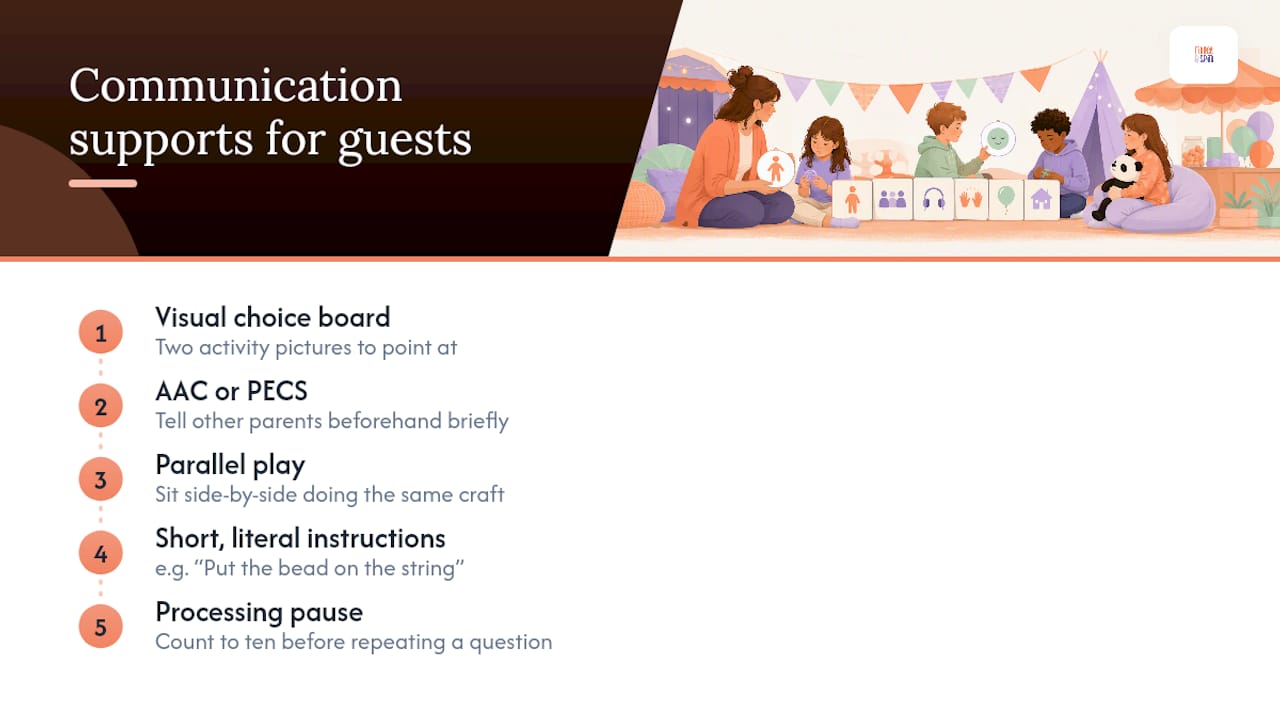
Parallel play removes most of the pressure to interact verbally at all. Two children sat side by side doing the same craft, not looking at each other, still counts as playing together. Model this for guests who default to eye contact and small talk; a quick “Ava likes doing this quietly, you can sit next to her” from an adult saves an awkward standoff.
Keep instructions short and literal. “Put the bead on the string” lands better than “let’s get creative with our jewellery.” Sarcasm, idioms and rhetorical questions (“shall we tidy up now?”) confuse more than they charm at a six-year-old’s party, autistic or not.
Give processing time after any question. Count to ten in your head before repeating yourself; the answer is often already forming, just slower than you’d expect from a room full of chatty five-year-olds.
Inclusion techniques for mixed social comfort
Some guests will want to run the whole party. Others will spend most of it watching from the doorway. Both are fine, and a good party plans for the gap between them rather than pretending it doesn’t exist.
Offer every activity at two intensities. A craft table can have a simple sticker version and a more involved cutting-and-gluing version, side by side, so a child can choose without being singled out for “the easy one.” Nobody needs to know which version anyone picked.
Never force a child into a game they’re avoiding. Avoidance is information, not defiance. If a child won’t join pass-the-parcel, that’s a preference being communicated clearly; respect it rather than coaxing.
Build in an observer role that still counts as participating. Handing out prizes, holding the timer, or being in charge of the music button lets a child stay connected to the group without the sensory or social demand of joining in directly.
Involving caregivers and support workers at the party
A support worker or grandparent who knows your child’s cues is worth more at a party than any amount of planning on paper.
Give any support person a clear, specific role rather than leaving them to hover uncertainly by the wall. “Can you sit near the quiet room in case Remy heads there” is more useful than a vague “just keep an eye on him.” Specific instructions mean they can actually help instead of guessing.
Brief them on your child’s early warning signs before the party starts, not during it. A hand over the ears, going quiet, repetitive movements, whatever your child’s tells are, so support isn’t reactive once things have already tipped.
Let caregivers take breaks too. Supporting a child through a two-hour social event is genuinely tiring work, and a caregiver who’s run dry has nothing left to offer when it matters most.
Getting siblings and peers ready beforehand
Siblings carry a lot at these parties, often quietly. They notice the extra attention, the different rules, the quiet room nobody explains to them.
Talk to siblings ahead of time about what might happen: the quiet room, the shorter guest list, why the party might end sooner than they’d like. A five-minute chat beforehand stops resentment building in the moment.
Give siblings and peer guests a simple, honest explanation rather than euphemism. “Sometimes loud noises are too much for Remy’s ears, so we keep the music quiet” makes more sense to a seven-year-old than vague talk of “differences.” Our guide to planning a birthday for an autistic child has more on framing this for family and friends who are new to it.
Let siblings have their own moment too, even a small one. A joint party can start to feel like someone else’s party from a sibling’s point of view, and a five-minute nod to them, a small treat, a job of their own, goes a long way.
Why most party advice still gets this backwards
Most party advice assumes bigger is better and busier is more fun. That’s backwards for a lot of autistic children, and honestly for a lot of the adults running the party too.
The research and the lived reality point the same way: fewer guests, shorter time, more control over the sensory environment. Not because autistic children can’t cope with excitement, but because excitement without an exit plan tips into overwhelm fast, and there’s no dignity in a meltdown in front of twenty classmates.
The conventional advice usually gets one thing wrong: it treats the quiet room as an optional extra, a nice-to-have if you get round to it. It isn’t. A quiet room only works if it’s introduced positively and modelled by adults, otherwise it sits empty and unused while your child struggles in the main room anyway.
If you take one thing from this guide, prioritise the exit plan and the quiet space before you think about themes or decorations. Cake and bunting are the easy bit. Getting your child home calm, rather than crashed, is the actual measure of whether the party worked.
— Caitlin
Book a sensory-friendly party with Fidget & Spin
Fidget and Spin is the alternative to piecing this together yourself venue by venue, decoration by decoration. We’ve already built the quiet room, the small group format and the sensory zones into every package, so you’re not starting from a blank page the week before your child’s birthday.
Our three party packages, The Wee One, The Big One and The Whole Shebang, all include private space, a proper chill-out zone and a small-group structure for ages 1 to 7 across Brighton, Hove and wider Sussex. Every booking starts with a short conversation about your child, their sensory profile and what’s worked or gone badly before, so the meet-and-greet and quiet room are set up around them specifically, not a generic template. We keep concession spots open through Pay-It-Forward donations at checkout, because cost shouldn’t decide whether a child gets a party that actually suits them. Check dates and see our party packages to get a straightforward quote for your area.
Sources
- Sensory-friendly party planning tips — They Are The Future
- Sensory-Friendly Party Ideas — Child Mind Institute
- Autism-friendly party planning — Neurolaunch
- SEND child birthday parties: a parent guide — Remarkable Minds
FAQ
What are some ideas for an autism-friendly birthday party?
Keep the guest list to four to eight familiar faces, keep the party duration short, and set up a dedicated quiet room alongside structured activity stations like sensory bins and craft packs.
What is the 6 second rule in autism?
This isn’t a recognised clinical term; if you’ve seen it referenced, it’s likely shorthand from a specific source rather than an established framework, so it’s worth checking the original context before relying on it.
What are the signs of autism in a 10 year old girl?
Signs vary widely and are often more subtle in girls than boys, sometimes showing as masking social effort, intense focused interests, or sensory sensitivities rather than obvious social differences; a GP or paediatrician is the right first step for assessment, not a party planning guide.
How do I help my autistic child find friends?
Small, structured settings with shared interests, like our weekly sensory play sessions, tend to work better than large, unstructured social events, because they lower the social demand while still creating chances to connect.
How many guests should an autism-friendly party have?
Four to eight guests is a solid starting point, though the right number depends entirely on your child; smaller groups with parallel activities consistently reduce overload compared with bigger, louder gatherings.