
TL;DR:
- Social skills checklists provide valuable insights into a child’s functional communication, emotional regulation, and participation.
- Using these tools alongside targeted, play-based practice and input from multiple perspectives fosters genuine social development.
When your child’s social development doesn’t follow the expected script, knowing where to start can feel genuinely overwhelming. A social skills checklist, what professionals often call a social competence assessment tool, won’t give you all the answers. But it does give you a map. It shows you where your child already shines, where they need more scaffolding, and which specific skills to practise rather than a vague sense that something isn’t quite clicking. This guide breaks down how to choose the right checklist, what the leading tools actually offer, and how to use them in ways that fit real children rather than textbook ones.
Key takeaways
| Point | Details |
|---|---|
| Prioritise neurodiversity-affirming tools | Choose checklists that focus on functional communication, not rigid norms like eye contact. |
| Match the tool to the context | Short emoji-based scales suit busy teachers; longer domain-based tools suit specialists and detailed planning. |
| Pair checklists with guided practice | Identifying weak domains is only useful if you then build targeted, play-based opportunities to practise them. |
| Gather multiple perspectives | Input from parents, teachers, and key workers gives a far more accurate picture than one rater alone. |
| Celebrate specific gains | Use checklist data to spot concrete progress, not just gaps, and share those wins with your child’s wider team. |
1. What makes a good social skills checklist for neurodiverse kids
Most checklists were designed with a neurotypical child in mind. You can spot them a mile off. They ask whether a child makes eye contact, whether they play “appropriately,” whether they initiate conversation the way other children do. For autistic children, ADHD children, and those with PDA or sensory processing differences, these markers are the wrong targets. Checklists should target flexible, functional social domains rather than universal behavioural mandates that exclude the very children they’re meant to support.
So what should you look for instead? Here are the features that actually matter:
- Functional communication focus. Does the checklist assess whether a child can get their needs met, initiate interaction in their own way, and respond to others? That matters more than how they do it.
- Emotional regulation items. Social skills don’t exist in isolation. A child who is dysregulated cannot access their social toolkit, full stop.
- Reciprocity and participation. Look for questions about turn-taking, shared attention, and willingness to engage, across different settings and with different people.
- Simplicity and quick completion. A form that takes forty minutes to fill in will not get filled in consistently. Shorter forms with clear rating scales get completed more reliably.
- Multi-rater design. A good checklist works for parents and teachers alike, reducing the chance that one person’s bad day skews the whole picture.
- Linkage to practice targets. The best tools don’t just identify a gap. They point towards what to do next.
Pro Tip: If a checklist asks your child to perform skills in ways that conflict with their neurotype (say, sustained eye contact or spontaneous verbal greeting), set those items aside. Score what’s relevant. Adapt the rest.
2. The leading social skills assessment tools worth knowing

There is no single perfect tool. What works for a preschool teacher with a class of twenty is different from what works for a parent tracking one child’s progress at home. Here’s an honest overview.
The 9-item emoji-based preschool scale
This is one of the more exciting developments in early childhood assessment. Researchers tested a 9-question emoji scale with 127 children aged 3 to 5, using a simple emoji Likert scale rather than abstract numbers. It achieved a Cronbach’s alpha of 0.89, which means very high reliability. Teachers completed it quickly and consistently, and the inter-rater agreement was strong. For busy early years settings, this kind of tool is genuinely practical rather than aspirational.
The Autism Social Skills Profile-2 (ASSP-2)
The ASSP-2 covers three domains: social reciprocity, social participation and avoidance, and what the tool calls detrimental social behaviours. It was designed specifically for autistic children and avoids the neurotypical assumptions baked into many general social skills measures. It’s a stronger fit for SEND specialists and SENCOs than for everyday parent use, but it gives a detailed picture that can inform an EHCP or a targeted intervention plan.
Informal educator checklists with rating scales
These are the forms you’ll find in many early years settings. Social skills checklists in education typically assess social play, emotional regulation, and group participation using rating scales alongside comment sections. They won’t give you standardised scores, but they’re flexible, quick, and can be adapted to a specific child’s profile. For parents who want something to use at home, a blank template like this is a good starting point.
The Social Interaction Competence Assessment Scale
For older children or more detailed monitoring, a 30-item competence scale takes around six minutes to complete and covers social strengths and challenges across a wider range of situations. It’s more appropriate as a coaching or intervention planning tool than as a quick classroom screener.
The key point here, and this matters, is that standardised tools break social skills into domains, which helps educators and parents stop treating social ability as one undifferentiated thing and start targeting specific skills. Cooperation is not the same as turn-taking. Empathy is not the same as sharing. Each deserves its own focus.
3. Comparing checklist tools at a glance
| Tool | Length | Age range | Key domains | Best for |
|---|---|---|---|---|
| Emoji-based preschool scale | 9 items | 3 to 5 years | Peer interaction, regulation, cooperation | Preschool teachers, quick screening |
| ASSP-2 | Multi-item, standardised | School age | Reciprocity, avoidance, challenge behaviours | SENCOs, autism specialists |
| Informal educator template | Variable | 1 to 7 years | Social play, group skills, emotional regulation | Parents, class teachers, keyworkers |
| Social Interaction Competence Scale | 30 items | Older children | Strengths and challenges across contexts | Intervention planning, specialists |
None of these tools is neurodiversity-affirming by default. You bring that perspective to the process. The tool just structures the observation.
4. How to actually use a social skills checklist well
Here’s the honest truth: a checklist sitting in a drawer teaches nobody anything. Checklists alone don’t teach social skills. What they do is give you a starting point for deliberate, targeted practice. The gap between filling one in and doing something useful with it is where most people get stuck.
These practical steps make the difference:
- Observe in multiple settings. A child who struggles to share at nursery might manage it brilliantly one-to-one at home. Prosocial skills vary significantly by context, so a single observation gives you a partial picture at best.
- Prioritise cooperation and sharing for practice. Research using a 25-item questionnaire with 50 teachers found that cooperation and sharing score lowest in preschool-aged children, suggesting these are the skills most in need of intentional guided practice rather than assumed to develop through free play.
- Use guided play, not instruction. Adults scaffolding during play to teach sharing, turn-taking, and problem-solving is far more effective than sitting a child down to talk about social rules. Play is the medium.
- Don’t misread atypical behaviour. A child using AAC to communicate, avoiding direct interaction due to PDA, or seeking sensory input mid-conversation is not failing socially. They’re regulating. Checklists need to be interpreted through that lens.
- Gather input from everyone. Parents, keyworkers, and class teachers often see genuinely different behaviour from the same child. Collating those perspectives gives a much richer and more honest picture.
- Pair each item with a behaviour cue. When you note that a child “rarely” takes turns, attach that to a specific scenario. “During Duplo play at nursery, with two other children.” That specificity is what turns a checklist result into a usable practice target.
Pro Tip: After completing a checklist, pick two, at most three, skills to focus on for the next half-term. Trying to work on everything at once produces progress on nothing.
5. Resources to use alongside your checklist
A checklist gives you a direction of travel. These tools help you actually get there.
- Social stories. A well-crafted social story introduces a situation, explains what might happen, and models a response. Fidget and Spin has a parent’s guide to social stories that takes the theory and makes it genuinely usable.
- Sensory-friendly play environments. A child who is overloaded cannot access social learning. Getting the sensory environment right is not a luxury. It’s a prerequisite. Our post on early years play strategies covers this in detail.
- Visual supports and PECS. For children using AAC or picture-based communication, visual supports and adaptive tools can make checklist items accessible that might otherwise appear impossible.
- Educational games that target specific domains. If your checklist flags cooperation as a weak area, there are specific games designed to practise that skill naturally. Games that build communication skills are worth exploring.
- Neurodiversity-affirming occupational therapy. For families who want specialist support, a neurodiversity-affirming OT can help translate checklist findings into a proper intervention plan.
- Collaboration between home and setting. Share your completed checklist with your child’s nursery or school. Ask them to share theirs with you. The most effective improvements happen when everyone is working from the same picture.
My honest take on social skills checklists
I’ll be straight with you. When I first started trying to understand Remy’s social development, I was handed a checklist that might as well have been written about a different child entirely. It asked whether he initiated play with peers. Yes, sometimes, in exactly the way the form meant. No, also. Depending on the day, the setting, how loud it was, whether he’d eaten, whether anyone had looked at him the wrong way on the walk over. Tick “sometimes” and move on, apparently.
What I’ve learned, slowly and through a fair amount of trial and error, is that checklists are genuinely useful when you treat them as conversation starters rather than verdicts. They helped me see that Remy’s cooperation skills needed deliberate, coached, playful practice. Not more free play at soft play, where he was just as likely to bolt into a corner. Actual guided play, with an adult nearby helping him navigate the moment.
I’m sceptical of anything that turns a child into a set of deficits on a form. But I’ve seen checklists used well, where they point a parent or teacher towards one or two specific things to work on, and then you build that into play. That’s when they earn their place. The social communication guide on our site helped me understand what I was even looking at, before I could meaningfully use any assessment tool.
If you’re using a checklist right now, my advice is this: be curious, not clinical. Observe your child with warmth. Then practise, one tiny thing at a time.
— Caitlin
Sensory play that does the teaching for you
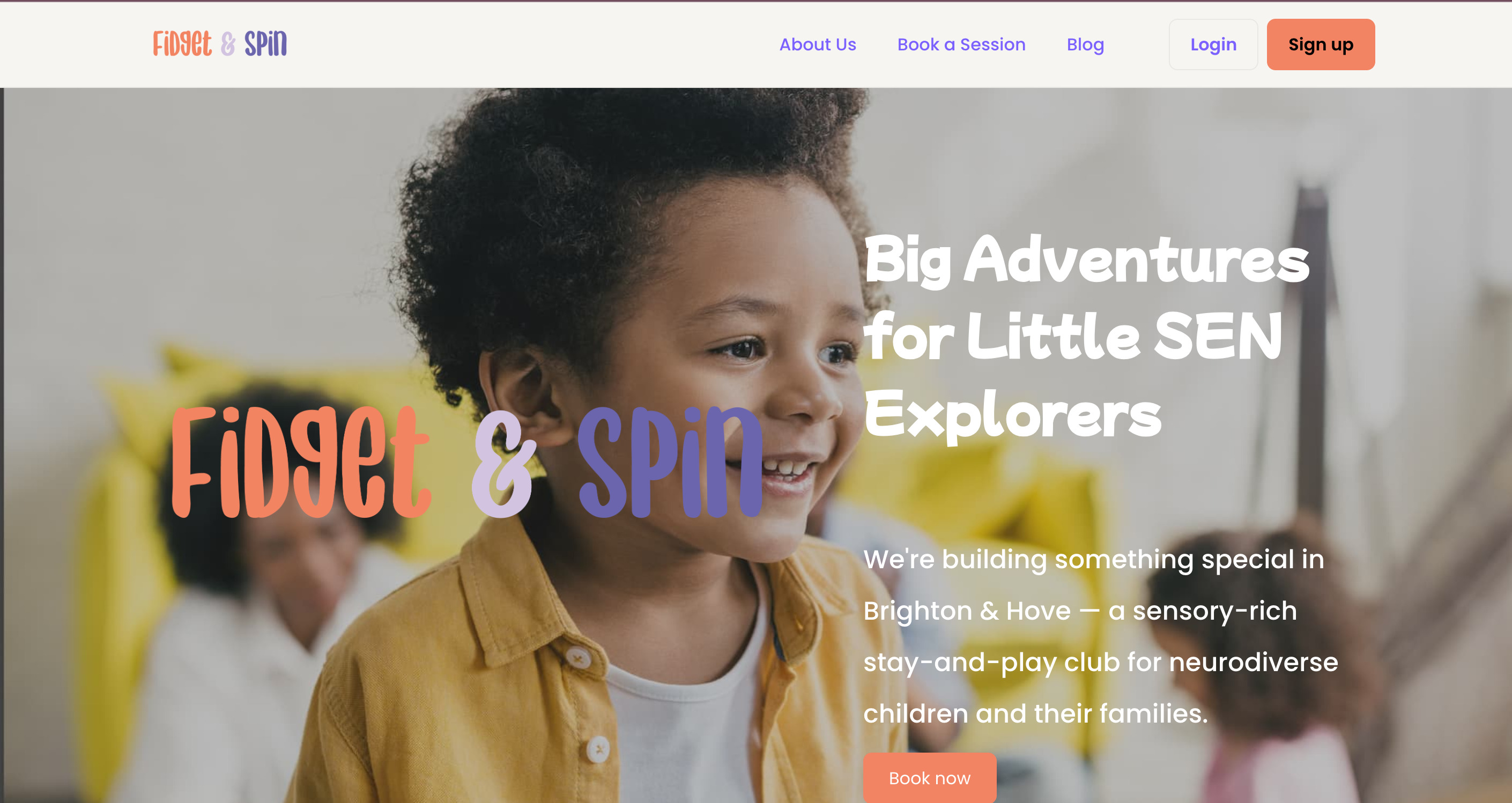
At Fidget and Spin, we didn’t set out to create a social skills programme. We set out to create a room where Remy didn’t have to leave early. But what we’ve found, consistently, is that the right sensory environment does the heavy lifting. Children practise cooperation, turn-taking, and shared attention naturally, when the space is regulated and the adults around them understand how neurodiverse children actually play.
Our weekly SEN stay-and-play sessions across Brighton and Hove are structured around three sensory zones: Wiggle & Bounce for big movement, Snuggle & Chill for low-stimulation moments, and Squish & Squeeze for tactile play. Each zone creates natural opportunities for exactly the kinds of interaction that show up on a social skills checklist, without anyone having to be drilled on it. Come and see what that looks like in practice.
FAQ
What is a social skills checklist used for?
A social skills checklist helps parents, teachers, and specialists observe and record a child’s social behaviours across specific domains such as cooperation, turn-taking, emotional regulation, and peer interaction. It provides a structured starting point for identifying strengths and areas that need targeted practice.
Are social skills checklists suitable for autistic children?
Yes, but only if the tool is neurodiversity-affirming. Avoid checklists that treat eye contact or verbal initiation as required skills. Look for tools like the ASSP-2 that focus on functional communication and reciprocal behaviour rather than neurotypical social norms.
How often should I complete a social skills assessment?
Most early years practitioners review a social competence checklist every half-term or term. This gives enough time to see genuine change while keeping the process manageable. More frequent checks can be useful when a specific skill is being actively targeted through guided practice.
Can parents use a social skills checklist at home?
Absolutely. Informal checklists with rating scales and comment sections are designed to be accessible to non-specialists. Completing one at home and comparing it with your child’s nursery or school observation gives a richer, more accurate picture of how your child is developing across different settings.
What should I do after completing a social skills checklist?
Pick two or three specific skills to focus on, then build those into daily play. Research consistently shows that checklist results paired with guided practice produce far better outcomes than observation alone. Social stories, sensory-friendly play, and adult-coached games are all effective next steps.
Recommended
- Promoting gentle social interaction for neurodiverse kids | Fidget and Spin Brighton
- Social stories for neurodiverse children: a parent’s guide | Fidget and Spin Brighton
- Play that builds communication skills in neurodiverse children | Fidget and Spin Brighton
- Educational games for neurodiverse kids: boost skills | Fidget and Spin Brighton