
TL;DR:
- Social stories are structured, personalized narratives that help children understand confusing social situations before they happen. They are most effective when introduced during calm moments, regularly updated, and tailored to the child’s specific needs and interests. These tools complement other interventions and support social skill development, especially in neurodiverse children aged one to seven.
Not every behaviour intervention suits every child. That’s something many of us learn the hard way, after weeks of trying a strategy that simply doesn’t fit our child’s particular way of experiencing the world. Social stories offer something different. Rather than applying a blanket rule or reward chart, they meet a child in a specific moment, describing a situation that feels confusing or overwhelming in language that makes sense to them. In this guide, we’ll explain what social stories are, how to create them, what the research actually says, and how to use them practically with children aged one to seven.
Table of Contents
- What are social stories and why they matter
- How social stories are constructed and tailored
- Evidence and limitations: what research tells us
- Practical tips for using social stories with young children
- A deeper take: why customisation and context trump generic solutions
- Where to find support for your child’s social skills
- Frequently asked questions
Key Takeaways
| Point | Details |
|---|---|
| Target a single goal | Writing a social story starts with choosing one specific social or communication target. |
| Personalise and update | Stories work best when tailored to your child’s current context and regularly revised as routines change. |
| Descriptive sentences matter | Emphasise descriptive and perspective sentences over directives, for positive, supportive storytelling. |
| Timing is vital | Introduce social stories when your child is calm for best effect and comprehension. |
| Evidence supports targeted use | Research shows benefits for specific behaviours, but stories are not a universal fix for broader social skills. |
What are social stories and why they matter
Social stories aren’t a gimmick. They’re a carefully designed, structured tool with a clear purpose: to help a child understand a situation that they find confusing, unpredictable, or distressing.
Social Stories are short, structured narratives written to describe social situations that are difficult or confusing. They help explain why other people do things and how people feel, and may include gentle advice about what the child can do. Think about a moment your child completely shut down at the school gate, or melted into the floor at the GP’s waiting room. A social story doesn’t try to fix that meltdown in the moment. It works before. It builds a mental map in advance, so the situation feels less like a surprise attack.
The approach was originally developed by Carol Gray, and it’s far more than just writing a little narrative about a tricky event. What is a social story? involves a rigorous process based on ten defining criteria. Stories must be descriptive, meaningful, respectful, and safe, including physically, socially, and emotionally. That last point matters enormously. A poorly written social story that inadvertently shames or pressures a child can do more harm than good.
Here’s what makes a well-written social story stand apart:
- It describes a specific situation rather than a vague concept like “being kind”
- It explains what others might think, feel, or do in that situation
- It helps the child understand the perspective of people around them
- It suggests what the child might do next, gently and without pressure
- It is written with the child’s voice and developmental level in mind
- It is safe emotionally, never blaming or criticising the child
“A social story is written to share accurate social and cultural information in a reassuring and meaningful way.” — Carol Gray
For neurodiverse children aged one to seven, these stories can be transformative. Young children are still building their understanding of the social world, and for many autistic children or those with developmental differences, that world can feel genuinely baffling. Social stories give it shape. They offer a script, a framework, a kind of emotional anchor for situations that might otherwise feel chaotic.
You can explore more ideas for tailoring social stories to your child’s specific interests and communication style on our blog, where we regularly share practical resources for families like yours.
How social stories are constructed and tailored
Now that we understand what social stories are, let’s look at how parents can construct them effectively.
The key elements of a great social story include a single clear goal, answers to six core questions, positive and descriptive language, and a careful ratio of sentence types. The framework suggests at least two descriptive or perspective sentences for every directive sentence. This matters because too many “you should do this” instructions makes the story feel like a telling-off rather than a supportive guide.
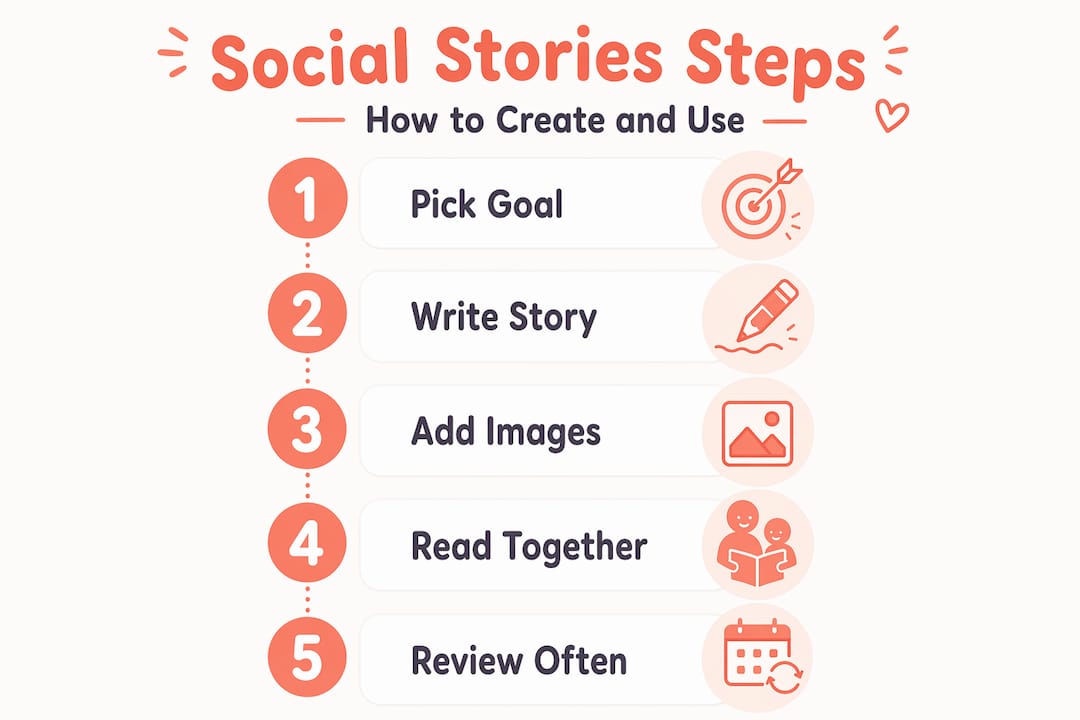
Here’s a practical step-by-step approach for constructing your own:
- Identify one single goal. Choose one specific situation your child struggles with, such as waiting for a turn, transitioning between activities, or coping with a fire alarm.
- Answer the six key questions. Where does this happen? When? Who is involved? What happens? How does it unfold? Why does it happen?
- Write with positive language. Describe what will happen and what your child can do, rather than focusing on what they shouldn’t do.
- Balance your sentence types. Include descriptive sentences (what happens), perspective sentences (how others feel), and only a couple of directive sentences (what the child might try).
- Personalise everything. Use your child’s name, reference familiar people, and incorporate their interests wherever it fits naturally. If your child loves trains, the waiting room becomes a station and patience is “waiting for the train to arrive.”
- Keep it short. For children aged one to five especially, a few sentences per page with clear images or symbols is far more effective than a lengthy text.
Here’s a simple comparison to illustrate the difference between a weak and a strong social story:
| Element | Weak version | Strong version |
|---|---|---|
| Goal | “Be good at the shops” | “Staying with my grown-up in the supermarket” |
| Language | “Don’t run off” | “I can hold the trolley to help me stay close” |
| Perspective | None included | “My grown-up might feel worried if they can’t see me” |
| Personalisation | Generic | Includes child’s name and preferred reward at the end |
| Length | Two pages of dense text | Five short pages with pictures |
Pro Tip: Involve your child in making the story wherever possible. Even young children can choose images, point to what feels right, or tell you how a character might feel. Ownership makes the story feel less like a rule and more like a shared understanding.
For practical construction steps, real-world examples from healthcare settings show how a well-prepared narrative can dramatically reduce anxiety for children before appointments.

Evidence and limitations: what research tells us
Having seen how to create social stories, it’s essential to understand what research says about their effectiveness. Because hope is important, but so is honesty.
A systematic review evidence published in the NCBI Bookshelf (a quality-assessed DARE review) found that five of six eligible controlled trials showed statistically significant benefits across outcomes related to social interaction in autistic children. That’s genuinely encouraging. But the same review is clear: uncertainty remains, particularly around whether those benefits are maintained over time and whether skills generalise from the story’s context to other situations.
| Study outcome | Findings |
|---|---|
| Social interaction skills | Positive results in 5 of 6 controlled trials |
| Maintenance over time | Insufficient evidence; needs further research |
| Generalisation across settings | Unclear; context-dependent |
| Range of neurodiverse profiles | Mostly autistic children; broader evidence limited |
What does this mean for you as a parent? A few things worth holding onto:
- Social stories are genuinely promising, not just well-meaning
- They work best for specific, targeted behaviours rather than broad social skills
- Don’t expect your child to transfer what they’ve learned from one story automatically to a completely different situation
- They work best alongside other communication strategies, such as AAC (Augmentative and Alternative Communication), PECS (Picture Exchange Communication System), or speech and language therapy
- Progress may be gradual and may need ongoing reinforcement
Think of social stories as one important thread in a much bigger tapestry of support. They’re not a magic fix, and no one claiming otherwise is being straight with you. But as a targeted, thoughtful intervention? They carry real weight.
For families accessing practical applications in session settings, social stories can be woven into group play environments in ways that reinforce their messages naturally and joyfully.
You can also find further discussion of social stories in clinical and allied health contexts, where practitioners increasingly draw on them to prepare children for unfamiliar procedures and environments.
Practical tips for using social stories with young children
To make theory truly useful, here’s how parents can apply social stories with young children in everyday life.
Timing is everything. NESS Social Stories guidance from the NHS Trust, alongside Carol Gray’s own framing, makes clear that stories should be introduced when your child is calm, not in the thick of a meltdown. Trying to use a social story during peak distress is a bit like trying to read a map while the car is already on fire. Introduce it during a relaxed moment. Bedtime, after breakfast, or during a quiet play activity can all work beautifully.
One of the most practical cautions comes from why social stories fall apart between sessions: stories often stop working not because they’re badly written, but because families don’t have the right materials available at the right moment, or because the story has become outdated as routines shift. A story written about a previous nursery keyworker who has since left is no longer useful. It may even confuse.
Here are some practical ways to keep social stories working well over time:
- Keep a printed or digital copy accessible. Have it in your bag, on your phone, or near the front door if it relates to going out.
- Read it regularly, not just before the challenging event. Familiarity builds confidence.
- Review and update stories every few months, or whenever a routine, key person, or environment changes significantly.
- Use pictures, symbols, or photographs. For children under five especially, visual support makes the story genuinely accessible rather than just decorative.
- Pair the story with a consistent sensory cue. A favourite blanket, a familiar smell, or a soft toy present during story time can help signal “this is a calm and safe moment.”
For more ideas around timing and emotional context, our sessions page details how we support children in regulated, predictable environments where learning through play feels natural rather than forced.
Pro Tip: If your child uses AAC or PECS, consider whether their social story could incorporate symbols or vocabulary from their existing communication system. Consistency across communication tools reduces cognitive load and helps the story feel like part of their world, not an add-on.
A deeper take: why customisation and context trump generic solutions
Here’s something worth saying plainly, because it doesn’t get said often enough: most social stories fail not because the method is flawed, but because the story is too generic. A story downloaded from the internet and applied wholesale to your child’s specific situation is like handing someone a map of the wrong city. It’s a map, technically. But it won’t get anyone where they’re trying to go.
We’ve seen this pattern repeatedly. A parent finds a beautiful, professionally illustrated social story about haircuts. The child in question happens to be terrified not of haircuts in general, but of the specific buzzing sound of electric clippers in that particular salon. A generic story doesn’t address that. A customised one, written with that specific detail included, absolutely can.
This is where we’d gently push back against the idea that social stories require professional sign-off before they’re “valid.” You know your child better than anyone. You know that they can hear the kettle from upstairs and find it overwhelming. You know that “lots of people” feels different to them than “me, my mum, and the dentist.” That nuance is exactly what makes a parent-authored story powerful.
The flip side? Don’t set and forget. A social story that fitted your child perfectly at age three may need complete rewriting by age five. Their understanding deepens, their routines shift, and their emotional vocabulary grows. The story should grow with them.
We’d also encourage families to use session flexibility in structured play environments to practise the situations covered in social stories in a low-stakes, supported way. Reading about a situation and experiencing it gently in real life are complementary, not competing.
The honest truth is that real learning happens when the story fits the specific moment, the specific child, and the specific context. Anything less is a near-miss.
Where to find support for your child’s social skills
Supporting a neurodiverse child’s communication and social skills is rarely a solo endeavour. You need community, consistency, and spaces where your child can practise skills in a genuinely safe environment.
At Fidget and Spin, our sensory stay-and-play sessions in Brighton & Hove are designed precisely for children aged one to seven who are still finding their feet in the social world. Our themed sensory zones and guided group activities give children real-world opportunities to practise the kinds of transitions, turn-taking, and social interactions that social stories prepare them for at home. You can learn about our sessions and see how we structure each visit to support communication, emotional regulation, and confidence through play. When you’re ready to give your little explorer a space to grow, you’re warmly welcome to book a sensory play session and come and join us.
Frequently asked questions
Are social stories effective for all neurodiverse children?
Social stories are most effective for targeted behaviours but may not generalise across all skills or settings without additional practice and teaching, and results across studies vary.
When is the best time to use a social story?
Social stories work best when introduced during a calm moment before a challenging situation arises, rather than during distress, to support genuine comprehension and uptake.
How often should social stories be updated?
Update stories regularly as your child’s routine, key people, or context change, since outdated stories can reduce how well a child applies the information in daily life.
Can social stories be used for children under age five?
Yes, but the story should be tailored to the child’s developmental level, use very simple language and clear visuals, and be introduced calmly before a challenging situation rather than during one.
Do social stories replace other communication interventions?
No. Social stories work best as a targeted complement to other approaches, and systematic review evidence supports viewing them as one tool among many rather than a stand-alone solution.