If soft play overwhelms your child, the answer isn’t a better soft play centre. It’s sensory stay-and-play sessions and SEN-friendly birthday parties, built from the ground up for autistic, ADHD, PDA and sensory-processing kids. I’m Caitlin, co-founder of Fidget and Spin, and this guide covers how they work, what to ask, and how to prepare your child so the day actually goes well.
TL;DR:
- Sensory stay-and-play sessions feature three separate zones and small groups, with trained staff focusing on calming children before meltdowns occur.
- SEN-friendly birthday parties are private, flexible, and have low-stimulation options like dimmed lighting and quiet spaces, with activities tailored to sensory needs.
- Always ask providers for specific details on sensory zones, staff training, group size, and policies for handling overwhelm before booking sessions or parties.
- Proper preparation, including pre-visits and visual schedules, significantly improves your child’s experience during sessions or events.
- Outdoor options like quiet parks and sensory gardens can supplement indoor sensory activities, especially when weather or routines are a concern.
Table of Contents
- Soft play alternatives: sensory stay-and-play sessions explained
- SEN-friendly birthday parties: what actually changes
- Choosing the right sensory alternative for your child
- Preparing your child before the day
- Activities, food and room set-up that actually work
- Handling the tricky moments: the birthday song and stimming
- Outdoor play options as alternatives to soft play
- Creative DIY soft play setups at home
- Local community resources worth checking
- Screen-based play versus physical soft play
- Inclusive play for a wider age and ability range
- A short, lived-experience case: what running sessions taught me
- Booking a sensory session or party with Fidget and Spin
- Sources
- FAQ
Soft play alternatives: sensory stay-and-play sessions explained
Soft play centres are loud, unpredictable and packed with other people’s kids barrelling into your child’s space. I know because I’ve stood in one, watching Remy’s shoulders creep up to his ears, calculating how fast I could get us to the car.
Sensory stay-and-play sessions work differently. Most run with three distinct zones instead of one chaotic room: a movement zone for big physical input, a tactile zone for hands-on fidgeting and squeezing, and a low-stim zone for kids who need to switch off. Group sizes stay small, typically under a dozen, so no child gets lost in a crowd.
Staff aren’t just watching for safety. They’re trained to spot rising dysregulation, offer sensory tools before a meltdown rather than after, and let a child skip a turn without a fuss. That flexibility matters more than any piece of equipment.
- Three separate zones instead of one open space
- Small group sizes with real adult attention
- Staff trained in sensory prompts, not just supervision
- Parents welcome to stay close, not banished to the café
Pro Tip: Ask what the ratio of children to trained staff is before booking. A session that’s genuinely small-group will tell you this number without hesitating.
SEN-friendly birthday parties: what actually changes
The birthday party invite used to fill me with dread before it filled me with anything else. Bouncy castle, thirty screaming kids, a birthday song belted out over a microphone. Remy’s parties looked nothing like that, and that was the whole point.
SEN-friendly party packages are built on private hire, so you’re not sharing a hall with a stranger’s football party next door. Guest lists stay smaller, lighting gets dimmed rather than flashing, and the birthday song becomes optional rather than compulsory. Timings flex too. Nobody’s watching the clock for the next booking.
A decent package usually includes:
- Activities matched to sensory profiles, not a one-size bouncy castle
- Sensory tools and fidgets available throughout, not just at the start
- A quiet or low-stim space built into the room, not an afterthought
- Flexible start and finish times if your child needs longer to settle
Before booking, ask directly: can noise be controlled, is singing optional, and what happens if my child needs to leave the room? Answers should come fast, not vaguely.
Choosing the right sensory alternative for your child
Picking between sessions and parties gets easier with a short checklist rather than a gut feeling formed at 11pm the night before booking.
- Check the sensory zoning. Ask whether movement, tactile and low-stim areas are physically separate, not just labelled corners of one room.
- Ask about staff training. A good answer names specific approaches (sensory prompts, flexible turn-taking), not just “we’re very experienced with kids.”
- Confirm group size. Smaller is better for regulation. Anything over ten or twelve children per session loses the point.
- Test booking flexibility. Can you cancel or rearrange without penalty if your child has a rough morning?
- Ask their parent/carer policy. Are you expected to stay, or can you step back if your child settles?
Red flags: vague answers about “inclusive ethos” with no specifics, no mention of a quiet space, or staff who can’t describe what happens when a child gets overwhelmed. If they can’t answer that last one, they haven’t thought about it properly.
Preparing your child before the day
The prep matters more than the party itself, in my experience. A rushed arrival at an unfamiliar venue is asking for trouble, however good the session turns out to be.
Book a short pre-visit if the venue offers one. Photograph or video the entrance, the chill-out space, and anything noisy, then build a simple social story from those images. Keep the pre-visit brief, focused on one or two landmarks rather than a full tour.
At home, run a visual schedule with pictures or a simple timer so your child knows what’s coming and when it ends. Rehearse the exit too. Practising “we leave after the cake” at home means it isn’t a surprise on the day.
- Photograph the entrance, chill zone and any loud equipment
- Build a two or three-step visual schedule, not a full itinerary
- Rehearse the exit line you’ll actually use
- Offer choice over lights, music volume and which fidget comes along
Pro Tip: Let your child hold the remote, literally or figuratively. Research on multi-sensory environments found autistic children showed more attention and fewer repetitive behaviours when they controlled the sensory equipment themselves, rather than having it dictated to them.
Activities, food and room set-up that actually work
Getting the activities right matters as much as the venue itself. A room full of good intentions and the wrong toys still ends in tears.
Structure activities around sensory profile rather than age alone. Timers help kids who need to know an activity will end. Small groups of two or three prevent the free-for-all that tips a session into chaos. Somatosensory games involving touch and movement have shown improvements in concentration and emotional control in small studies, which lines up with what I see weekly: tactile play calms kids down faster than almost anything else on offer.
Food-wise, keep it simple. Finger food beats anything requiring cutlery. Stick to familiar textures rather than “exciting” new snacks, and skip anything with a strong smell that could overwhelm a sensitive nose.
A proper chill-out zone needs:
- Noise-cancelling headphones on hand, not just offered once
- Dimmed or natural lighting, away from strip lights
- Calming toys and weighted items within reach
- A clear, unspoken rule that nobody has to explain why they’re there
Handling the tricky moments: the birthday song and stimming
Every SEN parent knows the moment. The lights dim, the cake appears, thirty voices launch into “Happy Birthday,” and your child’s whole body goes rigid.
Warn guests in advance that the song is optional and quiet clapping is fine instead of belting it out. Rehearse this with your child beforehand so it’s not a surprise. If stimming shows up, whether it’s hand-flapping, rocking or vocal sounds, let it happen. It’s regulation, not a problem to solve.
- Tell guests the song is optional before the party starts
- Rehearse the moment at home so your child knows what’s coming
- Let stimming happen; only step in if there’s a safety concern
- Have an exit plan ready and a way back in once things settle
Leaving isn’t failure. It’s often exactly the right call, and returning five minutes later once everyone’s calm counts as a win, not a retreat.
Outdoor play options as alternatives to soft play
Fresh air changes everything for some kids. No walls to bounce sound off, more space to move without bumping into anyone, and none of the fluorescent lighting that soft play centres seem to love.
Quiet local parks at off-peak times work well, particularly early mornings or weekday afternoons when the equipment isn’t already swarming with other children. Woodland trails and nature reserves offer a different kind of sensory input altogether: textures, smells and sounds that shift constantly but never at the volume of an indoor play barn.
That said, outdoor play brings its own challenges. Weather is unpredictable, which matters enormously if your child relies on routine. There’s less control over noise from other park users, and fewer places to retreat to if things get too much. A quiet corner with a bench and some shade can double as an impromptu chill-out zone if you scout it in advance.
Sensory gardens, where they exist locally, are worth seeking out specifically. They’re designed around varied textures and low, natural noise levels rather than the shrieking and clattering of a standard playground. Many are attached to community centres or accessible green spaces, and a quick search for “sensory garden” plus your area usually turns up something within a short drive.
Outdoor play won’t replace a structured sensory session for every child, particularly those who need predictability more than they need fresh air. But as one option among several, it’s worth having in the rotation, especially on the days when four walls feel like one too many.
Creative DIY soft play setups at home
Some days, leaving the house isn’t happening, and that’s fine. A living room can do more than you’d think with a bit of imagination and stuff you probably already own.
Cushions and duvets stacked into a soft landing zone give the bouncing and crashing that movement-seeking kids crave, without the crowd or the noise. A pop-up tent or a blanket draped over chairs creates an instant low-stim den, somewhere to retreat to that’s entirely under your child’s control. Fill a shallow tray with dried rice, pasta or kinetic sand for tactile input that doesn’t require leaving the kitchen.
Cardboard boxes go further than most bought toys. A large box becomes a tunnel, a den, or something to climb into and shut the world out from. Rotate a small box of textured items, fabric scraps, textured balls, a vibrating fidget, so there’s always something slightly new without overwhelming choice.

The advantage of a home setup is total control. You decide the lighting, the noise, who’s in the room and when it all gets packed away. The drawback is obvious too: no trained staff, no dedicated zones, and the responsibility for reading your child’s regulation sits entirely with you. For a rough afternoon it’s often enough. For a birthday, most parents still want more structure than a living room can offer.
Local community resources worth checking
Not every alternative needs a price tag. Many councils and charities run low-cost or free sensory-friendly sessions that don’t always show up in a quick search.
Children’s centres and family hubs, run through local councils, often host quiet play sessions specifically timed outside peak hours. SEN charity networks frequently organise their own stay-and-play mornings in community halls, usually cheaper than commercial venues and staffed by people who already understand sensory needs. Libraries have quietly become useful too. Many now run sensory story times with dimmed lights and reduced group sizes, a low-pressure way to try structured play without committing to a full session.
Local Facebook groups for SEN parents are worth joining purely for the recommendations. Other parents will tell you, honestly, which soft play centre has a quiet hour and which sensory room is really just a cupboard with a lava lamp in it. SENCOs and early years professionals often know of resources that never make it onto a council website, so asking your child’s school or nursery directly can turn up options you’d never find otherwise.
Availability varies hugely by area, and quality varies more. Ringing ahead and asking the same questions you’d ask a paid provider, about group size, noise levels and staff experience, still applies whether the session costs £5 or nothing at all.
Screen-based play versus physical soft play
Screens get a hard time in most parenting advice, and I get why. But for a lot of neurodiverse kids, a screen offers something physical play rarely can: total predictability.
A familiar app or show doesn’t change its lighting, doesn’t introduce a stranger’s toddler mid-session, and doesn’t demand social interaction your child isn’t ready for that day. For some children, particularly those who find unstructured physical spaces genuinely distressing, screen time functions as a legitimate regulation tool rather than a fallback.
The drawback is equally real. Screens don’t build the movement, balance and tactile experiences that a body needs, and they can make transitions back into the physical world harder rather than easier. Overreliance can also narrow a child’s tolerance for unpredictability over time, which matters if the goal is gradually widening what they can cope with.
The honest answer is that it’s not either/or. A short screen break before or after a sensory session, used as a regulation tool rather than a default, tends to work better than treating screens and physical play as opposing camps. Watch what your own child needs rather than following a blanket rule either way.
Inclusive play for a wider age and ability range
Most soft play centres are built with a fairly narrow child in mind: walking, roughly two to eight, no additional needs. Anyone outside that band gets a worse experience, whether that’s a one-year-old getting knocked over or a seven-year-old who’s too big for the equipment but not ready for the noise of an older kids’ zone.
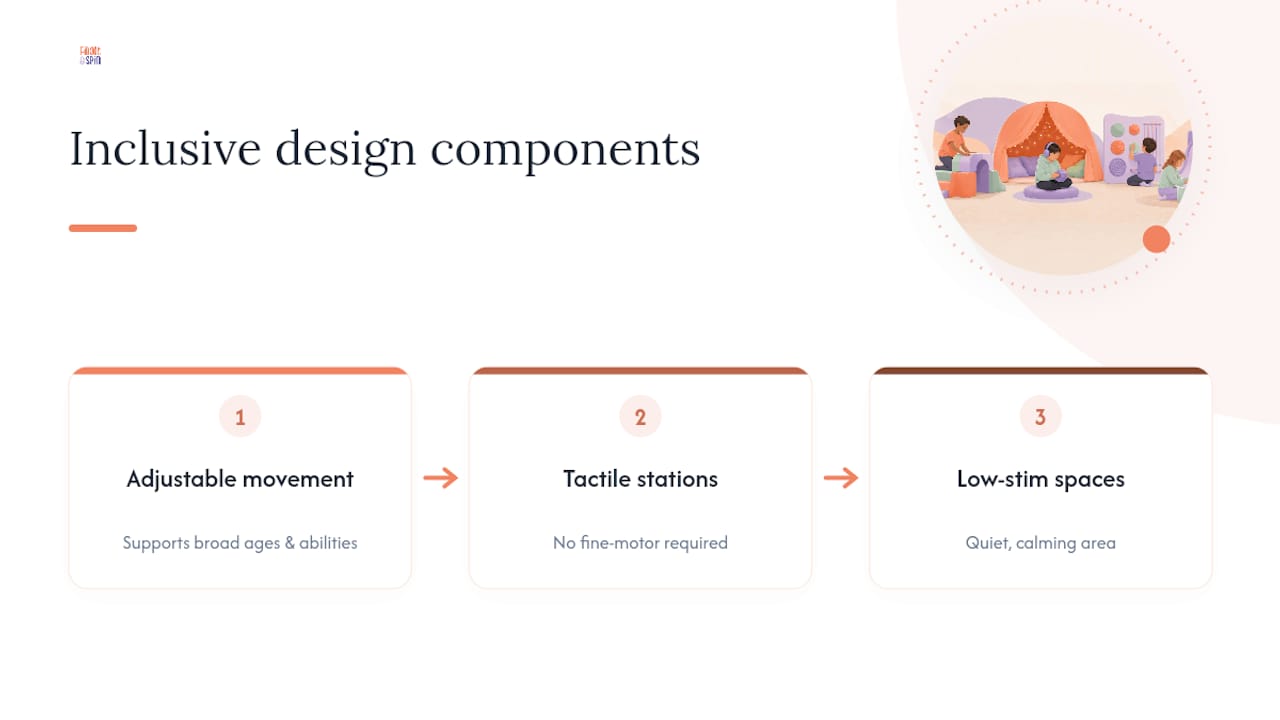
Genuinely inclusive alternatives design for a spread rather than a midpoint. That means equipment and activities that work for a toddler still finding their feet alongside an older child with different physical or sensory needs, in the same session, without either feeling like an afterthought. Movement zones with adjustable difficulty, tactile stations that don’t require fine motor precision, and low-stim spaces that welcome a six-year-old as readily as a one-year-old all point the same way: flexibility over fixed age bands.
Ability range matters just as much as age. A session or party that assumes every child can climb, run and shout misses kids who use wheelchairs, communicate through AAC or PECS, or simply process the world at a different pace. Ask providers directly whether their space and activities work for your child’s specific profile, not just their age on paper. The best answer names specific accommodations rather than offering a general reassurance that everyone’s welcome.
A short, lived-experience case: what running sessions taught me
Our first birthday party booking taught me more than months of planning ever could. A child bolted the second the birthday song started, and I hadn’t warned the family beforehand that singing was optional. We changed that immediately.
Now every party starts with a quiet word to guests, and every session runs across the three zones we built after watching what actually helped Remy versus what looked good on paper. Sensory play strategies only work when you’ve watched them fail first.
If you’re not sure whether a session suits your child, book a pre-visit. Fifteen minutes tells you more than any brochure.
— Caitlin
Booking a sensory session or party with Fidget and Spin
Fidget and Spin is the alternative to a standard soft play centre for parents in Brighton, Hove and across Sussex who need genuine sensory zoning, not a louder room with a different name on the door.
Our weekly stay-and-play sessions run for children covering toddler to early school age across three zones: Wiggle & Bounce for big movement, Snuggle & Chill for low-stim regulation, and Squish & Squeeze for tactile play and fidgets. Every session is small, staffed by people who understand sensory needs rather than just supervising a room.
For birthdays, our SEN-friendly party packages cover ages one to seven across several tiered options at varied prices. Every package includes private hire, flexible timing and a chill-out space as standard, not an add-on.
If you’re weighing this up against a DIY setup at home or a mainstream venue, book a pre-visit first. Check how our sessions work or look at party packages and get in touch to arrange a visit before the big day.
Sources
- Effect of controllability of multi‑sensory environment on behaviour of autistic children (PubMed)
- Somatosensory interaction games for autistic children (Frontiers in Psychiatry, 2023)
FAQ
Are sensory sessions suitable for very young toddlers?
Yes, most sensory stay-and-play sessions welcome children from around age one, with movement and tactile zones adjusted for younger bodies still developing balance and grip.
How much do SEN-friendly birthday parties typically cost?
Packages vary by provider and size, but Fidget and Spin offer tiered parties including options with all three sensory zones.
Do I need to stay with my child during a session?
Most sensory sessions welcome parents and carers to stay close by, and many actively encourage it, particularly for a first visit while your child settles.
What if my child needs to leave partway through a party?
A good SEN-friendly party plans for this from the start, with a chill-out space and a clear, judgement-free way to step out and return once your child feels ready.
Is the birthday song always compulsory at these parties?
No, singing is typically optional at SEN-friendly parties, and organisers usually notify guests in advance so quiet clapping can replace singing if that suits the child better.