
TL;DR:
- Early years inclusion involves proactively designing environments, routines, and relationships to ensure full participation of neurodiverse children from the start.
- Parents can support this by using communication supports, sensory planning, and building networks before attending group settings, along with sharing visual tools and individualized information.
Early years inclusion is defined as the ongoing, proactive practice of designing environments, routines, and relationships so that every child, including those with autism, ADHD, PDA, and sensory processing differences, can participate fully from the start. Not as an afterthought. Not with a laminated “all are welcome” sign on the door. Inclusion must be woven into everyday practice, and that starts at home, long before any setting gets involved. This guide uses the industry term inclusive early years practice alongside the step by step early years inclusion approach you are probably searching for, because both matter. Frameworks like Universal Design for Learning (UDL), communication tools like PECS, and sensory-affirming environments are the building blocks. And you, as a parent or carer, are the most important architect of all.
What practical tools do families need before starting early years inclusion?
Before you walk into any playgroup, nursery, or community session, it helps to know what you are working with. I spent months turning up to things with Remy and leaving twenty minutes later, both of us frazzled, because I had not thought about what he needed to feel safe enough to engage. That is not a failure. It is just the learning curve nobody warned me about.
The most useful tools fall into three categories: communication supports, sensory planning, and human networks.
| Support | What it does | When to use it |
|---|---|---|
| PECS (Picture Exchange Communication System) | Gives non-verbal or pre-verbal children a way to request and respond | Daily, at home and in settings |
| Visual schedules | Reduces transition anxiety by showing what comes next | Before and during any new activity |
| Sensory audit | Identifies triggers and preferences in a given space | Before attending a new group or setting |
| AAC device or app | Supports expressive communication beyond speech | Ongoing, across all environments |
| Key worker relationship | Provides a consistent, trusted adult in a setting | From day one in any new provision |
Proactive design of environments, including sensory-friendly zones and visual aids for the whole group, reduces the need for reactive adaptations later. This matters because reactive inclusion is exhausting for everyone, especially your child.
- Prepare a one-page “all about me” document to share with any new setting or group leader
- Identify your child’s regulation signals before you need them in public (what does tired look like? What does overwhelmed look like?)
- Build a small network of other SEN parents, even one or two people who get it, before you need them
Pro Tip: Bring your child’s visual schedule to new environments rather than waiting for the setting to create one. Familiar visuals in an unfamiliar place are a genuine anchor.
For more on play-based inclusion strategies that work in the early years, the Fidget and Spin blog has practical ideas grounded in real experience.
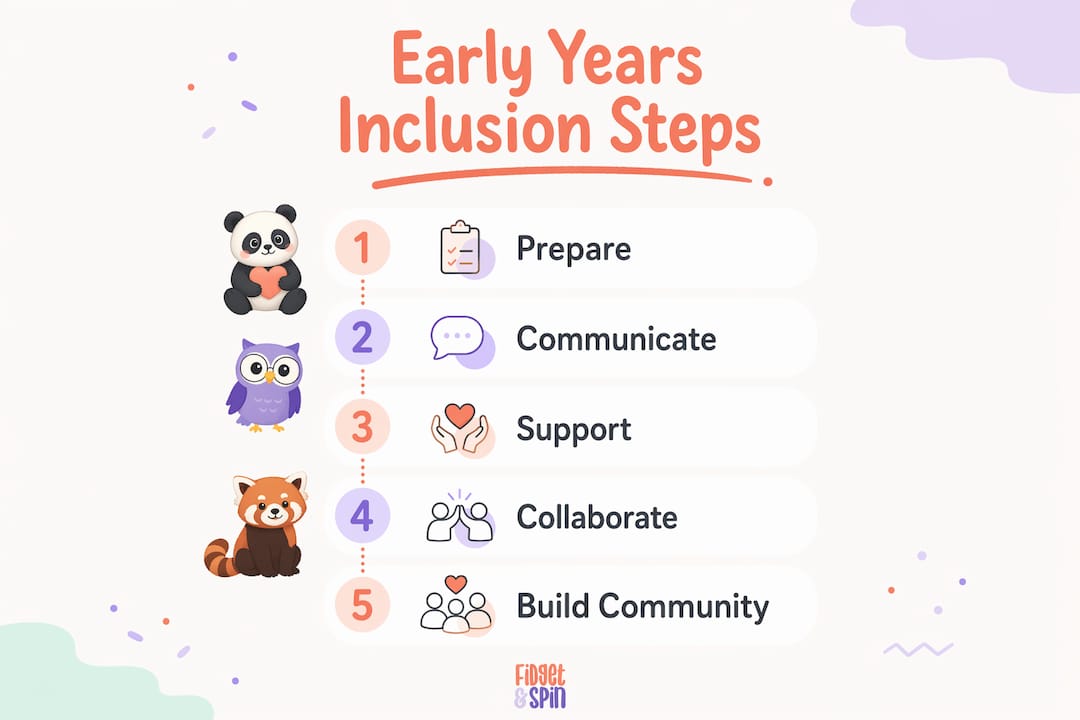
How to support your child step by step in inclusive play settings
The research-backed 5-step interaction cycle for neurodiverse children gives parents and practitioners a clear structure: engage, follow the child’s lead, scaffold peer interactions, respect stop or finished signals, then evaluate and adapt. It sounds clinical written out like that. In practice, it looks like this.
- Engage one-to-one first. Before Remy could cope with a group, he needed to feel safe with one adult. Sit alongside your child, not opposite them. Parallel play is real connection.
- Follow their lead. If they want to line up the cars rather than race them, line up the cars. Their play is not wrong. It is theirs.
- Scaffold peer interaction gently. Introduce one other child, not a group. Narrate what is happening. “Remy is building. Shall we watch?” gives another child a role without forcing contact.
- Respect stop and finished signals. A child who walks away, covers their ears, or goes flat is communicating. Honour it. Pushing through is not resilience training. It is dysregulation.
- Evaluate and adapt. After each session, ask yourself one question: what worked? Not what went wrong. What worked, even for five minutes?
Relational agency, responding flexibly to how your child communicates rather than sticking rigidly to a plan, is what makes this cycle actually work. The plan is a scaffold, not a script.
Pro Tip: Sensory regulation during group play is not a bonus extra. It is the whole game. Keep a small regulation kit in your bag: a chewy, a fidget, ear defenders, a familiar smell. Regulation first, participation second.

For ideas on making play genuinely inclusive rather than just physically present, there is a dedicated guide on the Fidget and Spin site.
How to collaborate with early years settings and professionals
Most parents I know dread the formal review meeting. The table, the paperwork, the sense that you are being assessed as much as your child. Here is what I have learned: the most useful conversations happen in the car park, not the meeting room.
Informal check-ins with educators build more responsive, tailored support than formal meetings alone. A two-minute chat at pick-up, a quick message to a key worker, a shared note in a home-setting book. These are the things that actually change what happens in the room with your child.
- Share the vocabulary you use at home. If you say “body break” instead of “time out,” tell them. Consistency in language reduces confusion for your child across environments.
- Ask to see the setting’s inclusion strategy. From December 2026, UK settings must publish their inclusion strategies as part of the Inclusive Mainstream Fund requirements. You are entitled to know how they plan to include your child.
- Ask about Early Years Inclusion Funding and whether your child’s place attracts additional support hours.
- Bring your visual tools to any meeting. Show, do not just tell.
Consistent vocabulary and visual tools shared between home and setting create cognitive continuity for neurodiverse children. When the words and pictures match, your child does not have to translate between two worlds. That translation costs energy they need for everything else.
Pro Tip: Ask the setting one specific question: “What does a good day look like for my child here?” The answer tells you everything about whether they actually know your child.
Sustainable inclusion requires genuine cooperation between education and specialist services, not siloed approaches where the SENCO, the speech therapist, and you are all working from different maps.
How to build community support beyond formal settings
The hardest part of early years inclusion is not the nursery. It is the soft play on a Saturday. The birthday party where the music is too loud and the other kids are too fast and you spend the whole time near the exit, watching your child’s face for the signs.
Family partnerships and community involvement are foundational to sustained inclusive early years experiences. That means finding your people, not just tolerating the spaces that were not built for you.
- Look for SEN-specific playgroups or stay-and-play sessions in your area. In Brighton and Hove, Fidget and Spin runs weekly sensory sessions across three zones designed around neurodiverse children’s actual needs.
- If a group does not exist, consider starting one. A WhatsApp group of three SEN parents who meet in someone’s garden counts.
- When other parents or children ask questions about your child’s behaviour, keep it simple and warm. “He processes things differently, so he needs a moment” is enough. You do not owe anyone a diagnosis.
- Use sensory play as a social entry point. Children who struggle with face-to-face interaction often connect through shared sensory experience, sand, water, dough, and movement.
The side-eye in soft play is real. So is the dread before a party. But so is the moment when your child finds their person, or their place, in a room that was actually designed for them. That moment is worth building towards.
For more on what social inclusion really means for neurodiverse children, beyond physical presence in a room, the Fidget and Spin blog goes deeper.
Common challenges in early years inclusion and how to handle them
Remy once lay down flat on the floor of a community centre and refused to move for forty-five minutes. I sat next to him. We both stared at the ceiling. That was a hard day. It was also, eventually, a useful one.
When a child withdraws or shuts down in a group setting, the instinct is to fix it quickly. Resist that. Shutdown is communication. Your job in that moment is to be a calm, non-demanding presence, not a problem-solver.
- Mismatched expectations are one of the most common sources of conflict between parents and settings. If you expect full participation and the setting expects quiet compliance, nobody is serving your child. Get explicit about what success looks like.
- Reactive inclusion happens when settings only adapt after something goes wrong. Anticipatory design is more effective. Push for adjustments to be built in from the start, not bolted on after a difficult week.
- Carer burnout is real and it affects your child’s inclusion. You cannot advocate clearly when you are running on empty. Rest is not a luxury. It is part of the plan.
“Inclusion is not a destination you arrive at. It is a practice you return to, every day, imperfectly and persistently.”
Pro Tip: After a hard session, write down one thing your child did that surprised you. Not a milestone. Just something real. It recalibrates your perspective faster than anything else I have found.
Persistence matters. So does reflection. The two together are more useful than any single strategy.
Key takeaways
Step by step early years inclusion works when parents combine proactive environment design, consistent communication tools, and genuine two-way collaboration with settings, rather than waiting for systems to adapt on their own.
| Point | Details |
|---|---|
| Start with regulation, not participation | A child who feels safe will engage; a child who is dysregulated cannot, regardless of the activity. |
| Use shared visual tools across home and setting | Consistent vocabulary and visuals reduce the cognitive load on your child in every environment. |
| Informal communication beats formal meetings | Quick, regular check-ins with key workers build more responsive support than termly reviews alone. |
| Community is part of inclusion | Finding or creating SEN-friendly spaces outside formal settings is as important as nursery placement. |
| Anticipate, do not just react | Proactive environment design reduces the need for crisis adaptations and protects your child’s dignity. |
What I actually think about early years inclusion
I have sat in enough meetings where someone used the phrase “inclusive ethos” to know that it often means very little in practice. An ethos does not help Remy when the lights are too bright and the music is too loud and the well-meaning practitioner is crouching in front of him asking him to use his words.
What actually helps is someone who has thought about the room before he arrived. Who put the ear defenders on the shelf where he can reach them. Who knows that he needs five minutes of parallel play before he can tolerate proximity. Who does not take it personally when he walks away.
Anthony and I built Fidget and Spin because we kept turning up to things that were not built for our son. Not because the people running them were unkind. They were often lovely. But lovely is not the same as designed. And neurodiverse children need design, not just goodwill.
The step by step approach to inclusion is not a checklist you complete and file away. It is a way of paying attention. To your child, to the environment, to the relationships around them. That kind of attention is something every parent of a neurodiverse child already practises, often without being told it has a name.
You are already doing more than you think. The question is just how to make the systems around you catch up.
— Caitlin
Try a session built for your child
At Fidget and Spin, we built our sensory stay-and-play sessions around the things mainstream groups consistently got wrong: the noise, the chaos, the lack of low-stimulation space, the absence of people who actually get it. Our weekly sessions in Brighton and Hove run across three zones, Wiggle and Bounce for big movement, Snuggle and Chill for quiet regulation, and Squish and Squeeze for tactile play, so your child can move between environments as their needs shift. No pressure to perform. No side-eye. Just play that was designed for them. Come and see how our sessions work and find a time that suits you.
FAQ
What is early years inclusion in practice?
Early years inclusion is the proactive design of environments, routines, and relationships so that neurodiverse children can participate fully alongside their peers from the outset. It goes beyond physical access to address sensory, communication, and social needs.
How do I start inclusion for my neurodiverse child at home?
Start with regulation tools your child already responds to, such as visual schedules, PECS, or sensory kits, and use them consistently across home and any group setting. The 5-step interaction cycle of engage, follow lead, scaffold, respect signals, and evaluate gives a practical daily framework.
What should I ask a nursery or playgroup about inclusion?
Ask to see their inclusion strategy, ask who your child’s key worker will be, and ask what a good day looks like for a child with your child’s needs. From December 2026, UK settings receiving Inclusive Mainstream Funding must publish their inclusion strategies publicly.
Why does my child shut down in group settings?
Shutdown is a regulatory response to sensory or social overload, not defiance or disinterest. Children with sensory and processing differences are significantly more likely to disengage without proactive environmental support in place.
Are sensory play sessions useful for early years inclusion?
Sensory play provides a low-demand, high-engagement entry point for children who struggle with direct social interaction. It builds connection through shared experience rather than face-to-face communication, which makes it particularly effective for autistic and PDA children in the early years.
Recommended
- What social inclusion really means for neurodiverse children | Fidget and Spin Brighton
- Effective early years play strategies for neurodiverse children | Fidget and Spin Brighton
- Sensory integration strategies: a step-by-step guide | Fidget and Spin Brighton
- Parent support tips for raising neurodiverse children | Fidget and Spin Brighton