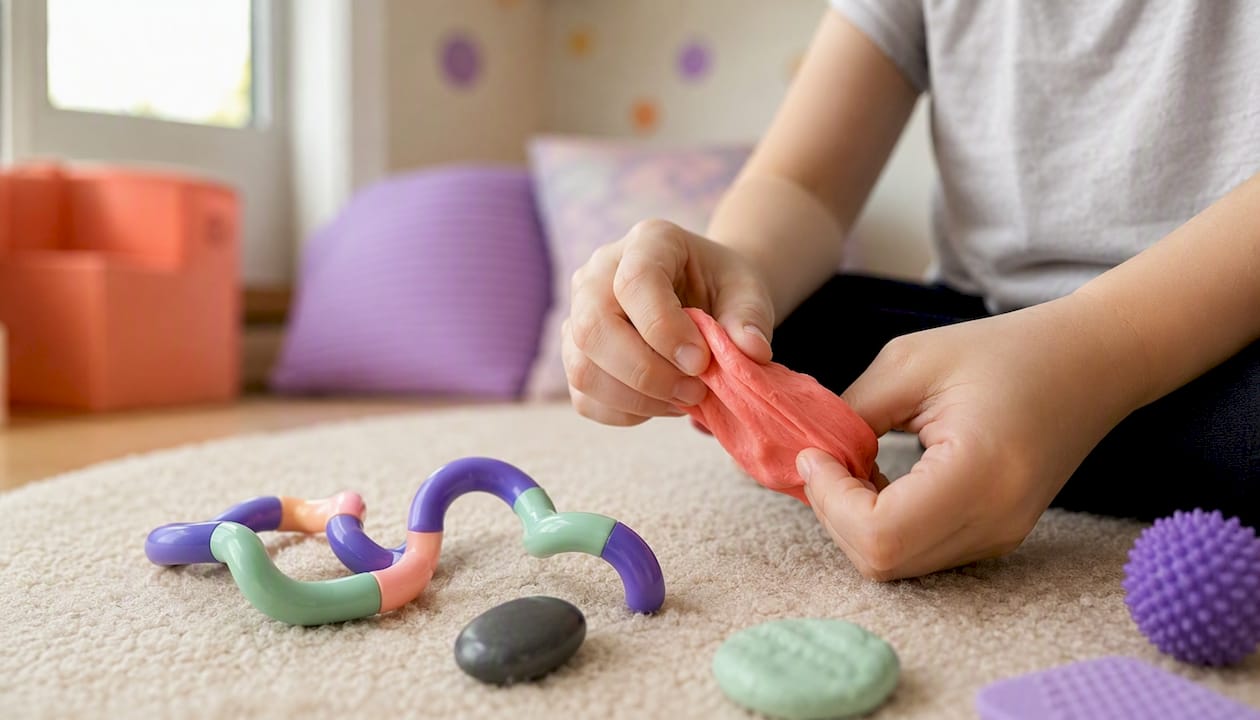
The main types of fidget toys fall into five categories: resistance/squishy (therapy putty, stress balls), motion/kinetic (fidget spinners, Tangle), texture/tactile (worry stones, textured strips), pop/click (Pop It, snap clickers), and wearable (fidget rings, spinner rings). If you’re starting from scratch, therapy putty is the single most versatile first pick — it’s quiet, endlessly repeatable, and works for a wide range of sensory needs.
Quick picks by category:
- Resistance: therapy putty or a firm stress ball
- Motion: Tangle Classic (quieter than a spinner)
- Texture: smooth worry stone or mochi squishy
- Pop/click: silicone Pop It (low noise, washable)
- Wearable: plain metal fidget ring (discreet, meeting-safe)
Start at home. Once you know which input helps, test it in the real setting — school, meeting, or commute. Choose the quietest option that delivers the right sensory feedback.
Key takeaways
The most effective fidget toy is the quietest one that delivers the specific sensory input the person actually needs — tried during a real task, not as a reward.
| Point | Details |
|---|---|
| Match tool to sensory need | Resistance for calming, motion for energy release, texture for grounding, wearable for discretion. |
| Start quiet | Silent or near-silent tools (putty, worry stone, fidget ring) work in the widest range of settings. |
| Trial during tasks | Give the fidget during a demanding activity, not as a prize; observe for one week before deciding. |
| Safety and cleaning matter | Check for small parts under age 3; replace putty when dirty; wash silicone with soap and water. |
| Fidget and Spin sessions | Weekly sensory play in Brighton lets children try different fidgets in a supported, SEN-friendly space. |
Table of Contents
- What are the main types of fidget toys and what does each one do?
- How to choose the right fidget for the person and the setting
- Safety, cleaning, and what to look for in materials
- What does the research actually say, and what do practitioners recommend?
- What I’ve learned from using fidgets in real life
- Sensory sessions and SEN-friendly parties in Brighton and Hove
- Sources
- FAQ
What are the main types of fidget toys and what does each one do?
Remy went through about six different fidgets in one term. Some helped. Some became projectiles. The difference, I’ve learned, is almost always about matching the type of input to what his nervous system is actually asking for — not just grabbing whatever’s in the drawer.
Here’s how the main categories break down.
1. Resistance and squishy fidgets
Therapy putty (also called therapeutic putty) is the workhorse of the sensory toolkit. You squeeze, stretch, pull, and roll it. The resistance gives proprioceptive feedback — the kind of deep-pressure input that can genuinely settle an overloaded nervous system. It’s silent, portable, and comes in different resistance levels (soft through extra-firm). Stress balls and mochi squishies sit in the same family: lower resistance, faster to use, good for quick regulation moments.
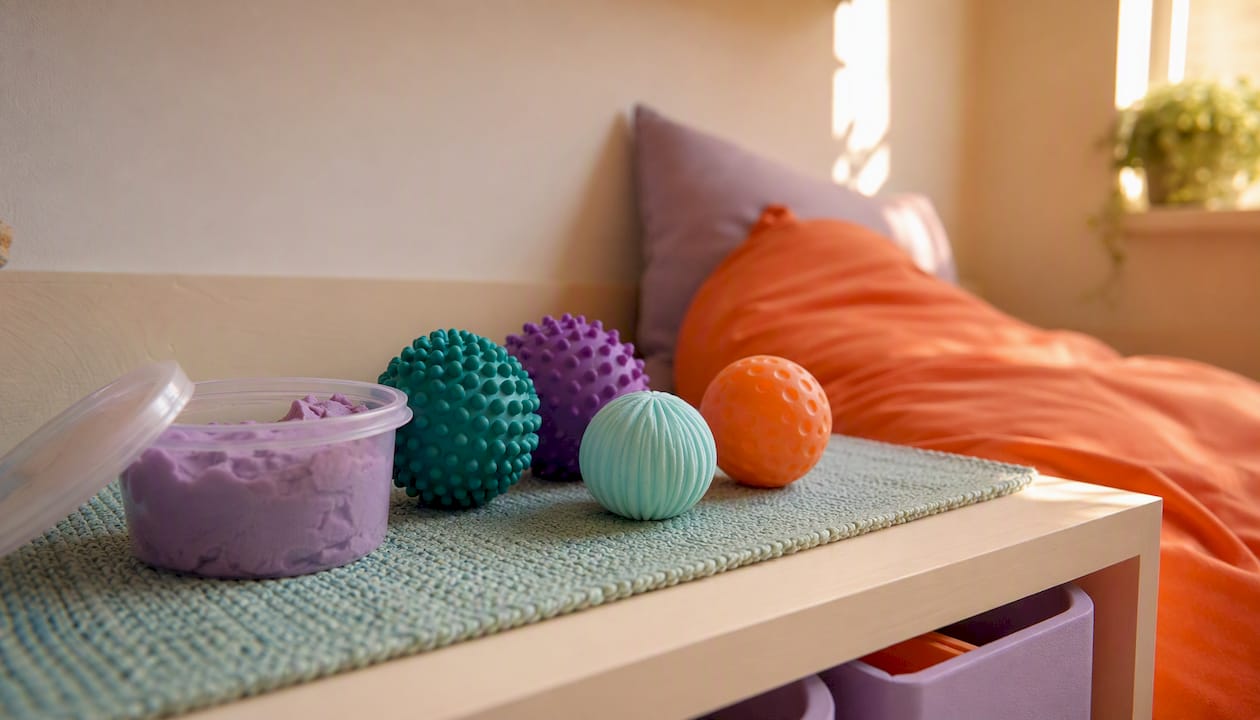
Noise level: silent. School/meeting friendliness: excellent.
2. Motion and kinetic fidgets
Fidget spinners are the ones everyone knows. They give vestibular-adjacent motion feedback through the fingers. The problem is that academic reviews note spinners have the least consistent evidence for improving on-task behaviour and can distract other children. The Tangle Classic is a better classroom bet: a series of interconnected curved sections you twist and reshape quietly. It keeps hands busy without the visual spectacle.
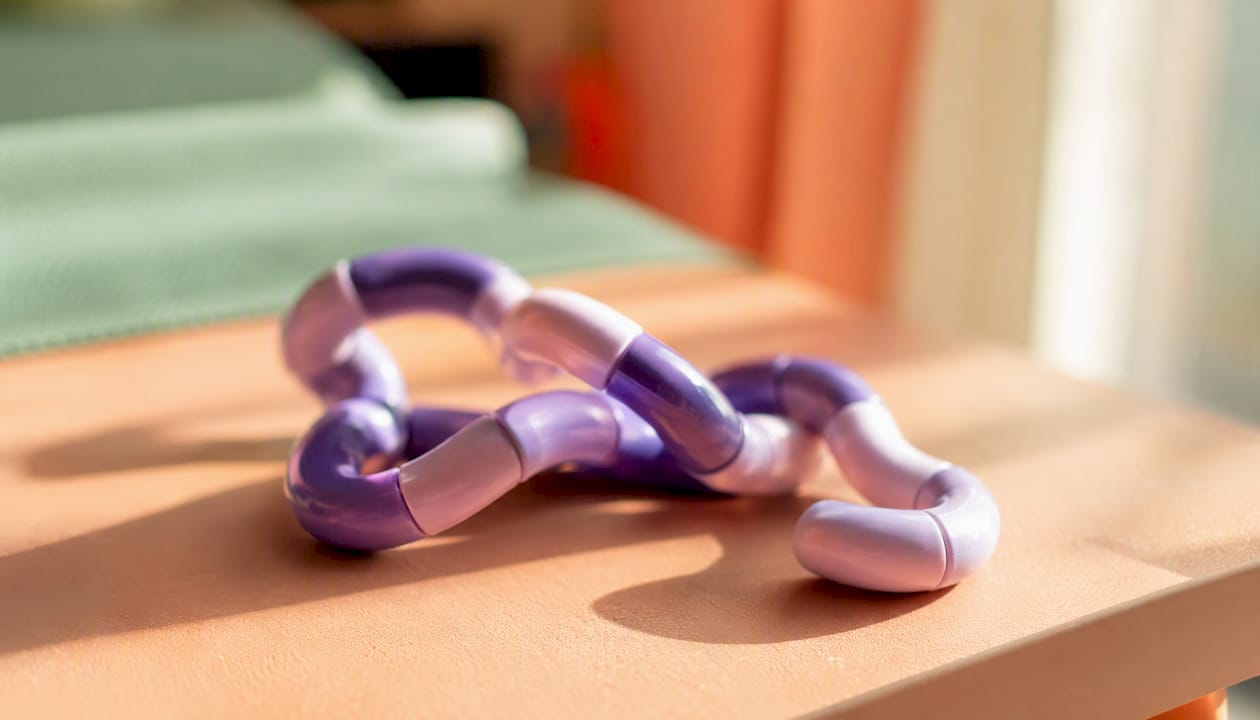
Noise level: low (Tangle) to medium (spinner). School friendliness: Tangle yes, spinner use with caution.
3. Texture and tactile fidgets
Worry stones are smooth, palm-sized stones with a thumb-sized indent. You rub the indent. That’s it. Deceptively calming. Textured sensory strips (adhesive strips with bumps, ridges, or velcro-like surfaces) can be stuck under a desk so a child gets tactile input without anyone noticing. Mochi squishies add a soft, slightly sticky texture that some children find deeply regulating.
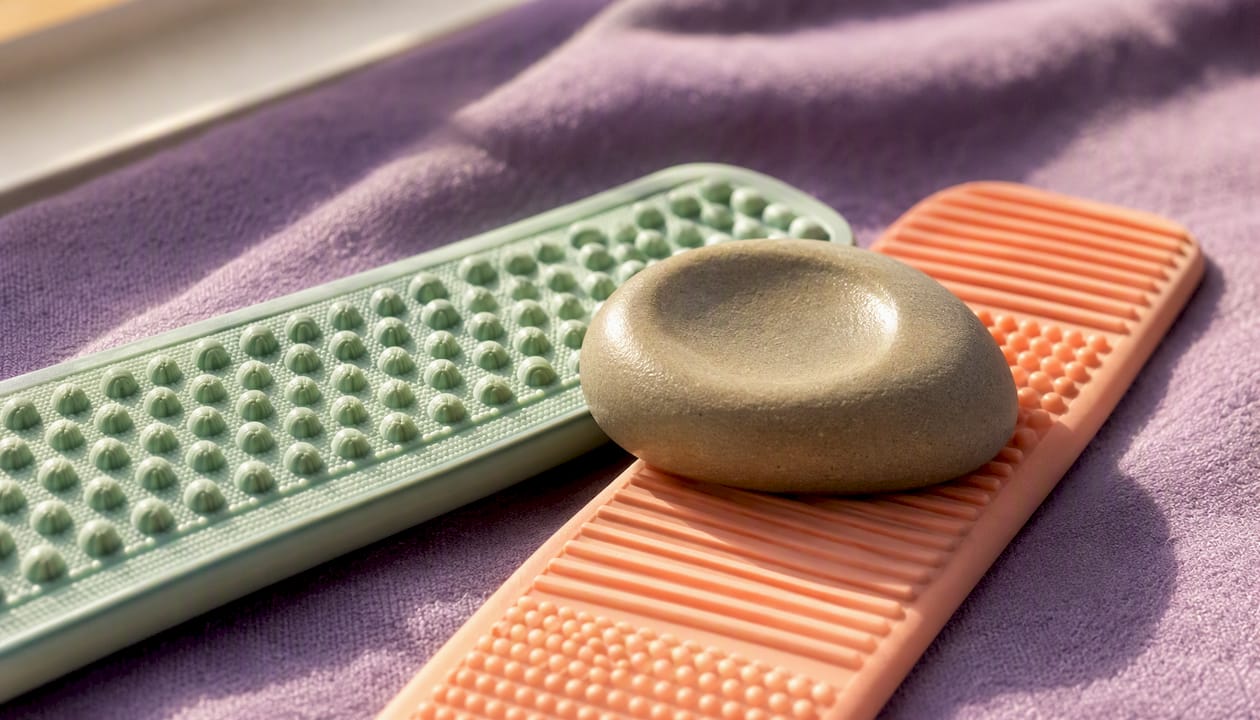
Noise level: silent. School friendliness: excellent, especially under-desk strips.
4. Pop and click fidgets
Pop It toys — silicone sheets with bubbles you push through — became ubiquitous after 2021. They’re washable, cheap, and satisfying. The pop sound is low but audible in a quiet classroom, so context matters. Snap-and-click toys (small plastic or metal mechanisms) give a sharper, more defined click. Both types suit children who seek repetitive, predictable sensory loops.
Noise level: low to medium. School friendliness: moderate — check the setting.
5. Wearable fidgets
Fidget rings and spinner rings are worn on the finger and turned, spun, or pressed. They’re the most discreet option in the entire category — genuinely invisible in a meeting or classroom. Plain metal bands with a spinning outer ring are the most durable. Avoid cheap plastic versions; the mechanism wears out quickly.
Noise level: silent. Meeting/school friendliness: excellent.
6. Cognitive and puzzle fidgets
Fidget cubes have six sides, each with a different mechanism: a joystick, a dial, buttons, a switch, a rolling ball, and a rubbing pad. They suit people who need variety rather than repetition. Sliding tile puzzles and small magnetic fidget sets also sit here. These work well at home or in low-demand settings but can pull attention away from a task if the puzzle element is too engaging.
Noise level: low to medium. School friendliness: moderate.
Comparison at a glance
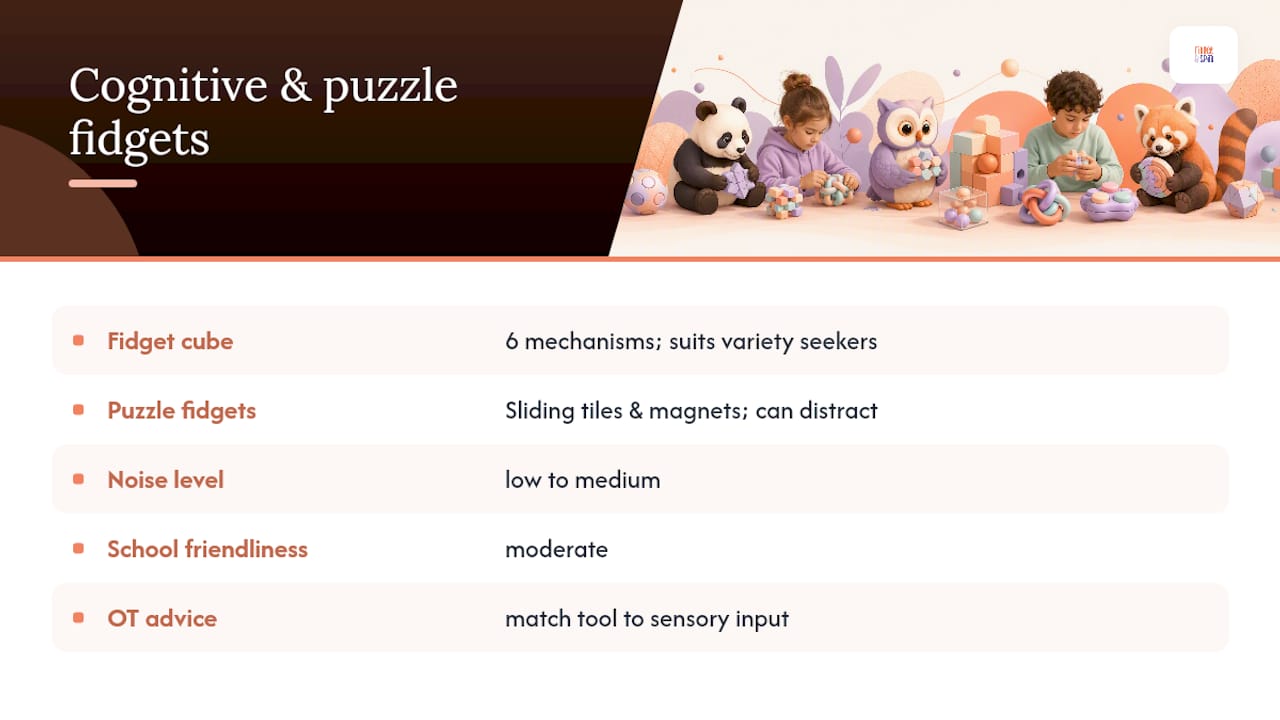
Occupational therapists recommend matching the tool to the specific sensory input a person seeks rather than choosing by popularity or novelty.
How to choose the right fidget for the person and the setting
The wrong fidget doesn’t just fail to help. It can make things worse — a clicky toy in a silent exam hall, a spinner that three other children are now watching instead of the board.
Step-by-step selection checklist:
- Identify the setting. Classroom or meeting needs silent or near-silent tools. Home or sensory sessions allow more variety.
- Name the sensory need. Is the person seeking calming input (resistance, texture) or stimulating input (motion, click)? Match the tool to the need.
- Check noise tolerance. Educators and occupational therapists consistently recommend quiet, low-tech options for school and work settings. Bright or noisy toys tend to become distractions rather than tools.
- Consider portability. A fidget ring or worry stone fits in a pocket. Putty needs a container. Choose what the person will actually carry.
- Check age and choking risk. Small parts — spinner bearings, cube buttons, tiny stones — are a risk for children under 3. Oral chews are safer than hand fidgets for children who mouth objects.
- Trial at home first. Give the tool during a demanding task (homework, a puzzle) rather than as a reward. Observe for 10–15 minutes.
- Test in the real setting. Set a one-week window. Note whether attention or task completion improves. If it doesn’t, swap the type — not just the brand.
- Replace when it stops helping. A fidget that’s become a toy is no longer doing its job.
Pro Tip: The quietest item that delivers the right sensory input is almost always the best choice. If a child is watching the fidget rather than using it peripherally, it’s too visually interesting.
On cost: cheap plastic breaks fast. For daily-use items — a fidget ring, a Tangle, a pot of putty — spending a little more upfront saves money over time. A good metal spinner ring or a branded Tangle lasts years. A £1 plastic cube from a market stall lasts a week.
Safety, cleaning, and what to look for in materials
The first time Remy put a fidget spinner bearing in his mouth, I aged about five years. Age and material safety matter more than most product listings admit.
Age and choking risk by type:
- Under 3: avoid anything with small parts. Stick to large silicone squishies, fabric fidgets, or purpose-made oral chews.
- 3–5: supervision needed with putty (don’t eat it), Pop Its (check for tears), and any toy with a removable component.
- 5+: most hand fidgets are appropriate with basic supervision.
- Oral seekers at any age: use purpose-made chew tools (chewelry, chew pendants) rather than repurposing hand fidgets.
Cleaning by material:
- Silicone (Pop It, silicone rings): wash with warm soapy water. Air dry. Replace if cracked.
- Solid plastic or metal (Tangle, fidget cube, fidget ring): wipe with a damp cloth or antibacterial wipe. Dry thoroughly.
- Therapy putty: do not wash. Replace when it picks up fluff, changes colour, or smells. Store in its original container.
- Fabric fidgets: hand wash or machine wash in a mesh bag. Check the label.
- Broken items: discard immediately. A cracked Pop It or a spinner with a loose bearing is a hazard.
Material safety: for oral chews, look for non-phthalate, food-grade silicone or medical-grade materials. Avoid unbranded items with no material information. For hand fidgets, standard non-toxic plastic or metal is fine. Longevity beats novelty — a small number of quality, washable items is better than a drawer full of throwaway plastic.
Age warning: in early years settings, community groups, and any environment where supervision varies, always check for small parts before handing a fidget to a child under 5.
What does the research actually say, and what do practitioners recommend?
I’ll be honest: when I first started reading the research on fidget toys, I expected a clear answer. I didn’t get one.
A meta-analysis of fidget devices concluded that the overall evidence for academic and behavioural improvements is inconclusive and highly dependent on study context and implementation. Classroom studies show mixed results: some found fidgets reduced disruptive movements when used appropriately alongside demanding tasks; others found neutral or negative effects, particularly when fidgets were given as a reward rather than a concurrent tool. Researchers reviewing classroom evidence noted that marketers’ claims consistently outpace the empirical evidence, and that careful selection, introduction, and monitoring are needed.
For adults with ADHD, the picture is slightly more encouraging. Some experimental research suggests that fidgeting can provide compensatory stimulation that helps sustain attention during cognitive tasks, though individual responses vary considerably.
In our sessions at Fidget and Spin, I’ve watched Remy and other children try both therapy putty and fidget spinners during a structured activity. The putty kept hands busy without pulling eyes away from the task. The spinner became the task. That’s not a clinical trial — but it’s consistent with what the research on fidget tools for neurodiverse children suggests about concurrent use.
Three practitioner-informed tips for recording whether a fidget helps:
- Set a short observation window (one week, same task, same time of day) and note task accuracy or engagement before and after introducing the tool.
- If attention improves and the fidget stays peripheral (not watched, not played with), keep it. If the child is focused on the fidget, swap the type.
- Rotate tools when usefulness wanes. The right fidget can change by day — that’s not failure, it’s normal sensory variability.
Fidgets support regulation. They don’t replace larger movement breaks, a sensory diet, or a broader regulation plan. Use them as one tool among many, not as the whole answer.
What I’ve learned from using fidgets in real life
I remember standing in a soft play café, watching Remy’s hands. He’d been given a bright, flashing spinner as a party bag gift. He was completely absorbed in it — not in the room, not in the play, just the spinner. We left early. Again.
A few weeks later, a friend handed him a small piece of knotted yarn. He twisted it through his fingers for forty minutes while we sat in a waiting room. He was calm. He was present. He answered questions. The yarn cost nothing.
That moment shifted how I think about the benefits of fidget toys. The flashiest option is rarely the most useful one. A smooth worry stone, a loop of yarn, a pot of putty — these low-cost, low-novelty tools often outperform the ones with the best packaging. Test, watch, and be willing to change. Fidgets are one part of a sensory toolbox, not a fix. And if something stops working, that’s fine. Swap it.
Sensory sessions and SEN-friendly parties in Brighton and Hove
If you want to see different types of fidgets in action — and watch your child try them in a genuinely safe, sensory-led space — Anthony and I run weekly stay-and-play sessions at Fidget and Spin in Brighton. Our Squish & Squeeze zone is built around exactly this: putty, tactile strips, Pop Its, worry stones, and more, all tested with neurodiverse children aged 1–6.
We also run SEN-friendly birthday parties across Brighton, Hove, and wider Sussex, with three packages starting at £220. Every party is designed for children with autistic, ADHD, PDA, and sensory-processing differences — flexible, low-pressure, and built around what actually works for families like ours. Have a look at what’s available and get in touch to check dates.
Sources
- Using Fidget Spinners to Improve On-Task Classroom Behavior for Students With ADHD - PMC
- Choosing the Right Fidgets for Elementary Students With Sensory Needs | Edutopia
- A Meta-Analysis of Fidget Devices as Academic and Behavioral Interventions
- Frontiers in Psychiatry article (2024) on fidgeting and attention
This article is general information, not a substitute for advice from a qualified doctor. Consult a qualified healthcare professional about your own circumstances before acting on anything here.
FAQ
What are the main types of fidget toys?
The main types are resistance/squishy (therapy putty, stress balls), motion/kinetic (Tangle, fidget spinners), texture/tactile (worry stones, textured strips), pop/click (Pop It, snap clickers), wearable (fidget rings), and cognitive/puzzle (fidget cube). Each type delivers a different kind of sensory feedback.
What is the best type of fidget toy for ADHD?
For ADHD, quiet resistance tools like therapy putty or a Tangle Classic tend to work well because they keep hands busy without pulling visual attention away from a task. Research suggests fidgeting can provide compensatory stimulation that helps some adults with ADHD sustain attention, though individual responses vary.
What are some good fidget toys for use in school or meetings?
Therapy putty, worry stones, under-desk textured strips, and plain fidget rings are the most meeting- and classroom-friendly options because they are silent and visually unobtrusive. Occupational therapists recommend quiet, low-tech fidgets over bright or noisy ones, which tend to distract rather than support focus.
Do fidget toys actually work?
The evidence is mixed. Some classroom studies show benefits when fidgets are used during demanding tasks rather than as rewards, but a meta-analysis found overall results inconclusive and highly context-dependent. Practical testing with observation over a short, defined period is the most reliable way to judge whether a specific tool helps a specific person.
Recommended
- Benefits of fidget toys for neurodiverse children | Fidget and Spin Brighton
- Why kids need fidget toys: a parent’s honest guide | Fidget and Spin Brighton
- What are fidget toys? A parent’s guide for neurodiverse kids | Fidget and Spin Brighton
- How fidget toys help focus in neurodiverse children | Fidget and Spin Brighton