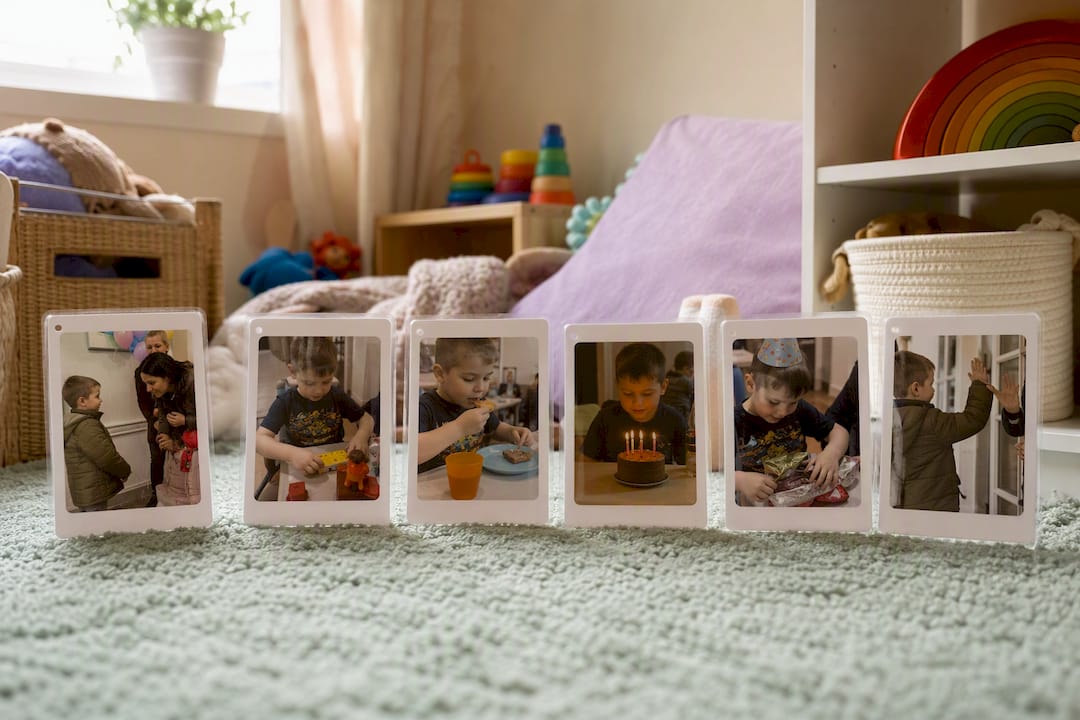
Make a four to six card picture schedule showing arrival, play, food, cake and goodbye. Agree an exit signal with your child before you leave the house. Do these two things and you strip out most of the uncertainty that makes birthday parties so hard for neurodiverse children.
A visual schedule is just a sequence of pictures showing what happens, in order. No jargon, no special kit. You can build one in the next ten minutes with paper and a biro.
Here’s your immediate task, before you read another word:
- Pick four to six moments: arrival, playing, food, cake, presents (optional), goodbye.
- Find or draw a picture for each. Photos work best if you have them.
- Stick them in order on card, paper, or a phone note.
- Agree a code word or a fixed time (“we leave after cake”) with your child now, not at the party.
Everything below explains why this works and gives you three templates you can copy exactly.
Key Takeaways
A visual schedule works because it replaces uncertainty with a fixed, visible sequence your child can check, control, and trust.
| Point | Details |
|---|---|
| Build a short schedule | Four to six cards covering arrival, play, food, cake, and goodbye is enough for most parties. |
| Agree an exit signal first | A pre-agreed code word or fixed time gives your child control and often helps them stay longer. |
| Match blocks to age | Toddlers need roughly eight to twelve-minute blocks, preschoolers ten to fifteen, before a change of pace. |
| Pack a sensory kit | Headphones, fidgets, a familiar snack and a comfort object cover most day-of needs in one small bag. |
| Fidget and Spin builds it in | The Wee One, Big One, and Whole Shebang party packages include a host brief, quiet zone, and printed visuals as standard. |
Table of Contents
- Why a visual schedule for a birthday party actually works
- How to build a visual schedule for a birthday party step by step
- Three templates you can copy today
- The day-of checklist and sensory kit
- Sharing and rehearsing the schedule before the day
- Caitlin’s real examples from Fidget and Spin sessions
- Customising the schedule to your child’s own sensory profile
- What actually goes wrong with visual schedules at parties
- Picture cards, whiteboards, or an app: which format suits your child
- Letting your child help build their own schedule
- Handling the unexpected without losing the plan
- Print the template. Skip the guilt.
- Party planning that actually removes the load, not just the noise
- Sources
- FAQ
Why a visual schedule for a birthday party actually works
Nobody warns you how much of parenting an autistic or ADHD kid is arithmetic. How many minutes until this gets too much. How many exits are near. I used to do that maths standing in soft play doorways, coat already half on, watching my son’s shoulders creep up towards his ears.
Uncertainty is the enemy, not noise or people necessarily. A child who doesn’t know what’s coming next has to hold every possibility in their head at once, and that’s exhausting before the party has even started. Previewing what’s ahead with photos or a short walkthrough reduces that arrival anxiety because the unknown becomes known. A picture schedule does the same job, just portable.
I remember the first time it worked properly. Remy was four, invited to a party at a trampoline place, the kind of venue that’s basically a wall of noise. We made four cards the night before. Bounce, snack, cake, home. He held that scrap of paper the whole time. When the DJ started up “Happy Birthday” too loud, he didn’t bolt, he checked the card.
Knowing cake comes before home meant he could tolerate the bit he hated. The schedule wasn’t a nice extra. It was the thing that let him stay.
That’s the whole argument for a visual schedule birthday party approach: it isn’t decoration, it’s regulation.
How to build a visual schedule for a birthday party step by step
You don’t need an app, a laminator, or a Pinterest board. You need paper, something to write with, and about fifteen minutes.
Materials checklist:
- Four to eight small pictures or symbols (photos, drawings, printed icons, or words if your child reads).
- Something to stick them to: card, a strip of paper, a cheap whiteboard, or a phone photo gallery.
- Velcro dots if you want cards removable, so your child can pull each one off as it’s done.
- A pen for last-minute changes.
Choosing steps matters more than making them pretty. Keep each card to one clear moment, not a paragraph. “Cake” not “we’ll all sing and then there might be candles and everyone claps.” One picture, one word underneath if that helps.
Order them the way the party will actually run: arrival, an activity block, food, cake, a possible second activity, goodbye. Six steps is usually the ceiling before it stops being useful and starts being another thing to process.
Timing needs to match age, not ambition. Toddlers manage blocks of roughly eight to twelve minutes before needing a change of pace; preschoolers can often stretch to ten or fifteen. Build your schedule around blocks that short, then let the party run longer within them rather than lengthening any single block.
For accessibility, adjust the format to the child, not the other way round. Toddlers and children who don’t yet read need photos. Some children respond better to simple line-drawn symbols, the kind used in PECS. If your child uses AAC, add the schedule as labelled buttons on their device so they can point to “next” themselves. A short video or social story works for children who process moving images better than a static line of cards.
Pro Tip: Laminate one blank card and keep a whiteboard pen in your bag. When plans change on the day, a hastily added or swapped card beats no update at all.
Three templates you can copy today
You don’t need to design this from scratch. Here are three starting points by age, each built around short blocks and a clear ending.
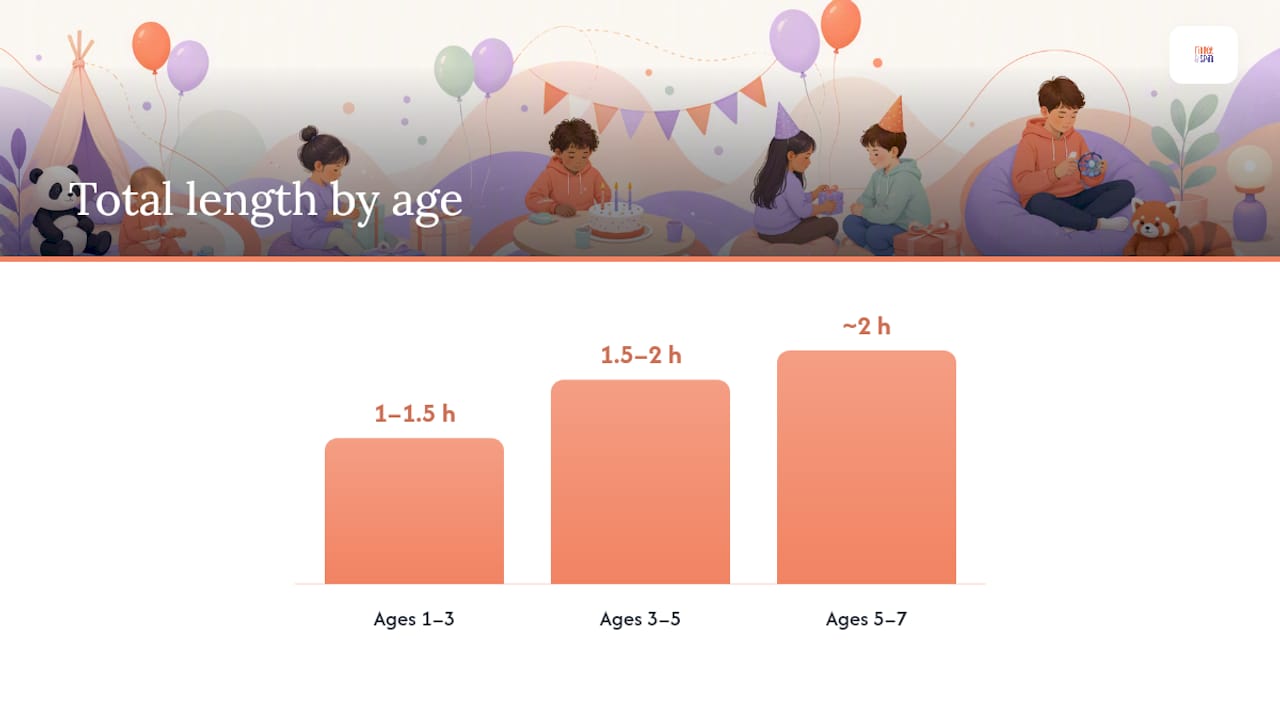
Template A, ages one to three: aim for one to one and a half hours total. Four cards: arrive, play, snack, home. Keep transitions physical, carrying your toddler between zones rather than relying on verbal instruction, since language processing under excitement is patchy at this age anyway.
Template B, ages three to five: one and a half to two hours. Five cards: arrive, activity one, food, cake, quiet corner or wind-down, home. The quiet card matters. Building in a deliberate lull before goodbye stops the ending itself from becoming another overstimulating event.
Template C, ages five to seven: around two hours. Six or seven cards with rough times attached: arrive (10 min), free play (20 min), games (20 min), food (20 min), cake (10 min), open presents or free play (20 min), home. At this age some children like ticking off the whiteboard themselves.
| Age band | Total length | Cards | Key feature |
|---|---|---|---|
| 1–3 years | 1–1.5 hours | 4 | Simple arrival to exit focus |
| 3–5 years | 1.5–2 hours | 5 | Includes a wind-down card |
| 5–7 years | ~2 hours | 6–7 | Timed blocks with planned free play |
None of these are fixed. If your child is flagging, compress the food block and head straight to the quiet card early. If they’re thriving, stretch free play and slot cake in later. The schedule bends. That’s the whole point of having one.
The day-of checklist and sensory kit
Nobody wants to be hunting for ear defenders in the car park five minutes before the party starts. Sort this the night before, or at worst over breakfast.
Brief the host with one message: is there a quieter room, where’s the toilet, where’s the nearest exit. A designated quiet space and an early, one-to-one introduction to the host makes a genuine difference to how the whole afternoon goes.
Pack your sensory kit:
- Ear defenders or headphones.
- A couple of favourite fidgets.
- A snack you know they’ll actually eat, not party food roulette.
- One comfort object.
- Sunglasses if lights or reflections are a trigger.
- Tissues and a spare top, because cake happens.
Pro Tip: Arrive five to ten minutes early. It lets your child see the room fill up gradually rather than walking into a wall of noise and bodies already at full volume.
Sit near the door if you can, and decide in advance which adult is holding the exit plan. It shouldn’t be a group decision made under pressure at 3pm.
Sharing and rehearsing the schedule before the day
A schedule nobody’s seen before is just a nice piece of paper. Start showing it two or three days out, then run through it calmly on the morning itself, no rushing.
- Two or three days before: show the cards, name each one out loud, let your child handle them.
- The morning of: run through it once more, slower, without the school-run panic in your voice.
- Send hosts a short message: “He’s autistic, does best with a quieter corner if there is one, and might need to leave early. Thank you for having him.”
- Role-play the sequence in your kitchen: “first we arrive, then we play for fifteen minutes, then cake.” Say it in the same order every time.
If your child asks to leave mid-party, that’s the schedule doing its job, not failing at it. Check the code word, offer the quiet card, and go if they need to go.
Caitlin’s real examples from Fidget and Spin sessions
The code word we use with Remy is “biscuits.” Ridiculous, I know. But at one party, he said it flatly in the middle of pass-the-parcel, and because we’d agreed it meant “leaving in five minutes, not right now,” he managed those five minutes without a meltdown.
Our three sensory zones map onto a schedule almost exactly. Wiggle & Bounce slots in as the big movement card. Squish & Squeeze covers tactile play and fidget time. Snuggle & Chill is the quiet card every schedule needs somewhere near the end. If you’re planning games for the movement block, our autism-friendly party games guide has ideas that fit straight in, and the full planning guide goes deeper on the whole day.

Customising the schedule to your child’s own sensory profile
Every child’s schedule should look slightly different, because every child’s triggers are different. There’s no universal version, whatever the printable templates online suggest.
If noise is the main issue, put the loudest moment, usually singing and candles, in the middle of the schedule rather than right before goodbye, so your child isn’t ending on the hardest bit. If transitions themselves are the trigger rather than any single activity, add a “nearly time” card between every step, a simple amber warning that something’s about to change.
For children who find unfamiliar food distressing, add a food card that shows a safe snack you’ve brought rather than the party spread. That single swap avoids a lot of standing-around-not-eating-while-everyone-stares. Our picky eater party food guide has practical swaps if this is a recurring issue for you.
If your child struggles more with people than noise, add a card for “find a quiet corner” that they can use any time, not just at a fixed point in the sequence. Some children want that option available throughout rather than scheduled once.
Watch for the difference between a preference and a hard trigger. A preference is something they’d rather not do but can tolerate briefly, like wearing a paper hat. A trigger is something that reliably tips them into distress, like sudden loud singing. Build the schedule around protecting against triggers first, and treat preferences as flexible.
Update the schedule after each party. What worked, what didn’t, what surprised you. Keep a running note on your phone. By the third or fourth party you’ll have a genuinely tailored template rather than a generic one.
What actually goes wrong with visual schedules at parties
The most common failure isn’t the schedule itself, it’s forgetting that real parties don’t run to time. Games overrun, cake comes early because another child is having a meltdown, the bouncy castle turns up late. If your schedule is a fixed script rather than a flexible sequence, the first hiccup undoes all your prep.
Fix this by building slack into the schedule from the start rather than trying to patch it live. Add a blank card labelled “something might change” somewhere in the middle, so an unexpected shift is itself expected.
Another common problem: other adults not knowing the schedule exists. A well-meaning relative decides to skip straight to presents, and your carefully sequenced cake-then-goodbye structure collapses. Brief whoever’s running proceedings, even briefly, so the schedule isn’t just something you and your child understand.
Cards going missing or getting damp with cake icing is more common than anyone admits. Keep a spare set in your bag, or photograph each card so you have a backup on your phone.
Some children fixate on the schedule itself, refusing to move on even when an activity naturally needs to end. If that happens, build a five-minute warning into your rehearsal, “two more minutes, then we cross this one off,” so the transition is expected rather than sudden.
And sometimes, honestly, the schedule just doesn’t land that day. Tiredness, an off morning, a change nobody could have predicted. That’s not the method failing, that’s a child having a hard day. The exit plan exists for exactly this.
Picture cards, whiteboards, or an app: which format suits your child
Picture cards on card or laminated strips are the most flexible option and cost almost nothing. You can rearrange them instantly if the party changes shape, and they survive being dropped, sat on, or gripped tightly through a wobble. The downside is they’re easy to lose and need making in advance.
A whiteboard with symbols drawn on works well for children who like the physical act of crossing things off. Visible progress, wiping or crossing off each completed step, is itself regulating because it gives a concrete sense of moving forward rather than an open-ended wait. It’s less portable than cards, though, and not much use once you’re actually at the venue.
A phone photo album, just a sequence of images swiped through in order, travels well and needs no printing. Many parents already have the photos. The drawback is that a phone is also a source of other notifications and distractions mid-party, which can undercut the calm you’re going for.
Dedicated visual schedule apps exist and some families get on well with them, particularly for children who already use a tablet for AAC. They’re more fiddly to set up than a paper version and rely on the device staying charged and in reach all afternoon, which at a bouncy castle party is not guaranteed.
For most families starting out, paper cards remain the easiest entry point. Low cost, no charging, and forgiving if a five-year-old grips one until it’s crumpled.
Letting your child help build their own schedule
A schedule your child had no say in is still better than nothing, but one they helped build tends to get more buy-in on the day. Even a three-year-old can point at which picture they want for “playing” versus “presents.”
Sit down together a few days before and lay out picture options for each slot. Let them choose between two photos rather than facing a blank page, choice from a limited set feels manageable in a way open-ended choice doesn’t. Ask which part of the party they’re most looking forward to, and put that card somewhere they’ll see it early, so there’s something to anchor to.
For children who read, let them write the words themselves rather than you writing for them. It sounds small, but ownership of the object seems to matter, the schedule becomes theirs rather than something imposed.
Older children in the five to seven range can help decide the exit code word too. Remy chose “biscuits” himself, and I’m fairly sure part of why it works is that it was his idea, not mine.
If your child wants to include something you know won’t happen, a pony, say, don’t just refuse. Talk through why, then let them pick something realistic to replace it. That negotiation is itself useful practice for handling disappointment in a lower-stakes moment than the party itself.
Handling the unexpected without losing the plan
Plans change. The magician’s late, another child’s crying, the venue’s swapped rooms without telling anyone. None of that has to undo your schedule if you’ve built in a way to adapt it live.
Keep a blank card and a pen in your bag at all times, not just as a backup but as your main tool for handling disruption. When something shifts, physically add or swap a card while narrating it: “look, we’re doing games now instead of food, then food after.” Seeing the change made visible is far less distressing than an unexplained shift in what’s happening around them.
If a scheduled moment gets skipped entirely, cross it off anyway rather than leaving it hanging. An unfinished, ambiguous card is worse for many children than one clearly marked done, even if “done” means “we’re not doing that today.”
Watch for early signs that a disruption is landing badly, stimming increasing, going quiet, gripping the schedule tighter. That’s your cue to use the quiet card or head towards the exit plan, not to push through and hope it settles. Identifying the two or three highest-risk moments in advance, arrival, singing, presents, means you’re watching for trouble at the right moments rather than being caught out.
And if the whole thing needs to end early, that’s not the schedule failing. That’s the schedule doing exactly what it’s for: giving your child, and you, a clear, pre-agreed way out.
Print the template. Skip the guilt.
Here’s my honest opinion after years of doing this and watching other parents do it too: most advice on this topic is too abstract to use under pressure. Nobody remembers a paragraph of tips at 2pm in a soft play with cake on their sleeve. They remember a card in their pocket.
That’s why I’d rather hand you three templates than three thousand words of theory. Print one, adapt it in five minutes, use it. The conventional advice tends to focus on the child’s behaviour, staying calm, managing meltdowns, when the actual lever is further upstream: reduce the uncertainty before it becomes a behaviour at all.
If I had to pick the one thing to prioritise first, it’s the exit plan, not the schedule itself. A schedule without a genuine, honoured exit code is just a countdown to a moment your child can’t control. With one, the whole afternoon changes shape. Your child isn’t enduring the party. They’re choosing to stay in it, minute by minute, because they know they can leave.
That’s not a small distinction. It’s the whole method.
Party planning that actually removes the load, not just the noise
There are other routes to a calmer birthday: DIY visual schedules, borrowed venues, a friend who’s good with kids. All of them still leave you doing the planning, the briefing, and the worrying on the day. Fidget and Spin exists because Anthony and I got tired of building this from scratch every single time, so we built the version that comes pre-built.
Our SEN-friendly birthday parties across Brighton, Hove and Sussex come in three packages. The Wee One (£220) suits a small, low-key celebration for younger children. The Big One (£320) adds more space and activity time for a fuller guest list. The Whole Shebang (£530) covers a longer, full-scale party across all three sensory zones. Every package includes a pre-visit, a host brief so nobody else needs explaining to on the day, a dedicated quiet zone, and printed visuals built into the setup rather than bolted on. If you’d like to see how our sessions structure the three zones into a working schedule, our session breakdown walks through it. Get in touch to check dates and we’ll send you a printable schedule template to use whichever package you choose.
Sources
For more depth on sensory-friendly party planning, They Are The Future’s guide to sensory-friendly parties covers the adjustable-dials approach in full, and Party Genius AI’s timeline generator helps you build out block timings for any age.
Closer to home, our guides on throwing a quiet birthday party and real Brighton party stories go further into local, practical setups.
- Strategies for Helping a Child With Autism Navigate a Birthday Party | Inclusive ABA
- Party Timeline Generator: Day-Of Schedule (2026) | Party Genius AI
- Sensory-Friendly Birthday Party Planning Guide — CEC
FAQ
What is a visual schedule for a birthday party?
It’s a short sequence of pictures, usually four to eight, showing the party’s key moments in order, from arrival through to goodbye, so a child knows what’s coming next.
How many steps should a birthday party schedule have?
Most children manage best with four to six cards; more than that tends to become another thing to process rather than a help.
What age should I start using a visual schedule?
You can start from around age one with very simple photo sequences, adjusting the number of cards and block length as your child grows.
What if my child wants to leave the party early?
That’s the exit plan working as intended. A pre-agreed code word or fixed time means leaving is a planned choice, not a crisis.
Does Fidget and Spin provide visual schedules at its parties?
Yes. Every Fidget and Spin party package includes printed visuals and a host brief built into the setup, so the schedule is ready before guests arrive.
Recommended
- Birthday without party ideas: practical alternatives for parents | Fidget and Spin Brighton
- Birthday party for a non verbal child: a real guide | Fidget and Spin Brighton
- How to throw a quiet birthday party for neurodiverse kids | Fidget and Spin Brighton
- Planning a birthday for an autistic child: a real guide | Fidget and Spin Brighton