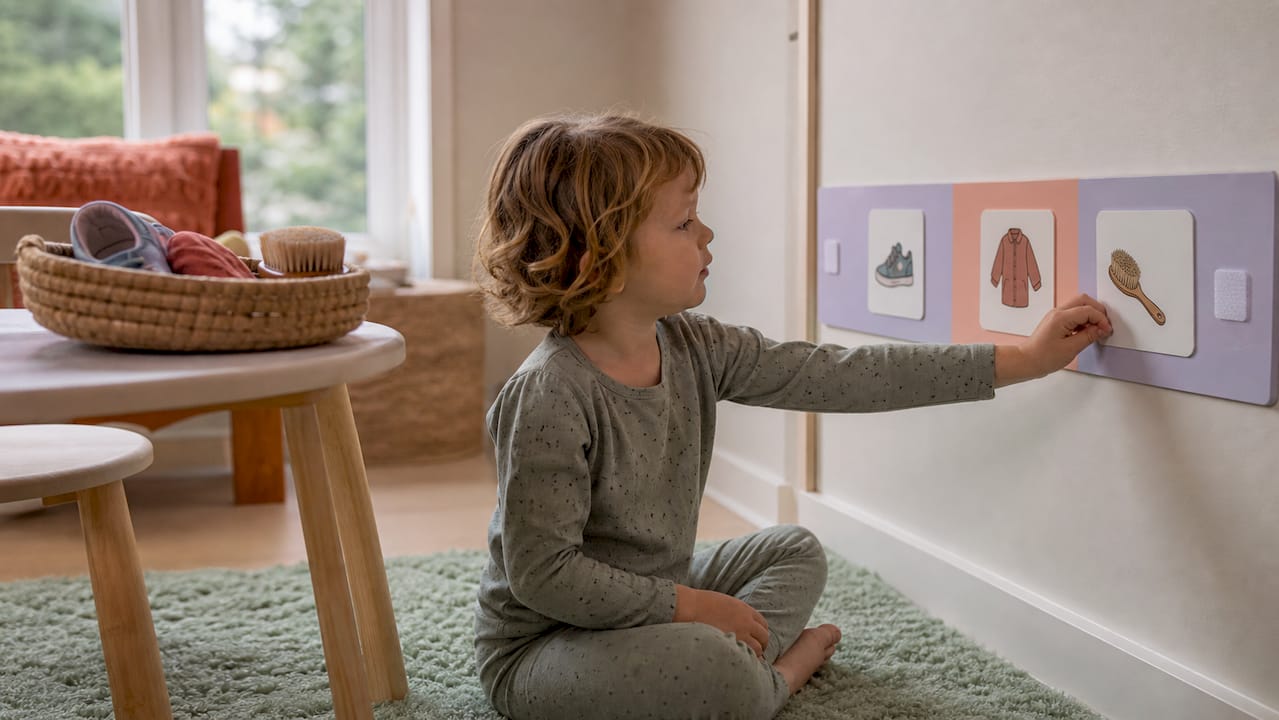
A simple visual timetable can cut morning meltdown time and increase independence. Do it now: pick one routine and make a three-step “first/then” board. That’s it. Match the pictures to how your toddler communicates, whether that’s an object, a photo, or a symbol, and use it before you try anything more complicated.
TL;DR:
- Visual timetables are most effective when starting with a simple routine that causes stress, such as leaving the house or morning preparations.
- Using real objects or photographs that match the child’s developmental stage enhances understanding and encourages independence.
- Gradually fading prompts from physical guidance to verbal cues typically takes three to four weeks, with progress measured by decreased prompts and increased independence.
- Preparing for changes or unexpected events with visual “change” cards can prevent meltdowns, but during a meltdown, relying on familiar visuals is more calming than introducing new instructions.
- Supportive sessions include hands-on modelling of visual routines with portable cards and cues, helping parents learn how to implement and adapt the system effectively.
Table of Contents
- What a visual timetable for toddlers actually does
- Quick start: build a toddler visual timetable in 15 to 30 minutes
- Photos, symbols, objects or apps: which format actually suits your toddler
- Teaching it, fading your help, and knowing if it’s working
- Using visuals for changes, unexpected events and meltdowns
- What I see in sessions and parties: hacks that actually get used
- A parent’s short perspective: start small and be kind to yourself
- Want to practise this with support? Come and try a session or party with us
- Key downloads and templates to save or print
- Sources
- FAQ
What a visual timetable for toddlers actually does
Picture this: you’ve said “shoes on” four times, your toddler is on the floor, and you’re already ten minutes late for nursery. That was me most Tuesdays for about a year. Then we started using a visual timetable, and mornings stopped being a negotiation.
A visual timetable takes what’s in your head, the sequence of what happens next, and puts it somewhere your toddler can see it. Toddlers, especially neurodivergent ones, often struggle to hold spoken instructions in working memory long enough to act on them. Say “brush teeth, then shoes, then coat” and by step two the whole sentence has evaporated. A picture doesn’t evaporate. It sits there, patient, waiting to be pointed at again.
This isn’t just an autism strategy, either. Visual schedules work for pretty much all toddlers because young children think in pictures before they think in words, so the demand on memory drops for neurodiverse and neurotypical kids alike.
Parents usually notice three things once a timetable is bedded in: fewer transitions turn into standoffs, you stop repeating the same instruction six times, and your toddler starts checking the board themselves instead of waiting to be told.
The trick is matching the visual to where your child actually is developmentally, not where you’d like them to be. Some toddlers need a real object (an actual shoe, not a photo of one) before a photo means anything to them. Others skip straight to symbols or even words. There’s no badge for skipping ahead. Start where your child is now.
Quick start: build a toddler visual timetable in 15 to 30 minutes
You don’t need a laminator, a Pinterest board, or a Saturday afternoon. You need a rough morning that’s making everyone miserable, some paper, and about half an hour.
1. Pick the one routine causing the most grief. Not all of them. One. For us it was leaving the house. For a lot of families it’s mornings, bedtime, or getting out of the bath. NHS and clinical guidance both recommend starting with a single routine and keeping the step count low, rather than trying to timetable the whole day at once.
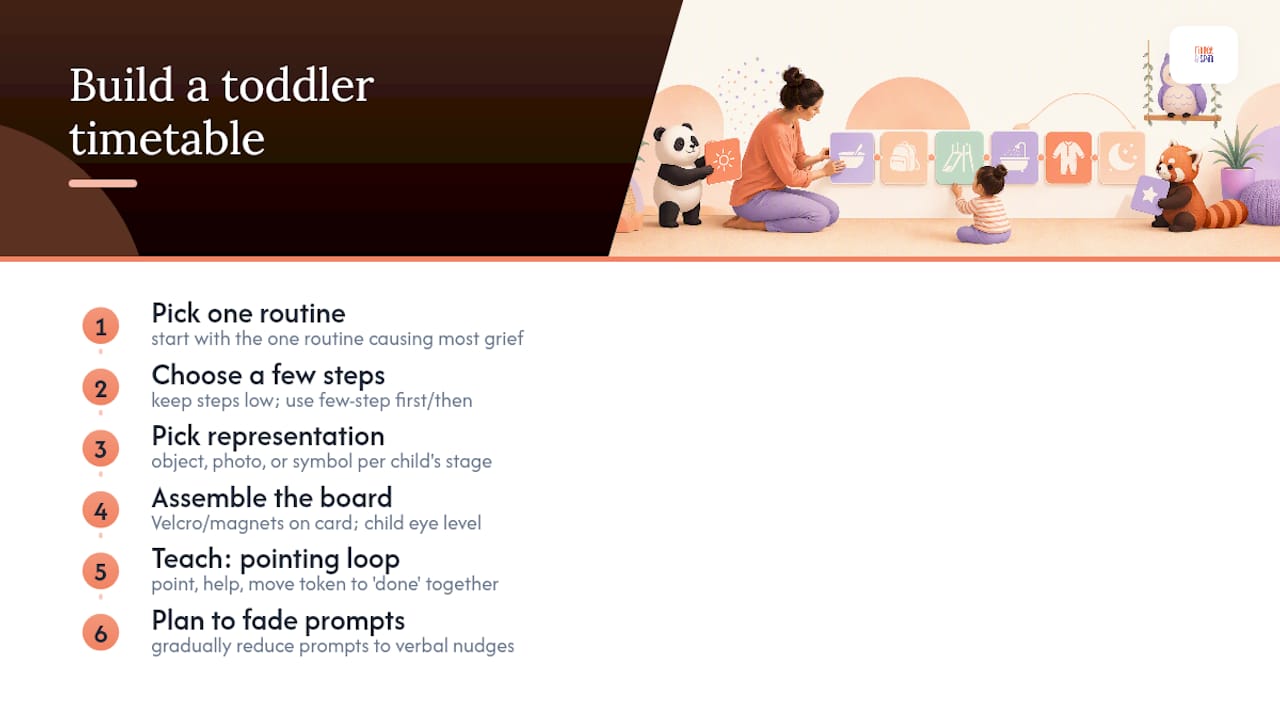
2. Choose a few steps, keeping the count low. Many parents make their first timetable too ambitious and it often collapses quickly. A few-step “first/then” board beats an overly long list that nobody finishes reading before the moment’s passed.
3. Pick your representation. Real object, photo, or symbol, depending on your toddler’s stage. If they’re pre-verbal or very literal, objects or photographs of the exact item usually work best because there’s no interpretation required. A picture of a shoe means nothing if your toddler needs to see their shoe.
4. Assemble the board. Velcro strips or magnets on a strip of card or an old cereal box work fine. Fix it at your child’s eye level, not yours, and add a “done” pocket or box at the end so completed steps have somewhere to go.
5. Teach it with the pointing loop. Show the picture, point to it, help your toddler complete the step, then physically move the token to “done” together. Repeat this loop during a calm moment, not mid meltdown. Speech and language therapy guidance is clear that a timetable left on the wall without this active teaching tends to get ignored as background wallpaper. You’re not just making a chart, you’re teaching a skill.
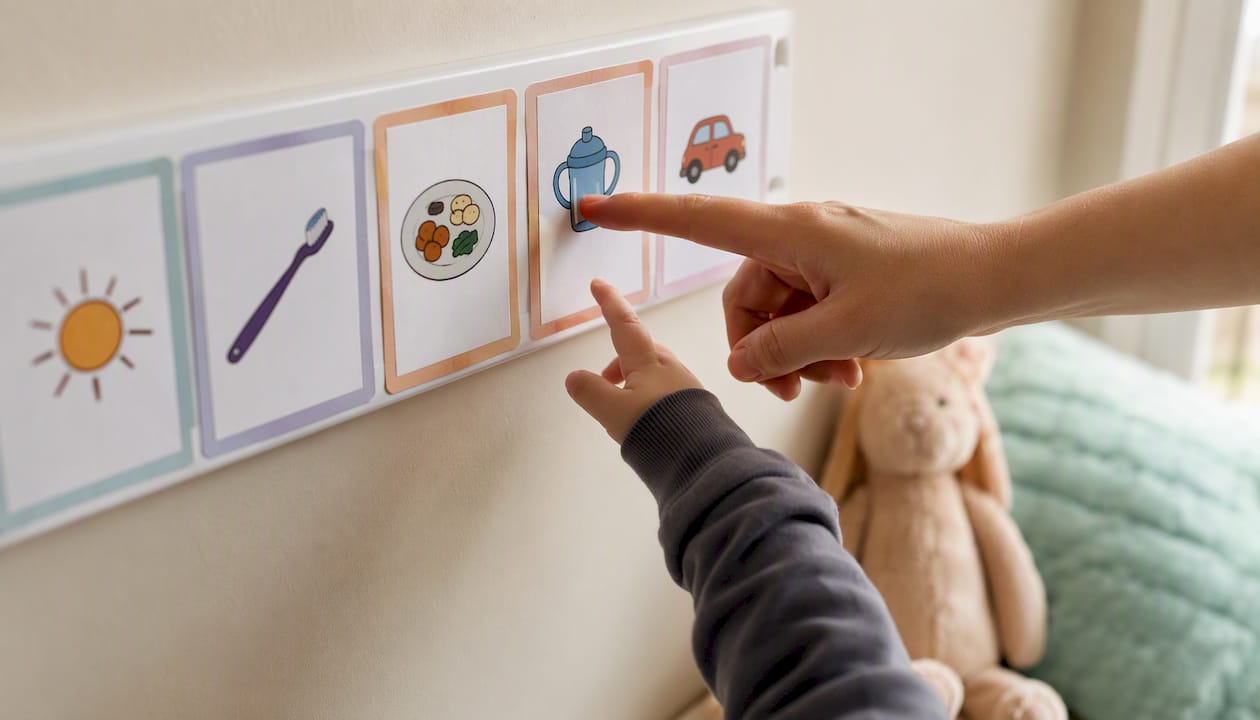
6. Plan to fade your prompting. Week one, you’re doing most of the pointing. By week three or four, you’re aiming for a verbal nudge only (“what’s next?”). Eventually the board runs itself and you’re just there for moral support.
Pro Tip: Practise the pointing loop during a completely calm five minutes, snack time works well, before you ever expect your toddler to use it during a stressful transition. Teaching a new skill during a meltdown is like trying to learn to swim mid-drowning.
Photos, symbols, objects or apps: which format actually suits your toddler
Every parent I’ve spoken to at our Brighton sessions has, at some point, bought a beautiful symbol pack and watched their toddler stare blankly at it. Symbols are abstract. If your toddler hasn’t got there yet, they’re just pretty shapes.
Here’s the rough order of how symbolic understanding tends to develop, and what to reach for at each stage:
- Real objects for pre-verbal or very early learners; an actual spoon beats any picture of one.
- Photographs of the specific item or person, not generic stock images, once your toddler recognises photos as representing real things.
- Simple line symbols or icons once your child can generalise (a drawn shoe means “any shoe”, not just theirs).
- Written words alongside symbols as reading emerges, gradually fading the picture.
For materials, you genuinely don’t need to spend anything. Phone photos printed at home, freezer bag pockets instead of laminating, and magnets from the fridge junk drawer all work. If you want proper templates, there are free printable visual schedule makers online that let you build a set from photos or icons, and many are geared towards toddlers specifically. Apps exist too, and they’re handy for portability, but a laminated card in your coat pocket doesn’t need charging and survives a coffee spill.
Where you put it matters as much as what’s on it. Mount the routine timetable where the routine happens: the getting-dressed schedule goes in the bedroom, not stuck to the fridge next to the shopping list. For journeys or parties, a small ring-bound “pocket timetable” travels with you.
Teaching it, fading your help, and knowing if it’s working
Nobody’s toddler picks up a visual timetable on day one. Ours took about three weeks before he’d check it without me pointing first, and there were several mornings I was convinced we’d wasted a Sunday afternoon on card and velcro.
Teach during the calm bits. Model the sequence yourself out loud once or twice (“look, first shoes”) before expecting your toddler to lead it. This lines up with the evidence-based approach recommended for toddlers: joint planning between caregivers, coached practice, and monitoring, rather than sticking a chart up and hoping.
A rough fading timeline looks like this:
- Weeks 1 to 2: full physical guidance. You’re pointing, moving tokens, narrating each step.
- Weeks 3 to 4: verbal prompt only. “What’s first?” replaces hand-over-hand help.
- Weeks 5 onwards: gesture or glance towards the board. Your toddler starts checking independently.
Track a few simple things rather than obsessing over perfect data. How many prompts did you give this week versus last? Is your toddler glancing at the board unprompted? Is the whole routine taking less time, start to finish? You don’t need a spreadsheet, a notes app or the back of an envelope is fine.
If, after a good few weeks of consistent practice, there’s been no shift at all, or your toddler seems distressed rather than helped by the visual, that’s worth raising with a speech and language therapist or occupational therapist. Sometimes the format’s wrong (symbols when objects were needed), sometimes there’s a processing difference that needs a different approach entirely, and a professional can help you work out which. We’ve written more on where OT and play-based support fits alongside home strategies, if you want to go further.
Using visuals for changes, unexpected events and meltdowns
Change is the thing that undoes even a well-practised timetable. A supply teacher, a cancelled swimming lesson, granny visiting unannounced, any of it can tip a toddler who was doing fine into full meltdown.
Prepare the night before where you can. An “oops” or “change” card, something as simple as a card with a wobbly line drawn on it, can be slotted into the timetable to flag “this bit is different today” before it happens, rather than springing it on your toddler live.
During an actual meltdown, this is not the moment to introduce anything new. Keep communication minimal and rely on a single, familiar visual cue your toddler already knows well, rather than a new instruction or a new picture they’ve never seen. New information during dysregulation tends to add fuel, not clarity. If your child has a known regulation step, a quiet corner, a weighted toy, headphones, build that into the schedule itself as a step, not an emergency measure you only remember afterwards. Recognising the early physical signs of overwhelm before things escalate gives you a window to use the visual cue while it can still help.
For something like a birthday party, a short script works: the night before, walk through a simple visual sequence together (arrive, cake, presents, home). At the event, you’re just pointing back to a card you already reviewed, not explaining a new concept in a noisy hall full of balloons.
What I see in sessions and parties: hacks that actually get used
I once left a soft play birthday party eleven minutes after arriving, screaming toddler under one arm, abandoned party bag in the other. In the car, I drew four boxes on the back of a receipt: car, home, snack, telly. He calmed down looking at a receipt. That’s a visual timetable. It doesn’t need to be Pinterest-worthy to work.
At our sensory sessions across the three zones, Wiggle & Bounce, Snuggle & Chill, Squish & Squeeze, we use portable “now and next” cards constantly, especially when a child needs to move between zones. Textured tokens help sensory seekers; a bit of felt or a bobbly bead glued to the corner of a card gives something to rub while they process what’s coming next. At parties, we tuck a laminated quiet-corner card into the birthday child’s hand early, so they know retreating is always an option, not a failure.

If you want more on adapting routines day to day, our guide on supporting an autistic toddler has further practical adaptations, and there’s a longer piece specifically on using a visual schedule for birthday parties if that’s your immediate dread.
A parent’s short perspective: start small and be kind to yourself
I won’t pretend this is tidy. Some weeks the timetable works beautifully. Other weeks it’s face down under a pile of washing and we’re back to shouting about shoes. Both are normal.
Celebrate the small wins, your toddler glancing at the board once without being told is a genuine win, not a footnote. Try one tiny experiment this week: three steps, one routine, nothing more. And know that for a lot of children, the need for a visual timetable fades naturally as language and confidence grow. You’re not building a crutch. You’re building a bridge they’ll walk across and eventually not need.
— Caitlin
Want to practise this with support? Come and try a session or party with us
Reading about the pointing loop is one thing. Watching a member of staff run it with your toddler while you actually get a cup of tea is another thing entirely. Fidget and Spin gives you both, staff who model visual routines in real time and a room built so the timetable actually gets used, not just laminated and forgotten.
Our weekly sessions run across three sensory zones, Wiggle & Bounce, Snuggle & Chill, and Squish & Squeeze, in small groups where portable timetables and now/next cards are already part of how the room runs, not an extra thing you have to bring and explain. You can see exactly how that works on our sessions page. If a birthday’s looming and the thought of it is making your stomach drop, our SEN-friendly party packages in Brighton, Hove and across Sussex build visual previews and quiet-corner cues into the day from the start, so nobody’s improvising with a receipt in a car park. Have a look at current dates and check availability for your child’s age group.
Key downloads and templates to save or print
A few resources are worth bookmarking rather than rebuilding from scratch. The AFIRM visual supports brief sets out the coaching and monitoring steps behind evidence-based practice. Leicestershire Partnership NHS Trust’s guidance covers starting small and placement. The Autism Toolbox visual supports page explains matching visuals to communication stage, and a free visual schedule maker lets you build printable cards from your own photos.
Sources
- Supporting learners and families — visual supports (Autism Toolbox)
- Visual supports for toddlers (AFIRM brief packet)
- Using visuals to support autistic people (Leicestershire Partnership NHS Trust)
FAQ
At what age should I start a visual timetable?
There’s no fixed age. Once a toddler can recognise an object or photo as representing something real, a simple first/then board can help.
How many steps should a toddler’s visual timetable have?
Start with three to five steps for a single routine. NHS and charity guidance both point to short step counts and one routine at a time as the format most likely to succeed.
Should I use photos or symbols for a toddler?
Use whichever your toddler already understands. Objects or real photographs usually work best for pre-verbal or very literal toddlers, with symbols and text introduced only once your child generalises pictures reliably.
What do I do if my toddler ignores the timetable?
Check whether it’s being actively taught, not just displayed. A board left on the wall without the pointing loop and regular modelling tends to get ignored, so build in short, calm practice sessions rather than expecting independent use straight away.
Can visual timetables help during meltdowns?
Yes, but only with a cue your toddler already knows well. Introducing a new picture or instruction during a meltdown tends to add confusion rather than calm, so stick to a single familiar visual reminder.
Do Fidget and Spin sessions use visual timetables?
Yes. Portable now/next cards and quiet-corner cues are built into our sensory sessions and SEN-friendly parties across Brighton, Hove and Sussex, so parents can see the approach modelled by staff in real time.