
TL;DR:
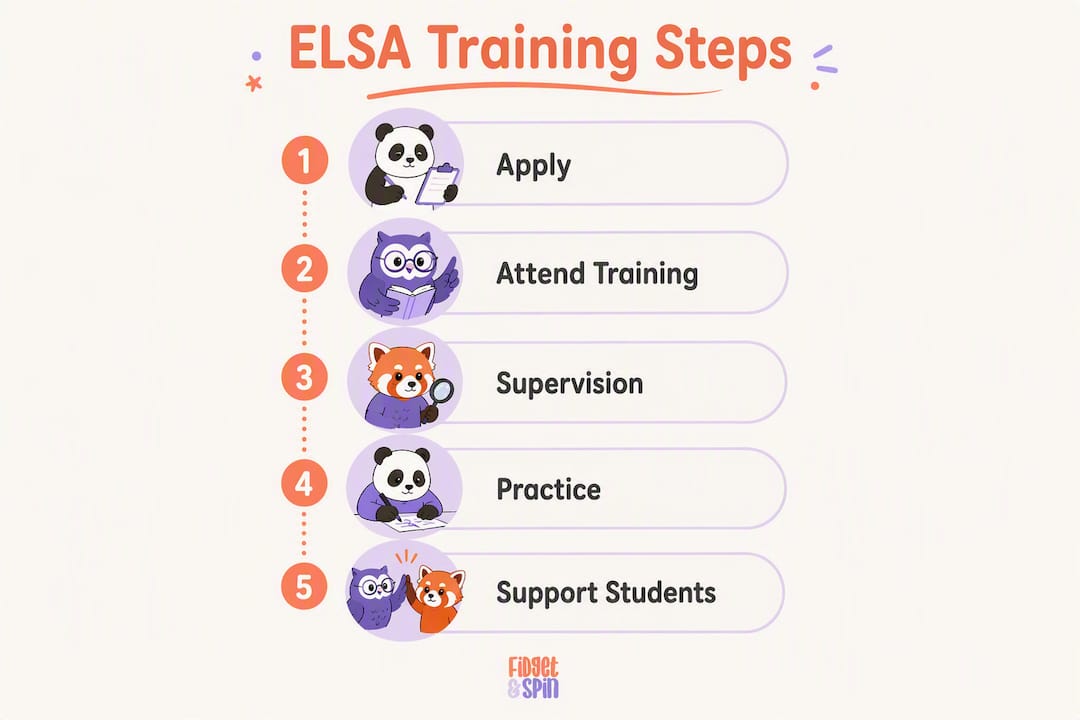
- ELSA is a UK school-based programme that trains staff to provide short-term emotional support for pupils. It lasts typically six to twelve weeks and is supervised by educational psychologists to ensure quality.
ELSA training is a UK school-based programme that trains teaching assistants and learning mentors to deliver short-term, evidence-based emotional support for pupils. It stands for Emotional Literacy Support Assistant, and it is a school staff qualification, not something parents do themselves. If your child’s SENCO has mentioned it, or you’ve heard the term at a review meeting and nodded along while quietly Googling it later, here’s what you actually need to know.
- ELSA is a national UK programme developed by educational psychologists
- Training is for school staff (usually teaching assistants or learning mentors), not parents or carers
- It sits at tier 2: targeted, short-term support, usually lasting several weeks.
- It sits below specialist NHS services such as CAMHS, which handles more complex mental health needs
- The ELSA title is protected: staff must complete accredited training and attend ongoing supervision
Table of Contents
- What is ELSA and why do schools use it?
- Who trains as an ELSA and what does the training cover?
- Is the ELSA title protected, and what are its limits?
- What might ELSA support actually look like for your child?
- How to ask about ELSA at your child’s school
- Other options if ELSA isn’t available or isn’t the right fit
- Key takeaways
- What I’ve learnt from being on this side of the table
- Fidget and Spin: sensory sessions and SEN-friendly parties in Brighton
- Useful sources
- FAQ
What is ELSA and why do schools use it?
The programme was originally developed in 2004 in Hampshire by Sheila Burton, a Principal Educational Psychologist. The idea was practical: build emotional support capacity inside schools rather than relying entirely on external services. When a child is struggling with anxiety, friendship difficulties, or low self-esteem, waiting months for an external referral isn’t always realistic. An ELSA gives the school a trained person who can step in early.
ELSA fits into the school’s existing structure. The SENCO usually oversees it, and the local Educational Psychology Service provides training and ongoing supervision. It’s evidence-based, grounded in psychological principles, and designed to work across mainstream and specialist settings from Reception through to Year 13.
Pro Tip: If your child has an EHCP or is on the SEN register, ask the SENCO at your next review whether ELSA support has been considered as part of their provision.
Who trains as an ELSA and what does the training cover?
Teaching assistants and learning mentors are the most common trainees. The qualities that matter most aren’t academic: empathy, the ability to build relationships, and a genuine interest in a child’s emotional world. The training itself typically runs for 5–7 days and is delivered by the local Educational Psychology Service.
The core training modules cover:
- Emotional awareness — helping children name and understand feelings
- Self-esteem — building a child’s sense of their own worth
- Active listening and communication skills
- Anger and anxiety management
- Friendship skills and social skills
- Therapeutic stories and social stories
- Working with puppets (particularly useful for younger or more reticent children)
Suffolk County Council lists multiple days of initial training as their model; Gloucestershire cites around a week depending on local provision. The content is broadly consistent nationally, but the exact format varies by Educational Psychology Service. That variation matters: it’s worth asking your local EPS what their specific model looks like.
After initial training, ELSAs attend regular supervision sessions to discuss cases, access peer support, and develop their skills further.

Is the ELSA title protected, and what are its limits?
Yes, and this is worth understanding clearly. ELSA training is delivered by educational psychology services and the role requires ongoing professional supervision to maintain accreditation. Local Educational Psychology Services keep registers of practising ELSAs and lead that supervision. If a school tells you they have an ELSA, that person should be on a local register and attending regular supervision sessions.
What ELSA is not:
- It is not a substitute for specialist mental health services
- It is not behaviour management or a consequence for poor conduct (ELSA time is not for sorting out incidents)
- It is not open-ended therapy; programmes typically last 6–12 weeks with specific, measurable goals
- It is not suitable for complex or long-term mental health needs, which should be referred to CAMHS
Pro Tip: If your child’s needs feel bigger than short-term school support can address, ask the SENCO for a CAMHS referral alongside any ELSA work. The two aren’t mutually exclusive.
What might ELSA support actually look like for your child?
Picture a child who melts down every Monday morning, or one who eats lunch alone because they can’t read the social cues in the playground. An ELSA works with that child in a consistent, private space, away from classroom noise and interruption. Sessions are usually one-to-one, though small groups work for friendship and social skills goals.
A typical programme runs like this:
- Weeks 1–2: Getting to know each other; agreeing goals with the SENCO and, ideally, with parents
- Weeks 3–10: Weekly sessions with a clear objective each time; activities might include therapeutic stories, emotion cards, puppets, or role play
- Final review: Progress measured against the original goals; next steps agreed
For emotional regulation in particular, the ELSA should also be sharing home strategies with you. That collaboration is part of the model: ELSA works best when school and parents agree goals and when session learning connects to home life.
How to ask about ELSA at your child’s school
Most parents find out about ELSA by accident. A teacher mentions it, or another parent in a WhatsApp group brings it up. You don’t have to wait. Here are the questions worth asking your SENCO directly:
- Does the school have a registered ELSA on staff?
- Who supervises them, and how often does that supervision happen?
- How are goals agreed, and will I be involved in that process?
- How will I be kept informed during the programme?
- Can I receive session summaries or a review at the end?
On consent: schools should inform you before your child starts ELSA sessions. You can ask for written confirmation of goals and a review date. If the school has no ELSA, ask whether they are planning to train someone and where they sit on the local Educational Psychology Service waiting list. Approaching SENCOs with specific, prepared questions tends to get a more useful response than a general “what support is available?”
Other options if ELSA isn’t available or isn’t the right fit
Sometimes there’s no ELSA in the school. Sometimes the waiting list is long. Sometimes your child’s needs are sensory and regulatory rather than primarily emotional literacy-focused. There are other routes.
- Local Educational Psychology Service — can advise on school-based interventions beyond ELSA
- CAMHS — the NHS service for more complex child and adolescent mental health needs; ask your GP or SENCO for a referral
- Local SEN charities — Brighton and Hove has several; your SENCO or the local SEN support network can point you in the right direction
- Community sensory play providers — for children whose regulation difficulties show up most in sensory environments, structured sensory play can complement school-based emotional work
Fidget and Spin’s weekly sensory sessions in Brighton and Hove offer exactly that kind of complement: small, calm, sensory-zoned sessions for neurodiverse children aged 1–6, run by SEN parents who understand what regulation actually looks like in practice. They’re not clinical, but they’re not random either.
When choosing any community provider, check for: staff with SEN experience, a sensory-aware environment, small group sizes, and a willingness to liaise with your school or SENCO if needed.
Key takeaways
ELSA training equips school staff to deliver short-term, supervised emotional literacy support for pupils, typically across 6–12 weeks, as a tier 2 intervention sitting below specialist NHS services.
| Point | Details |
|---|---|
| What ELSA stands for | Emotional Literacy Support Assistant — a national UK programme developed by educational psychologists. |
| Who it trains | School staff (teaching assistants, learning mentors), not parents; initial training runs 5–7 days. |
| Programme length | Pupil support typically lasts 6–12 weeks with SMART targets and a formal review. |
| Protected title | ELSAs must complete accredited training and attend half-termly supervision via the local Educational Psychology Service. |
| Fidget and Spin | Sensory sessions in Brighton and Hove offer a community-based complement to school ELSA work for neurodiverse children aged 1–6. |
What I’ve learnt from being on this side of the table
I spent a long time nodding in SEND reviews without fully understanding what was being offered. ELSA came up when Remy was in Reception and I genuinely thought it was something I could sign up for myself. (It isn’t. I checked.) What I’ve come to understand is that the best outcomes happen when parents are treated as part of the team, not just informed after the fact.
The thing nobody tells you is that you can ask for involvement in goal-setting. You can ask for home strategies. You can ask who supervises the ELSA and when. Schools aren’t always forthcoming with that information, not because they’re hiding it, but because they’re stretched and assume you’ll ask if you want to know. So ask.
What helped us most alongside school support was finding spaces where Remy could practise regulation without it being a lesson. Sensory play, small groups, familiar adults. The emotional literacy skills an ELSA builds in school land better when a child has somewhere outside school to practise being regulated. That’s not a clinical observation. It’s just what we noticed.
Fidget and Spin: sensory sessions and SEN-friendly parties in Brighton
If your child is working on emotional regulation or social skills at school, the gap between Friday afternoon and Monday morning is real. Fidget and Spin’s weekly sensory stay-and-play sessions give neurodiverse children aged 1–6 a low-pressure space to move, explore, and connect, across three sensory zones: Wiggle & Bounce for big movement, Snuggle & Chill for low-stimulation rest, and Squish & Squeeze for tactile play.
We also run SEN-friendly birthday parties across Brighton, Hove and Sussex for ages 1–7, with three packages starting from £220. Every party is designed around sensory needs, not despite them. Anthony and I built this because mainstream venues weren’t built for children like Remy. They still aren’t. We were.
Find out how our sessions work or get in touch to talk through what your child needs.
Useful sources
If you want to read the formal guidance or contact your local Educational Psychology Service, these are the most reliable starting points:
- ELSA Network — About ELSA: the national programme overview, including the protected title and supervision requirements
- Suffolk County Council — ELSA evidence brief: a detailed, evidence-based summary of how the programme works
- Suffolk County Council — ELSA training page: practical training and implementation details
- Bristol Local Offer — ELSA: a clear local authority explanation of training topics
- Gloucestershire County Council — ELSA training: useful for understanding local variation in training length
To find your local Educational Psychology Service, search “[your local authority] Educational Psychology Service” or ask your SENCO directly. When you contact them, ask specifically whether your school has a registered ELSA and what the current waiting list looks like for new training cohorts.
FAQ
What does ELSA stand for in schools?
ELSA stands for Emotional Literacy Support Assistant. It is a national UK programme in which school staff, usually teaching assistants, are trained by educational psychologists to support pupils’ emotional development.
How long does an ELSA programme last for a child?
Most ELSA programmes last several weeks, with sessions focused on specific, measurable goals agreed between the ELSA, the SENCO, and ideally the child’s parents.
Can parents request ELSA support for their child?
Yes. Ask your child’s SENCO whether the school has a registered ELSA on staff and request that ELSA support is considered as part of your child’s provision, particularly if they have an EHCP or are on the SEN register.
When should CAMHS be considered instead of ELSA?
ELSA is a short-term, tier 2 intervention. If your child has complex or long-term mental health needs that go beyond emotional literacy support, ask the SENCO or your GP for a CAMHS referral.
Is ELSA training something parents can do themselves?
No. ELSA training is a school staff qualification delivered by Educational Psychology Services. It is not available to parents, though the ELSA model does encourage parents to be involved in goal-setting and to receive home strategies to use alongside sessions.
Recommended
- SEN parenting UK: what support is actually out there | Fidget and Spin Brighton
- SEN community Brighton: your 2026 parent guide | Fidget and Spin Brighton
- SEN activities in Brighton and Hove: 2026 parent guide | Fidget and Spin Brighton
- What is SEN? Understanding support for your child in Brighton | Fidget and Spin Brighton