

TL;DR:
- Narrative therapy reframes problems as separate from individuals, empowering clients to rewrite their personal stories. It emphasizes externalising issues, exploring unique outcomes, and co-creating preferred narratives through non-judgmental, collaborative conversations. This approach effectively addresses trauma, anxiety, and identity struggles, fostering lasting change and self-agency.
Most of us grew up believing that therapy is about fixing what’s broken. You walk in with a problem, someone helps you analyse it, and you leave less broken than before. Narrative therapy turns that idea on its head entirely. What is narrative therapy, really? At its heart, it’s a collaborative approach that says you are not the problem. The problem is the problem. Developed in the 1980s by Michael White and David Epston, it’s a way of helping people step back from the stories that have been weighing them down and start writing something truer, and kinder, instead.
Table of Contents
- Key takeaways
- What is narrative therapy and its core principles
- How narrative therapy works in practice
- Who narrative therapy can help
- Narrative therapy compared to other approaches
- Using narrative therapy principles in daily life
- My honest take on narrative therapy
- Sensory stories and safe spaces at Fidgetandspin
- FAQ
Key takeaways
| Point | Details |
|---|---|
| You are not the problem | Narrative therapy separates your identity from your difficulties, reducing shame and self-blame. |
| Stories shape reality | The narratives we tell about ourselves directly influence how we feel and behave in daily life. |
| Therapist as partner | The therapist does not diagnose or direct; they help you uncover your own strengths and preferred story. |
| Effective for many struggles | Research shows narrative therapy helps with depression, anxiety, trauma, PTSD, and more. |
| Usable outside therapy | Core principles like externalising problems and noticing exceptions can support daily emotional regulation. |
What is narrative therapy and its core principles
Narrative therapy was developed in Australia and New Zealand by Michael White and David Epston in the 1980s, and it grew out of a deep frustration with approaches that labelled people as disordered or damaged. The central belief is beautifully simple. People are not their problems. They are the authors of their own lives, and those lives contain far more richness than a single problem-saturated story might suggest.
The approach rests on a few core principles that set it apart from most other therapies.
- Externalising the problem. Rather than saying “I am anxious,” narrative therapy encourages you to say “Anxiety is affecting my life.” That small linguistic shift creates psychological distance, reducing the shame that comes from feeling like you are the problem.
- The ‘not-knowing’ stance. The therapist treats the client as the expert in their own life story, asking questions to uncover hidden strengths rather than diagnosing or directing.
- Dominant versus subjugated stories. Narrative therapy recognises that stories exist within cultural and political contexts. Some stories get amplified by society, families, or systems. Others get pushed down. Therapy helps surface the quieter, truer stories.
- Re-authoring. Once a problem story is externalised, the work becomes about co-writing a preferred story that aligns with the person’s actual values, strengths, and hopes.
- Language as reality. The words we use do not just describe our experience. They actively shape it.
I remember the first time someone explained externalising to me in simple terms, and honestly, it felt a bit like someone had just turned a light on in a room I’d been fumbling around in for years. The idea that my child’s meltdowns were not him but something happening to him changed how I responded completely.
Pro Tip: If you encounter the phrase “the problem is the problem, not the person,” you have found the clearest one-line summary of what the narrative therapy approach is built on.
How narrative therapy works in practice
One of the things that surprises people most about narrative therapy in counselling is how different the session experience feels. There is no worksheet. No homework to hand in. No structured programme to follow week by week. It is a conversation, and it is deliberately exploratory.
Here is a rough shape of how the process tends to unfold:
- Naming the problem story. The therapist invites you to describe the difficulty in your own words, then gently helps you name it as something separate from yourself. Anxiety becomes “the worry spiral.” Depression might become “the fog.”
- Mapping the problem’s influence. Together, you explore where and when the problem shows up, what it tells you about yourself, and how it has affected your relationships, choices, and identity.
- Finding unique outcomes. These are the moments when the problem didn’t win. A day the fog lifted. A moment you chose differently. These sparkling moments are the seeds of a new story.
- Thickening the alternative story. The therapist helps you explore these exceptions in detail. Who was there? What does it say about what you value? This builds a richer, more empowering narrative.
- Co-authoring the preferred story. Over time, the new story gains weight. You start to identify with it more than with the problem-saturated one.
Narrative therapy is intentionally non-directive, trusting clients as experts of their own lives. The therapist is more like a curious journalist than a teacher or doctor. They ask questions like, “What does this moment tell you about who you really are?” rather than “Here’s what I think you should do.”
Pro Tip: If you find traditional therapy frustrating because it feels prescriptive or makes you feel like a problem to be solved, narrative therapy’s conversational, story-centred approach may feel like a genuine relief.

Who narrative therapy can help
Narrative therapy is effective for anxiety, depression, PTSD, substance use, and cancer-related distress. That is a broad range, and it reflects the fact that nearly all of those struggles involve a story about oneself that has become constricting and painful.
The research is genuinely encouraging. 74% of participants with depression achieved reliable improvement using narrative therapy in clinical trials, a figure comparable to CBT. For trauma-informed work, narrative therapy for trauma shows particular promise when delivered in relational, safe settings. Studies exploring justice-involved young people aged 12 to 18 found that relational, trauma-informed frameworks like narrative therapy produced meaningful change in how young people understood themselves and their futures.
“Narrative therapy’s non-pathologising nature removes shame and self-blame, allowing clients to see themselves as authorities of their own stories.” — Therapy Group DC
Here is a balanced look at where narrative therapy shines and where it has limits:
| Strength | Limitation |
|---|---|
| Non-pathologising and empowering | Slower initial symptom relief than CBT |
| Builds lasting sense of agency | Less structured, which suits some but not all |
| Reduces shame and self-blame | Requires comfort with open-ended reflection |
| Effective for trauma and identity | May not suit those who prefer directive guidance |
| Culturally aware and systemic | Fewer standardised outcome measures available |
Initial symptom relief may be slower in narrative therapy compared to CBT. That is worth knowing upfront. If you are in acute crisis and need fast stabilisation, a more structured approach may be a better first step. But if you are looking to understand yourself more deeply, shift a long-held story, or recover your sense of agency after trauma, narrative therapy offers something genuinely powerful.
Narrative therapy compared to other approaches
People often come to narrative therapy after trying something else, or they arrive wondering how it differs from what they’ve already heard of. Here is a plain-language comparison:
| Approach | Focus | Therapist role | Homework? | Key strength |
|---|---|---|---|---|
| Narrative therapy | Stories and meaning | Collaborative partner | None | Empowering, non-shaming |
| CBT | Thoughts and behaviours | Expert teacher | Yes, structured | Fast symptom reduction |
| Psychodynamic | Unconscious patterns | Interpreter | Minimal | Deep self-understanding |
| Family therapy | Relational systems | Facilitator | Sometimes | Whole-system change |
The key contrast with CBT is one of style and focus. CBT identifies unhelpful thought patterns and teaches new ones, often with exercises to practise between sessions. Narrative therapy, by contrast, asks deeper questions about where those thought patterns came from, what stories they belong to, and whether those stories are even yours to begin with. Neither is better in every situation. They just work differently.
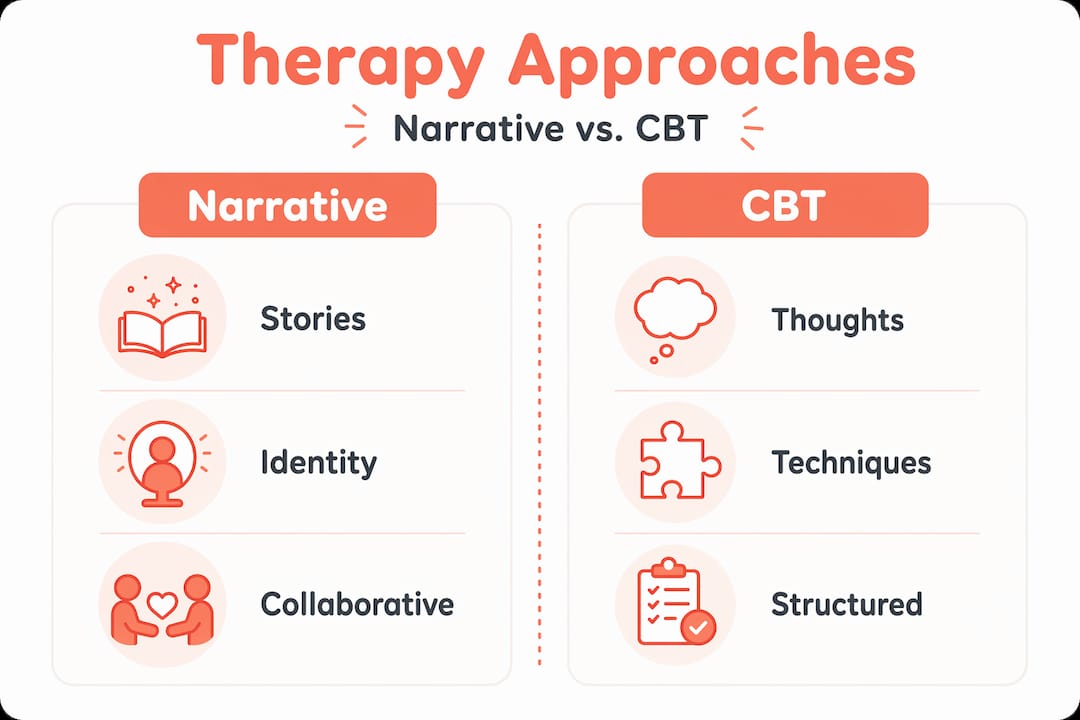
Narrative therapy shares some ground with family therapy in its awareness of social and systemic influences on identity. Where psychodynamic approaches tend to look backwards into the unconscious, narrative therapy stays mostly in the present, asking what story is being told right now and how it might be retold.
Using narrative therapy principles in daily life
You do not need a therapy room to start noticing your own stories. Some of the most grounding work from narrative therapy can be done quietly, in everyday moments, especially if you are a parent navigating the emotional gymnastics of raising a neurodiverse child.
Here are ways to bring these ideas into your daily life:
- Notice the story you’re telling. When something difficult happens, pause and ask: is this a fact, or is this an interpretation? Separating fact from constructed narrative is genuinely the first step toward changing a story that is hurting you.
- Practise externalising language. Instead of “I’m a terrible parent,” try “Guilt is telling me I’m a terrible parent.” The distance that creates is not just wordplay. It genuinely softens the emotional weight.
- Look for the exceptions. When did things go differently? When did the problem not show up? Even one small moment counts, and it matters because it proves the story is not the whole truth.
- Write or speak your preferred story. Share it with someone you trust, or write it down. Narrative therapy in counselling often uses letters and written reflections precisely because putting words to a preferred story makes it more real and more durable.
- Be patient with yourself. Open-ended reflection is uncomfortable at first, especially if you are used to seeking quick answers. Recognising the stories we tell ourselves takes practice, and that is okay.
For parents of neurodiverse children in particular, these practices can support emotional regulation, not just for yourselves but in how you narrate experiences for your children too. The way we frame a difficult moment (“You lost control of your body” versus “You’re just badly behaved”) shapes what story a child begins to hold about themselves.
My honest take on narrative therapy
I’ve sat with narrative therapy ideas long enough now to say this clearly: the ‘not-knowing’ stance is one of the most freeing things I have ever encountered, both in the therapy room and at home. When I stopped trying to be the expert on my son’s inner world and started asking genuinely curious questions, our conversations changed completely.
What I’ve learned from watching narrative therapy touch real people’s lives is that the biggest resistance is almost always to slowness. We want the fix. We want the technique. The idea that you might need to spend a few sessions just mapping out a problem story before anything shifts can feel counterintuitive, especially when you are exhausted.
But here is what I’d say to that: the stories we carry about ourselves are often decades old. They didn’t form overnight, and they won’t shift in a single session. What narrative therapy offers is not a quick fix but a genuinely different relationship with who you are. For neurodiverse families especially, where so many dominant stories have been written about you rather than by you, that reauthoring process is not just healing. It’s something close to radical.
If you are curious about whether narrative therapy might suit you, the best first step is simply to try one session with a practitioner who works this way. You’ll know fairly quickly whether the conversation feels like home.
— Anthony
Sensory stories and safe spaces at Fidgetandspin
If this way of thinking about stories and identity resonates with you, you might find it interesting that the principles behind narrative therapy sit quietly underneath a lot of what we do at Fidgetandspin. We believe every child arrives with their own story, and our job is to make sure that story has space, colour, and room to grow.
Our sensory play sessions in Brighton are designed for neurodiverse children aged 1 to 7, and every session gives children and families a chance to explore new experiences without pressure or judgement. We see the moments when a child surprises themselves, those unique outcomes, as the most important part of the session. You can read more about how our sessions work to get a feel for the environment we create. If you are ready to come along and give your little one a big adventure, you can browse and book a sensory session directly. We would love to see you there.
FAQ
What is narrative therapy in simple terms?
Narrative therapy is a counselling approach that helps people separate their identity from their problems and rewrite the stories they tell about themselves. The central idea is that you are not the problem; the problem is the problem.
What are the main narrative therapy techniques?
The core techniques include externalising the problem, finding unique outcomes (moments when the problem did not take over), and co-authoring a new preferred story with the therapist. All of these involve careful, explorative questioning rather than structured exercises.
Is narrative therapy effective for trauma?
Yes. Narrative therapy for trauma is well-supported, particularly in relational and trauma-informed settings. Research shows it is effective for PTSD, anxiety, depression, and distress related to serious illness, with improvement rates comparable to CBT for depression.
How is narrative therapy different from CBT?
CBT focuses on identifying and changing unhelpful thoughts, often with structured homework. Narrative therapy focuses on the stories behind those thoughts, without homework, and with the therapist in a collaborative rather than expert role. CBT tends to offer faster symptom relief; narrative therapy tends to offer deeper identity-level change.
Who can benefit from narrative therapy?
Adults and young people dealing with depression, anxiety, trauma, grief, identity struggles, or difficult life transitions often find narrative therapy particularly helpful. It suits people who value insight, storytelling, and a non-directive therapeutic relationship over quick symptom management.