
TL;DR:
- Proprioception is the body’s internal sense that constantly informs the brain about muscle and joint positions, enabling movement and posture regulation. In neurodiverse children, sensory processing differences can impair proprioception, affecting coordination and safety, but targeted activities like jumping or carrying heavy objects can support development. Incorporating purposeful movement and sensory snacks into daily routines can help regulate the nervous system and improve proprioceptive function over time.
If you’ve ever been told your child has “proprioceptive difficulties” and nodded along while quietly thinking, “What on earth does that mean?”, you’re not alone. What is proprioception? It’s a question that trips up a lot of parents, and the most common answer — “it’s about balance” — is only a small part of the picture. Proprioception is far broader, involving the constant stream of information your child’s muscles and joints send to their brain to help plan movement, maintain posture, and make thousands of tiny automatic adjustments every single day. Understanding it properly can genuinely change how you support your child.
Table of Contents
- What is proprioception and how does it work?
- Why proprioception matters for neurodiverse children’s sensory development
- How proprioception interacts with other senses to support balance and coordination
- Practical ways to support your child’s proprioceptive needs at home and school
- Common challenges and misconceptions about proprioception
- Why understanding proprioception changed how I support my child’s sensory needs
- Discover sensory play sessions designed to support proprioceptive development
- Frequently asked questions
What is proprioception and how does it work?
Let’s start at the beginning. Proprioception is your body’s internal sense of itself. Not sight, not hearing, not touch in the way we usually think of it. This is something quieter and more constant. It’s the sense that tells you where your hand is even when your eyes are closed. The sense that lets your child climb the sofa without looking at their feet. It runs in the background, always.
Specialised receptors called proprioceptors, found in muscles, tendons, and joints, constantly send information to the brain about the body’s position and movement. Think of them as tiny reporters, filing updates every fraction of a second.
There are three main types of proprioceptors, and each one does something slightly different:
- Muscle spindles — these detect changes in muscle length and speed of stretch. When your child reaches for a cup, muscle spindles are already feeding information to the brain about how far the arm is extending.
- Golgi tendon organs — these live where muscles meet tendons and monitor tension. They help prevent over-contraction, which is why we don’t accidentally snap our own tendons during effort.
- Joint receptors — found in the capsules surrounding joints, these respond to movement and pressure at the joint itself, giving information about joint angle and compression.
Together, these three work as a team to give the brain a constantly updated map of the body.
Pro Tip: You don’t need to memorise the science to use it. The key takeaway is that proprioception happens inside the body, which is why it can’t be fixed with visual instructions alone. Movement is the teacher.
Why proprioception matters for neurodiverse children’s sensory development
Having explored the body’s proprioceptive system, it’s important to see why this matters for your child’s development and sensory needs.
For neurodiverse children, proprioception isn’t just a background process. It’s often a source of real difficulty, and those difficulties ripple into everything. Sitting at a table, holding a pencil, navigating a busy corridor, tolerating clothing. All of these involve constant proprioceptive feedback that helps children plan movements and maintain posture.
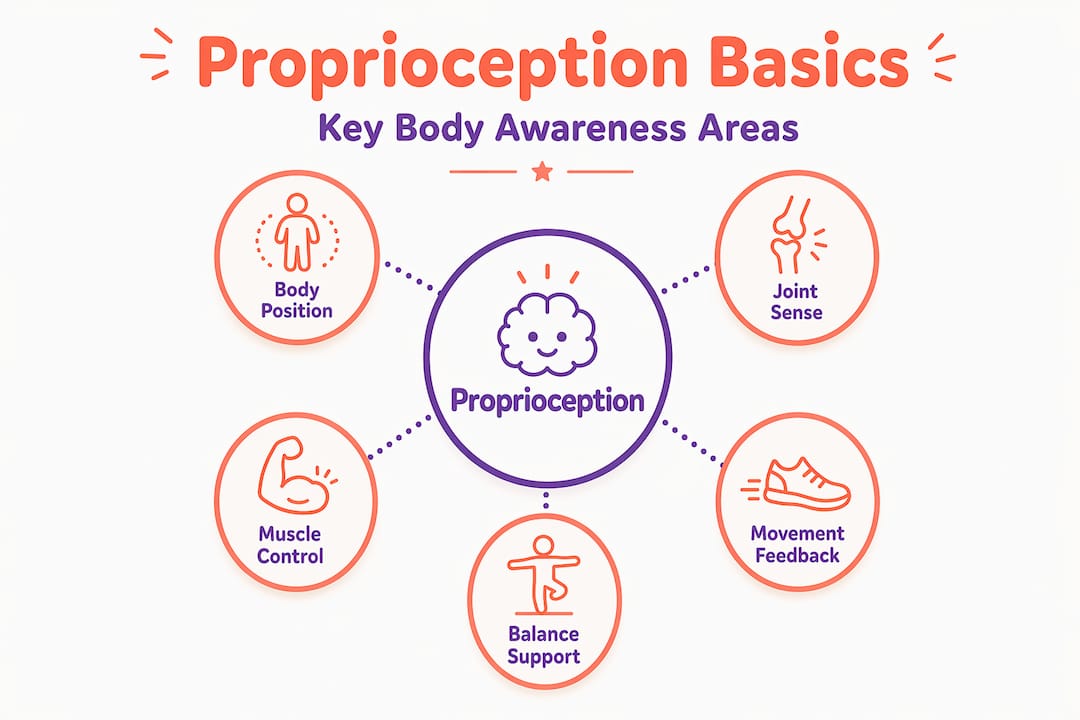
When proprioceptive processing is different — whether that’s under-responsive, over-responsive, or inconsistent — life can feel genuinely chaotic for a child. They might slump, fidget, crash into things, or grip objects far too tightly. Not because they’re being difficult. Because their brain isn’t getting the information it needs in a form it can use.
Here’s where it gets really useful for parents:
- 🏋️ Pushing and pulling (think heavy bags, pushing a trolley, or pressing against a wall) provides strong, organising proprioceptive input
- 🤸 Jumping, bouncing, and stomping compress the joints and send a rush of input to the brain
- 🏊 Swimming and climbing offer sustained, whole-body proprioceptive engagement
- 🧱 Carrying heavy objects such as a backpack or a stack of books works the same way
- 🛏️ Deep pressure activities like weighted blankets or firm hugs can mimic proprioceptive input for children who seek it
These are sometimes called sensory snacks. Short, purposeful bursts of proprioceptive input that help regulate a child’s nervous system before a task that requires focus or calm.
“Proprioception delivers constant sensory feedback that helps children plan movements and maintain posture, impacting actions like sitting, holding objects, and moving safely through space.” — Somerset NHS Foundation Trust
One thing I want you to hold onto: proprioceptive differences are very common in neurodiverse children. This is not a failure of parenting. It’s a difference in sensory processing that responds beautifully to the right kind of support.
How proprioception interacts with other senses to support balance and coordination
To get a fuller picture, let’s explore how proprioception works alongside other senses to keep your child balanced and coordinated.

Proprioception doesn’t operate in isolation. Balance, for instance, is a team effort. It draws on proprioceptive input from the body, visual information from the eyes, and signals from the vestibular system (the inner ear). When one of those streams is unreliable or delayed, the others have to compensate. That’s why some children close their eyes during certain movements and actually do better, because they’re leaning into a stronger sensory channel.
Research shows that visual and proprioceptive inputs both contribute significantly to children’s dynamic postural control, and that these systems continue developing and refining well into childhood. This is genuinely reassuring. It means there is a developmental window in which support, movement, and play can make a measurable difference.
Here’s a simple way to think about how children use different sensory inputs at different stages:
| Age range | Primary balance strategy | Role of proprioception |
|---|---|---|
| 1 to 2 years | Mostly visual cues | Emerging, relies heavily on falling and correcting |
| 3 to 4 years | Vision and touch combined | Beginning to integrate proprioceptive feedback reliably |
| 5 to 7 years | More proprioceptive and vestibular | Increasingly able to balance with eyes closed |
For neurodiverse children, this progression may look different. Some children spend longer in an earlier stage. Others may skip or shortcut certain integrations, which shows up as apparent clumsiness or difficulty with sports and movement games.
Pro Tip: If your child struggles with balance, try activities that combine proprioceptive and visual input together, like rolling along a mat, or walking heel-to-toe along a coloured line on the floor. You’re giving multiple systems something to work with at once.
Practical ways to support your child’s proprioceptive needs at home and school
Understanding proprioception’s role is one thing; knowing how to support your child through sensory activities is where it gets wonderfully practical.
The good news is that you don’t need specialist equipment to offer meaningful proprioceptive input. You need movement, resistance, and repetition. Short proprioceptive activities throughout the day can have a calming and organising effect, helping children prepare for sitting, concentrating, or learning.
Here are some everyday ideas that work across home and school settings:
- 🚪 Wall press-ups before sitting down at a table — hands flat against the wall, push and hold for five seconds
- 🎒 Carry the school bag rather than wheeling it. Even a gentle load adds helpful input
- 🛒 Supermarket helper — let your child push the trolley or carry a basket. Purposeful and regulating
- 🏃 Jumping before transitions — five big jumps before moving from one activity to another can settle a dysregulated child far faster than any verbal instruction
- 🧴 Firm massage to arms or legs using lotion — this is something many children will accept even if they resist other sensory activities
- 🪑 Wobble cushions on chairs offer gentle proprioceptive input while seated, helping children who fidget to actually focus better
One thing that doesn’t work particularly well? Telling a child to “be aware of their body” or “try to sit still.” Proprioception is not a conscious skill. Practising it through movement is the only way to build it. Words alone won’t get there.
Pro Tip: Build sensory snacks into natural transitions. Before getting dressed, after breakfast, before homework. You’re not adding a therapy programme to your day. You’re using moments that already exist.
Common challenges and misconceptions about proprioception
Before we finish, it’s helpful to clear up some common misunderstandings that can confuse parents and carers trying to support proprioceptive development.
The biggest misconception is that proprioception is only about balance and clumsiness. If your child doesn’t fall over all the time, some people assume their proprioception is fine. But different receptor types provide different kinds of feedback, meaning a child can have perfectly adequate dynamic balance and still struggle significantly with judging grip pressure, body awareness during transitions, or spatial planning in busy environments.
Here are a few myths worth gently unpacking:
- ❌ “My child is clumsy because they’re not paying attention.” Clumsiness is often a proprioceptive processing difference, not a focus or behaviour issue.
- ❌ “He’ll grow out of it.” Some children do develop more reliable proprioceptive integration with time and activity. Others benefit enormously from targeted support rather than waiting.
- ❌ “She’s sensory seeking because she wants attention.” Sensory seeking, particularly crashing, jumping, and squeezing, is often a child trying to self-regulate through proprioceptive input. It’s a coping strategy, not a behaviour problem.
- ❌ “We’ve explained what to do, so he should be able to do it.” This one is so common, and so understandable. But proprioception cannot be taught verbally. It needs to be felt and practised.
“Proprioception involves multiple receptor types that provide different kinds of feedback, meaning a child’s proprioceptive difficulties can affect position, tension, or movement differently, not just balance.” — Kenhub physiology overview
The moment I stopped seeing my child’s movement differences as behavioural, things started to shift. It wasn’t defiance. It was neurology.
Why understanding proprioception changed how I support my child’s sensory needs
I’ll be honest. When a therapist first mentioned proprioception to me, I wrote it on a Post-it note and googled it in the car. It felt like one more impossible word in an already overwhelming vocabulary of sensory processing terms. And then, slowly, it started to make sense of so many things.
The crashes into furniture that seemed deliberate. The way my child gripped a pencil so hard the page almost tore. The meltdowns that seemed to come out of nowhere after a long, still afternoon. All of it had a thread running through it. The body was not getting what it needed.
What changed things practically was sensory snacks. Not a formal programme. Not an expensive piece of equipment. Just building small moments of proprioceptive input into the rhythm of our day. Jumping before breakfast. Helping carry the washing. Rolling in a blanket before bed. None of these things felt like therapy. They just felt like life. And they worked.
The other shift was stopping trying to explain body awareness to my child. You cannot talk someone into feeling their joints. But you can create a trampoline session, a rough-and-tumble game, a heavy load to carry across the room. The body learns from doing. That insight alone saved us both a lot of frustration.
If you take nothing else from this article, take this: your child’s proprioceptive needs are not a burden to manage. They’re an invitation to move together. And that, actually, is a pretty wonderful thing.
Discover sensory play sessions designed to support proprioceptive development
If this article has sparked something, and you’re wondering what proprioceptive support actually looks like in practice for your child, we’d love to welcome you to a session.
At Fidget and Spin, our sensory play sessions are designed specifically for neurodiverse children aged 1 to 7, with whole-body movement, proprioceptive input, and emotional regulation woven into every activity. From climbing zones to heavy-work stations, every element has a purpose. You can explore how our sessions work on our website, and find a time that suits your family. Come and see what your little sensory explorer can discover.
Frequently asked questions
What exactly does proprioception mean for my child?
Proprioception is your child’s sense of body position, meaning their ability to know where their body parts are and how they’re moving without looking, which supports coordination, posture, and everyday movement.
How can proprioceptive activities help my child stay calm?
Short activities like pushing, pulling, or jumping provide the nervous system with organising input, and these sensory snacks have a calming effect that helps children settle and focus more easily.
Is proprioception the same as balance?
No. Balance is just one part of it. Proprioception also covers how muscles and joints send information that helps the brain plan and adjust movements automatically across all kinds of everyday activities.
Can my child’s proprioception improve with age?
Yes. Postural stability and proprioceptive acuity both develop during childhood, and targeted movement activities can support and accelerate this development alongside natural maturation.